The financial stakes are real. According to the SHRM Civility Index (Q3 2024), U.S. organizations lose an estimated $2.1 billion per day in reduced productivity and absenteeism due to workplace incivility. That's not a rounding error — it's a structural problem most organizations aren't actively managing.
This post offers a practical, behavior-informed guide for managers. You'll find six concrete strategies for identifying disruptive behavior early and responding in ways that create lasting change — not just temporary quiet.
TLDR
- Disruptive behavior includes chronic negativity, gossip, insubordination, outbursts, and habitual tardiness — each capable of eroding team culture fast.
- Address behavior promptly and privately, focusing on observable actions rather than personality labels.
- Document incidents carefully and build a clear action plan before escalating to formal discipline.
- Positive reinforcement of improved behavior is as important as correcting the unwanted behavior.
- A behavioral science approach identifies why disruption occurs, making interventions more targeted and longer-lasting.
What Counts as Disruptive Behavior in the Workplace?
Disruptive behavior is any repeated pattern of conduct that interferes with team functioning, morale, or productivity. The key word is repeated — isolated friction between coworkers is normal. What managers need to address are patterns that start affecting the broader team.
Common Categories
- Chronic negativity and complaining with no constructive intent
- Gossip and rumor-spreading that erodes trust and distorts team communication
- Bullying or intimidation, ranging from overt aggression to subtle social exclusion
- Consistent refusal to follow reasonable workplace directives
- Habitual tardiness or absenteeism that disrupts workflows and signals disengagement
- Volatile reactions to feedback — outbursts or emotional escalation in response to normal management
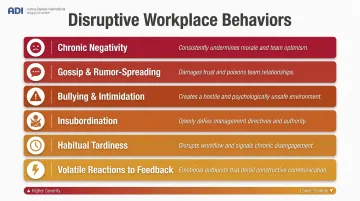
Some of these behaviors are obvious. Others are subtle enough that managers may hesitate before acting — bullying that plays out through exclusion or tone is the hardest to call out.
Some disruptive behaviors have an underlying cause: a personal crisis, chronic stress, or a mental health condition. That doesn't make the behavior acceptable, but it does affect how you respond. If you suspect something deeper is at play, consult HR before intervening on your own.
The Real Cost of Letting Disruptive Behavior Go Unchecked
The Ripple Effect on Your Team
Disruptive behavior rarely stays contained. When one employee regularly intimidates, gossips, or lashes out, the people around them absorb the impact. Psychological safety — the shared belief that it's safe to speak up, take risks, and admit mistakes — erodes quickly. Affected colleagues become more guarded, less collaborative, and more likely to disengage.
SHRM research shows that 58% of employees who quit cite their manager as the primary reason, and culture-driven turnover has cost organizations an estimated $223 billion over five years.
With replacement costs running between 33% and 200% of an employee's annual salary, even a single departure triggered by a disruptive coworker represents a meaningful financial loss.
The Organizational and Legal Risk
Disruptive behavior left unchecked creates escalating legal exposure — and organizations that can't demonstrate early corrective action face an uphill defense. The numbers underscore the stakes:
- The EEOC received 88,531 new charges in FY2024
- Resolved cases resulted in over $243 million in benefits to charging parties
- Many of these situations could have been mitigated with earlier, documented managerial intervention
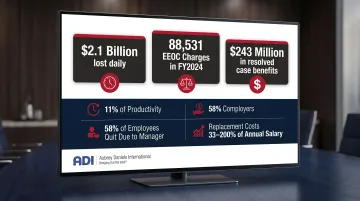
Harassment complaints, hostile work environment claims, and wrongful termination disputes all become harder to defend the longer behavior goes unaddressed.
What Silence Communicates
When disruptive behavior goes unaddressed, the rest of the team takes notice. Inaction sends a clear message — intentional or not — about what the organization actually tolerates. That message shapes culture more powerfully than any posted policy or training program.
6 Key Strategies for Managing Disruptive Behavior in the Workplace
Strategy 1: Identify and Document the Specific Behavior
Effective intervention starts with precise observation. "He's aggressive" is a character judgment. "He raised his voice and interrupted two colleagues during the Tuesday team meeting" is a documented behavior. That distinction matters: it affects both the legal defensibility of any disciplinary action and whether the employee has something concrete to change.
What to document:
- Date, time, and location of the incident
- Description of the specific behavior (what was said or done)
- Context and what preceded the behavior
- Names of any witnesses
- Date and substance of any verbal conversation that followed
SHRM's documentation guidance recommends capturing this information contemporaneously — the closer to the event, the more defensible the record. Gaps in documentation have been used as evidence of pretext in discrimination claims, so consistency matters even when a single incident seems minor.
Strategy 2: Address the Behavior Promptly and Privately
Delay is a problem. Every day you wait sends an implicit signal that the behavior is within acceptable limits. Public confrontation is equally counterproductive: defensiveness and humiliation both make genuine change less likely.
How to structure the conversation:
- State the specific behavior — reference your notes, not your interpretation
- Describe the impact — on teammates, workflow, or the team environment
- Invite their perspective — ask what was happening from their side without assuming intent
- Clarify expectations — be direct about what needs to change and by when
- Keep the tone solution-focused — the goal is change, not confrontation
A useful frame: lead with curiosity before correction. An employee who feels heard is more likely to engage honestly, and that conversation often reveals context you didn't have.
Strategy 3: Apply a Behavioral Lens — Look at Antecedents and Consequences
Most management approaches focus on the behavior itself. A more effective approach asks why the behavior is occurring and what's keeping it going.
The ABC model (Antecedent–Behavior–Consequence) offers a practical diagnostic framework:
- Antecedent — what happens before the behavior? Is there a consistent trigger (certain meetings, a particular colleague, ambiguous instructions)?
- Behavior — the specific observable conduct
- Consequence — what happens after? Is the behavior being inadvertently rewarded?
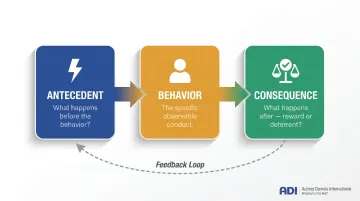
That last question is often where organizations get stuck. An employee whose outbursts consistently result in tasks being reassigned, or whose complaints get them excused from difficult conversations, is being reinforced for the very behavior you're trying to stop.
ADI's approach, refined over 45 years of applying behavioral science to organizational performance, is built on this principle. Their proprietary PIC/NIC Analysis® helps leaders examine which consequences — positive, negative, immediate, or delayed — are actually driving behavior in their specific context. Adjusting antecedents and consequences typically produces more durable results than discipline alone.
Strategy 4: Develop a Mutually Agreed-Upon Action Plan
A collaborative action plan produces more genuine behavior change than a top-down directive. When employees have input into the plan, they're more likely to own it.
The plan should include:
- Specific behavioral expectations (observable and measurable)
- Clear timelines and checkpoints
- Available support — coaching, manager check-ins, EAP resources where applicable
- Agreed consequences if the behavior continues
Put it in writing. A documented plan protects the organization if the situation escalates, demonstrates good faith on your part, and gives the employee a clear reference point for what success looks like. Think of it as accountability with a roadmap: both sides know what's expected and what happens next.
Strategy 5: Administer Discipline Fairly and Consistently
When behavior continues despite coaching and an agreed action plan, progressive discipline may be necessary. The risk at this stage isn't just the employee's conduct. It's also how the organization handles it.
Inconsistent discipline creates serious legal and cultural exposure. If two employees exhibit similar behavior but receive different consequences, perceptions of favoritism or discrimination follow quickly.
Courts have treated inconsistent discipline as evidence of pretext in discrimination claims, so how you document and apply consequences matters as much as the decision itself.
Before issuing formal discipline:
- Consult HR to ensure the action aligns with written organizational policy
- Confirm the consequence is proportionate to the behavior and consistent with precedent
- Verify the full documentation trail is in place
- Confirm delays haven't been interpreted as condoning the behavior
The goal of discipline is still behavior change, not punishment. Employees who feel a process was fair are more likely to adjust; those who feel targeted are more likely to escalate.
Strategy 6: Follow Up and Reinforce Positive Change
This is where most managers fall short. The conversation happens, the plan gets written, and then attention moves elsewhere — until the behavior resurfaces.
Follow-up isn't optional. It's what converts short-term compliance into lasting change.
What consistent follow-up looks like:
- Scheduled check-ins at agreed intervals (weekly or biweekly initially)
- Specific, timely acknowledgment when improvement is observed: "I noticed you handled that differently in today's meeting, and it made a real difference"
- Honest conversation if backsliding occurs, without waiting for it to escalate again
- Gradual transition from close monitoring to normalized management as behavior stabilizes
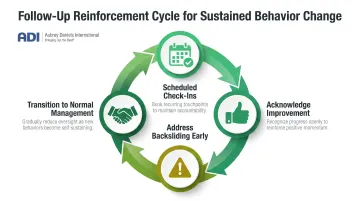
Reinforcing improvement is not softness. Research on behavior-based approaches shows that recognized behavior gets repeated. An employee who improves and hears nothing about it has little reason to sustain the effort.
Why a Behavioral Science Approach Makes the Difference
Most workplace discipline is reactive: something goes wrong, a manager responds, and the goal is to stop the behavior. That's necessary — but it's not sufficient.
A behavioral science approach, grounded in Applied Behavior Analysis, adds a critical layer: understanding the environmental conditions that are maintaining the behavior in the first place. Without that, interventions address symptoms without touching root causes.
One of the most underappreciated dynamics in organizational behavior is inadvertent reinforcement. Employees who dominate meetings get attention. Those who create friction in group settings often find colleagues routing around them — which eliminates social pressure but also removes accountability. Complainers sometimes receive accommodations. Meanwhile, the constructive, compliant employees who cause no friction go unnoticed.
Shifting that reinforcement environment is what drives durable change. ADI's Behavioral Leadership Training and Applications of Behavioral Leadership workshop equip managers to do exactly that: identify what's driving behavior in their specific context and adjust the conditions that sustain it.
Dr. Aubrey Daniels, who founded ADI and introduced the phrase "Performance Management," built this framework on a clear premise: when you understand behavior and can identify what reinforces people, you can obtain exceptional performance. That logic works in both directions. When you understand what's reinforcing disruptive behavior, you can change it.
Building a Culture Where Disruptive Behavior Is Less Likely
The most effective time to address disruptive behavior is before it becomes entrenched. Organizations that invest in clear behavioral expectations from onboarding, regular manager training, and proactive communication norms see fewer escalations — and handle them more effectively when they do occur.
Google's Project Aristotle identified psychological safety as the single most important factor in team performance. Teams where members feel safe to speak up, disagree constructively, and admit mistakes are more innovative and resilient — and far less prone to the interpersonal friction that escalates into disruptive behavior.
What a psychologically safe environment looks like in practice:
- Managers model the respectful conduct they expect — especially under pressure
- There are clear, accessible processes for raising concerns without fear of retaliation
- Feedback flows regularly in both directions, not only during performance reviews
- Standards are applied consistently, so employees trust the system is fair
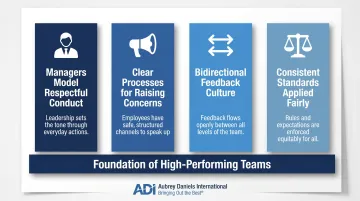
Managers shape the standard. When they avoid difficult conversations, respond inconsistently, or behave differently depending on who's watching, they communicate that expectations are negotiable. Employees notice — and adjust their own behavior accordingly.
Frequently Asked Questions
How do you handle disruptive behavior in the workplace?
Act quickly and address the behavior privately, using specific and factual observations rather than generalizations. Agree on a clear action plan with the employee, follow up consistently, and escalate to HR-supported discipline only if the behavior continues after coaching.
How do you tell someone their behavior is unacceptable at work?
Focus on specific, observable behavior and its impact — not character judgments. Use a calm, private setting and frame the conversation around expectations and improvement. "When you interrupted Sarah twice in today's meeting, it shut down her input" lands better than "you're disrespectful."
How should you handle an employee who overreacts?
Allow the immediate emotional reaction to de-escalate before addressing the behavior. Then have a private conversation focused on the pattern — not just the incident — and explore whether stress, unclear expectations, or other contributing factors are present.
What are red flag words for HR?
Watch for language suggesting threats ("I'll make them pay"), legal action ("this is discrimination"), or personal crisis ("I can't go on"). These phrases require immediate documentation and escalation to HR or EAP resources.
What are commonly cited unethical workplace behaviors?
Commonly cited unethical behaviors include dishonesty, harassment or bullying, taking credit for others' work, and misuse of company resources. These often intersect with disruptive conduct and typically warrant HR involvement when identified.