Introduction
Most organizations set performance objectives that focus on outcomes: sales numbers, project deadlines, error rates, customer satisfaction scores. These targets matter, but they only describe what employees must achieve — not how to achieve it.
When managers track only results, they measure effects while ignoring causes. That gap explains why the same performance problems keep recurring. Gallup's 2025 engagement data found that 46% of employees don't clearly know what's expected of them at work — a striking number given how much time organizations spend setting targets.
Behavioral performance objectives fill this gap by describing the specific, observable actions employees should demonstrate to produce results. This article defines behavioral performance objectives, breaks down their components using the Mager framework, provides role-specific examples, and walks through best practices for setting and sustaining them.
TLDR
- Behavioral objectives describe how work gets done, not just what results are produced
- Effective objectives include three components: observable action, context (conditions), and performance standard (criterion)
- Behaviors are directly controllable — unlike outcomes — which makes behavioral objectives more actionable for employees
- Consistent manager feedback and reinforcement determines whether behavioral objectives stick
- Review objectives quarterly to maintain relevance as roles and business needs evolve
What Are Behavioral Performance Objectives?
Behavioral performance objectives are specific, observable statements describing the actions, methods, and conduct an employee should demonstrate in their role. They differ from outcome goals directly: outcome goals specify end results ("close 10 deals per quarter"), while behavioral objectives specify the actions that produce those results ("respond to all prospect inquiries within 4 business hours, acknowledging their request and providing next steps").
The UC Berkeley People & Culture framework defines this relationship explicitly:
Performance Expectations = Results + Actions & Behaviors
This formula captures what effective performance management actually requires. Results represent "the goods and services produced by an employee," while actions and behaviors represent "the methods and means used to make a product and the behaviors and values demonstrated during the process."
Behavior, in other words, is the day-to-day activity that produces results — not a soft add-on to performance, but its operational foundation.
Multiple Names, Same Concept
Organizations use various terms to describe these objectives:
- Behavioral goals
- Performance dimensions
- Competency indicators
- Learning objectives
- Behavioral expectations
Regardless of the label, all describe observable, job-relevant conduct that can be defined, measured, coached, and reinforced.
Why Behavioral Objectives Drive Real Workplace Performance
The Behavioral Science Foundation
Behavior is observable, measurable, and can be systematically shaped through clear expectations (antecedents) and consequences (reinforcement or feedback). Setting a behavioral objective establishes the starting point, but sustainable performance improvement requires employees to understand precisely what actions are expected and managers to reinforce those actions consistently.
The business case is compelling: research shows that the quality of a manager accounts for 70% of the variance in team engagement. Behavioral objectives matter because behaviors are within the employee's direct control, whereas outcomes can be influenced by market conditions, product quality, pricing, and other external factors. When objectives focus on controllable actions, employees feel more ownership and accountability.
Manager Effectiveness Through Precision
When managers define behavioral expectations clearly, they move from vague directives ("be more collaborative") to specific, coachable behaviors ("share project status updates with the team in the Monday stand-up meeting, highlighting blockers and requesting input"). This precision transforms coaching, feedback, and recognition from subjective judgments to objective observations.
Consider the data: employees are 3.6 times more likely to be motivated to do outstanding work when their manager provides daily feedback versus annual feedback. Yet only 16% of employees say their last conversation with their manager was extremely meaningful. Behavioral objectives give managers something concrete to observe and discuss, making feedback more actionable.
The Reinforcement Gap
Organizations frequently set behavioral expectations but fail to build the consistent feedback and reinforcement systems needed to make those behaviors stick. This is the reinforcement gap—the disconnect between defining what people should do and creating the environmental conditions that sustain those actions.
ADI's core principle, grounded in over 45 years of applying Applied Behavior Analysis to workplace performance, addresses this directly: identifying what truly reinforces employees unlocks sustainable behavior change. Consequences are defined by their impact, not their intention. Leaders may believe they're providing positive reinforcement, but if desired behaviors don't increase, the reinforcement isn't working.
ADI's Performance Management approach helps organizations close this gap by aligning behavioral expectations with reinforcement systems designed for lasting results.
Business Impact Beyond Individual Performance
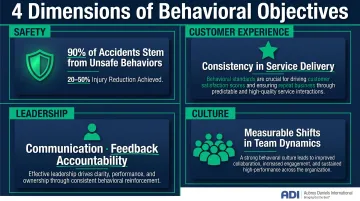
Well-defined behavioral objectives reach beyond individual productivity. Their impact spans multiple dimensions of organizational health:
- Safety: Nearly 90% of occupational accidents result from unsafe behaviors; behavior-based safety programs have achieved injury reductions of 20–50% in systematic reviews
- Customer experience: Behavioral clarity drives consistency in service delivery across customer-facing roles
- Leadership: Behavioral objectives shape how decisions are communicated, how feedback is delivered, and how accountability is built
- Culture: Shared behavioral standards create measurable shifts in team dynamics and organizational norms
Together, these make behavioral objectives one of the most practical tools available for driving performance improvement at scale.
The 3 Components of a Well-Written Behavioral Objective
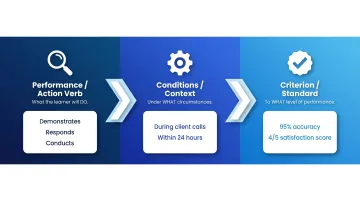
The Mager framework, developed by Robert Mager in 1962, remains the most widely established method for writing performance-based objectives. Every effective behavioral objective should contain three components:
1. Performance — The Action Verb
The behavior must be described using a specific, observable action verb that describes what the learner or employee will do. Observable action verbs include:
- Demonstrates
- Completes
- Communicates
- Responds
- Identifies
- Conducts
- Delivers
- Documents
Avoid vague terms like "understands," "knows," "appreciates," or "values" that describe internal mental states rather than observable actions. If you can't see or measure it happening, it's not a behavioral objective.
2. Conditions — The Context
Conditions describe the context, constraints, or tools under which the behavior should occur. Examples include:
- "During client calls"
- "When a safety incident is reported"
- "Within 24 hours of receiving a request"
- "Using the standard incident report template"
- "Given project data and working aids"
Conditions aren't always required. Include them when the context meaningfully shapes how the behavior should be performed.
3. Criterion — The Performance Standard
The criterion sets the performance standard by defining quality, accuracy, frequency, or timeliness. Examples include:
- "With no more than one escalation per quarter"
- "Achieving a customer satisfaction score of 4/5 or higher"
- "Identifying four out of five product defects"
- "With 95% accuracy"
- "Within 15 minutes of notification"
Tie the criterion to the behavior itself, not just to outcome targets. A quick test: if you can observe and measure it without inferring intent, the criterion is well-written.
Putting It Together: Before & After
Vague expectation: "Be more responsive to customers."
Well-written behavioral objective: "Respond to all customer inquiries via email within 4 business hours, acknowledging receipt and providing an expected resolution timeline. Meets standard when follow-up requests from the same customers decrease by 30% quarter-over-quarter."
Behavioral Performance Objectives: Examples by Role
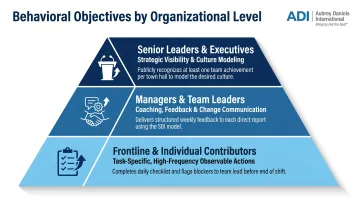
The examples below show how behavioral objectives translate across levels of an organization. Notice that each one names a specific behavior, defines the conditions under which it occurs, and links it to a measurable standard—the three elements that make objectives observable and coachable.
Frontline / Individual Contributors
Individual contributor objectives work best when they target high-frequency, observable behaviors tied to clear performance outcomes.
In customer service: "When handling a customer complaint call, acknowledge the customer's concern within the first 60 seconds and offer a resolution or escalation path before ending the call—rated as meeting standard when post-call surveys score the interaction 4/5 or above."
Notice what this objective avoids: vague language like "be empathetic" or "resolve issues." Instead, it specifies timing, action, and a concrete measurement standard.
In manufacturing and safety: "Follow the lockout/tagout procedure for all equipment maintenance tasks as specified in the safety protocol, with zero deviations observed during monthly safety audits."
The zero-deviation standard leaves no ambiguity. Compliance isn't graded on a curve—the behavior either happens or it doesn't.
Managers and Team Leaders
Manager-level objectives often target behaviors that influence others—coaching quality, communication patterns, and how feedback is delivered.
On structured feedback: "Conduct a structured one-on-one check-in with each direct report weekly, providing at least one specific piece of positive behavioral reinforcement and one developmental observation per session—consistent for a rolling 90-day period."
On change communication: "When communicating a team-level change, present the rationale and expected impact before the change takes effect, allowing time for questions—evidenced by team meeting notes and confirmed by direct reports during quarterly feedback surveys."
Both examples use multiple evidence sources (session consistency plus direct report confirmation), which strengthens accountability without relying on manager self-report alone.
Senior Leaders / Executives
At the executive level, behavioral objectives often focus on visible modeling—the behaviors leaders demonstrate publicly that shape organizational norms.
On recognition and modeling: "Visibly recognize at least two examples of desired team behaviors in all-hands or department meetings each quarter, specifically naming the behavior and its business impact."
The word "visibly" is doing important work here. It distinguishes a private email from a public acknowledgment—the kind of recognition that signals to the broader team what the organization actually values.
Best Practices for Setting and Sustaining Behavioral Objectives
Involve Employees in the Process
Set behavioral objectives collaboratively rather than dictating them top-down. Research shows that goal-setting participation positively affects employees' proactive behavior and increases perceived insider status. Employees who participate in defining expected behaviors have greater ownership and are more likely to demonstrate and sustain those behaviors.
Align individual behavioral objectives with team and organizational goals to ensure consistency and relevance. When employees understand how their specific behaviors connect to broader business priorities, they see purpose in the expectations.
Build in Regular Feedback Loops
Behavioral objectives without consistent observation and feedback lose their impact. Managers should schedule regular check-ins to discuss behavioral progress—not just review outcome metrics—and be prepared to recognize and reinforce progress in real time.
80% of employees who receive meaningful feedback in the past week are fully engaged, regardless of work location. Feedback should occur frequently—a few times per week for most jobs—and immediately after the behavior when possible.
Building this feedback cadence systematically is harder than it sounds. ADI's consulting and certification programs help leaders identify what genuinely reinforces their teams and embed day-to-day feedback practices that make behavioral change stick—not just during a rollout, but long-term.
Review and Update Objectives Regularly
Behavioral objectives should evolve as roles, team needs, and organizational priorities shift. Set a cadence—quarterly or at major project milestones—to review whether current behavioral objectives still align with what the business needs.
94% of employees prefer real-time feedback to formal reviews, and organizations with continuous feedback see 14.9% lower turnover rates. Static objectives quickly become irrelevant or demotivating. Treating behavioral objectives as living documents—not annual checkboxes—is what separates organizations that sustain change from those that cycle back to old habits.
Common Mistakes to Avoid When Writing Behavioral Objectives
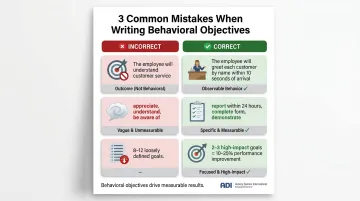
Writing Outcomes Instead of Behaviors
The most common error is framing a behavioral objective as a result rather than the specific behavior that produces that result.
Outcome target (not behavioral): "Achieve a 95% customer satisfaction score."
Behavioral objective: "Demonstrate active listening and summarize the customer's issue before proposing a solution on every service call."
The distinction matters: outcomes depend on behaviors plus external factors, while behaviors are directly controllable by the employee.
Using Unobservable Language
Words like "understand," "value," "be aware of," or "appreciate" cannot be directly observed or measured. Behavioral objectives must describe what the employee visibly does, not what they internally think or feel.
Unobservable: "Appreciate the importance of safety."
Observable: "Report all near-miss incidents within 24 hours using the standard incident report form."
Getting the language right is only half the challenge — the other half is knowing when to stop adding more.
Setting Too Many Objectives at Once
Overloading employees with a long list of behavioral objectives dilutes focus. Prioritize a small set of high-impact behaviors—particularly those most directly linked to performance outcomes or culture—and build mastery before adding new objectives.
Goal-setting research shows that goal setting improves performance by 10-25% when done correctly, but only 40% of goals are specific and measurable. For most employees, two to three well-defined behavioral objectives drive more change than a list of ten vague ones.
Frequently Asked Questions
What are some examples of behavioral objectives?
Behavioral objectives specify observable actions with clear performance standards. Examples include:
- A customer service representative responding to all email inquiries within 4 business hours, acknowledging the request and providing next steps
- A manager conducting weekly one-on-one check-ins with direct reports, delivering at least one specific positive reinforcement per session
- A safety technician completing pre-shift equipment inspections using the standard checklist, with zero skipped items during monthly audits
What is an example of a performance-based objective?
Performance-based objectives combine a specific action verb, conditions, and a success criterion. For example: "Deliver project status updates to all stakeholders every Friday by 3 PM, with key risks and next steps clearly identified." This objective is measurable, observable, and tied directly to a business need.
What is the difference between behavioral objectives and performance objectives?
The two terms are often used interchangeably in workplace contexts. "Behavioral objectives" emphasize specific observable actions an employee takes, while "performance objectives" may also include results-based targets. The most effective approach combines both—defining what results are expected and what behaviors will produce them.
How do you measure behavioral objectives at work?
Behavioral objectives are measured through direct observation, structured feedback (manager check-ins, peer input, customer surveys), and documented evidence (meeting notes, audit logs, call recordings). Consistency of the behavior over time—not just a single instance—defines successful achievement.
What makes a behavioral objective effective?
An effective behavioral objective is specific (uses observable action verbs), realistic, clearly contextualized (conditions stated when relevant), and tied to a criterion that defines acceptable performance. Avoid vague language like "demonstrate professionalism" in favor of concrete, coachable descriptions such as "respond to all team emails within 8 business hours."
How often should behavioral objectives be reviewed?
Review behavioral objectives at least quarterly or at key project milestones. Behaviors and business needs evolve, and static objectives can quickly become irrelevant or demotivating. Regular reviews ensure alignment and provide meaningful feedback—Gallup recommends quarterly goal check-ins with each team member as a minimum standard.