Introduction
Most workplace incidents don't happen because of faulty equipment alone. According to the UK Health and Safety Executive, human failure contributes to "almost all" workplace accidents, with research showing that 80-90% of serious injuries trace back to human error or unsafe behavioral choices. The root cause isn't individual incompetence—it's organizational environments where people don't speak up, teams don't collaborate, and safety feels like a compliance checkbox rather than a shared value.
Safety climate and teamwork climate are measurable, behavioral dimensions of organizational culture that leaders can actively shape. Both show up as observable patterns: how people communicate, which behaviors get reinforced, and whether employees believe the organization genuinely prioritizes safety and collaboration in daily decisions—not just on paper.
This article covers what these concepts mean, how they interact, why they matter for organizational health, how to measure them, and which behavioral strategies produce real, lasting change.
TLDR:
- Safety climate and teamwork climate are tightly linked—organizations with strong teamwork see better safety outcomes
- Both climates are driven by what behaviors leaders model, reinforce, and respond to consistently
- Measurement using validated surveys provides actionable data to track progress and target interventions
- Positive reinforcement of safe communication and reporting drives sustainable culture change
- Behavioral science gives leaders a practical system for strengthening both climates at the same time
Safety Climate, Teamwork Climate, and Organizational Culture: Key Concepts
Defining Safety Climate
Safety climate is the shared perception employees hold about how much an organization truly prioritizes safety—not just in policies, but in day-to-day decisions, leader actions, and what gets reinforced. Researcher Zohar first defined it in 1980, and the core idea holds today: safety climate captures what employees genuinely believe is rewarded, expected, and reinforced when it comes to safety—regardless of what the policy manual says.
Safety climate differs from safety culture. Culture represents the deeper, longer-term set of values and beliefs embedded in an organization over time. Climate is the measurable, observable snapshot of those perceptions at a point in time—the surface layer of culture that responds more quickly to leadership interventions.
Defining Teamwork Climate
Teamwork climate refers to shared perceptions about how well people collaborate, communicate, support one another, and trust each other within and across teams. The environment must actively enable and reward effective team behavior—not just organize people into groups.
Key indicators include:
- Open communication without fear of reprisal
- Mutual support across roles and disciplines
- Constructive conflict resolution
- Meaningful input in decisions affecting work
Connection to Organizational Culture
Organizational culture is the sum of what people believe, how they behave, and what gets reinforced over time. Safety climate and teamwork climate are two critical dimensions that both reflect and shape that broader culture.
They function as leading indicators of cultural health, not just compliance metrics. The practical stakes are significant:
- Strong climates → higher engagement, better error reporting, lower incident rates
- Weak climates → underreported incidents, collaboration breakdowns, rising turnover
The Relationship Between Teamwork Climate and Safety Climate
The Mutually Reinforcing Dynamic
Strong teamwork climate supports safety climate because teams that communicate openly, trust each other, and feel psychologically safe are more likely to report hazards, flag errors, and hold each other accountable for safe behavior. The relationship runs both directions: a strong safety climate also reinforces the trust and communication habits that make teams effective.
Research from 12 neonatal intensive care units found a Spearman correlation of rho = 0.74 (p < 0.01) between teamwork climate and safety climate scores using the Safety Attitudes Questionnaire. Unit-level rankings on teamwork climate closely tracked rankings on safety climate, demonstrating these constructs move together.
The Behavioral Mechanism
Both climates are ultimately determined by what behaviors are modeled, prompted, and reinforced in the workplace. From a behavioral science perspective:
- Antecedents set the stage—structured team meetings, safety briefings, reporting systems
- Behaviors occur—speaking up, reporting near-misses, collaborative problem-solving
- Consequences determine whether behaviors recur—positive reinforcement, neutral response, or punishment
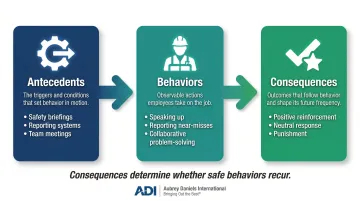
When leaders consistently reinforce safe communication, collaborative problem-solving, and speaking up without fear of punishment, both climates strengthen together.
What Weakens Both Climates Simultaneously
Common organizational conditions erode both climates at once:
- Blame-oriented incident responses that punish reporters instead of addressing root causes
- Siloed team structures that fragment communication and create information gaps
- Leadership signals prioritizing productivity over safety through actions, resource allocation, or recognition systems
- Inconsistent consequence systems where safety violations are sometimes enforced, sometimes ignored
NIOSH research in U.S. mining found that nearly 47% of workers felt safety problems were "out of their hands," and organizational health and safety support accounted for 36% of the variance in near-miss reporting behavior. When employees perceive that organizational systems don't support safety or collaboration, both climates suffer.
The Amplification Effect
Improvements in one climate often accelerate improvements in the other, which makes it strategically efficient to address both together rather than treating them as separate initiatives.
A systematic review of primary care settings found that for every 1-percentage-point increase in overall safety culture scores, there was a 1.9% increase in monthly safety reports. For organizations looking to move the needle on reporting behavior, investing in cultural conditions may be the highest-leverage place to start.
How Teamwork and Safety Climate Impact Organizational Culture
Impact on Employee Behavior and Discretionary Effort
When employees perceive genuine organizational commitment to safety and collaboration, they go beyond minimum requirements—volunteering safety improvements, mentoring peers, and proactively reducing risk.
Discretionary Effort—the voluntary performance employees give when positively reinforced and engaged—explains this shift. In positive reinforcement environments, employees don't just comply with safety rules. They actively look for ways to improve safety systems and support teammates.
Impact on Trust and Psychological Safety
Strong teamwork climate builds the psychological safety employees need to speak up about hazards, near-misses, or process problems. Researcher Amy Edmondson defines it as "a shared belief held by members of a team that the team is safe for interpersonal risk-taking"—and it's foundational to both reporting behavior and team effectiveness.
When people trust they won't be punished for raising issues, the organization gains access to critical safety-relevant information it would otherwise miss. That access directly shapes incident outcomes—which is where the data becomes compelling.
Impact on Error Reporting and Incident Rates
Organizations with strong safety and teamwork climates tend to report more near-misses (a sign of transparency, not more danger) and experience fewer serious incidents over time.
A systematic review of 17,926 participants documented a "reporting paradox": high-psychological-safety teams report more near-misses because members feel safe disclosing incidents. This increased transparency enables organizations to address hazards before they cause harm.
NIOSH research in construction found a direct correlation: the higher the safety climate scores, the lower the recordable incident rate.
Impact on Retention and Well-Being
A study of 10,627 healthcare workers across 396 work settings links poor teamwork and safety climate directly to higher burnout and turnover. Settings with high exposure to Positive Leadership WalkRounds showed measurably better outcomes:
- Personal burnout: 32.4% vs. 45.9% in low-exposure settings (p < 0.001)
- Safety climate: 69.6% vs. 49.6%
- Teamwork climate: 52.7% vs. 36.8%
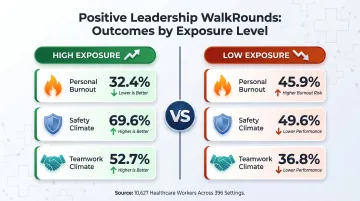
Employees who feel unsafe—physically or psychologically—are more likely to disengage and leave. That makes safety climate a business performance issue with direct implications for retention, productivity, and cost.
Measuring Teamwork and Safety Climate in Your Organization
Why Measurement Matters
Safety climate surveys and teamwork assessments give leaders a data-driven baseline to identify gaps, track progress, and prioritize interventions—before problems escalate into incidents.
Validated survey tools—such as the Safety Attitudes Questionnaire (SAQ) or SCORE Questionnaire—use structured Likert-scale questions to produce domain-specific scores. Scores are typically transformed to a 0-100 scale, with scores of 75 or above indicating a "mature" or "good" climate.
What Good Survey Questions Look Like
Effective survey questions are specific, behavioral, and tied to observable workplace conditions.
Teamwork Climate Questions:
- "Team members speak up if they see a problem"
- "Disagreements in this work setting are appropriately resolved (i.e., not who is right but what is best)"
- "It is easy for personnel here to ask questions when there is something that they do not understand"
- "The people here from different disciplines/backgrounds work together as a well-coordinated team"
Safety Climate Questions:
- "I would feel safe being treated here as a patient" (healthcare context)
- "Errors are handled appropriately in this work setting"
- "My suggestions about safety would be acted upon if I expressed them to management"
- "The culture in this work setting makes it easy to learn from the errors of others"
Connecting Measurement to Action
Collecting climate data is only the first step. Organizations routinely gather survey results but struggle to translate scores into targeted behavioral change.
ADI's consulting and assessment services help organizations interpret climate data behaviorally and design targeted interventions. That means pinpointing specific leader behaviors to reinforce, identifying systems to redesign, and adjusting consequence environments to sustain the change.
Behavioral Science Strategies to Strengthen Both Climates
Use Positive Reinforcement to Drive Safe and Collaborative Behaviors
Behavior is shaped by its consequences. Leaders who consistently and specifically reinforce safe behaviors—such as praising an employee for flagging a near-miss or recognizing a team that collaborated on a safety solution—make those behaviors more likely to recur.
Contrast this with purely punitive approaches that drive incidents underground rather than eliminating them. Research in mining environments documented how a "historic culture of blame" suppressed near-miss reporting, with workers citing the perceived need to ignore safety rules to get the job done.
Build Leader Behavioral Fluency in Safety and Teamwork
Leaders must model the behaviors they want to see—actively participating in safety discussions, asking for team input, and visibly prioritizing safety over speed when trade-offs arise.
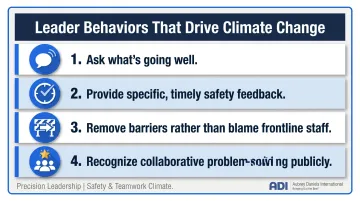
ADI's Precision Leadership approach develops leader behaviors that are observable, measurable, and reinforced over time. This includes:
- Asking "what's going well" rather than only focusing on problems
- Providing specific, timely feedback on safe behaviors
- Removing barriers to safe work rather than blaming frontline employees
- Recognizing collaborative problem-solving publicly
Create Antecedent Conditions That Prompt Desired Behaviors
Antecedents—prompts, reminders, structures, and processes—set the stage for behavior. For safety climate, this means pre-task briefings, accessible hazard reporting systems, safety huddles with structured agendas, and visual boards tracking safety metrics. For teamwork climate, antecedents include structured communication norms (such as SBAR for handoffs), cross-functional collaboration processes, clear role expectations, and regular team feedback sessions.
Antecedents, however, only start the cycle. What determines whether those behaviors stick is what happens immediately after them.
Address the Consequence Environment Around Near-Miss Reporting
A frequently overlooked lever is the consequence environment around near-miss reporting. When reporting results in blame—even subtle blame—people stop reporting. When it's reinforced, safety intelligence across the organization increases.
Organizations should:
- Thank reporters publicly
- Act visibly on reported concerns
- Share learnings organization-wide
- Avoid asking "who" before understanding "what" and "why"
Sustain Improvements Through Ongoing Feedback Loops
Climate doesn't improve through a one-time training event. Lasting change requires:
- Ongoing measurement and trend analysis
- Regular feedback to teams on progress
- Leader coaching and skill development
- Consistent reinforcement systems
ADI's approach to sustainable safety culture change draws on principles from Judy Agnew's co-authored work Safe by Accident?, combining data-based feedback, consistent recognition, and structured accountability to prevent regression over time.
Frequently Asked Questions
What is a safety climate survey?
A safety climate survey measures employees' shared perceptions about how much their organization prioritizes safety in practice. It uses Likert-scale questions across dimensions like leadership commitment, communication, and reporting norms. Scores of 75 or above on a 0–100 scale generally indicate a strong climate.
What are good teamwork and safety climate survey questions?
Good teamwork climate questions address open communication, mutual support, and trust (for example, "Team members speak up if they see a problem"). Safety climate questions address leadership commitment and psychological safety around reporting — such as "I can raise a safety concern without fear of retaliation." Validated instruments like the Safety Attitudes Questionnaire offer tested examples.
Why is teamwork important for safety?
Teamwork is critical to safety because effective communication, mutual accountability, and trust enable team members to catch errors, share hazard information, and coordinate in high-pressure situations. Research shows organizations with strong teamwork climate also tend to have stronger safety outcomes, including higher near-miss reporting and lower incident rates.
What are the 4 C's of health and safety culture?
The UK Health and Safety Executive defines them as Control, Communication, Co-operation, and Competence. Together, these dimensions cover how leaders enforce safe practices, how safety responsibilities are communicated, how employees and employers collaborate, and how staff are trained to work safely.
What is the difference between safety climate and safety culture?
Safety culture refers to the deep-rooted values, beliefs, and norms about safety embedded in an organization over time. Safety climate is the observable, measurable snapshot of those perceptions at a given moment. Climate is often called the "surface layer" of culture — more immediately responsive to leadership behavior and targeted interventions.
How can leaders improve safety climate in the workplace?
Leaders improve safety climate by consistently modeling safe behaviors, positively reinforcing employees who report hazards or raise concerns, responding visibly and promptly to safety issues, and avoiding blame-oriented responses to incidents. Behavioral science research shows that consequence management—what happens after a safe or unsafe behavior—is the most powerful lever leaders have.