Introduction
Picture a team meeting where someone has a promising idea that could solve a costly operational problem. They rehearse it in their head, lean forward to speak—and then stop. The thought of being dismissed in front of colleagues activates a threat response so strong they stay silent. That silence isn't a personality trait or a failure of courage. It's a neurological response, and it's costing teams far more than most leaders realize.
Psychological safety is the shared belief that a team is safe for interpersonal risk-taking — a definition introduced by Dr. Amy Edmondson of Harvard Business School in her landmark 1999 study. It has since become the foundation for understanding high-performing teams. The research behind it is concrete. Google's Project Aristotle, which studied 180 teams across engineering and sales, found that psychological safety was the single most important factor in team effectiveness, outranking dependability, structure, meaning, and impact.
This article covers what leaders need to know to act on that finding:
- What happens in the brain when psychological safety is absent
- Which neurochemicals regulate trust and threat responses
- Which team behaviors destroy safety at a neurological level
- What behavioral science tells us about building environments where people do their best thinking
Key Takeaways
- Social threats like criticism or exclusion trigger the same neural pain pathways as physical injury, shutting down clear thinking and problem-solving
- Neurochemicals like oxytocin, dopamine, and cortisol shape whether team members feel safe enough to contribute and collaborate
- Timothy R. Clark's four-stage model of psychological safety shows most teams stall at early stages without consistent behavioral reinforcement
- Behaviors like interrupting, punishing mistakes, and dismissing ideas erode psychological safety by activating threat responses
- Leaders build psychological safety through consistent daily reinforcement patterns, not one-time workshops or speeches
What the Brain Is Actually Doing When Psychological Safety Is Absent
The brain operates a continuous threat-detection system. The amygdala constantly scans for danger, both physical and social. When it perceives a threat—whether that's a predator or public criticism in a team meeting—it triggers a fight-flight-freeze response that immediately diverts blood flow and cognitive resources away from the prefrontal cortex.
This mechanism evolved to keep us alive. In modern workplaces, it fires with the same neurological force when someone fears being excluded from a decision or criticized for a mistake.
"Amygdala hijack," a term coined by Daniel Goleman in his 1996 book Emotional Intelligence, describes what happens when emotional responses override rational processing. In team settings, this looks like:
- An employee who stays silent during brainstorming sessions
- Someone who avoids escalating a known problem to management
- A team member who deflects blame rather than owning a mistake
These aren't character flaws—they're survival responses to perceived social threats.
How Social Threat Impairs Cognitive Function
Dr. Amy Arnsten's research demonstrated that even mild uncontrollable stress causes rapid and dramatic loss of prefrontal cortex cognitive abilities, including working memory and cognitive flexibility. The mechanism is biochemical: stress floods the PFC with excess catecholamines (norepinephrine and dopamine), activating low-affinity receptors that disconnect neural networks. Control shifts. The brain moves from top-down PFC reasoning to bottom-up amygdala reaction.
Research using the Trier Social Stress Test—a protocol involving public speaking and mental arithmetic before evaluators—confirmed that social-evaluative stress impairs PFC-dependent cognition just as severely as physical stressors. When someone feels threatened by a manager undermining their credibility, they become measurably less able to solve complex problems and more likely to make errors.
The Neural Overlap Between Social and Physical Pain
Eisenberger, Lieberman, and Williams' 2003 study used fMRI to demonstrate that social exclusion activates the anterior cingulate cortex (ACC)—the same region that processes physical pain. Participants who were excluded during a virtual ball-tossing game showed ACC activity that correlated directly with their self-reported distress levels.
Telling someone to "just ignore it" misses the point entirely. Workplace rejection and criticism register as literal pain in the brain—not metaphorically, but neurologically.
Cumulative Effects of Chronic Low-Level Threat
Damage doesn't require a dramatic incident. Chronic low-level social threat—a steady environment of judgment, ambiguity, or unpredictability—keeps cortisol elevated over time, degrading memory, decision-making, and engagement. Gallup's 2025 State of the Global Workplace report found that only 20% of employees worldwide were engaged, costing an estimated $10 trillion in lost productivity. US engagement fell to 31% in 2024, a 10-year low. These losses don't stay contained to individuals—they compound across entire organizations.
The Four Types of Psychological Safety
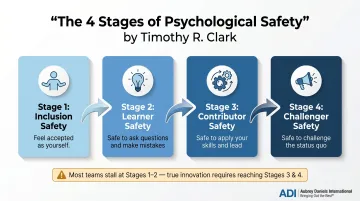
Timothy R. Clark, founder of LeaderFactor, developed a four-stage model that defines the progression of psychological safety within teams:
Stage 1: Inclusion Safety
Feeling accepted as a member of the team and safe to be yourself.
Stage 2: Learner Safety
Feeling safe to ask questions, experiment, and make mistakes without judgment.
Stage 3: Contributor Safety
Feeling safe to contribute meaningfully using your skills and taking initiative.
Stage 4: Challenger Safety
Feeling safe to question the status quo and challenge authority without retaliation.
Most teams never progress past Stage 1 or 2 because organizations send mixed signals — saying mistakes are learning opportunities while punishing them, or inviting questions and then responding dismissively.
Those contradictions are neurologically costly. The brain registers inconsistency as a threat signal, reinforcing defensive behavior and locking teams out of the higher stages where real innovation and performance happen.
Moving a team from Stage 2 to Stage 4 requires leaders to consistently reinforce specific behaviors — curiosity, productive dissent, controlled experimentation — across dozens of everyday interactions. A single workshop or an open-door policy declaration won't shift the pattern. The brain learns from what leaders repeatedly do, not what they occasionally say.
The Neurochemicals That Build or Break Team Trust
Oxytocin: The Trust Molecule
Oxytocin plays a central role in social bonding, trust, and cooperation. It's released during moments of genuine connection, recognition, shared success, and vulnerability. When present in team environments, oxytocin increases willingness to collaborate, take interpersonal risks, and extend trust to others.
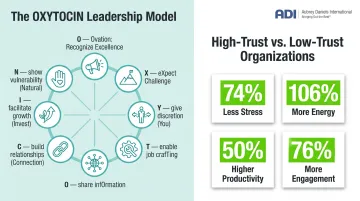
Dr. Paul Zak's research identified eight management behaviors that trigger oxytocin release, organized under the mnemonic OXYTOCIN:
- Recognize excellence (immediate, peer-driven, tangible, unexpected, personal, and public recognition)
- Induce challenge stress (difficult but achievable goals that strengthen social connections)
- Give discretion (autonomy over how projects are managed)
- Enable job crafting (letting employees choose projects aligned with their interests)
- Share information broadly (radical transparency about goals and strategy)
- Build relationships intentionally (structured opportunities for social connection)
- Facilitate whole-person growth (focus on personal and professional development)
- Show vulnerability (leaders asking for help stimulates oxytocin in others)
Zak found that employees at high-trust companies reported 74% less stress, 106% more energy, 50% higher productivity, and 76% more engagement compared to those at low-trust organizations.
Cortisol: The Threat Hormone
Cortisol is released in response to perceived threat—including ambiguity, inconsistency, unfairness, and public criticism. A meta-analysis of 208 laboratory studies by Dickerson and Kemeny found that cortisol is not responsive to all stressors, but specifically to conditions involving social-evaluative threat (situations where performance can be judged negatively) combined with uncontrollability.
This maps directly to psychologically unsafe workplace conditions. Elevated cortisol from chronic low-grade threats compresses cognitive bandwidth and drives self-protective, competitive, and withdrawn behaviors.
Key emotional triggers for cortisol in workplace settings:
- Fear of judgment or humiliation
- Anticipatory anxiety about performance evaluation
- Experiences of unfairness or loss of control
- Unpredictable consequences for mistakes
These don't require dramatic events—chronic uncertainty about how a manager will respond creates the same sustained cortisol elevation.
The Oxytocin-Cortisol Relationship
The two neurochemicals discussed above don't operate independently. Oxytocin has documented stress-buffering properties that reduce cortisol's physiological impact — meaning social bonding and trust-building behaviors are neurologically protective against chronic workplace stress, not just emotionally beneficial. When leaders build trust through recognition, connection, and shared vulnerability, they're creating a biological buffer that protects team members' cognitive capacity.
Dopamine: Motivation, Recognition, and Reward
Where cortisol narrows behavior, dopamine expands it. Dopamine drives motivation and reward-seeking — and when team members receive genuine recognition, see their contributions matter, or are given autonomy over meaningful work, dopamine reinforces those behaviors and drives continued engagement.
Neuroscience research on intrinsic motivation reveals that dopamine is activated through:
- Autonomy over meaningful decisions triggers reward circuitry in the prefrontal cortex
- Achieving a stretch goal produces dopamine bursts that reinforce further effort
- Feeling valued by the group activates the same neural reward pathways as financial compensation
Critically, recognition acts as a dopamine trigger only when it's informational (confirming competence: "Your logic on this project was brilliant") rather than controlling ("Do this again so you get another trophy"). The implication for leaders is concrete: specific, competence-confirming feedback produces neurochemical engagement that generic praise cannot.
Team Behaviors That Undermine Psychological Safety
Specific team member behaviors trigger neurological threat responses in colleagues, even when unintentional. The five patterns below are among the most common — and most damaging:
- Interrupting or talking over others signals that someone's input doesn't matter, activating status threats. David Rock's SCARF model demonstrates that threats to status activate the same neural networks as threats to one's life.
- Publicly criticizing or shaming mistakes activates social pain pathways in the anterior cingulate cortex. The brain processes this as literal pain — not just discomfort.
- Dismissing ideas without engagement ("That won't work") creates certainty threats. The brain generates error responses that consume excess neural energy when patterns become unpredictable.
- Taking credit for others' contributions violates fairness expectations, activating the insular cortex (associated with disgust) and triggering a strong threat response.
- Exclusionary side conversations or decision-making triggers relatedness threats. Without safe social connection, the brain shifts into a defensive, threat-detection state.
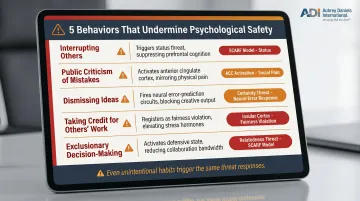
Even habitual patterns, like checking a phone during someone's presentation or defaulting to sarcasm, activate the same threat responses as deliberate exclusion.
The Amplified Impact of Leader Behaviors
Leader behaviors have an outsized neurological effect compared to peer behaviors. Research by Nembhard and Edmondson found that leader inclusiveness—defined as words and deeds that invite and appreciate others' contributions—had a significant positive effect on psychological safety, particularly for lower-status team members. Power differentials heighten the brain's sensitivity to status-based threats.
Berkeley Executive Education summarizes: "How a leader responds to dissent, mistakes, or bad news determines whether people speak up again—or retreat into silence. One punitive response can undo months of trust-building."
How Leaders Can Build Psychological Safety Using Behavioral Science
Psychological safety isn't built through a single workshop or motivational speech. It's built through consistent patterns of reinforcement over time. What leaders reinforce—through positive responses, attention, and reward—and what they punish—through criticism, dismissal, or silence—shapes whether speaking up becomes a behavior that increases or decreases in frequency.
This is the Applied Behavior Analysis lens that underpins ADI's Performance Management approach: identify what reinforces your people and systematically shape the behaviors that build trust.
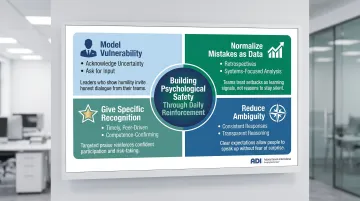
Model Vulnerability Deliberately
Leaders who openly acknowledge uncertainty, share their own mistakes, and say "I don't know—what do you think?" reduce the perceived power distance that amplifies threat responses. Research confirms that when leaders show vulnerability—specifically asking for help from colleagues—it stimulates oxytocin production in others, increasing trust and cooperation. Vulnerability activates empathy circuits and signals that imperfection is safe, without undermining authority.
Normalize Mistakes as Data, Not Failure
Create explicit team norms around learning from errors:
- Brief retrospectives after setbacks
- "What did we learn?" check-ins
- Public recognition when someone surfaces a mistake early
- Systems-focused problem analysis rather than blame assignment
With consistent, repeated positive experience, neuroplasticity allows the amygdala to gradually stop tagging mistakes as threats. Davidson and McEwen's research demonstrated that the amygdala is highly plastic—chronic social stress causes it to grow while shrinking the prefrontal cortex, but positive social experiences and consistent top-down regulation can reverse this pattern.
Give Recognition That Is Specific, Timely, and Genuine
Vague praise has limited neurochemical effect. Zak's research found that recognition has the largest effect on trust when it:
- Occurs immediately after a goal is met
- Comes from peers (not just managers)
- Is tangible, unexpected, personal, and public
- Confirms competence with specific details
Example: "Your logic on the capacity analysis was brilliant—you identified the constraint we'd been missing for weeks" activates dopamine. "Great job" does not.
Consequences are defined by their impact, not their intention. If the behavior you're trying to reinforce doesn't increase, reinforcement hasn't occurred — regardless of how positive the gesture felt to the leader.
Reduce Unnecessary Ambiguity and Inconsistency
The brain experiences unpredictability as a threat signal. Rock's SCARF model identifies Certainty as one of five primary social threat domains: "The brain likes to know the pattern occurring moment to moment... uncertainty creates an error response that takes up more energy."
Leaders who communicate clearly about decisions, share the reasoning behind changes, and respond consistently to mistakes and ideas give the prefrontal cortex permission to stay engaged rather than divert to constant threat-monitoring. ADI's consulting work helps organizations design structured reinforcement systems that make these expectations explicit and measurable. When employees can reliably predict what happens when they speak up, admit mistakes, or challenge assumptions, predictability itself becomes the safety signal — and the threat-monitoring cycle breaks.
Frequently Asked Questions
What is the neuroscience behind psychological safety?
The brain's threat detection system (amygdala) responds to social threats—criticism, exclusion, judgment—the same way it responds to physical danger, triggering a fight-flight-freeze response that impairs prefrontal cortex function. A psychologically safe environment keeps this system calm, enabling higher-order thinking, collaboration, and creativity.
What are the 4 types of psychological safety?
Timothy R. Clark's model identifies four progressive stages: Inclusion Safety (feeling accepted), Learner Safety (safe to ask questions and make mistakes), Contributor Safety (safe to apply skills and take initiative), and Challenger Safety (safe to challenge the status quo). Each stage builds on the previous and requires consistent behavioral reinforcement to sustain.
What team member behaviours will reduce psychological safety?
Common behaviors that erode psychological safety include interrupting or dismissing others, publicly criticizing mistakes, taking credit for others' work, and exclusionary decision-making. These trigger neurological threat responses—status, certainty, and fairness violations—even when unintentional, activating the same brain regions as physical threats.
What emotion triggers the release of cortisol?
Fear, anticipatory anxiety about social judgment, and experiences of unfairness or loss of control are the primary emotional triggers for cortisol release. In team settings, chronic low-grade threats—unpredictable manager responses, ambiguous expectations—are often more damaging than dramatic events because they sustain cortisol elevation over time.
Does oxytocin counteract cortisol?
Oxytocin has stress-buffering properties that can reduce cortisol's physiological impact. This means trust-building behaviors—recognition, genuine connection, shared vulnerability—are not just emotionally beneficial but neurologically protective, reducing the chronic stress that erodes cognitive performance over time.
Psychological safety is a neurological requirement for high performance, not a soft concept or cultural aspiration. When leaders understand how the brain responds to threat and systematically reinforce behaviors that signal safety, they unlock the cognitive capacity, creativity, and discretionary effort that drive exceptional results. ADI has applied these behavioral science principles with organizations worldwide for over 45 years, helping leaders build environments where trust is deliberately designed and consistently maintained.
Ready to build psychological safety in your organization? Contact Aubrey Daniels International at 678-904-6140 or info@aubreydaniels.com to learn how behavioral science can transform your team's performance.