Introduction
Most organizations have safety programs, procedures, and dedicated safety teams—yet preventable incidents persist. If the systems are in place, why does safety performance still stall?
The missing piece is rarely more rules or training. It's culture. A safety culture roadmap is a deliberate, phased plan that changes the beliefs, behaviors, and reinforcement systems driving how people actually act around safety—not just what they're told to do.
At Aubrey Daniels International (ADI), we've spent over 45 years applying behavioral science to help organizations transform safety culture. This guide walks through the four-phase strategic framework we use with clients:
- Assessing your current cultural baseline
- Building leadership and reinforcement systems
- Engaging every organizational level
- Sustaining change through consistent measurement
Each phase builds on the last—moving your organization from compliance-driven safety toward a culture where safe behavior is the default.
Key Takeaways
- Safety culture roadmaps shift organizations from compliance-based to commitment-based safety
- The roadmap follows four phases: baseline assessment, leadership system design, all-level engagement, and sustained measurement
- Rules and training set expectations; consequences and reinforcement shape what employees actually do
- Leadership behavior drives employee safety behavior more than any other factor
- Sustainable culture requires leading indicators, not just lagging incident data
What a Safety Culture Roadmap Is (and Why Rules Alone Won't Get You There)
A safety culture roadmap is a strategic, sequenced plan that addresses the beliefs, behaviors, and organizational systems shaping how safety is practiced daily. It differs from a safety program—a set of policies and procedures.
The compliance-versus-commitment distinction matters:
- Compliance cultures: Employees follow rules to avoid punishment
- Commitment cultures: Safe behavior is intrinsically valued and socially reinforced
Research shows 80-90% of serious workplace injuries trace to human error or unsafe behavioral choices, with some studies finding that 96% of all workplace accidents begin with unsafe behavior. This isn't a training gap or missing procedure—it's a behavioral reality.
The Behavioral Science Principle Behind Effective Roadmaps
Behavior is a function of its consequences. Rules and training are antecedents—they set the stage for behavior. But what happens after a behavior determines whether it continues or stops.
In most workplaces, the consequence pattern looks like this:
- Safe behavior → no reaction (ignored)
- Unsafe behavior → punishment after incidents, or tolerance when production pressure builds
Neither pattern reinforces safety. Roadmaps that produce lasting change are built around consequence management—deliberately designing what happens after behavior to make safe choices more likely to repeat.
Phase 1: Assess Your Current Safety Culture Baseline
You can't chart a route without knowing your starting point. Baseline assessment is non-negotiable.
Leading vs. Lagging Data
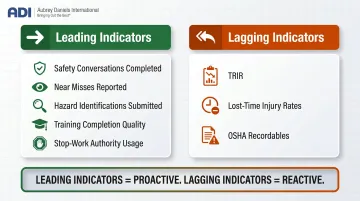
Lagging indicators (injury rates, OSHA recordables) tell you what already happened. Leading indicators (near-miss reporting rates, safety conversation frequency, hazard identification submissions) predict what's coming and give you something actionable to manage.
The Campbell Institute's research confirms that sole focus on lagging metrics is not as effective in promoting continuous improvement as using leading indicators to anticipate and prevent incidents.
Credible Assessment Methods
A multi-method approach is essential because what leaders believe about culture often differs sharply from what frontline workers experience:
- Anonymous employee surveys to surface perception gaps
- Structured leader safety observations to evaluate behavioral patterns
- Focus groups with frontline workers to understand barriers and enablers
- Safety system audits to assess structural and procedural integrity
NSC research found nearly 30% of workers who experience pain at work do not report it, and safety leaders consistently rate workplace culture more positively than frontline employees.
Using a Safety Culture Maturity Model
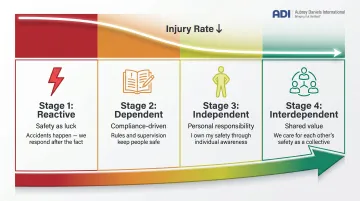
Once you've gathered multi-source data, the next step is placing your organization on a maturity continuum. Cultures typically progress through identifiable stages. The Bradley Curve identifies four stages:
- Reactive - Safety viewed as luck; highest injury rates
- Dependent - Safety defined by management rules; compliance-driven
- Independent - Individuals take personal responsibility; injury rates drop
- Interdependent - Safety is a shared value; teams feel responsible for one another; lowest injury rates
The Hearts and Minds model offers five levels from pathological (regulatory compliance only) to generative (ownership of safety improvement).
Assessment should place your organization on this continuum and identify specific behavioral gaps: Are supervisors having regular safety conversations? Are near misses suppressed due to fear of blame? Are safe behaviors reinforced or only unsafe behaviors noticed?
Share Findings Transparently
When workers see their input reflected in an action plan, trust in the process grows. Share results across all levels — not just leadership. A brief written summary distributed to participants, a visual posting of key themes on the floor, or a short town hall discussion each sends the same message: this wasn't a checkbox exercise.
That credibility is what makes Phase 2 possible. Workers who believe their input mattered are far more likely to engage with the behavioral changes you'll ask of them next.
Phase 2: Build the Foundation—Leadership Behaviors and Reinforcement Architecture
Leadership behavior is the most powerful antecedent in the entire safety system. When leaders visibly prioritize safety in daily decisions, resource allocation, and personal conduct, they set behavioral expectations for the organization.
A 2024 peer-reviewed study found that after safety leadership training, supervisors were 4.1 times more likely to conduct safety meetings and **3.1 times more likely to model safe behaviors**.
What Safety Leadership Behavior Actually Looks Like
Authentic safety leadership includes:
- Conducting genuine safety walkthroughs (not inspections)
- Asking behavior-focused questions: "What makes it hard to work safely here?"
- Stopping production when safety is compromised
- Modeling the exact behaviors expected of employees
This differs sharply from performative leadership—speeches about safety while production deadlines consistently override safety concerns. This differs sharply from performative leadership: speeches about safety while production deadlines consistently override safety concerns. Behavior is the signal employees read, not intent.
That behavioral signal only holds when the organizational environment is designed to reinforce it.
Designing a Reinforcement Architecture
Organizations need to systematically design the consequences that follow safe behavior. Currently in most organizations:
- Safe behavior is ignored (produces no reaction)
- Unsafe behavior is punished after incidents or tolerated due to production pressure
Neither pattern reinforces safe culture.
The Role of Positive Reinforcement
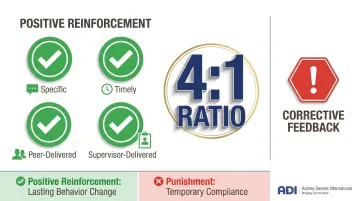
Behavioral science research shows that positive reinforcement consistently outperforms punishment for building lasting behavior change. It increases the probability that safe behaviors will be repeated. Punishment creates temporary compliance. Once the enforcer leaves, the unwanted behavior returns.
The recommended ratio: 4:1 (four positive reinforcements for every corrective feedback).
Recognition that is specific and timely, from both peers and supervisors, creates the social reinforcement that outlasts any training event. This is what separates organizations that sustain culture change from those that plateau after initial compliance gains.
Structural Elements Leaders Must Put in Place
- Assign safety accountabilities to every management layer, not just the safety team
- Build both formal and informal recognition processes that reinforce safe behavior consistently
- Align safety goals with operational decision-making so production pressure doesn't quietly override safety
Phase 3: Engage and Equip Every Level of the Organization
Top-down commitment creates conditions for change, but frontline engagement is where culture actually lives.
Psychological Safety in the Safety Context
Employees who feel empowered to speak up, report hazards, and challenge unsafe practices are the true mechanism of a self-sustaining safety culture. Psychological safety means confidence that raising a safety concern won't result in blame, retaliation, or ridicule.
Research on 1,150 leaders found psychological safety has a significant positive correlation with task performance (r = 0.51, p < 0.01) and individual satisfaction (r = 0.70, p < 0.01).
Practical Engagement Structures
- Joint safety committees with real decision-making authority
- Peer-to-peer safety observation and feedback systems
- Near-miss reporting processes that reward transparency rather than punish the reporter
Design these systems to remove barriers: forms should be simple, follow-up should be visible, and outcomes should be communicated back to employees.
Training That Changes Behavior, Not Just Knowledge
Most safety training is designed to inform, not to change behavior. Effective training must:
- Target specific behavioral competencies (hazard recognition, peer feedback, stopping unsafe work)
- Use real scenarios from the actual workplace
- Include practice and feedback—not just passive instruction
The Engageli Active Learning Impact Study found a 54% increase in learning outcomes when training incorporates active participation versus passive delivery.
The Supervisor's Role in Daily Safety Behavior
Supervisors translate leadership intent into what employees actually experience each day. Their conversations, reactions, and habits set the reinforcement conditions that either support or undermine safe behavior.
A 2025 study of 359 construction workers found a strong correlation between supervisor safety communication and safety behavior (r = 0.736, p < 0.01). That communication worked through three distinct pathways: safety knowledge, self-efficacy, safety motivation, and psychological ownership for safety.
Equipping supervisors to lead safety effectively means training them on:
- Behavior-based coaching techniques for frontline teams
- Delivering specific, timely positive reinforcement for safe practices
- Holding safety conversations that build accountability without triggering defensiveness
Phase 4: Measure Progress and Sustain Cultural Change
What gets measured gets managed—but most organizations measure the wrong things.
Leading Indicators Are More Actionable
Leading indicators predict future performance:
- Safety conversations completed
- Near misses reported
- Hazard identifications submitted
- Training completion quality
- Stop-work authority usage frequency
Lagging indicators (TRIR, lost-time injury rates) tell you what already happened. A roadmap without leading indicator dashboards will always be reactive.
Accountability Structure That Sustains Momentum
- Regular safety culture reviews at the leadership level
- Team-level safety metrics visible to frontline employees
- Formal cycle: review data → identify behavioral barriers → adjust interventions → recognize progress
Accountability without positive reinforcement for improvement becomes purely punitive and erodes trust. That reinforcement dynamic also determines whether cultural gains compound over time or quietly stall.
Continuous Cultural Improvement
Safety culture is never "finished." Use annual culture resurveys, behavioral observation data trends, and incident pattern analysis to identify where the roadmap needs to evolve.
Cultures that plateau often do so because reinforcement systems become routine and lose impact. That's the signal to refresh recognition approaches and engagement mechanisms before momentum fades.
General Motors' results underscore what sustained commitment produces: from 1994 to 2008, total recordable and lost-time injury rates dropped by more than 95%, according to a culture change transformation case study. Transforming culture takes years of deliberate effort, not a single program rollout.
Common Roadblocks That Derail Safety Culture Roadmaps
Most Common Failure Modes
- Leadership lip service: Safety gets stated as a priority, but production decisions consistently say otherwise — and workers notice.
- One-and-done thinking: Culture change treated as a project with a finish line rather than an ongoing management system.
- Training without reinforcement: Awareness campaigns and courses don't move behavior if the environment still punishes the right actions and rewards the wrong ones.
McKinsey's 2021 global survey confirms that more than 70% of needed change either fails to be launched or completed.
The Punishment-Heavy Safety Culture Trap
Punishment-heavy safety cultures suppress reporting without improving behavior. Workers learn to hide near misses and minimize incidents rather than surface them.
A 2026 quasi-experimental study found that punitive cultures create fear of punishment, reputational loss, and termination risk — pushing workers toward "silent behavior" rather than reporting.
The data shows how sharply this suppresses transparency:
- Pre-intervention silence scores averaged 31.8 out of 45
- After Just Culture training for head nurses, scores dropped to 19.7 (Cohen's d = 2.89, a very large effect)
- Error reporting frequency rose from 1.45 to 2.30
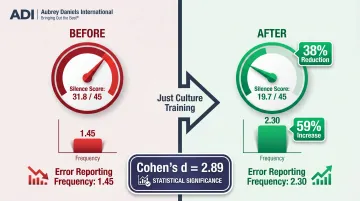
That's exactly the problem: incident data in high-punishment cultures often looks better than it is — until a major event occurs and the hidden pattern becomes impossible to ignore.
How Behavioral Science Overcomes These Roadblocks
Suppressed reporting is a symptom of the wrong reinforcement environment — not a workforce problem. ADI's behavior-based approach helps organizations shift from reactive punishment to proactive positive reinforcement by:
- Designing reinforcement systems that are specific, immediate, and certain
- Building internal coaching capability so culture change is owned by the organization
- Shifting the primary management tool from punishment to positive accountability
Frequently Asked Questions
What is the difference between a safety culture and a safety program?
A safety program is a set of policies, procedures, and compliance requirements. A safety culture reflects the shared beliefs, values, and daily behaviors of everyone in the organization. Safety programs can exist on paper without a supporting culture, but culture determines whether the program is actually followed.
How long does it take to build a strong safety culture?
Meaningful cultural shifts typically take 2-5 years of sustained effort. Early behavioral changes can be visible within months if reinforcement systems are redesigned. Short-term safety initiatives rarely produce lasting change.
What are the most common reasons safety culture transformation efforts fail?
Three failure modes account for most unsuccessful transformations: lack of genuine leadership commitment beyond words, treating culture change as a one-time program rather than an ongoing management system, and leaving the reinforcement environment unchanged so safe behavior goes unrecognized.
How do you measure progress on a safety culture roadmap?
Leading indicators (near-miss reporting rates, safety observation frequency, training participation quality) are more actionable and predictive than lagging indicators (incident rates). Leading indicators track culture change in real time and allow for proactive adjustment.
What role does positive reinforcement play in safety culture change?
Positive reinforcement (specific, timely acknowledgment of safe behaviors) is the primary behavioral mechanism for sustaining culture change. It increases the probability that safe behaviors will be repeated. Rules and training alone only set expectations—they don't change what actually happens after behavior occurs.
How should supervisors be trained differently for safety culture work compared to standard safety training?
Supervisors need behavioral coaching skills: observing specific safe behaviors, delivering genuine positive reinforcement, conducting non-defensive safety conversations, and modeling the behaviors they expect. This goes beyond procedural safety knowledge because supervisors control the daily reinforcement environment their teams live in.