This guide clarifies what each discipline truly encompasses, exposes why integration attempts commonly fail, and offers behavior-grounded best practices for making the two work as one unified strategy. You'll discover how behavioral science principles—not just better systems—create the connective tissue that transforms separate HR processes into a coherent performance improvement engine.
Key Takeaways
- Talent development builds employee capabilities over time; performance management aligns and improves day-to-day behavior and results
- When siloed, both strategies underperform—development doesn't transfer to behavior change, and performance management lacks a growth pathway
- Behavioral science is the anchor: knowing what reinforces people makes development stick and performance sustainable
- Six practices close the gap—goal alignment, behavior-focused feedback, check-ins, succession data loops, shared metrics, and manager development
Defining Talent Development and Its Role in Organizational Growth
Talent development is a subset of the broader talent management umbrella, focused specifically on growing the skills, capabilities, and potential of existing employees—distinct from talent acquisition or workforce planning.
What talent development encompasses:
- Formal training programs and workshops
- On-the-job stretch assignments
- Mentoring and coaching relationships
- Leadership development tracks
- Career progression frameworks
According to the Association for Talent Development (ATD), talent development refers to "efforts that foster learning, employee engagement, talent management, and employee development to drive organizational performance, productivity, and results."
Talent management covers the full employee lifecycle—recruiting, onboarding, deployment, retention, and succession—while talent development zeroes in on learning and skill-building within that lifecycle.
The Business Case for Development Investment
Organizations spent an average of $1,254 per employee on workplace learning in 2024, with employees using 17.4 formal learning hours per year, according to ATD's 2025 State of the Industry report. The cost per learning hour increased 34% from $123 to $165 between 2023 and 2024—a signal that organizations are trading volume for higher-impact learning experiences.
This investment directly impacts retention. Career-related reasons—lack of growth opportunities, inadequate progression, or insufficient professional development—are the #1 cause of employee turnover, according to SHRM and the Work Institute's 2025 Retention Report. The data reinforces this from another angle: 88% of organizations cite retention concerns and identify learning opportunities as their top strategy to address it, per LinkedIn's 2025 Workplace Learning Report.
Performance Management vs. Talent Development: Key Differences
Performance management is the ongoing process of setting clear expectations, measuring behavior and results, providing timely feedback, and reinforcing progress toward organizational goals.
Dr. Aubrey C. Daniels coined the term "performance management" in the late 1970s to describe this behavior-focused approach — a method rooted in Applied Behavior Analysis for managing both behavior and outcomes.
| Dimension | Performance Management | Talent Development |
|---|---|---|
| Scope | Individual behavior and results | Capability growth and potential |
| Time Frame | Immediate and ongoing cycles | Long-term trajectory |
| Primary Driver | Accountability and alignment | Learning and potential |
| Ownership | Manager-led | Shared between HR, L&D, and manager |
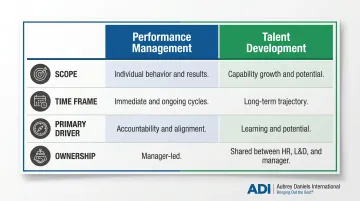
Each serves a distinct function. Treating them as interchangeable creates strategic confusion for HR teams and undermines both objectives.
Why Integration Matters—and Why It Often Fails
When performance data informs development priorities and development investments improve measurable performance, organizations create a self-reinforcing cycle of improvement. Organizations very or extremely effective at enabling human performance are 2.08x more likely to report positive financial results, according to Deloitte's 2025 Global Human Capital Trends research.
Yet only 6% of organizations successfully use data and evidence to capture worker performance value while maintaining trust. This gap represents the core integration challenge: most organizations understand the value but cannot execute.
Two Common Failure Modes
Connected Systems, Unchanged Behavior
Systems are linked on paper—performance reviews reference development plans, learning management systems connect to competency models—but managers don't know how to use performance conversations to motivate development. The paperwork exists. The behavior doesn't change.
Training That Doesn't Stick
Employees attend workshops, gain knowledge, then return to environments where no one recognizes, supports, or reinforces the new behaviors. According to ATD research, without reinforcement, coaching, and on-the-job application, a significant portion of formal training never transfers to sustained behavior change. The gap between learning and doing is where most integration efforts quietly collapse.
The Behavioral Science Case for Integration
The foundational insight from Applied Behavior Analysis (ABA) anchors durable performance improvement: behavior is shaped by its consequences. For integration to work, both performance management and development efforts must be designed around what actually reinforces employees—not just what measures or trains them.
Positive Reinforcement as the Integration Mechanism
When managers recognize and reinforce the specific behaviors that reflect skill growth, they turn talent development investments into lasting behavior change rather than one-time training events. The PIC/NIC principle explains why: consequences that are Positive, Immediate, and Certain shape behavior far more effectively than delayed, infrequent, or ambiguous feedback.
Most performance management systems fall short because they focus on outcomes (ratings, scores, results) rather than the precise behaviors that produce those outcomes. Without behavior-level specificity, feedback can't guide development, and development programs can't target what actually needs to change.
Why Annual Reviews Fail
Deloitte's 2025 research reveals the depth of the problem:
- Only 2% of CHROs believe their performance management system works
- 72% of workers do not trust their organization's performance management process
- 64% view reviews as "a complete waste of time"
- Less than 47% of workers know what is expected of them
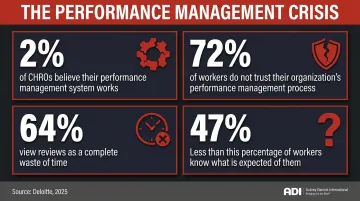
These findings converge on a single mechanism: traditional outcome-focused reviews provide delayed, negative, uncertain feedback—the exact opposite of what behavioral science identifies as effective reinforcement.
Behavior-Based Feedback as Connective Tissue
Those findings point directly to the fix: behavior-based feedback. That means identifying which specific behaviors an employee needs to develop, reinforcing those behaviors consistently as they emerge, and adjusting development plans based on real behavioral data—not just annual review scores.
Aubrey Daniels International has applied this approach across 400+ organizations over 45 years. When reinforcement is built into both the performance management process and the development journey, discretionary effort increases and gains sustain. Skills don't revert after training ends.
6 Best Practices for Integrating Performance Management and Talent Development
Practice 1: Align Individual Development Goals with Organizational Performance Objectives
Integration starts at goal-setting. Development goals should not exist separately from performance goals. Managers and employees should collaboratively set goals that are both performance-relevant (measurable business outcomes) and development-anchored (specific skills or behaviors to build).
Gallup research finds employees are 4x more likely to be engaged when managers involve them in setting goals. Yet only 30% of employees actually experience this involvement. This gap represents one of the largest untapped engagement levers available.
How to implement:
- Frame development goals in terms of behaviors that drive business results
- Include both what needs to be achieved (outcome) and what skills will be developed (capability)
- Review alignment quarterly, not just annually
- Make the connection between growth and contribution explicit
Practice 2: Use Performance Data to Drive Development Planning
Performance reviews, 1:1 check-ins, and feedback data should directly inform which development investments to prioritize. Identify skill gaps and behavior patterns from performance data, then match them to targeted development interventions — not generic training catalogs.
Only 32% of executives say their current approach enables timely, high-quality talent decisions regarding high and low performers. The LinkedIn 2025 Workplace Learning Report found that among the most mature organizations, 55% track employees developing new skills and 48% measure retention as a learning program metric—but these are the exceptions, not the norm.
How to implement:
- Conduct quarterly performance-development reviews where data drives decisions
- Map skill gaps identified in performance conversations directly to learning interventions
- Track whether development investments close identified performance gaps
- Eliminate training that doesn't connect to documented performance needs
Practice 3: Shift from Annual Reviews to Continuous, Behavior-Focused Feedback
Annual reviews are too infrequent to drive real behavior change or reinforce development progress. Continuous feedback loops—where managers observe specific behaviors, provide immediate positive or corrective feedback, and connect that feedback to the employee's development goals—turn the integration concept into daily practice.
Gallup research shows employees who receive daily feedback from their manager are 3x more likely to be engaged than those who receive feedback once a year or less. Managers trained in coaching see up to 18% higher team engagement and 20-28% improvement in their own performance metrics.
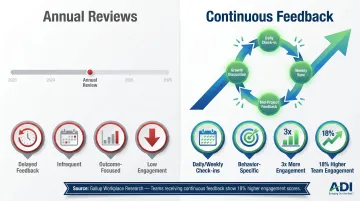
Adobe's experience validates this approach. After eliminating annual reviews in late 2011 and replacing them with ongoing "Check-in" conversations, Adobe saved approximately 80,000 hours of manager time and saw voluntary attrition trend downward.
How to implement:
- Replace annual reviews with weekly or bi-weekly check-ins
- Train managers to identify and reinforce specific behaviors, not just outcomes
- Use 1:1s to discuss both performance progress and development milestones
- Provide managers with simple frameworks for behavior-focused feedback
Practice 4: Build Succession Planning from Integrated Performance and Development Insights
Succession planning is most effective when it draws on both demonstrated performance data and development trajectory data. Employees should be evaluated not just on current results but on behavioral indicators of growth potential.
Aligning talent review conversations with performance management cycles keeps the pipeline continuously informed — and prevents succession from becoming a once-a-year checkbox.
Korn Ferry research reveals a significant intention-action gap: 90% of organizations say succession planning is important, but only 37% invest substantially in it. Without integrated performance and development data, organizations lack the evidence base to identify and prepare successors.
How to implement:
- Include development progress as a criterion in succession discussions
- Track behavioral indicators of leadership potential, not just current performance ratings
- Conduct talent reviews quarterly, aligned with performance cycles
- Use succession conversations to inform individual development investments
Practice 5: Create Shared Metrics That Span Both Disciplines
Develop metrics that reflect both performance outcomes and development progress simultaneously. Track not just whether an employee hit their quarterly target, but whether they demonstrated the key behaviors they set out to develop. This prevents performance management from cannibalizing development focus and gives L&D teams evidence of behavior transfer.
The Kirkpatrick Model remains the industry standard with four levels: Reaction, Learning, Behavior, and Results. Yet most organizations measure primarily at Levels 1-2 (satisfaction and knowledge) while the integration value is captured at Levels 3-4 (behavior change and business results).
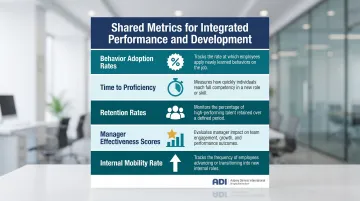
Shared metrics to consider:
- Behavior adoption rates (% of employees demonstrating trained behaviors on the job)
- Time to proficiency for new skills
- Retention rates of employees in development programs vs. those not enrolled
- Manager effectiveness scores (combining performance results with development support quality)
- Internal mobility rate correlated with development participation
Practice 6: Equip Managers as the Integration Point
Managers are where integration succeeds or stalls. If managers can't conduct developmental performance conversations, no system or metric will close the gap.
Organizations that invest in manager capability — through behavior-based coaching training, structured 1:1 frameworks, and reinforcement strategies — see measurably stronger integration outcomes.
Gallup's research puts it plainly: managers account for 70% of the variance in team-level employee engagement. Yet DDI's 2024 analysis reveals nearly 40% of leaders report receiving inadequate coaching from their own managers — and high-potential employees are 2x more likely to intend to leave when they lack an effective coaching manager.
Companies with strong coaching cultures are 2.9x more likely to engage and retain top talent, with 1.5x higher odds of ranking in the top 10% for financial performance.
Those metrics only hold if managers have the skills to act on them — which points directly to where most organizations under-invest.
How to build manager capability:
- Provide structured training in behavior-based coaching skills
- Give managers simple tools for conducting developmental 1:1s
- Reinforce managers when they connect performance feedback to development goals
- Measure and reward manager effectiveness at developing their teams
ADI's Applications of Behavioral Leadership workshop builds exactly this capability. Managers leave with a 5-step change process, behavioral coaching skills, and practical frameworks for weaving short, high-impact coaching interactions into daily work — no restructuring required.
Frequently Asked Questions
What is the difference between talent development and performance management?
Talent development builds employee capabilities and long-term growth potential through training, coaching, and career pathing. Performance management sets expectations, measures results, and delivers feedback to improve day-to-day work. Used together, development goals are shaped by performance data while performance improvements are supported by targeted development investments.
What is the difference between L&D (Learning & Development) and T&D (Training & Development)?
Training & Development (T&D) refers to structured skill-building programs such as workshops, courses, and certifications. Learning & Development (L&D) is a broader term encompassing informal learning, coaching, performance support, and organizational learning culture — and is now the more widely used term in HR for describing how organizations build capability.
What are the 4 pillars of performance management?
The four commonly cited pillars are: Planning (setting clear expectations and goals), Monitoring (measuring progress continually), Reviewing (evaluating performance periodically), and Rewarding (recognizing and reinforcing good performance). Effective performance management treats these as an ongoing cycle rather than isolated annual events.
What are the 5 C's of performance management?
The 5 C's framework includes: Clarity (clear expectations and standards), Communication (regular dialogue between manager and employee), Coaching (skill and behavior guidance), Consequences (reinforcement and accountability), and Consistency (applying standards fairly and continuously across the organization).
What are the 5 C's of talent management?
According to Professor Randall S. Schuler's framework, the five C's are: Competencies (skills, knowledge, and behaviors required by the workforce), Commitment (degree of employee dedication to organizational goals), Culture (shared values and norms shaping behavior), Costs (financial management of human capital investment), and Capabilities (organizational capacity to adapt, innovate, and execute collectively).
Ready to integrate performance management and talent development in your organization? For over 45 years, Aubrey Daniels International has helped organizations apply behavioral science to drive measurable, lasting performance results. Contact ADI at 1-678-904-6140 or info@aubreydaniels.com to learn how behavior-based consulting, leadership development workshops, and manager coaching programs can strengthen how your organization develops and manages talent.