Introduction
Most organizations operate some version of performance management—annual reviews, quarterly check-ins, competency frameworks. Yet despite nearly universal adoption, few achieve the outcomes the process promises. The gap isn't a matter of effort; it's one of design.
When treated as an administrative task—a compliance checkbox for HR—performance management becomes what employees dread and managers avoid. Grounded in behavioral science and implemented as a strategic driver, it becomes one of the most powerful tools an organization has for aligning daily effort with strategy, sustaining engagement, and producing results that actually show up on the bottom line.
Leaders face real pressure: competitive talent markets, disengaged workforces, and a persistent disconnect between what strategy demands and what teams actually execute. Each of these challenges traces back to a failure to manage behavior—the daily actions that produce organizational outcomes.
The numbers are stark. 72% of workers and 61% of managers do not trust their organization's performance management process, and only 6% of organizations effectively use data to capture worker performance value. The cost isn't just employee frustration—it's billions in lost productivity, preventable turnover, and strategic initiatives that never get off the ground.
What follows is a look at what rigorous performance management actually delivers—and what it costs when organizations settle for the alternative.
Key Takeaways
- Performance management grounded in behavioral science aligns effort, sustains motivation, and drives measurable results across teams
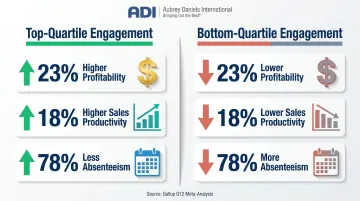
- Top-quartile engagement teams outperform bottom-quartile teams by 23% in profitability, 18% in sales productivity, and experience 78% less absenteeism
- Without structured PM, organizations drift into reactive management: inconsistent results, disengaged employees, and climbing turnover costs
- Maximum value comes from behavioral specificity, strong manager capability, and running PM as a continuous system rather than a calendar event
- ADI has delivered behavior-based performance management across 400+ companies for over 45 years, producing sustainable culture change and measurable bottom-line gains
What Is Performance Management?
Performance management is the ongoing process of setting clear behavioral and outcome expectations, providing timely feedback and reinforcement, and adjusting conditions so employees consistently deliver what the organization needs. It is a behavioral management framework — not an annual review, not a rating system — designed to make exceptional performance the norm rather than the exception.
The term "Performance Management" was coined by Dr. Aubrey Daniels, founder of Aubrey Daniels International (ADI), to describe a science-based approach to motivating people. Unlike intuition-driven or policy-driven management, this approach is grounded in Applied Behavior Analysis — the study of how consequences shape behavior. Dr. Daniels introduced the phrase to describe how organizations can motivate employees to enthusiastically deliver results, not merely comply with minimum standards.
Properly applied, performance management shapes organizational behavior by managing the conditions that produce it. That means building:
- Reinforcement structures that reward the right behaviors consistently
- Feedback loops that give employees real-time clarity on their progress
- Environmental conditions that remove obstacles to high performance
The goal isn't to measure what happened last quarter. It's to make high performance inevitable going forward.
Key Advantages of Performance Management
The advantages below are grounded in nearly a century of behavioral science research — and they show up as operational and strategic outcomes organizations can track, measure, and build on. Applied consistently, they compound over time.
Strategic Alignment That Unlocks Discretionary Effort
One of performance management's most critical functions is bridging the gap between organizational strategy and individual daily behavior. Strategy documents don't drive results—people do. Performance management translates abstract goals into tangible, actionable behaviors at every level of the organization.
How PM creates alignment in practice:
- Leaders define the behaviors and outcomes that move organizational priorities forward
- Managers reinforce those behaviors in real time through observation and feedback
- Employees understand exactly how their work connects to results, creating meaning and focus
Why this is an advantage:
Most employees meet minimum performance expectations regardless of management quality. The difference between adequate and exceptional performance lies in discretionary effort—the extra engagement people choose to give when they feel connected to the work and recognized for their contributions. Performance management is the mechanism that reliably unlocks this.
Teams in the top quartile of engagement show 23% higher profitability than bottom-quartile teams, along with 18% higher sales productivity and 78% less absenteeism, according to Gallup's Q12 Meta-Analysis covering over 183,000 business units. When everyone's behavior is aligned to the same priorities, decision-making improves, resources are used more effectively, and strategic initiatives actually get executed.
The challenge is real: only 46% of employees strongly agree they know what is expected of them at work, down 10 percentage points from March 2020. Even high-performing companies fail to deliver approximately 30% of the potential of their strategy, according to McKinsey. That gap is behavioral, not strategic.
KPIs impacted:
- Goal attainment rates
- Employee productivity per role
- Strategic initiative completion rates
- Manager-to-team alignment scores
When this advantage matters most:
Strategic alignment through PM is especially critical during periods of growth, change, or transformation—when there is the highest risk of individual effort drifting away from organizational priorities.
A Reinforcement-Based Feedback Loop That Sustains Engagement
Performance management's second major advantage is the creation of a feedback and reinforcement system that keeps employees motivated, not just informed. There is a critical distinction: feedback tells people what happened; positive reinforcement changes and sustains behavior.
When managers identify the specific behaviors that drive results and consistently reinforce them in the moment, employees experience a direct connection between their actions and meaningful recognition. Timely, specific reinforcement tied to observable behaviors is what drives sustained engagement.
Why this is an advantage:
Most organizations rely on corrective feedback or infrequent annual reviews. Behavioral science shows these approaches are far less effective at sustaining behavior change than timely positive reinforcement. Employees receiving daily manager feedback are 3.6 times more likely to be motivated to do outstanding work compared to those receiving only annual feedback. Yet 49% of companies still use annual or semiannual review cycles, while 94% of employees prefer real-time feedback.
The cost of neglecting this is substantial. Only 26% of employees strongly agree they received recognition or praise for good work in the past seven days, and employees who don't feel adequately recognized are twice as likely to say they'll quit within the year.
That turnover is largely preventable. 52% of voluntarily exiting employees say their manager or organization could have prevented their departure, and 51% had zero conversations about their satisfaction or future in the three months before leaving — a gap that better reinforcement practices directly close.
ADI's core principle reflects this: when organizations understand what genuinely reinforces their people—not just generic recognition—they can build feedback systems that create cultures where people want to perform at their best.
KPIs impacted:
- Employee engagement scores
- Voluntary turnover rate
- Manager effectiveness ratings
- Frequency of performance conversations
- Discretionary effort indicators
When this advantage matters most:
Reinforcement-based feedback is most impactful in roles with high variability in output quality (e.g., sales, customer service, operations) and in organizations navigating culture transformation or engagement challenges.
Measurable and Sustainable Performance Improvement at Scale
Unlike one-time training events or annual goal-setting exercises, a well-designed performance management system creates lasting behavior change. It does this by targeting the conditions that produce behavior, not just the behaviors themselves.
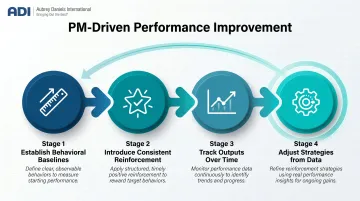
How PM generates measurable improvement:
- Establish behavioral baselines so you know where performance starts
- Introduce consistent reinforcement tied to specific, observable actions
- Track outputs over time to identify trends and patterns
- Adjust strategies based on what data reveals, moving from reactive problem-solving to proactive performance optimization
Why this is an advantage:
Sustainability is where most PM initiatives fail. Organizations that build systems around behavioral science principles — rather than periodic HR processes — maintain improvements because reinforcement becomes part of how managers lead every day, not just at review time.
Employees who feel their work is managed through meaningful feedback are 80% engaged, compared to baseline engagement levels that have fallen to just 20% globally in 2025. That disengagement gap costs the world economy an estimated $10 trillion in lost productivity, or 9% of global GDP.
PM-generated performance data also enables smarter succession decisions, reduces reliance on subjective impressions, and builds internal leadership capability at lower cost than external hiring. Yet only 6% of organizations report their PM evaluations accurately predict potential, and just 19% of managers objectively rate potential.
KPIs impacted:
- Year-over-year performance trend data
- Internal promotion rates
- Training ROI
- Error rates
- Operational throughput
- Leadership pipeline strength
When this advantage matters most:
This advantage is most visible at scale—in large organizations or those with geographically distributed teams—where behavioral consistency across managers is hardest to maintain without a systematic PM framework. This is where ADI's consulting and certification programs have delivered measurable impact for organizations across industries, including healthcare, manufacturing, financial services, energy, and utilities.
What Happens When Performance Management Is Missing or Ignored
Without a consistent performance management (PM) system, managers rely on intuition, episodic reviews, and reactive correction. This produces inconsistent results across teams even when individuals are capable. The absence of structured performance management doesn't create a neutral environment—it creates a deteriorating one.
The compounding consequences organizations experience:
- Employees work hard on the wrong priorities — no system connects daily behavior to strategic goals, and leaders assume clarity exists when it doesn't. Only 46% of employees know what is expected of them at work.
- Without reinforcement, motivation erodes quietly. Turnover rises, discretionary effort disappears. Manager engagement has dropped to 22% in 2025 — down 9 points since 2022 — and disengaged managers pull their teams down with them.
- Problems surface only when they're large enough to demand attention. Organizations spend resources correcting issues that timely feedback and coaching would have prevented.
- As organizations grow, performance variability increases without a shared language for what "good" looks like behaviorally. What works in one team doesn't transfer to another.
The financial impact is measurable. According to Gallup research, disengagement and attrition cost a median S&P 500 company between $228 million and $355 million per year in lost productivity. Bottom-quartile engagement teams experience 78% more absenteeism, 63% more safety incidents, 32% more quality defects, and up to 51% higher turnover than top-quartile teams.
How to Get the Most Value from Performance Management
Performance management delivers its greatest value when treated as an ongoing system of behavioral management—not a once-a-year HR exercise. The most successful implementations are those where performance conversations happen regularly, reinforcement is timely and specific, and data is used to continuously adjust.
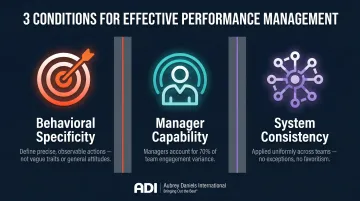
Three conditions determine whether PM actually works:
- Behavioral specificity: Define precise behaviors, not vague competencies. Instead of "be customer-focused," specify what that looks like: responding to inquiries within two hours, using the customer's name during the conversation, following up within 24 hours. This is what separates PM grounded in behavioral science from generic goal-setting.
- Manager capability: Equip managers to identify what reinforces each individual, deliver feedback in the moment, and use data for coaching decisions rather than relying on annual impressions. Managers alone account for 70% of the variance in team-level engagement. Without capable managers, even the best PM system fails.
- System consistency: Apply PM consistently across teams and levels—not just in high-visibility roles. Consistency creates predictability, fairness, and credibility. Selective implementation undermines all three.
ADI's workshops, consulting, and certification programs help organizations build this capability internally. With over 45 years of applied behavioral science experience across healthcare, manufacturing, financial services, and energy, ADI has helped hundreds of organizations develop PM expertise that holds up well beyond the initial rollout.
Conclusion
Performance management's power lies not in the process itself but in what it produces: behavioral alignment, sustained engagement, and measurable performance improvement that compounds over time when applied consistently.
Organizations that treat PM as a strategic system—grounded in an understanding of what actually reinforces human behavior—gain advantages that are difficult for competitors to replicate. The results show up in concrete ways:
- A workforce that consistently gives discretionary effort
- A leadership pipeline built on objective performance data
- Reduced turnover as people find meaning and recognition in their work
- A culture where continuous improvement is the norm, not the exception
Applied behavior analysis has decades of research behind it — and the organizations that put it to work as an ongoing practice, not a calendar event, are the ones that build performance cultures their competitors can't easily copy. That's the real return on a well-run PM system.
Frequently Asked Questions
What is the difference between performance management and organizational development?
Performance management focuses on aligning and improving individual and team behavior and outcomes on an ongoing basis, while organizational development is a broader discipline concerned with planned, systemic change across an organization's structures, culture, and processes. Effective PM directly supports and advances OD goals.
Is performance management part of organizational development?
Yes, performance management is considered a core component within the broader scope of organizational development. It provides the behavioral infrastructure through which OD initiatives are implemented and sustained at the individual and team level.
What falls under organizational development?
OD encompasses culture change, leadership development, change management, team effectiveness, process improvement, and performance management—all aimed at improving an organization's overall health and capacity to achieve its goals.
What are the 4 types of organizational development interventions?
The four main categories are:
- Human process interventions — such as team building and coaching
- Technostructural interventions — such as job redesign and restructuring
- Human resource management interventions — such as performance management and rewards systems
- Strategic interventions — such as culture change and mergers
What are the 3 P's of organizational performance?
The 3 P's refer to People, Process, and Performance. Sustainable organizational results depend on having the right people equipped with effective processes, operating within a system that measures and reinforces strong performance.