Introduction
Manufacturing leaders invest millions in KPI dashboards, lean programs, and process upgrades—yet performance improvements either fade within months or never reach their potential. Despite sophisticated tracking systems and ambitious targets, many organizations find themselves running in place, repeatedly launching initiatives that fail to stick.
The missing variable is human behavior. Every output metric — OEE, yield, throughput — is downstream of what people actually do on the shop floor. Managing performance effectively means shaping those behaviors with science, not just measuring their aftermath.
This guide covers the critical KPIs that matter most, proven best practices for sustainable improvement, and why a behavioral science approach produces results that outlast the next quarterly review.
TLDR:
- Manufacturing performance management links operational metrics to workforce behavior to drive efficiency, quality, and safety
- Most approaches fail by reacting to lagging indicators rather than shaping the behaviors that produce results
- The 5 essential KPIs are OEE, First Pass Yield, Throughput, Production Downtime, and On-Time Delivery
- Best practices include behavior-linked goals, frequent feedback, reinforced training, and deliberate recognition
- Behavioral science sustains performance by targeting the consequences that drive discretionary effort
What Is Manufacturing Performance Management?
Manufacturing performance management is the ongoing process of setting goals, monitoring KPIs, providing feedback, and improving both operational workflows and employee behavior to achieve efficiency, quality, and safety targets.
Two distinct layers must be addressed together:
- Operational performance — machines, processes, and output metrics
- Workforce performance — how employees behave, make decisions, and respond to their environment
Organizations that focus exclusively on operational metrics miss the human behaviors that determine whether equipment runs optimally, quality standards are met, and safety protocols are followed consistently.
Dr. Aubrey Daniels founded ADI on this principle and introduced the term "performance management" to describe how organizations can get employees to enthusiastically do what the business needs. Grounded in behavior analysis, the approach recognizes that sustainable improvement depends on understanding what motivates people to repeat the behaviors that matter.
Why Most Manufacturing Performance Management Approaches Fall Short
The most common failure mode is reactive management: organizations focus on lagging indicators like defect rates, output numbers, and downtime reports, then scramble to respond after the fact. This approach never addresses the upstream behaviors that produce those outcomes in the first place.
The result is a measurement trap: leaders track dozens of KPIs but never connect that data to specific, observable employee behaviors and the consequences that reinforce or discourage them. Metrics become information-rich but action-poor.
A plant manager knows scrap rates increased 8% last month but can't identify which behaviors need to change — or how to motivate those changes.
The Timing Gap
In manufacturing, annual or quarterly reviews arrive too late to catch problems in time. Research shows that frequent, specific feedback materially reduces errors compared to infrequent or global feedback. A peer-reviewed study found that while both frequency and specificity improve quality, infrequent feedback must be highly specific to be effective—but frequent feedback narrows the gap between specific and global approaches.
That feedback gap doesn't just affect quality — it drives people out the door. 42% of employee turnover is preventable, according to leavers themselves. Yet 45% said no leader or manager discussed their satisfaction, performance, or future in the three months before they left. The absence of routine manager-employee conversations is itself a symptom of lagging, reactive management rather than upstream behavioral coaching.
When feedback loops stretch to weeks or months, employees lose the connection between their actions and outcomes. By the time they hear about a problem, the moment to adjust has long passed.
Key KPIs That Drive Manufacturing Performance Management
Foundational Operational KPIs
Track these core metrics to identify performance gaps:
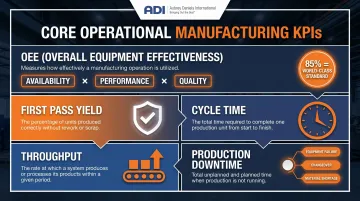
OEE (Overall Equipment Effectiveness) = Availability × Performance × Quality. World-class OEE is 85% for discrete manufacturing, though typical observed values hover around 60%. Breaking OEE into its three factors makes it easier to act on specific loss drivers rather than a single aggregate number.
- First Pass Yield (FPY) — the percentage of units produced without rework or scrap — is a direct signal of how well quality is built into the process, not inspected after the fact.
Cycle Time tracks how long it takes to complete one unit or process step, revealing bottlenecks before they compound.
Throughput measures total units produced over a set period, linking capacity utilization directly to revenue potential.
Production Downtime quantifies unplanned stoppages. Separating equipment failures, changeovers, and material shortages helps teams prioritize the right fix.
Workforce Performance KPIs
These metrics directly reflect employee behavior and team effectiveness:
Labor Productivity (units produced per labor hour) shows how effectively your workforce converts time into output.
Turnover Rate is more than an HR metric — replacement costs range from 40% of salary for frontline roles to 200% for managers, making retention a bottom-line concern.
Overtime Rate can signal understaffing, process inefficiency, or poor workload distribution — often all three at once.
On-Time Delivery ties together scheduling, production, and supply chain. When it slips, the root cause is rarely just one function.
Selecting Actionable, Behavior-Linked KPIs
A good manufacturing KPI should tell leaders which behaviors to reinforce or change — not just which number is red. Daily process walks that set shift goals and provided direct feedback improved productivity at Revere Copper by linking specific employee actions to measurable results.
Most manufacturing leaders track too many metrics at once. Lean daily management points to 5-7 KPIs on daily boards as the sweet spot for focus and follow-through. When selecting KPIs, consider three filters:
- Does this metric connect to a specific, observable behavior your team can influence?
- Does it align with a current strategic priority — safety, quality, throughput, or cost?
- Can frontline supervisors act on it without waiting for an executive decision?
If the answer to any of these is no, the metric probably belongs in a monthly report — not on a daily management board.
Best Practices for Manufacturing Performance Management
Set Clear, Measurable, and Behavior-Linked Goals
Effective manufacturing goals combine numeric targets with the employee behaviors that achieve them. Pairing "reduce defects by 10%" with "complete pre-shift equipment checks every shift" gives workers something concrete to act on — not just a number to chase.
Use SMART criteria but add the behavioral layer: goals should describe what people will do differently, not just what numbers should change.
Example: Instead of "Increase OEE to 80%," try "Operators will complete the 8-point startup checklist before each shift and log equipment anomalies within 15 minutes of detection, targeting 95% compliance by month-end."
Participation in goal setting increases proactive behavior through perceived insider status. When employees help define the behaviors and metrics, they take greater ownership of results.
Provide Frequent, Specific, and Timely Feedback
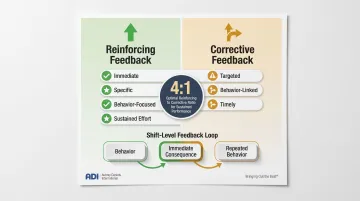
The timing of feedback is critical in manufacturing: a worker who receives feedback days after an incident or output shortfall has little opportunity to connect the feedback to their behavior. Shift-level feedback loops (brief huddles, real-time scorecards, on-the-spot recognition) consistently outperform weekly or monthly reviews for behavior change.
Corrective vs. reinforcing feedback: Corrective feedback points out what went wrong; reinforcing feedback acknowledges what was done right. Positive reinforcement is significantly more effective than correction at sustaining high performance. ADI recommends at least a 4:1 positive-to-corrective ratio to shape and sustain desired behaviors.
In a manufacturing case study, daily process walks with shift goals and immediate feedback improved productivity by closing the gap between behavior and consequence. Employees knew within hours — not weeks — whether their actions moved the needle.
Weekly meaningful manager conversations are associated with 4× higher likelihood of high engagement, creating a foundation for continuous performance improvement.
Prioritize Continuous Training and Skill Development
Manufacturing's rapidly evolving technology landscape — automation, IoT, predictive maintenance — creates constant skill gaps. 1.9 million manufacturing jobs could remain unfilled by 2033, with 65% of National Association of Manufacturers survey respondents citing attracting and retaining talent as their top challenge. Demand for simulation and software skills has increased 75%.
Ongoing training should be tied to performance goals, not treated as a one-time event. The concept of "everboarding" — continuous, in-flow-of-work learning focused on retention and ongoing upskilling — offers a more effective model than traditional onboarding alone.
Training effectiveness depends on reinforcement. Skills learned in a classroom erode quickly unless employees are positively reinforced for applying them on the job — positive consequences are what convert training into lasting behavior change.
94% of employees would stay longer if employers invested more in learning and development, and 80% rank development as a high priority when job hunting.
Recognize and Reinforce High Performance Deliberately
Recognition in manufacturing is often inconsistent or tied only to major milestones. Effective performance management requires managers to actively catch employees doing things right and deliver meaningful, specific, and timely positive reinforcement. That consistency is what sustains discretionary effort and separates teams that do the minimum from those that do their best.
74% of manufacturing employees report high burnout, according to O.C. Tanner's manufacturing-specific data. Integrated recognition is associated with large multiples in engagement and belonging, and higher intent to stay 2+ years.
Key principles:
- Make recognition immediate (within the shift, not the month)
- Be specific about the behavior, not just the outcome ("I noticed you double-checked the torque specs before moving to the next unit — that attention to detail prevents costly rework")
- Deliver it personally and publicly when appropriate
- Connect the behavior to business impact
When people experience positive consequences for their effort, high performance gets noticed, valued, and repeated — no plaque required.
How Behavioral Science Transforms Manufacturing Performance
All manufacturing performance—whether it's OEE, safety compliance, or product quality—is ultimately produced by human behavior. The science of Applied Behavior Analysis (ABA) offers manufacturing leaders a research-backed framework for understanding why employees behave as they do and how to reliably change behavior in sustainable ways.
The ABC Model in Manufacturing
The ABC model (Antecedents → Behavior → Consequences) explains performance in manufacturing contexts:
- Antecedents (job instructions, supervisor prompts, standard work procedures) set the stage for behavior—they tell people what to do.
- Behavior is what employees actually do on the floor.
- Consequences (what happens to employees after they perform) determine whether a behavior will be repeated.
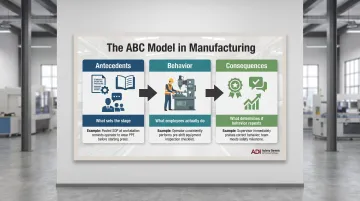
Most performance management programs invest heavily in antecedents—better training, clearer SOPs, upgraded equipment—and ignore consequences. But antecedents alone don't sustain behavior. If an operator follows a new procedure but receives no acknowledgment, faces extra hassle, or sees no difference in outcomes, that behavior will fade.
Peer-reviewed research in manufacturing settings demonstrates that structured antecedents combined with deliberate consequences around defined behaviors improve production quality and throughput.
Discretionary Effort: The Performance Multiplier
Consequences also determine how much effort employees voluntarily bring to their work. The difference between the minimum acceptable performance and the best an employee can deliver is discretionary—employees give it willingly only when the work environment reinforces it. Gallup defines engaged employees as those who consistently bring discretionary effort, driving innovation and performance.
Manufacturing leaders who understand positive reinforcement can unlock this discretionary effort. When employees experience meaningful, positive consequences for going beyond the minimum—whether through recognition, autonomy, problem-solving opportunities, or tangible rewards—they repeat those behaviors.
Why Punishment-Based Management Fails
Negative reinforcement and punishment-based management (fear of discipline, pressure-based supervision) produce short-term compliance but undermine engagement, increase turnover, and erode safety culture in manufacturing environments. Meta-analysis links fear-based management to lower task performance and measurable declines across multiple performance facets.
In safety specifically, punitive cultures suppress incident reporting and organizational learning—employees hide mistakes rather than surfacing them. When employees know that speaking up, flagging hazards, and suggesting improvements will be acknowledged and acted upon, they actively contribute to performance gains.
ADI's Behavioral Approach to Manufacturing
Aubrey Daniels International has spent over 45 years applying behavioral science to performance improvement in manufacturing and other industries. Their behavior-based Performance Management approach—including consulting, certification programs like Applications of Behavioral Leadership, and workshops—is designed to help manufacturing leaders build environments where high performance is reinforced, not demanded.
When you systematically pinpoint critical behaviors, measure them, and deliver positive consequences, the results show up in output quality, throughput, and safety incident rates. To learn how ADI's consulting and training services can support your operation, visit aubreydaniels.com.
Frequently Asked Questions
What are the 5 key performance indicators for manufacturing?
The five most widely tracked manufacturing KPIs are OEE (Availability × Performance × Quality), First Pass Yield, Throughput, Production Downtime, and On-Time Delivery. Together, they cover equipment efficiency, quality, capacity, and delivery—giving operations leaders a complete picture of plant health.
What are the 7 performance metrics?
Seven commonly cited manufacturing metrics are Cycle Time, Capacity Utilization, Scrap Rate, Labor Productivity, Inventory Turns, Machine Downtime Rate, and Cost Per Unit. These span speed, quality, equipment reliability, and cost efficiency across the production floor.
What are the 5 C's of performance management?
The 5 C's are Clarity (clear expectations), Communication (open dialogue), Coaching (skill development and feedback), Consequences (reinforcement and accountability), and Continuous Improvement (ongoing process refinement). Each element builds on the last to create a sustainable performance culture.
What are the 4 pillars of PMS?
The four pillars are Goal-Setting (measurable objectives aligned to strategy), Monitoring and Measurement (tracking KPIs and behaviors), Feedback and Coaching (timely, actionable input), and Recognition and Rewards (positive consequences for desired performance).
What are the 4 P's of performance?
The 4 P's—Purpose (why the work matters), People (who performs and leads), Process (how work flows), and Progress (measuring advancement toward goals)—offer a holistic view of manufacturing performance from strategy down to daily execution.