This is the core tension manufacturing leaders face: operational excellence demands are rising while the human system that delivers results is breaking down. Only 20% of employees globally were engaged in 2025, costing the global economy approximately $10 trillion in lost productivity. In manufacturing, top-quartile engaged teams show 14% higher production productivity compared to bottom-quartile teams—proving that engagement isn't soft HR talk, it's an operational metric.
Engineering culture transformation is not a communications campaign or a new values poster. It is a deliberate, sustained shift in the behaviors people exhibit every day, at every level of the organization. This article covers why manufacturing culture change is harder than most leaders expect, what behavioral science reveals about how culture actually works, and what leaders must do differently to make change stick.
Key Takeaways
- Manufacturing culture is built from daily behaviors; real transformation means changing what people do, not just what they think
- Structural barriers drive most resistance: command-and-control legacies, rigid hierarchies, and undertrained leaders
- Sustainable change requires positive reinforcement, not compliance pressure
- Leaders must be visible sponsors of change, modeling the behaviors they want to see
- Lasting culture change takes 18–36 months and requires consistent reinforcement throughout
Why Manufacturing Culture Transformation Is Uniquely Hard
The Command-and-Control Legacy
Most manufacturing environments were built around rigid compliance models where supervisors enforce procedures and operators follow instructions. While this model delivered consistency in an earlier era, it fundamentally suppresses the engagement, problem-solving, and initiative that modern manufacturing demands.
The data is stark. Gallup's research shows that when employees are not engaged, productivity drops measurably—with bottom-quartile teams producing 14% less than top-quartile engaged teams. Worse, disengaged employees contribute to 64% more safety incidents and 41% more quality defects.
Command-and-control cultures rely on negative reinforcement: employees do just enough to avoid punishment. The result is minimum performance. High-performing plants run on discretionary effort — the initiative and ownership that no compliance mandate can generate.
The Occupational Hierarchy Problem
In many engineering and manufacturing organizations, a cultural divide separates engineers (who design and analyze) from technicians and operators (who build, maintain, and run systems). This hierarchy suppresses bottom-up knowledge, alienates skilled technical workers, and contributes to persistent difficulty filling high-skill applied roles.
A 2024 Deloitte study found that over 50% of the manufacturing workforce believes technology availability is important for attracting talent, while only 31% of executives agreed to prioritize it—a perception gap that reflects structural disconnects between operational and leadership perspectives.
That gap is structural — built into how expertise has been valued for decades — and it keeps critical operational knowledge from reaching the people making decisions about operations.
The Generational Talent Squeeze
Approximately 25% of the U.S. manufacturing workforce is over age 55, up from 10% in 1995. These experienced workers are retiring with irreplaceable institutional knowledge that was never formally captured. Meanwhile, incoming digital-native employees arrive with expectations of transparency, accessible information, and visible career development.
Deloitte projects 3.8 million net new employees will be needed in manufacturing between 2024 and 2033, with 1.9 million likely to remain unfilled. This demographic shift creates urgency for culture change—but also a window of resistance if the transition is poorly managed.
Filling open positions is only part of the problem. The harder task is transferring decades of tacit knowledge to a new generation with different learning styles, communication norms, and career expectations.
The Engineering-Business Communication Gap
That demographic urgency rarely translates into executive action on its own. Engineering leaders driving change face a second obstacle: translating the value of process improvements, technology upgrades, or cultural investments into the business language executives respond to. Without that bridge, culture change initiatives get deprioritized.
McKinsey found that over 70% of manufacturers remain stuck in "pilot purgatory," unable to scale digital innovations beyond initial trials. A key factor: failure to align operational technology teams with business leadership on value articulation and scaling strategies.
When technical leaders can't show how behavioral or process changes impact the bottom line, transformation efforts lose executive sponsorship—and without sponsorship, they fail.
The Leadership Skillset Gap
Engineers and technical managers are typically promoted for technical mastery, not for the political, relational, and motivational skills that culture change requires. This creates a specific vulnerability: leaders who can diagnose technical problems brilliantly but struggle to cast a vision, persuade skeptics, or build the coalition needed to shift entrenched behaviors.
Culture transformation requires different competencies than technical problem-solving. It requires:
- Building trust across organizational levels
- Coaching frontline supervisors to reinforce new behaviors
- Managing resistance without resorting to mandates
- Communicating value in business terms executives understand
- Sustaining effort through setbacks and slow progress
Engineering programs rarely teach these skills. Technical promotion criteria rarely reward them. Yet in practice, they determine whether a transformation succeeds or stalls.
Culture Is Behavior: The Science Behind Lasting Manufacturing Culture Change
Culture Is What People Do, Not What They Believe
Organizational culture is not an abstract concept. It is the aggregate of behaviors that people repeat consistently over time because those behaviors are being reinforced. Changing culture means identifying which behaviors define the desired state, analyzing what reinforces existing (often undesirable) behaviors, and deliberately changing the consequence structure.
Most culture change efforts fail because they treat culture as a mindset problem. Leaders launch communications campaigns, hold town halls, and post new values on break room walls. But these are antecedents—they can prompt behavior, but they cannot sustain it.
Only consequences determine whether behavior is repeated.
The ABC Model: Antecedent-Behavior-Consequence
The ABC model provides a practical lens for diagnosing culture:
- Antecedents (policies, training, instructions) can prompt behavior but cannot sustain it
- Behavior is the observable action people take
- Consequences (what happens immediately after the behavior) determine whether the behavior is repeated
Most culture change efforts invest heavily in antecedents—new policies, training programs, kickoff events—and almost nothing in consequences. This is why they fail to produce lasting change.
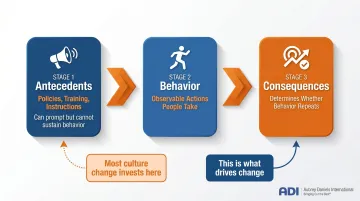
For example, a plant manager announces that safety is the top priority (antecedent). But if supervisors are praised for meeting production targets while safety protocols are quietly bypassed, the real consequence structure rewards speed over safety. The culture will reflect what gets reinforced, not what gets announced.
Compliance vs. Positive Reinforcement
In command-and-control environments, behavior is managed primarily through negative reinforcement (avoiding punishment) or rules-based compliance. This can produce minimum performance, but it does not produce discretionary effort—the extra initiative, problem-solving, and ownership that high-performing cultures require.
Positive reinforcement, when applied systematically and specifically, is the mechanism that drives employees to go beyond the minimum. Research by Aubrey Daniels International, grounded in over 45 years of applied behavioral science, shows that negative reinforcement yields only minimum compliance, while positive reinforcement is the only mechanism to access discretionary effort above baseline performance.
In manufacturing, discretionary effort is the gap between what employees must do to keep their jobs and what they are capable of doing when fully engaged. Closing that gap is the difference between mediocre and exceptional performance.
Behavior-Based Performance Management
ADI's behavior-based Performance Management approach gives manufacturing leaders a scientific method for diagnosing and reshaping their consequence environment. Unlike change management programs that treat culture as a communications or training problem, it focuses on what actually happens day-to-day when someone raises a safety concern, proposes an improvement, or takes initiative to solve a problem.
Practically, this means analyzing three things:
- Which behaviors drive the results you want
- What is currently reinforcing the behaviors you see (desired or not)
- How to redesign consequences to accelerate the culture you're building
The payoff is measurable. Gallup's research across 112,312 business units found that top-quartile engaged teams experienced 23% higher profitability, 41% fewer quality defects, and 64% fewer safety incidents—proof that discretionary effort delivers real operational outcomes, not just improved morale.
What Manufacturing Leaders Must Do Differently to Lead Culture Change
Become Visible Behavior Models
Employees do not follow announcements—they follow observable behavior. If a plant manager says safety culture is the priority but walks past a hazard without responding, the real culture message is clear.
Leaders must identify the specific behaviors they want to see more of and demonstrate those behaviors consistently and visibly, especially under pressure. That consistency is how new norms become credible — not through memos, but through repeated, visible action.
Prosci's research since 1998 identifies sponsorship as the #1 contributor to change success, with effective sponsors increasing success probability from 25% to 85%. Active, visible leadership sponsorship is not optional—it is the difference between success and failure.
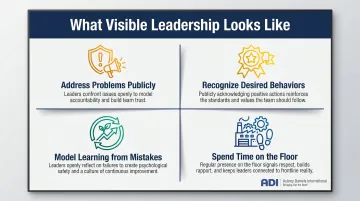
Visible modeling means:
- Leaders stop walking past problems they've asked others to address
- Leaders publicly recognize employees who demonstrate desired behaviors
- Leaders admit mistakes and model the learning behaviors they want to see
- Leaders spend time on the floor, not just in conference rooms
Replace "Change as a Project" Thinking with "Change as Leadership Work"
Many manufacturing leaders treat culture transformation as a special initiative that runs alongside their real job. This framing undermines the effort before it begins.
Culture change is leadership. It requires active coaching, regular behavioral feedback, and daily reinforcement decisions. McKinsey found that transformations are 5.3x more likely to succeed when senior leaders consistently model desired changes.
Treating transformation as a project implies it has a start and end date. It doesn't. Culture is maintained through daily leadership behavior, or it erodes.
Build Psychological Safety Across Hierarchies
In hierarchical manufacturing environments, critical operational knowledge is often suppressed because operators and technicians don't feel safe raising issues, challenging designs, or proposing improvements.
Research published in Manufacturing & Service Operations Management confirmed that psychological safety is a significant predictor of employee knowledge sharing in manufacturing settings. When employees fear blame or dismissal, they withhold information that could prevent failures.
Practical steps to build psychological safety include:
- Run structured daily team huddles that solicit frontline input and visibly act on it
- Provide anonymous feedback channels so concerns surface before they become failures
- Formally recognize improvements that originate on the shop floor
- Respond to problem reports in ways that reward raising issues, not punish them
When operators see their input drive real decisions, participation compounds — and so do the improvements.
Connect Behavior Change to Business Outcomes
Culture transformation gains traction when leaders can show the workforce that specific behavioral changes produce measurable results: shorter cycle times, fewer defects, declining safety incidents.
This requires translating culture goals into specific behavioral metrics that are tracked, reviewed, and celebrated at the team level, not just the plant level. For example:
- Track how often supervisors deliver specific positive feedback daily
- Measure how frequently operators raise process concerns
- Count improvement ideas submitted by cross-functional teams
These leading behavioral indicators predict whether culture is shifting. When they improve, lagging outcome metrics (productivity, quality, safety) follow.
A Practical Framework for Engineering Culture Transformation in Manufacturing
Assess Current Culture Behaviors, Not Just Attitudes
Effective culture assessment goes beyond engagement surveys. Leaders need to identify specifically which behaviors are currently rewarded (even unintentionally), which are punished or ignored, and what consequences are driving the culture as it exists today.
This behavioral audit—examining what actually happens, not what people say happens—is the starting point for credible transformation. Behavior-based safety research documents 20-50% safety improvements through behavioral observation processes, compared to traditional attitude surveys.
Questions to ask during assessment:
- What behaviors get recognized and rewarded?
- What behaviors get ignored or subtly discouraged?
- What happens when someone reports a problem?
- What happens when someone proposes an improvement?
- What behaviors do supervisors demonstrate under pressure?
The answers reveal the real culture, not the aspirational one.
Define the Target Culture in Behavioral Terms
Leadership teams should translate culture aspirations ("we want a culture of continuous improvement") into concrete, observable behaviors that frontline supervisors and operators can understand and that managers can reinforce.
Vague values don't change behavior. Specific behavioral expectations, articulated at each level of the organization, do.
Consider what behavioral translation looks like in practice:
| Culture Aspiration | Behavioral Translation |
|---|---|
| "Continuous improvement culture" | Operators surface one process improvement weekly in team huddles; supervisors respond within 48 hours |
| "Safety-first culture" | Supervisors stop work immediately when hazards appear; hazard reporters get same-day acknowledgment |
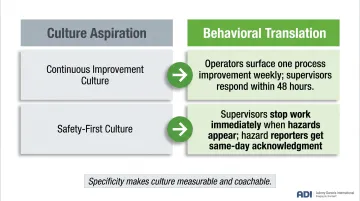
Behavioral specificity makes culture change measurable, coachable, and sustainable.
Sequence Change to Build Momentum, Not Overwhelm
Identify high-leverage behavioral targets early in the transformation: two or three specific behaviors that are visible, achievable, and tied to outcomes people care about.
McKinsey's research on behavior change emphasizes that early wins are critical to building belief. When people see real improvements that make their work easier, they start to believe broader change is possible.
Sequencing principles:
- Start small: Focus on 2-3 high-impact behaviors, not 20
- Make it visible: Choose behaviors others can observe and recognize
- Tie to outcomes people care about: Safety, quality, efficiency
- Build on success: Once early behaviors are established, layer in additional changes
Each early win does two things: it builds leadership credibility and rewires the consequence environment that kept the old culture in place. That combination is what makes subsequent changes stick.
Measuring and Sustaining Culture Change on the Factory Floor
Leading Behavioral Indicators vs. Lagging Outcome Metrics
Lagging metrics—safety incident rates, scrap rates, productivity—are important but tell you what already happened. Leading behavioral indicators—supervisors delivering specific positive feedback daily, operators raising process concerns without fear, cross-functional teams sharing improvement ideas—tell you whether the culture is actually shifting.
Process safety research from CCPS distinguishes between leading indicators (predictive metrics to evaluate trends and prevent incidents) and lagging indicators (post-incident measures). In culture transformation, the same principle applies.
Leading behavioral indicators provide early warning when reinforcement is drifting. Examples:
- Number of positive recognitions supervisors give per week
- Frequency of frontline-sourced improvement suggestions
- Response time when problems are reported
- Participation rates in team huddles or problem-solving sessions
Tracking these metrics gives leaders actionable data to sustain momentum.
Systematic Reinforcement Infrastructure
Most culture change efforts erode within 6-18 months because the reinforcement infrastructure was never built to maintain them. MIT Sloan Management Review reports that culture change initiatives may take 18 to 36 months depending on breadth and depth—but without active reinforcement, gains disappear.
Sustaining transformation requires deliberate reinforcement systems:
- Recognize specific cultural behaviors consistently, not just outcomes
- Build cultural behaviors into performance management so they carry real consequences
- Give frontline supervisors structured coaching routines to reinforce desired behaviors daily
ADI's Performance Management approach gives organizations a structured method for designing and sustaining these reinforcement systems. Gallup found that 70% of variance in team engagement is determined solely by the manager—making frontline supervisor capability the most impactful lever for culture change.
The Recalibration Imperative
Culture measurement is not a one-time post-implementation survey. Sustaining transformation in manufacturing requires periodic behavioral audits that identify where reinforcement is working, where old behaviors are returning, and where leadership attention is needed to prevent regression.
Research on behavioral drift identifies six processes that cause workers to drift from safe and productive behaviors:
- Habituation — repeated exposure dulls attention to established norms
- Extinction — behaviors that stop being reinforced gradually disappear
- Unprogrammed reinforcement — shortcuts get rewarded naturally (faster, easier), pulling people off standard behaviors
- Avoidance paradox — workers avoid reporting problems to sidestep negative consequences
- Rule-governed behavior decay — compliance with stated rules erodes without consistent follow-through
- Competing contingencies — production pressures routinely win out over safety or quality behaviors
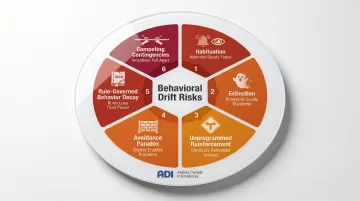
Each mechanism is addressable. Leaders who monitor these signals and recalibrate reinforcement systems accordingly are the ones who sustain culture change past the 18-month mark—when most efforts have already begun to unravel.
Frequently Asked Questions
What are the common 'C' and 'P' frameworks (e.g., 4 C's, 5 C's, 4 P's, 5 P's) for leading culture transformation in engineering and manufacturing?
Many frameworks use "C" or "P" mnemonics—Clarity, Commitment, Capability; or Purpose, People, Process—to organize culture transformation efforts. The most effective ones go beyond conceptual checklists to define the specific behavioral changes required at each organizational level, grounded in consequence analysis and reinforcement systems.
Why does culture transformation fail in manufacturing environments?
Most transformations fail by treating culture as a communications problem rather than a behavioral one—without visible leadership sponsorship or reinforcement systems to sustain new habits. McKinsey research confirms it: fewer than 30% succeed, and when frontline employees aren't engaged, that number drops to 3%.
How long does engineering culture transformation typically take?
Meaningful behavioral shifts typically begin to appear within 6-12 months of focused effort. However, embedding a new culture so that it persists through leadership changes and business disruptions generally takes 18-36 months of consistent reinforcement, according to research from MIT Sloan Management Review.
What role do frontline supervisors play in manufacturing culture change?
Frontline supervisors are the single most influential lever in manufacturing culture transformation. They control the daily consequence environment that either reinforces or undermines the desired culture, making their coaching and reinforcement behaviors a critical target of any transformation effort.
How do you measure progress in a manufacturing culture transformation?
Track both behavioral leading indicators—such as feedback frequency or improvement suggestions—and outcome lagging indicators like productivity, safety, and retention. Behavioral metrics provide earlier, more actionable data than outcome measures alone.
What is the difference between culture change and culture transformation in manufacturing?
Culture change refers to incremental adjustments in norms or practices. Culture transformation implies a more fundamental shift in the values and behavior patterns that define how work gets done—requiring stronger leadership commitment and a systematic approach to rebuilding the reinforcement environment that shapes daily behavior.
Engineering culture transformation in manufacturing is a behavioral science challenge with measurable business impact. The plants that succeed are led by people who understand that culture is behavior, behavior is shaped by consequences, and lasting change requires reinforcement systems that outlive any kickoff event.