Introduction
Organizations pour significant resources into safety systems, compliance programs, and training—yet incidents keep happening. The gap isn't usually a lack of procedures. It's that procedures don't reliably change behavior.
Safety initiatives can spark behavior, but they rarely sustain it. Most organizations already have the right tools and processes. The real problem is inconsistent application—and that's a culture problem, not a systems problem.
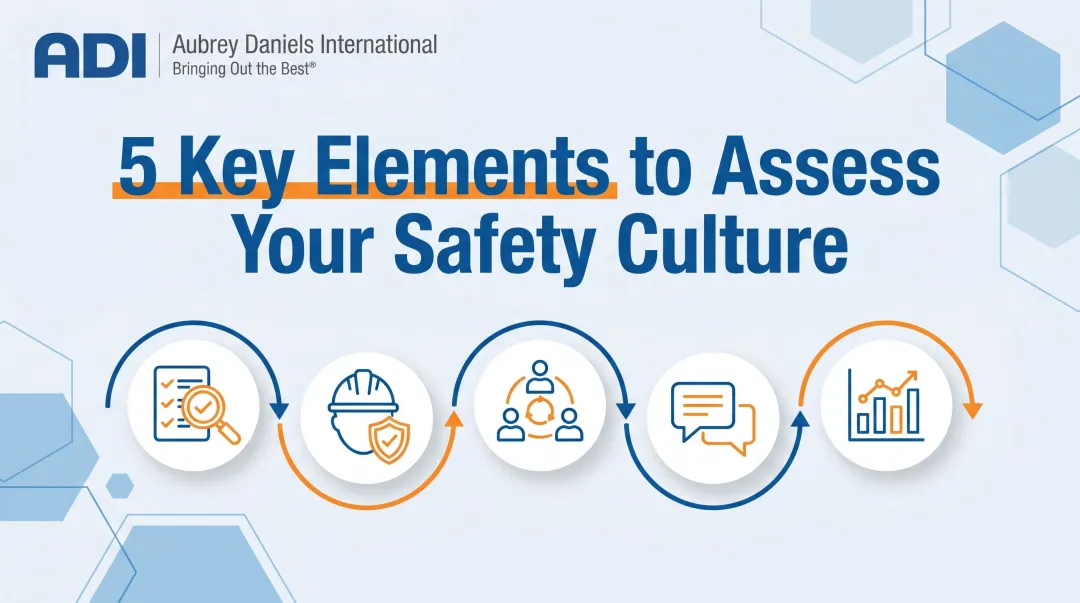
This post covers what organizational safety culture actually means and how the Hudson-Parker Safety Culture Ladder reveals where your organization stands. It also breaks down the four elements of a strong culture and why a behavioral science approach is what makes lasting change stick.
TLDR
- Safety culture is shaped by what people do when no one is watching—not by what procedures say
- The Hudson-Parker framework places organizations on a five-level scale, from Pathological to Generative
- Four elements drive strong safety culture: leadership, empowerment, accountability, and learning
- Behavior is shaped by consequences—compliance-only approaches rarely move the needle
- Lasting culture change requires reinforcement systems, not just more rules
What Is Organisational Safety Culture?
What Is Organizational Safety Culture?
The most widely cited definition comes from the ACSNI Study Group on Human Factors (1993): safety culture is "the product of individual and group values, attitudes, perceptions, competencies, and patterns of behaviour that determine the commitment to, and the style and proficiency of, an organisation's health and safety management."
James Reason built on this with his concept of an informed culture—one where managers and operators have current knowledge about human, technical, organizational, and environmental factors affecting safety.
ADI's own definition takes a more explicitly behavioral stance: safety culture is "repeated patterns of behavior—influenced by people, systems, processes, and the environment—that contribute to or detract from safety." These patterns are strengthened or weakened by people and systems over time.
Safety Culture vs. Safety Climate vs. Safety Programs
These three concepts get conflated regularly. The distinctions matter.
| Concept | What it is | Stability |
|---|---|---|
| Safety culture | Deep-rooted values and behavioral norms | Slow to change; years of sustained effort |
| Safety climate | A snapshot of how employees perceive safety right now | Shifts quickly with leadership changes or incidents |
| Safety programs | Formal systems, procedures, and tools | Tools that culture either uses well or ignores |
Research by Bergman et al. (2014) found climate assessments predicted severe incidents for roughly three months—a reminder that a single survey is not a durable measure of culture health.
Strong programs with weak culture rarely deliver lasting results. A strong culture makes even average systems effective, because people consistently follow through on what those systems ask of them.
The Safety Culture Maturity Framework: Five Levels of Organisational Development
The Safety Culture Maturity Framework: Five Levels of Organizational Development
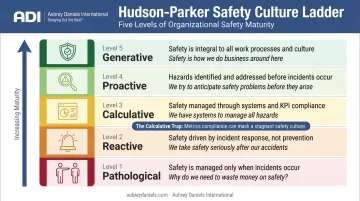
The Hudson-Parker Safety Culture Ladder—developed by Dianne Parker, Malcolm Lawrie, and Patrick Hudson and published in Safety Science in 2006—remains the most widely used framework for diagnosing where an organization sits on the journey toward safety excellence. Originally developed through Shell's Hearts and Minds program, it describes five distinct mindsets, each representing a fundamentally different relationship with safety.
The Five Levels
Level 1 – Pathological: Safety is a burden. Incidents get hidden. Blame is the default. Production and profit override everything else. The implicit message is "who cares, as long as we don't get caught."
Level 2 – Reactive: Safety gets attention after incidents—rules proliferate, investigations happen—but attention fades once things calm down. Compliance is the driver, not genuine care.
Level 3 – Calculative: This is where many organizations plateau. Systems, metrics, and audits are in place. Safety is managed through data. The risk here is the calculative trap: becoming absorbed in dashboards and KPIs while never genuinely caring about people. Hudson's own research notes that command-and-control management styles make this level particularly difficult to move beyond.
Level 4 – Proactive: Leadership actively seeks out problems before they cause harm. Employees feel empowered to raise concerns. Continuous improvement is real, not rhetorical.
Level 5 – Generative: Safety is integrated into every business decision. Collective responsibility is felt at every level. A state of "chronic unease" keeps the organization vigilant even when incident rates are low.
Common Assessment Pitfalls
The ladder is a practical framework—useful as both a diagnostic tool and a development roadmap. Understanding where you sit on it is only half the challenge; the other half is avoiding the patterns that distort your read. Organizations misuse it in predictable ways:
- Leaders talk the talk in assessments, then revert under production pressure — a pattern sometimes called cultural tourism
- Good audit scores can mask deep disengagement at the frontline — the façade effect
- Visible but trivial actions — hard hats for a five-minute site visit, for example — divert attention from real systemic risks (safety theater)
Maturity models are widely used but not validated as precise predictive instruments. Use the ladder to orient your thinking, not to assign a score and declare progress.
The 4 Key Elements of a Strong Safety Culture
These four elements don't function independently. Remove any one, and the others weaken. What holds them together is behavioral: what people actually do in each area depends on the consequences they experience.
1. Committed Leadership
Culture transformation begins with leaders whose visible behaviour—not just their stated priorities—signals that safety is non-negotiable. There's a meaningful difference between safety as a priority (which can shift when production pressure rises) and safety as a core value (which doesn't).
Committed safety leadership looks like:
- Regular floor presence, not just formal safety walks
- Meaningful conversations about safety conditions and concerns
- Following safety rules personally, without exception
- Responding positively when employees raise concerns
Research from Oah et al. (2018) found safety leadership correlated strongly with safety climate (r = 0.66). Leaders set the reinforcement environment that the entire workforce operates within.
2. Employee Empowerment and Psychological Safety
Workers must feel genuinely safe to stop work, report near-misses, and raise concerns without fear of retaliation. High near-miss reporting is a sign of a healthy culture—it means people trust the system enough to use it.
The data on what happens when that trust is absent is stark. The NSC SAFER survey (2023) found that psychologically unsafe workers were 80% more likely to report a medically attended or lost-time injury, and workers who believed reporting was discouraged were 2.4 times more likely to have experienced a work-related injury.
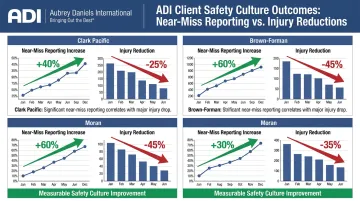
ADI client data reinforces this. Clark Pacific saw near-miss reporting increase by more than 500% alongside a 78% reduction in injuries. At Brown-Forman, near-miss reporting increased exponentially while injuries fell to zero over two years. Moran went from 2–3 near-miss reports per month to 150–180 per month. In each case, the spike in reporting preceded and accompanied the decline in incidents.
3. Accountability at Every Level
Effective accountability isn't punitive blame—it's a clear, consistent set of expectations applied equitably from the CEO to the frontline.
Inconsistency destroys trust. When some employees face consequences for a behavior while others doing the same thing don't, the message people receive isn't about safety. It's about favoritism and power.
ADI's approach reframes accountability as forward-looking: understanding the behavioral and environmental factors that led to an at-risk action, then changing those factors. James Reason's just culture framework similarly distinguishes acceptable error from unacceptable behavior, supporting reporting without punishing honest mistakes.
4. Learning and Continuous Improvement
High-performing safety cultures treat incidents and near-misses as learning inputs, not occasions for blame. This requires:
- Systematic investigation focused on root causes, not blame attribution
- Closed-loop processes that ensure lessons actually reach the people who need them
- A continuous improvement mindset that guards against complacency—especially at high maturity levels where long runs without incidents can breed overconfidence
ADI's near-miss analysis approach specifically examines both intended and unintended consequences for reporting, analyzes trends for targeted prevention, and defines new behaviors at each organizational level to maximise learning impact.
A Behavioural Science Approach to Building Safety Culture
Safety culture is, at its root, a behavioural phenomenon. Values and beliefs define culture in the abstract, but it's behaviour—what people actually do, especially when no one is watching—that determines safety outcomes. And behaviour is shaped by its consequences.
That principle sits at the foundation of ADI's work. With over 45 years applying Applied Behavior Analysis to organisational performance across 400+ companies globally, ADI's core argument is straightforward: organisations that understand how consequences drive behaviour can move beyond surface-level safety programmes and create conditions where safe behaviour is genuinely reinforced. Judy Agnew's co-authored book Safe By Accident? Take the Luck Out of Safety is a foundational resource for leaders wanting a practical grounding in this approach.
The ABC Model in Safety Contexts
The antecedent-behaviour-consequence (ABC) model explains why compliance-focused safety often fails:
- Antecedents (rules, training, signage, procedures) set the stage for behaviour
- Consequences—what happens after a behaviour—determine whether that behaviour recurs
In many workplaces, unsafe shortcuts are positively reinforced: the task gets done faster, no one notices, the peer group approves. Safe behaviour, meanwhile, often goes unreinforced entirely. ADI's PIC/NIC Analysis® identifies exactly this dynamic—examining whether consequences are Positive, Immediate, and Certain (what drives shortcuts) versus Negative, Immediate, and Certain (what compliance depends on).
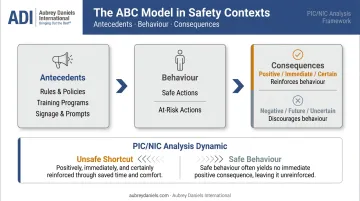
Rules and training alone rarely change culture for this reason. They're antecedents. They prompt behaviour. They don't sustain it.
The Role of Positive Reinforcement
Discretionary effort—employees going beyond the minimum to keep themselves and colleagues safe—cannot be mandated. It's generated through positive reinforcement, not fear of punishment.
Effective positive reinforcement of safety is:
- Timely: delivered close to the observed behaviour, not at the end of a quarter
- Specific: tied to what the person actually did, not a generic "good job"
- Sincere: genuine acknowledgement, not a checkbox exercise
- Behaviour-focused: recognising the safe action itself, not just the absence of incidents
ADI teaches leaders that reinforcing behaviour rather than celebrating results is a critical distinction. A facility with zero incidents this month may or may not have a culture worth reinforcing—what matters is whether the specific behaviours that prevent incidents are being consistently reinforced every day.
Moving Up the Maturity Ladder
Organisations stuck at the calculative level track metrics without changing the reinforcement contingencies that drive actual behaviour. The path forward requires identifying which specific safe behaviours characterise the target culture level, then engineering reinforcement systems that make those behaviours more likely.
ADI's safety culture engagement follows a systematic sequence:
- Survey and site assessment
- Placement on the safety culture continuum
- Behavioural roadmap development (defining critical behaviours at each organisational level)
- Customised leadership training
- Safety system optimisation
- Follow-up coaching
Coaching is the final and often most important step. It's where reinforcement systems get refined, embedded, and sustained over time.
Measuring and Sustaining Safety Culture Over Time
Leading vs. Lagging Indicators
Organizations that rely only on lagging indicators (injury rates, workers' compensation costs) are measuring culture's shadow. They see what already happened, not the behaviors driving future outcomes.
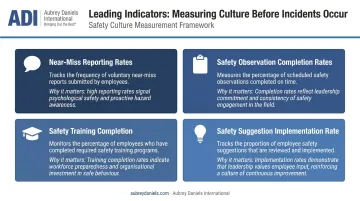
OSHA defines leading indicators as proactive, preventive, and predictive measures that provide information about program performance before incidents occur. Four worth tracking:
- Near-miss reporting rates — volume and trend over time, segmented by department and shift
- Safety observation completion rates — are planned observations actually happening?
- Safety training completion — tied to hazard control, not just attendance records
- Safety suggestion implementation rate — are concerns raised by workers being acted on?
The last one is often overlooked. If employees submit safety suggestions and nothing happens, the reinforcement message is clear: reporting is pointless. Closing the loop on suggestions is itself a cultural act.
Assessing Safety Culture Maturity
Rigorous assessment requires multiple data sources:
- Validated safety culture surveys with genuine anonymity to surface honest data (ADI's Safety Culture Survey has been deployed in 26 countries and 12 languages, covering proactive vs. reactive management, reporting conditions, consequence management, and personal responsibility)
- Behavioral observations to validate what surveys reveal
- Leadership interviews and focus groups to understand intent vs. impact
- Near-miss and incident data analysis for trend patterns
Don't rely on aggregate scores. Analyze results by department, shift, and seniority level. Organizations frequently have "split personality" cultures where one division operates at a proactive level while another is stuck in reactive mode. Aggregate data hides both the problem and the opportunity.
Sustaining Momentum
Measurement creates the baseline — but what you do with it determines whether gains hold. Culture improvement stalls when organizations treat it as a program with an end date. Sustainability requires:
- Regular pulse checks against the maturity model to catch drift early
- Fresh initiatives that prevent complacency, especially when incident rates are already low
- Embedding safety into performance reviews, hiring criteria, and onboarding—making it an organisational norm rather than a periodic campaign
- Genuine milestone recognition tied to specific behaviors, not just outcome metrics
ADI's Safety Pulse Checks—brief 6–8 question surveys deployed periodically—are designed for exactly this purpose: tracking whether the cultural gains from an initial intervention are holding.
Frequently Asked Questions
What is the framework of organisational culture?
Organizational culture frameworks describe the shared values, beliefs, and behavioral norms that govern how people act within an organization. In safety, frameworks like the Hudson-Parker Safety Culture Ladder identify distinct maturity levels from reactive (safety addressed only after incidents) to generative (safety integrated into all operations), giving leaders both a diagnostic tool and a development roadmap.
What are the 4 elements of safety culture?
The four core elements are committed leadership, employee psychological safety to report concerns, consistent accountability at all levels, and a learning orientation that treats incidents as improvement opportunities. Each element depends on the others — and all four require active reinforcement to function.
What is the difference between safety culture and safety climate?
Safety culture reflects the deep-rooted values and behavioral norms about safety that develop over years of consistent reinforcement. Safety climate is a snapshot of how employees perceive safety conditions at a given moment. Climate can shift rapidly with leadership changes or recent incidents; culture evolves slowly and requires sustained behavioral change to genuinely transform.
How long does it take to change an organisation's safety culture?
Meaningful transformation typically requires sustained effort over several years. Hearts and Minds implementation evidence suggests a highly developed culture can take up to a decade to achieve. Safety climate can shift more quickly with new leadership, but genuine cultural change requires consistent reinforcement of new behaviors until they become ingrained norms.
Why is compliance-focused safety not enough to build a strong safety culture?
Compliance creates antecedents (rules, procedures, signs) that cue safe behavior, but doesn't reinforce it once established. Employees who comply only to avoid punishment will revert when oversight is absent. A genuine safety culture requires positive reinforcement that makes safe behavior rewarding even when no one is watching.
How do you assess where your organisation sits on the safety culture maturity ladder?
Start with validated safety culture surveys that guarantee genuine anonymity, then supplement with behavioral observations, leadership interviews, and near-miss data analysis. Don't rely on aggregate scores — examine results by department, shift, and seniority level to surface internal gaps that organization-wide averages conceal.