Introduction
Fleet managers operate with a harsh reality: drivers are the critical reason in 94% of traffic crashes, and when crashes occur, the financial toll is staggering. U.S. traffic crashes cost employers $72.2 billion annually in medical care, liability, lost productivity, and property damage. Despite massive investment in monitoring technology—telematics, dash cams, AI safety systems—many organizations see brief compliance bumps but few lasting improvements in how drivers actually perform behind the wheel.
That monitoring gap comes down to a fundamental distinction: collecting data on driver behavior is not the same as changing it. A well-designed fleet safety program closes that gap by shaping how drivers think, decide, and act—not just when they know they're being watched.
This article examines how structured fleet safety programs produce lasting behavioral change, and why programs that measure without consequence rarely do.
TL;DR
- Behavior changes only when measurement is paired with timely feedback and real consequences
- Recognition of safe driving produces lasting behavior change than punishment-only systems
- Data-driven, individualized coaching addresses root causes rather than symptoms
- Without a behavioral foundation, programs produce short-term compliance—not sustained improvement
- The most effective programs treat behavior change as ongoing management practice, not one-time training
What Is a Fleet Safety Program?
A fleet safety program is a structured system of policies, training, monitoring tools, and response protocols designed to reduce risk by shaping how drivers behave behind the wheel. This isn't theoretical safety management—it's a practical framework for changing what drivers do when supervisors aren't watching.
Fleet safety programs operate across any organization that uses vehicles for work: delivery companies, field service teams, utilities, construction firms, and government agencies. While industries vary, the behavioral challenge remains constant—how to make safe driving the default choice for every driver, every trip.
That's what separates a well-designed program from a compliance checklist: it functions as a behavioral management system. The real measure of success is whether drivers make safer choices under pressure, when no one is watching, and when the easier option is the riskier one. Policies and documentation only matter when they create conditions that reinforce the right behaviors and discourage the wrong ones.
Key Advantages: How Fleet Safety Programs Improve Driver Behavior
The advantages below focus on measurable behavioral outcomes—what actually changes in how drivers perform—rather than abstract program features. Each advantage connects to outcomes fleet managers can observe, track, and validate through data.
Advantage 1: Measurement Creates Visibility Into Specific Behaviors That Can Be Changed
You cannot change behavior you cannot observe. Fleet safety programs introduce systematic measurement of specific driving actions—speeding events, hard braking, following distance violations, phone use, harsh acceleration—making these behaviors visible and manageable for the first time.
Telematics and monitoring tools shift the dynamic from reactive to proactive. Instead of responding to accidents after they occur, managers identify which specific behaviors create risk and address them before incidents happen. A driver who triggers following distance alerts on highway routes presents a different coaching opportunity than one who speeds in residential zones. Measurement makes that distinction possible.
Data removes ambiguity. Drivers receive objective evidence about their own behavior rather than subjective criticism, reducing defensiveness and increasing receptiveness to coaching. Research from UC San Diego found that manager-led coaching based on specific behavioral data produced a 24% improvement in driving behavior, compared to passive methods that deliver general safety reminders without behavioral context.
Every unaddressed behavioral pattern, whether chronic speeding or repeated harsh braking, represents both accident risk and accelerated vehicle wear. The FMCSA Large Truck Crash Causation Study makes the stakes concrete: traveling too fast for conditions appeared in 23% of large truck crashes with a relative risk of 7.7, while following too close carried a relative risk of 22.6 despite appearing in only 5% of crashes.
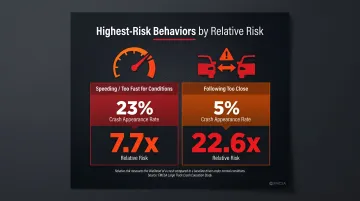
Measurement enables organizations to target the specific behaviors with the highest risk leverage, rather than applying the same intervention to everyone.
KPIs impacted:
- Accident rate
- Near-miss frequency
- Telematics safety score
- MVR violation rates
- Cost per incident
When this advantage matters most:
Measurement delivers the highest impact in fleets where driver behavior has never been systematically tracked. Organizations moving from reactive incident response to proactive behavioral monitoring see the sharpest early improvements, often within weeks of implementing consistent measurement and feedback loops.
Advantage 2: Positive Reinforcement Builds Safe Driving Habits That Last
Behavior followed by positive consequences is more likely to be repeated. Fleet safety programs that recognize and reward safe driving create a motivational environment where drivers want to maintain safe practices, not just avoid punishment.
Recognition programs work when they're structured and inclusive. Tiered safety scores, driver-of-the-month acknowledgments, performance bonuses tied to safety metrics, and manager check-ins that highlight good performance create a positive consequence loop that punishment-based systems cannot replicate. A case study using behavior-based safety found that an inclusive recognition program—where all drivers above a safety threshold were eligible—yielded a 47% reduction in speeding and hard-braking incidents within three weeks, while top-performer-only rewards failed to maintain results.
Punishment creates avoidance motivation: drivers focus on not getting caught rather than genuinely improving. Positive reinforcement creates approach motivation, where safe behavior becomes intrinsically rewarding. Peer-reviewed meta-analysis of behavior-based safety programs across 88 organizations found average injury reductions of 25% in year one, 34% in year two, and 42% by year three, demonstrating that positive reinforcement systems produce compounding improvements over time.
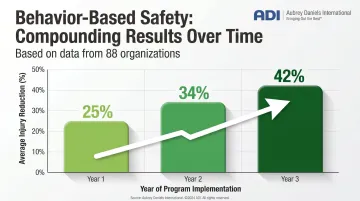
Recognition programs shift how drivers perceive safety: from a management imposition to a personal and team standard. When that shift takes hold, safe driving stops requiring enforcement and starts requiring maintenance.
KPIs impacted:
- Driver safety score improvement over time
- Reduction in repeat violations
- Driver engagement/satisfaction scores
- Turnover rate among safety-program participants
When this advantage matters most:
Positive reinforcement delivers its highest impact in organizations where drivers have historically experienced safety programs as purely punitive. Fleets with high turnover or low driver morale often see the most significant culture shifts when recognition becomes a consistent program component.
Advantage 3: Targeted Coaching Addresses the Behavioral Root Causes of Risk
Generic safety training creates knowledge; targeted coaching creates behavior change. Data-driven fleet programs identify which specific behaviors each driver needs to work on and deliver coaching that directly addresses those behaviors.
Supervisors use telematics data to have structured, specific conversations: "Your following distance on highway routes triggers more alerts than any other driver. Let's talk about why and what changes when you're under deadline pressure." This immediate, behavior-specific feedback is far more effective than delayed, generalized training delivered to all drivers regardless of individual performance patterns.
Research validates this approach. Foundational educational research (Bloom's 2-sigma) found that one-on-one instruction produced mastery in about 90% of learners versus 20% under conventional classroom methods. The UC San Diego study on fleet coaching confirmed that behavior-based, individualized coaching helps drivers retain safety lessons and reduce risk more effectively than classroom training.
Behavior changes when three conditions are met: the driver understands what specific action to change, receives feedback close in time to the behavior, and experiences a meaningful consequence for improvement. Generic training addresses none of these conditions effectively.
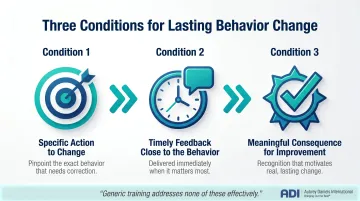
Targeted coaching also improves resource efficiency. Managers spend less time on drivers who are performing well and more time on those with the highest risk profile, improving ROI on safety program resources.
KPIs impacted:
- Rate of repeat behavioral incidents
- Coaching completion rates
- Individual driver safety score trajectories
- Time-to-improvement after coaching intervention
When this advantage matters most:
Targeted coaching is especially valuable for large fleets where individual attention is difficult to scale. Data-driven prioritization ensures the highest-risk drivers receive the most support, while strong performers receive recognition rather than unnecessary correction.
What Happens When Fleet Safety Programs Are Missing or Poorly Designed
Without a behavior-focused safety program, accidents and violations occur with no early-warning system, forcing organizations into a purely reactive posture—constantly firefighting incidents rather than preventing them.
The hidden cost is behavioral drift. Without consistent measurement, feedback, and reinforcement, safe driving habits erode over time. Experienced drivers develop shortcuts, new drivers normalize whatever behavior they observe, and unsafe practices become the de facto standard.
The underlying principle is well-established in behavioral science: behavior that goes unreinforced weakens. Meanwhile, behavior that delivers short-term convenience—speeding to make a deadline, skipping pre-trip inspections to save time—tends to strengthen.
When Measurement Stops Short of Action
This behavioral erosion gets worse when fleets invest in monitoring tools but never act on what they collect. Many organizations install telematics systems only to let data sit in dashboards while drivers receive no feedback and behavior goes unchanged. A UC San Diego study found that telematics alone provides risk indicators but does not target behavioral motivation—linking events to actionable coaching is what drives real change.
Measurement without consequence is surveillance, not safety management. Drivers know they're being watched but have no meaningful reason to change what they're doing. The program becomes a source of resentment rather than a performance improvement system.
How to Get the Most Value from Your Fleet Safety Program
Fleet safety programs produce the strongest behavioral outcomes when three elements work together consistently: accurate measurement of specific behaviors, immediate and meaningful feedback, and positive consequences for improvement. Removing any one of these weakens the system.
The supervisor behavior factor:
The program is only as effective as the managers implementing it. Supervisors need training to deliver specific, behavior-focused coaching conversations, recognize improvement early, and apply consequences consistently. ADI's Performance Management approach builds exactly this kind of supervisory capability, emphasizing recognition of specific behaviors and positive accountability systems. When managers operate this way, the management system itself reinforces safe behavior — and improvements hold.
When supervisors shift from critics to coaches, the organizational culture transforms from subordinating to supportive. This shift is measurable: a distribution center case study showed that when managers implemented performance management principles, lost-time accidents decreased 45% and the facility achieved 90% accuracy compared to a 70% baseline.
Sustaining improvement through the fading principle:
That cultural shift also shapes how reinforcement should evolve over time. When new behaviors are being established, high-frequency reinforcement and coaching makes sense. As safe driving becomes habitual, you can taper that reinforcement — but cutting it out entirely risks behavioral regression.
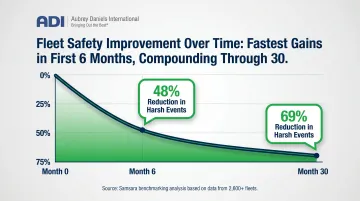
Build a cadence into the program that maintains engagement without creating program fatigue. Samsara's benchmarking analysis of 2,600+ fleets found that improvement velocity is fastest in the first six months and continues through 30 months, with harsh events decreasing 48% at six months and 69% at 30 months. This timeline demonstrates that sustained reinforcement over years produces compounding results, but the intensity of that reinforcement can taper as behaviors stabilize.
Conclusion
A fleet safety program's real value lies not in the technology it deploys or the policies it documents, but in how consistently it shapes what drivers do behind the wheel. Measurement creates visibility. Reinforcement builds motivation. And consistent coaching is what turns one-time corrections into lasting habits.
These improvements compound over time. Organizations that treat fleet safety as an ongoing behavioral management practice — not a one-time training initiative — see results that extend well beyond the cab:
- Drivers become active participants in maintaining standards, not passive rule-followers
- Incident rates and liability exposure drop as safe habits replace risky ones
- Operating costs fall as fuel efficiency, vehicle wear, and insurance claims improve
- Safety culture strengthens to the point where the right behaviors happen without being policed
That shift — from enforced compliance to genuine habit — is the real measure of a fleet safety program's success.
Frequently Asked Questions
What specific driver behaviors do fleet safety programs typically target?
The most common behavioral targets include speeding, hard braking, harsh acceleration, distracted driving (particularly phone use), following distance violations, and seatbelt compliance. Effective programs prioritize specific, measurable behaviors captured through telematics rather than general attitude goals alone.
Why do some fleet safety programs fail to produce lasting behavior change?
The most common failure modes are programs that monitor without delivering feedback, punishment-only approaches that create avoidance rather than genuine improvement, and one-time training events without ongoing reinforcement. Behavior change requires consistent consequences tied to specific actions, not just awareness or documentation.
What is the role of positive reinforcement in fleet driver safety?
Positive reinforcement—recognizing and rewarding safe driving rather than only penalizing unsafe behavior—creates lasting motivation by making safe performance rewarding in itself. Drivers develop intrinsic motivation to perform safely, which produces more durable culture change than consequence-avoidance alone.
How long does it take to see measurable improvements in driver behavior from a fleet safety program?
Initial behavioral improvements are often visible within weeks of implementing consistent feedback and recognition systems. Sustainable culture-level change typically requires three to six months, with timelines shaped largely by how frequently feedback is delivered and how effectively supervisors execute coaching conversations.
How do telematics tools support behavior change versus simply tracking it?
Telematics provides the behavioral data needed for specific coaching conversations and recognition moments—the technology itself doesn't change behavior. It enables the timely, specific feedback and consequence systems that do. Without follow-through on the data, telematics becomes surveillance rather than a driver coaching tool.
What's the difference between a compliance-based and a behavior-based fleet safety program?
Compliance-based programs focus on meeting rules and avoiding violations through documentation and policy enforcement. Behavior-based programs focus on reinforcing the specific actions that prevent incidents—using measurement, feedback, and positive consequences to address the driver's motivational environment, not just their knowledge of the rules.