Introduction
Stepping into a manufacturing plant as a new safety manager means walking into high-speed machinery, tight production deadlines, and a workforce that may view you as another corporate outsider enforcing rules that slow them down.
Most new safety managers find that the role described in the job posting bears little resemblance to the reality on the floor. Credibility isn't granted with a title — it's earned through relationships, technical competence, and visible follow-through.
The position may seem straightforward on paper — audit compliance, investigate incidents, conduct training — but early success depends almost entirely on how you sequence your first actions. Move into enforcement mode before you understand the floor dynamics, and you'll face resistance that undermines every initiative you launch. Start by listening and observing, and you lay the groundwork for changes that actually stick.
This article walks through the exact first steps to take in your first two weeks, what to assess before implementing changes, which early missteps cost new managers their credibility, and how to start building a safety culture where workers participate because they see the value — not just because they're required to.
TL;DR
- Build relationships with management and floor workers before changing anything
- Complete a plant-wide hazard assessment within two weeks, referencing OSHA 300 logs
- Use a frequency-severity matrix to prioritize hazards objectively
- Launch non-punitive near-miss reporting to surface hidden risks
- Deliver at least one visible quick win in your first 30 days to build trust and credibility
Your First Two Weeks as a New Safety Manager in a Manufacturing Plant
The sequence of actions you take in your first two weeks shapes your entire tenure. Done correctly, it builds the trust and baseline data you need to lead effectively. Get it wrong, and you'll spend months rebuilding credibility you never had to lose.
Step 1: Meet Every Member of the Management Team
On day one, proactively introduce yourself to each manager individually rather than waiting for formal introductions. This signals initiative and respect for their operations.
In one-on-one conversations, ask targeted questions:
- What goals are they currently working toward, and how are they evaluated?
- What do they expect from the safety function?
- What immediate safety concerns do they want addressed?
These conversations reveal whether leadership sees safety as a cost center or a performance driver. You'll learn which managers will champion your initiatives and which will require more persuasion. Document their concerns; you'll reference them when presenting your hazard assessment findings.
Step 2: Introduce Yourself to the Floor Workers
Arrange brief, department-level group introductions within your first two days. Keep them focused:
- Your role and how it supports their safety
- Your vision for making safety practical, not bureaucratic
- How they can reach you directly
Invite workers to share pressing safety concerns, but don't allow introductory meetings to become complaint sessions. This demonstrates to management that you respect production operations and understand the difference between listening and problem-solving.
Workers will judge you by your follow-through on these early conversations. If they mention a hazard and you fail to address it, reporting stops. That follow-through starts with understanding what safety systems already exist on paper.
Step 3: Review All Existing Safety Documentation
Pull and examine every piece of existing safety documentation:
- Written safety programs and standard operating procedures
- OSHA recordkeeping logs (Forms 300, 300A, 301)
- Incident investigation reports from the past two to three years
- Prior OSHA inspection findings and abatement records
- Employee training records and certifications
Note what is current versus outdated, what is missing entirely, and whether documentation reflects what actually happens on the floor. Gaps here signal where your highest risks live.
Under 29 CFR 1904, most manufacturing employers must maintain OSHA injury and illness records for five years. Verify that Form 300A summaries were posted from February 1 through April 30 as required.
Recordkeeping violations carry real consequences: penalties reach $16,550 per serious violation and $165,514 for willful violations.
Step 4: Conduct a Comprehensive Hazard Assessment of the Plant
Walk every area of the facility, including production floor, maintenance areas, storage rooms, loading docks, roof access, and exterior grounds. Observe operations firsthand and note:
- Machine guarding completeness and condition
- Lockout/tagout compliance during maintenance
- Chemical storage, labeling, and Safety Data Sheet accessibility
- Ergonomic risk factors (repetitive motion, awkward postures, heavy lifting)
- Emergency exit access and egress routes
- Powered industrial truck operation
OSHA's recommended practices for hazard identification emphasize conducting initial and periodic inspections of all operations, equipment, work areas, and facilities. Under 29 CFR 1910.132(d), you must also document a written certification of your PPE hazard assessment, including the workplace evaluated, the person certifying the assessment, and the date.
During walkthroughs, have brief one-on-one conversations with workers to learn how tasks are actually performed versus how they are documented. Workers frequently develop informal workarounds to meet production demands. Understanding these reveals behavioral risk factors that written procedures miss entirely.
Step 5: Prioritize Findings and Present to Leadership
Organize all identified hazards into a single document and rank them using a frequency-severity matrix. This structured, objective method determines what gets addressed first versus later:
| Severity | Frequent | Occasional | Rare |
|---|---|---|---|
| Fatal/Catastrophic | Immediate action required | High priority | Medium priority |
| Serious Injury | High priority | Medium priority | Low priority |
| Minor Injury | Medium priority | Low priority | Monitor |
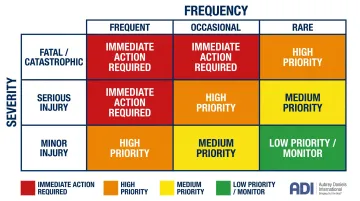
Schedule a formal presentation with the full management team to share findings, explain your prioritization methodology, and propose a phased action plan. Frame it as a baseline assessment, not as blame for past failures. Leadership buy-in at this stage determines whether you'll have the resources and authority to implement solutions.
What to Assess Before You Start Making Changes
Jumping into changes before understanding the full context is one of the fastest ways to lose management and worker trust.
Review OSHA 1910 General Industry Standards applicable to manufacturing. Five of the FY2024 top 10 most-cited standards fall under general industry regulations:
- Hazard Communication (1910.1200): 2,888 citations
- Respiratory Protection (1910.134): 2,470 citations
- Lockout/Tagout (1910.147): 2,443 citations
- Powered Industrial Trucks (1910.178): 2,248 citations
- Machine Guarding (1910.212): 1,541 citations
Cross-reference these standards with what is currently documented and practiced in your plant. Gaps here represent immediate compliance exposure.
Find and review the plant's injury and illness data for at least the past three years. Look for patterns:
- Which departments or workstations have the highest incident rates?
- What times of day or shifts show elevated risk?
- Which job roles or tasks are overrepresented in incidents?
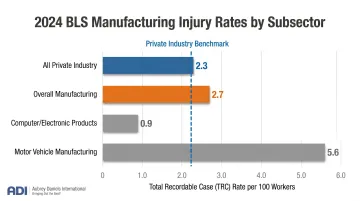
BLS 2024 data shows manufacturing recorded a total recordable case (TRC) rate of 2.7 per 100 FTE workers, compared to 2.3 for all private industry—approximately 17% higher. Subsector variation is dramatic: motor vehicle manufacturing hit 5.6 TRC, while computer/electronic products recorded just 0.9. Benchmark your plant against both overall manufacturing and your specific subsector to understand where you stand.
Every plant has workers and supervisors who aren't listed on any org chart but quietly shape how peers respond to new programs. Identifying these informal safety influencers early is worth the effort — their buy-in often determines whether an initiative takes hold or quietly dies on the floor. Before proposing any changes, spend time understanding who they are and where they stand on safety.
Key Factors That Determine Your Early Impact in Manufacturing Safety
Two new safety managers in identical plants can achieve dramatically different outcomes based on how they manage a handful of critical variables.
Management buy-in is the single most important factor. Without visible leadership support—managers participating in walkthroughs, addressing hazards promptly, and reinforcing safe behavior—safety initiatives become the safety manager's problem alone. Research from the Campbell Institute found a correlation of r = -0.86 between training hours (a leading indicator driven by management investment) and incidence rates. When leadership increased training hours, injury rates declined proportionally. Position safety as a business performance issue, not a compliance cost — and show how reducing incidents affects absenteeism, workers' compensation premiums, and production continuity.
Worker trust and psychological safety determine whether you see the real risk picture. Employees who fear retaliation for reporting near-misses or hazards will under-report, leaving you blind. The Campbell Institute's research confirms that anonymous reporting systems produce an "immediate difference" in surfacing near misses previously unknown to management. Establish clear, non-punitive reporting mechanisms immediately, and follow through on every report.
Compliance rules tell workers what to do, but behavior is driven by consequences — what gets reinforced or ignored in daily operations. If a worker bypasses machine guarding to meet a production deadline and nothing happens (or worse, they're praised for speed), that unsafe shortcut gets reinforced.
Identifying these behavioral drivers reveals why unsafe practices persist even when workers know the rules. It also points directly to where intervention will have the most impact.
Quick wins and visible follow-through build momentum. Find at least one hazard that can be fixed quickly and visibly in the first 30 days — even a small fix demonstrates that safety concerns are heard and acted on. This builds reporting behavior and trust far more effectively than months of policy revisions.
Here's a simple way to think about which factors you control directly in your first 90 days:
- Management buy-in: Secure it early by tying safety metrics to business outcomes leadership already tracks
- Worker trust: Establish anonymous reporting from day one; respond to every submission
- Behavioral drivers: Observe what gets reinforced on the floor, not just what the policy says
- Quick wins: Fix one visible hazard in 30 days to demonstrate follow-through
Common Mistakes New Safety Managers Make in Their First 90 Days
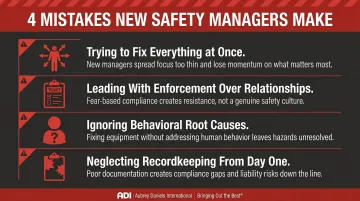
Four patterns derail new safety managers faster than almost anything else:
Trying to fix everything at once. Without a prioritized plan, managers spread themselves too thin and burn out before making visible progress. Focus on the top five to seven risks first — document the rest, but don't tackle them all at once.
Leading with enforcement rather than relationships. A citation-heavy, compliance-only approach triggers defensiveness from supervisors and workers, making future cooperation much harder. Build credibility through listening and problem-solving before ramping up enforcement.
Ignoring behavioral root causes. When managers fix physical hazards but overlook the conditions and reinforcement patterns that lead workers to bypass safeguards, incidents keep recurring. Research consistently shows human factors contribute to the vast majority of workplace accidents — and modern safety science treats these as systemic failures, not individual blame. OSHA Publication 3885 explicitly warns against stopping investigations at "worker error" and recommends asking "Why?" repeatedly to surface root causes like inadequate training, poor tool maintenance, or unrealistic scheduling.
Neglecting recordkeeping from day one. Gaps in OSHA records, training logs, and corrective action tracking create immediate legal exposure. Serious violations carry penalties up to $16,550 per violation; willful violations reach $165,514. Those gaps compound fast.
Building a Safety Culture That Goes Beyond Compliance
Compliance creates the floor, not the ceiling. A manufacturing plant where workers only follow safety rules when someone is watching is one supervisor absence away from an incident.
The difference between compliance-driven and behavior-based safety cultures is foundational:
Compliance-driven culture: Reacts to incidents after they occur, relies on audits and citations to motivate behavior, and enforces rules without building understanding. Workers comply to avoid discipline—not because they value safety.
Behavior-based safety culture: Uses proactive observation and positive recognition, involves workers in identifying hazards, and builds an environment where safe behavior is consistently reinforced. Workers internalize safe practices rather than just following orders.
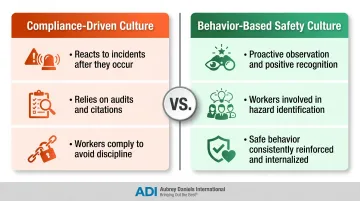
Behavior-based cultures produce sustained results because they address the behavioral and systemic drivers of incidents—not just the compliance checklist.
That distinction shapes where new safety managers should focus first. Rather than defaulting to enforcement, start by observing work behaviors without immediately correcting. Understand the antecedents and consequences driving what you see, then use positive reinforcement to encourage safe practices consistently. ADI's behavior-based safety methodology, built on over 45 years of applied behavioral science, offers a structured approach to this kind of culture shift in manufacturing and high-risk environments.
Practical starting points include:
- Involve workers in solving hazards they identify — people support what they help build
- Recognize safe behaviors publicly and consistently, not just when something goes wrong
- Treat safety performance as a shared team metric, not a discipline trigger
- Create non-punitive near-miss reporting with visible follow-through so workers see their input matters
Honeywell achieved a 50% reduction in recordable injuries over three years by doubling safety observations to approximately 8 per employee per year and transitioning from a manager-only reporting system to one accessible to all employees. The broader reporting base surfaced previously invisible hazards, enabling prevention before escalation.
Frequently Asked Questions
What OSHA certification should a safety manager have for a manufacturing plant?
The OSHA 30-Hour General Industry course is the foundational credential, covering hazard communication, lockout/tagout, machine guarding, and PPE. For career advancement, the Certified Safety Professional (CSP) or Associate Safety Professional (ASP) from the Board of Certified Safety Professionals are the most recognized credentials in the field.
What is the first step in implementing a safety management system?
The first step is establishing management commitment and leadership buy-in. OSHA Publication 3885 identifies Management Leadership as the first of seven core elements—without visible support from leadership, safety programs stall: they lack both the authority to enforce standards and the resources to act on hazards.
What are the most common safety hazards in manufacturing plants?
The five most-cited general industry standards in FY2024 reveal the most common violations: hazard communication failures, respiratory protection gaps, lockout/tagout violations, powered industrial truck incidents, and machine guarding deficiencies. Struck-by incidents, chemical exposures, and ergonomic injuries round out the hazard picture across most manufacturing subsectors.
How should a new safety manager prioritize hazards when everything seems urgent?
Use a risk ranking matrix based on severity (potential consequence) and frequency (likelihood of occurrence) to sequence corrective actions. This method provides a defensible, transparent framework that helps you focus limited time and resources where they matter most.
How do you get employee buy-in for safety programs in manufacturing?
Buy-in comes from involving workers in identifying hazards and solutions, following through on their concerns quickly, and recognizing safe behaviors rather than only reacting to violations. When workers see their input taken seriously, they start driving safety forward rather than waiting to be managed.
How long does it take to establish a safety program in a manufacturing plant?
A basic program framework—recordkeeping, hazard assessment, emergency action plans—can be set up within 60 to 90 days. Building a genuine safety culture that consistently changes worker behavior typically takes one to two years of sustained effort, with measurable improvements appearing along the way.