Introduction
The cement industry's safety performance lags behind other manufacturing sectors. According to the World Business Council for Sustainable Development Cement Sustainability Initiative (WBCSD CSI), directly employed workers face a fatality rate of 1.94 per 10,000 employees, with contractor fatalities double that of direct employees. The WBCSD confirms that "the cement industry's health and safety performance is lagging behind that of other sectors of manufacturing industry."
These numbers carry real operational weight: lost workdays that disrupt production schedules, regulatory exposure that drives up insurance costs, equipment downtime that affects output targets, and the devastating human cost to workers and their families.
In the United States alone, cement and concrete product manufacturing recorded a Total Recordable Incident Rate of 3.1 per 100 full-time workers, with days away, restricted, or transferred (DART) cases at 1.8.
Improving safety performance in cement plants requires more than compliance checklists and PPE mandates. It takes rigorous engineering controls combined with a genuine shift in how workers and leaders behave every day — making safety an embedded organizational value, not a rulebook exercise.
TLDR:
- Traffic/mobile plant interactions (43%), falls from heights (21%), and contact with moving equipment (15%) cause 79% of cement plant fatalities
- Visible leadership — site walks, prompt issue resolution, direct worker engagement — drives safety performance more than delegation alone
- Physical hazard controls are necessary but insufficient; sustained low injury rates require behavior-based culture built on observation and positive reinforcement
- Leading indicators like near-miss reports predict future accidents; lagging indicators like injury counts only confirm what already went wrong
Why Safety in Cement Manufacturing Is More Complex Than It Appears
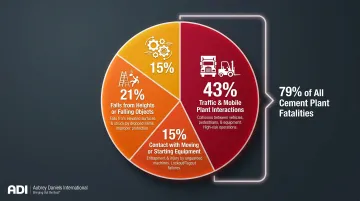
Cement workers often underestimate their environment's danger because there is no single catastrophic explosion risk like oil and gas facilities. This creates a false sense of normalcy that obscures the very real hazards present. WBCSD data confirms the top three causes of fatalities:
- Traffic and mobile plant interactions: 43%
- Falls from heights or falling objects: 21%
- Contact with moving or starting equipment: 15%
Together, these three categories account for 79% of all cement plant fatalities, a distribution that demands multiple concurrent control strategies rather than a single-point solution.
Secondary Hazards That Compound Risk
Beyond these leading causes, cement plants present numerous additional exposures that accumulate over time:
- Confined space entry risks in silos and hoppers, including suffocation and burial in loose material
- Heat stress from kiln area exposure, which reduces alertness and reaction time
- Cement dust containing respirable crystalline silica causes silicosis, lung cancer, and COPD; OSHA sets the permissible exposure limit at 50 micrograms per cubic meter
- Musculoskeletal injuries from heavy lifts and repetitive manual handling
- Chemical burns from prolonged skin contact with wet cement
- Noise levels up to 120 dB near ball mills, degrading situational awareness and causing long-term hearing loss
What this risk profile reveals is that cement plant safety failures are rarely singular events. They emerge from daily accumulations of routine exposures, unchecked shortcuts, and systems that weren't designed with behavior in mind. Engineering controls address the physical hazards — but without behavioral and cultural reinforcement, those controls get bypassed, ignored, or gradually erode.
Step 1: Establish Safety Policy, Standards, and Leadership Accountability
A written safety policy with clear standards forms the baseline, but it becomes effective only when management behavior consistently reinforces it. What workers observe their managers doing carries far more weight than what any policy document states.
What Leading Safety Looks Like in Practice
Managers who lead safety effectively:
- Conduct regular site walks where they observe work, ask questions, and listen to frontline concerns
- Discuss safety directly with workers during routine interactions, not just after incidents
- Promptly address reported issues with visible follow-through and communication of resolution
- Recognize safe performance specifically and publicly, reinforcing behaviors worth repeating
- Allocate resources (time, equipment, training) that demonstrate safety is truly a priority
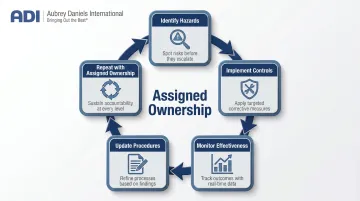
Effective safety management operates as a cycle, not a one-time event. Each stage requires assigned ownership to move from planning to results:
- Identify hazards through inspections, near-miss reports, and worker input
- Implement controls using the hierarchy of controls (elimination, substitution, engineering, administrative, PPE)
- Monitor effectiveness through leading and lagging indicators
- Update procedures based on what the data reveals
- Repeat continuously with assigned ownership at each stage
Supervisors: The Critical Link
Supervisors translate policy into shop floor reality. When supervisors understand the site's safety management system, have adequate resources, and receive coaching to reinforce safety expectations, consistent execution becomes possible.
Frontline supervisors equipped with behavioral coaching skills are the difference between compliance-driven safety and a culture where safe behavior is the default. In cement plants specifically — where shift handoffs, high-dust environments, and equipment-intensive tasks create daily exposure — that distinction matters.
Step 2: Identify and Control the Top Three Hazards in Cement Plants
Cement plants face a concentrated set of hazards responsible for the vast majority of fatalities. The five categories below account for the most serious risks—start with the highest-fatality causes and work down.
Traffic and Mobile Plant (43% of Fatalities)
Pedestrian-vehicle interactions in cement plants and quarries represent the highest-fatality risk category. Effective control requires dedicated engineering intervention, not just signage.
Cross-Functional Team Approach:
- Map all interaction points where pedestrians and vehicles converge
- Assess risk at each location based on frequency, speed, visibility, and consequence
- Install hard controls: physical barriers, designated pedestrian zones, traffic flow redesign, line-of-sight improvements
The UK's Health and Safety Executive confirms that roadways and footpaths should be separate whenever possible, with physical segregation as the primary recommended control. OSHA requires that permanent aisles and passageways be appropriately marked and free from obstructions where mechanical handling equipment is used.
Falls from Heights and Falling Objects (21% of Fatalities)
Structured Site Survey:
Involve both production and maintenance personnel to identify all work-at-height locations, including:
- Platforms for equipment access
- Roof work during maintenance
- Silo and hopper tops
- Elevated conveyors
Hierarchy of Controls:
Prioritize elimination through engineering solutions (platforms with guardrails) over reliance on personal fall arrest systems. When harnesses are necessary, ensure regular inspection of all fall protection equipment and verify that anchor points are rated and certified.
Every work-at-height task should include pre-task planning that identifies fall hazards and confirms controls are in place before work begins.
Moving and Starting Equipment (15% of Fatalities)
Machine guarding and formal lockout/tagout (LOTO) procedures prevent contact with energized or moving equipment. OSHA estimates that compliance with the LOTO standard prevents 120 fatalities and 50,000 injuries annually across all industries.
Critical LOTO Requirements:
- Isolation devices must be available, accessible, and actually used—not bypassed under time pressure
- All energy sources (electrical, mechanical, hydraulic, pneumatic, thermal) must be controlled
- Authorized employees must verify zero energy before beginning maintenance work
- Lockout is the most frequently cited OSHA standard in manufacturing, indicating widespread non-compliance
Workers injured from hazardous energy exposure lose an average of 24 workdays for recuperation. That's a direct hit to both workforce stability and production output.
Confined Spaces: Silos, Hoppers, and Ducts
Suffocation and entrapment risks in cement-specific confined spaces are documented causes of fatalities. The ILO confirms that workers have been buried in loose material when entering silos without lifeline or standby personnel.
Confined Space Entry Program Requirements:
OSHA Standard 29 CFR 1910.146 mandates:
- Atmospheric testing for oxygen content, flammable gases, and toxic contaminants before entry
- Written permit system signed by entry supervisor and posted at entry portal
- Trained attendant stationed outside for entire duration of entry
- Pre-planned rescue procedures with designated rescue personnel who practice rescues at least annually
Silos and hoppers are explicitly referenced in the standard as confined spaces requiring permit procedures.
Dust, Heat, and Chemical Exposure
Respirable Crystalline Silica:
Cement dust causes silicosis and progressive respiratory disease with prolonged exposure. OSHA's permissible exposure limit is 50 micrograms per cubic meter as an 8-hour time-weighted average, with an action level of 25 micrograms requiring medical surveillance every three years.
Controls Include:
- Engineering controls: ventilation systems, dust suppression at transfer points, enclosed conveyors
- Proper PPE selection: respirators when engineering controls cannot achieve compliance
- Health monitoring programs to catch early warning signs before disease progresses
Heat Stress in Kiln Environments:
The Bureau of Labor Statistics estimates 33,890 work-related heat injuries and illnesses involving days away from work across all industries. Kiln areas in cement plants expose workers to extreme radiant heat and high ambient temperatures.
Recommended controls include:
- Cold air showers at entry and exit points
- Thermal screening of high-exposure work areas
- Medical supervision for kiln repair and maintenance work
- Scheduled rest breaks in cooled or shaded areas

Step 3: Build a Culture Where Safe Behavior Becomes the Default
Compliance-focused safety programs enforced primarily through punishment fail to sustain performance. When safety is driven by fear of consequences, workers learn to avoid detection rather than genuinely adopt safe behaviors. Behavioral science confirms that behavior is shaped more reliably by positive consequences than by negative ones.
Behavior-Based Safety (BBS): Structured Observation and Feedback
BBS uses structured observation processes where trained observers watch specific safety-critical behaviors, provide immediate feedback, and reinforce correct behaviors. This shifts focus from outcomes (injury counts that confirm what already went wrong) to behaviors (what people actually do), giving managers early visibility into risk before accidents occur.
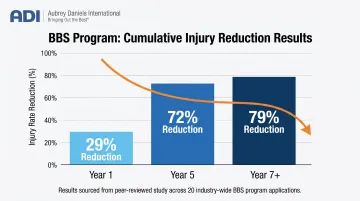
Research published by the American Psychological Association shows BBS programs produce:
- 29% reduction in recorded injury rates after one year
- 72% reduction after five years
- 79% reduction after seven or more years
These results come from a peer-reviewed study of 20 industry-wide applications. The compound effect of consistent behavioral intervention outperforms punitive approaches across every time horizon — and the mechanism behind those results is reinforcement, not fear.
The Role of Positive Reinforcement
When safe behavior is noticed and specifically acknowledged by supervisors and peers, it is more likely to be repeated. Recognition doesn't require formal programs — timely, sincere acknowledgment of a correctly performed lockout procedure or proper fall arrest use goes further than a monthly safety award.
ADI's work with organizations — grounded in behavioral science principles explored in Judy Agnew's co-authored book Safe by Accident? — shows that positive consequences, not punishment, drive lasting behavior change.
One automobile plant in Mexico achieved a 92% reduction in first-time occupational medical visits through immediate and weekly feedback on safe behaviors. That result didn't come from stricter enforcement; it came from consistent, targeted reinforcement.
Involve Frontline Workers in Safety Ownership
Practical Approaches:
- Stop-work authority: Any worker—apprentice or superintendent—has the right and responsibility to halt unsafe conditions without fear of retaliation
- Pre-task safety analysis huddles: Brief team discussions before high-risk work identify hazards and confirm controls
- Cross-functional hazard identification teams: Frontline workers participate in inspections and risk assessments, bringing operational knowledge that desk-based assessments miss
These practices create shared accountability rather than passive compliance, transforming safety from something done to workers into something workers actively shape.
What Managers Must Stop Doing
Inadvertent behaviors that undermine safety culture include:
- Skipping safety steps under production pressure signals that schedule always wins — workers read that message clearly
- Leaving reported hazards unaddressed teaches workers that raising concerns is pointless, which silences future participation
- Waiting until an incident to discuss safety confirms that it's reactive, not a genuine daily operating value
These behaviors undo formal policies and reveal what leaders truly prioritize.
Measuring Safety Performance: Move Beyond Lagging Indicators
Lagging vs. Leading Indicators
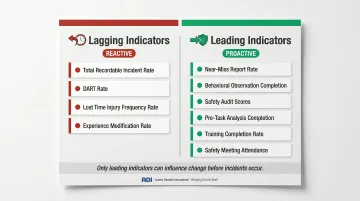
The Global Cement and Concrete Association (GCCA) defines:
Lagging indicators as "reactive in nature"—measuring the effectiveness of a safety program after the facts. They can only record what has already happened.
Leading indicators as "proactive in nature"—safety initiatives aimed at preventing adverse events before they happen. These are the only indicators that "can influence change."
Common Lagging Indicators:
- Total Recordable Incident Rate (TRIR)
- DART rate (Days Away, Restricted, or Transferred)
- Lost Time Injury Frequency Rate
- Experience Modification Rate (EMR)
Common Leading Indicators:
- Near-miss report submission rates
- Behavioral observation completion rates
- Safety audit scores and findings closure rates
- Pre-task safety analysis completion percentages
- Training completion rates
- Safety meeting attendance and participation
Sole focus on lagging metrics creates a false sense of security—a plant can have zero recordables for months while behavioral risk accumulates undetected. The absence of accidents is not proof of a safe system.
The Importance of Near-Miss Reporting Culture
A high near-miss report rate signals a healthy safety culture, not a troubled one. It means workers trust the system and are surfacing risks before they escalate.
OSHA defines a near-miss as "an opportunity to improve health and safety in a workplace based on a condition or an incident with potential for more serious consequences." Near-miss investigation provides clear indication of where hazards exist.
Practical Steps to Encourage Reporting:
- Implement no-blame investigation processes that focus on system improvement, not individual fault
- Provide visible follow-through on reported concerns with communication of actions taken
- Recognize and thank employees who report near-misses, reinforcing the behavior
- Track and trend near-miss data to identify recurring hazard patterns
Workers will stop reporting if their input disappears into a black hole or results in punishment.
Use Inspection and Audit Data as a Feedback Loop
Near-miss data only tells part of the story. Inspections and audits fill the gaps — but only when they drive action, not just documentation.
Regular scheduled and unscheduled site inspections should generate corrective actions with assigned owners and deadlines. Tracking closure rates reveals whether the system is actually working or quietly stalling.
Use that data to do more than measure:
- Benchmark performance across shifts, departments, or plant sites to identify best practices worth spreading
- Feed safety findings directly into coaching conversations with frontline supervisors
- Build recognition programs around teams that close corrective actions on time and surface hazards proactively
ADI's behavioral science-based Performance Management approach gives safety leaders a practical framework for turning inspection data into behavior change — not just reports filed and forgotten.
Common Safety Mistakes That Undermine Progress
Over-Reliance on Lagging Indicators Alone
Measuring only injury rates creates false confidence. A plant can show zero recordables while the conditions for a fatal event remain unaddressed. The Campbell Institute confirms that "sole focus on lagging metrics is not as effective in promoting continuous improvement as using leading indicators to anticipate and prevent injuries and incidents."
The WBCSD CSI noted improvement in Lost Time Injury frequency rates while acknowledging that "similar progress has yet to be achieved on fatality reductions"—exactly the disconnect that leading indicators help prevent.
Treating Safety as a Compliance Function Rather Than an Operational Value
When safety is owned only by the safety department and not embedded in daily operations management, it becomes a checkbox exercise.
This siloing plays out in predictable ways on the floor:
- Supervisors don't discuss safety routinely with crews
- Hazard reports go unanswered or receive delayed responses
- Workers stop trusting the system and stop reporting
- Safety becomes something done for audits, not for protection
Safety must be integrated into how work is planned, executed, and reviewed—not managed separately by the safety department.
Ignoring Remote or Smaller Facilities
The same siloing problem often intensifies at sites with fewer resources. Quarries, terminals, warehouses, and logistics sites in the cement supply chain frequently lack the staffing of main plant locations—and they can't be left without adequate oversight.
That said, over-engineering safety management systems for small sites creates administrative burden without proportional protection. Simplified systems focused on the highest-consequence hazards work better here. Supplement internal capability with external audits or insurer resources, and prioritize supervisory coaching—one of the most accessible and cost-effective approaches available.
Frequently Asked Questions
What are the top causes of fatal accidents in cement plants?
WBCSD data confirms three leading causes: traffic and mobile plant interactions (43%), falls from heights or falling objects (21%), and contact with moving or starting equipment (15%). These three categories account for 79% of fatalities in cement manufacturing.
How does leadership behavior affect safety performance in cement plants?
Managers who visibly conduct site safety walks, address issues promptly, openly recognize safe performance, and discuss safety regularly with workers create conditions where safe behavior becomes normalized rather than forced. What leaders do daily determines whether safety culture is genuine — policies alone never are.
What is behavior-based safety and is it relevant to the cement industry?
Behavior-based safety uses structured observation and positive reinforcement to shape safe behaviors systematically. It is especially applicable in cement plants, where most incidents stem from routine behavioral shortcuts rather than catastrophic failures. Industry-wide BBS programs have demonstrated 72% injury reduction over five years.
What are leading safety indicators and why do they matter?
Leading indicators — such as near-miss reports, observation completion rates, and audit scores — measure conditions before accidents happen, giving managers actionable data to intervene early. Unlike lagging indicators, which only confirm what already went wrong, leading indicators are the primary lever for preventing incidents before they occur.
How do you reduce confined space risks in cement plant silos and hoppers?
OSHA requires atmospheric testing before entry, a formal permit system, a trained attendant stationed outside, and pre-planned rescue procedures. Never enter without all controls confirmed in place—silo entry has caused burial fatalities when these protocols were bypassed.
How can smaller cement facilities with limited resources improve safety performance?
Focus a simplified safety management system on the highest-consequence hazards first. Supplement internal capability with external audits or insurer resources, and prioritize supervisory coaching — it's a low-cost lever that drives real culture change at the frontline.
About Aubrey Daniels International
For over 45 years, Aubrey Daniels International (ADI) has applied the science of behavior to accelerate business performance in manufacturing, mining, utilities, and other high-hazard industries. ADI's behavioral science-based approach to safety culture transformation helps organizations move beyond compliance to build environments where safe behavior becomes the default. Through Safety Leadership training, behavior-based safety implementation, and Performance Management consulting, ADI equips leaders with practical tools grounded in decades of research. Learn more at ADI's website or contact us at +1 678-904-6140.