This guide doesn't offer another list of leadership virtues to aspire toward. Instead, it focuses on the specific behavioral areas where even experienced leaders most commonly fall short, and what behavioral science tells us about why those gaps are so persistent. The goal is practical: identify where the real leverage points are, understand what's driving the gap, and create conditions where new behaviors can actually stick.
TL;DR
- Leadership improvement works when it targets specific, observable behaviors — not vague qualities like "be more empathetic"
- Highest-leverage focus areas: reinforcing right behaviors, setting clear expectations, delivering behavior-focused feedback, and delegating with purpose
- Most leaders already know what good leadership looks like — the gap is in execution
- Spotting real behavioral gaps takes structured observation and multi-source feedback — self-reflection alone isn't enough
- New behaviors only stick when the environment consistently reinforces them
Why Leadership Behavior Improvement Is Never "One and Done"
Leadership isn't a fixed skill set you master once and maintain. The organizational contexts leaders operate in keep shifting — new teams, higher stakes, broader scope — and behaviors that worked at one level often become liabilities at the next. Continuous behavioral development isn't a sign of inadequacy; it's a professional necessity.
Leadership skills are internal capacities, but leadership behaviors are what employees actually experience. A leader can be highly capable yet still fail to translate that capability into consistent, observable action. Improvement must be defined in behavioral terms — specific, measurable actions — because good intentions don't change how a leader shows up day to day.
That gap between capability and behavior shows up clearly in the research. Research summarized by industry practitioners indicates that 75% of leadership development professionals estimate that less than half of what they train gets applied on the job. And a review from MIT Sloan found that attitude change following leadership programs often doesn't reliably predict subsequent behavior change.
Knowledge transfer, on its own, isn't enough — what matters is whether new behaviors actually take hold and stick after the training ends.
Key Areas of Improvement in Leadership Behavior
The areas below aren't exhaustive. They represent the behavioral domains with the greatest leverage on team performance, trust, and organizational outcomes — grounded in what behavioral science identifies as high-impact leadership actions.
Reinforcing the Right Behaviors at the Right Time
Most leaders default to managing problems. They spend disproportionate time on what's going wrong and underrespond — or don't respond at all — to what's going right. This is a costly pattern.
The behavioral science principle at work here is straightforward: behaviors that are followed by meaningful positive consequences are more likely to be repeated. A leader who consistently fails to reinforce effective behavior isn't being neutral — they're inadvertently allowing that behavior to weaken over time.
According to Gallup's 2024 workforce analysis, employees who receive manager feedback and recognition at least weekly show a 61% engagement rate, compared to substantially lower rates for those who receive it less frequently.
The frequency gap is significant. Research suggests only about 1 in 5 employees receives weekly feedback, while many managers believe they're providing it regularly.
Effective reinforcement is not generic praise. "Great job" accomplishes very little. What works is reinforcement that is:
- Specific — names the exact behavior observed
- Timely — delivered close to when the behavior occurred
- Meaningful to the individual — not a one-size-fits-all response
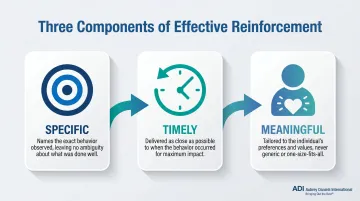
From a behavioral science perspective, timing matters because the connection between the behavior and its consequence needs to be clear. Delayed or vague praise breaks that connection.
Setting Clear Expectations and Following Through on Accountability
Accountability failures usually originate upstream — not with employees, but with how leaders communicate expectations in the first place. Telling someone to "be more proactive" or "take ownership" doesn't give them a behavioral target. They can't act on it consistently because there's no specific behavior defined.
The solution is behavioral pinpointing: translating broad expectations into specific, observable, measurable behaviors. Instead of "communicate better," a pinpointed expectation might be: "Send a project update to stakeholders every Friday by 3pm." That's actionable — and it gives leaders something concrete to follow up on.
The consequence side of accountability is where many leaders fall short a second time. Gallup data from 2025 shows teams whose leaders are rated exceptional at accountability have 51% engagement, compared to just 17% when leaders are rated poor at accountability — and less than half of leaders consider themselves outstanding in this area.
Letting underperformance slide to avoid conflict, or failing to acknowledge when expectations are met, both undermine accountability. Either way, the message to the team is that standards are negotiable. Inconsistent consequences erode trust faster than most leaders realize.
"Closing the loop" behaviorally means two things:
- Acknowledging when expectations are met (reinforcing the behavior)
- Addressing promptly when they're not (providing corrective feedback, not silence)
Giving Feedback That Shapes Future Behavior
Most feedback leaders give is evaluative: "you did well," "that could have gone better." Evaluative feedback doesn't change behavior because it doesn't give people a clear map of what to repeat or adjust. Behavioral feedback describes the specific action and its impact — it's actionable.
The difference in practice:
- Evaluative: "That presentation was strong."
- Behavioral: "You opened with the business impact before the data, which kept the room engaged from the start. Keep doing that."
Immediacy matters too. Feedback delivered close in time to the behavior is far more effective than a delayed performance review. The behavioral connection is clearest when feedback is fresh.
Avoiding difficult feedback conversations is itself a behavioral pattern — and one with compounding consequences. Performance issues don't resolve on their own. Other team members notice when underperformance goes unaddressed, and their confidence in leadership fairness erodes. The leader's credibility takes the hit.
ADI's Stop-Start-Continue Survey is one practical tool that creates structured space for this kind of direct, behavior-specific feedback — asking direct reports what behaviors their leader should stop, start, and continue. The responses translate directly into coaching action plans.
Using Delegation to Build Team Capability
Under-delegation is one of the most common and costly leadership behavior patterns — and one of the most invisible. The leader who does too much feels productive. The downstream costs show up elsewhere: less bandwidth for strategic work, and a team that never develops because they're never stretched.
Delegation done well is an investment in expanding the behavioral repertoire of team members — giving them the chance to practice, make decisions, and build genuine competence. Research on delegation outcomes links it to improved employee satisfaction, team performance, creativity, and customer satisfaction.
The behavioral driver behind under-delegation follows a predictable pattern. When a leader handles a task themselves, the reinforcement is immediate: it gets done, it gets done right, and the discomfort of uncertainty is avoided.
The long-term costs — a dependent team, a leader perpetually in the weeds — are delayed and less visible. That asymmetry keeps the pattern locked in.
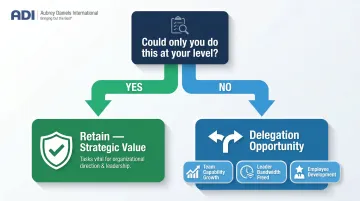
A useful audit: look at your recurring task list and ask which items could only be done by you at your level. Any task that doesn't meet that standard is a delegation opportunity.
Why Leaders Know What Good Leadership Looks Like — But Still Struggle
This is the knowing-doing gap — and it's more than a motivation problem.
Behavioral science is direct on this point: behavior is shaped by its consequences. If the environment doesn't consistently reinforce new leadership behaviors, those behaviors won't persist regardless of how compelling the training was or how committed the leader felt leaving the room.
The Competing Contingencies Problem
Old leadership habits often have a structural advantage. They're immediately reinforced — they feel familiar, produce short-term results, and avoid the discomfort of something new. New behaviors, by contrast, are uncomfortable in the short term and produce meaningful rewards only much later.
This asymmetry in reinforcement timing is one of the primary reasons leadership development efforts fail. The leader who wants to shift from doing to coaching faces a constant pull back to default patterns because the default patterns keep getting rewarded right now.
That pull isn't just internal — the surrounding environment shapes it too.
Culture as an Antecedent
Organizational culture functions as a powerful antecedent — the conditions that set up behavior before it occurs. If a culture rewards urgency and individual contribution over coaching and developing others, leaders who try to shift toward more deliberate, people-focused behaviors will face friction at every turn.
This is why changing leadership behavior often requires examining and adjusting the broader environment, not just the individual leader. ADI's consulting process identifies the organizational systems, incentives, and communication structures that inadvertently discourage the very behaviors leaders are being asked to build.
Even when the environment supports change, leaders still face a more personal obstacle.
The Self-Awareness Gap
Leaders must be able to observe their own behavioral patterns before they can change them. The problem: self-report is unreliable. Research on self-other rating discrepancies consistently shows a significant gap between how leaders rate themselves and how others experience them. Leaders with higher self-awareness — where self-ratings closely match others' ratings — are 36% more likely to achieve above-average organizational performance outcomes, according to research summarized by the Niagara Institute.
Structured observation and multi-source feedback aren't optional extras. They're prerequisites for accurate self-awareness.
How to Pinpoint Which Leadership Behaviors Need the Most Work
Effective improvement starts with a focused analysis — not a generic list of "good leadership behaviors," but a clear answer to: which specific behaviors are currently limiting this leader's impact?
Use Performance Patterns as Diagnostic Signals
Patterns of low engagement, chronic execution gaps, or team avoidance behaviors often trace back to identifiable leader behaviors upstream. Low feedback frequency, inconsistent follow-through on accountability, and under-delegation all leave fingerprints in team performance data. Start there.
Convert Vague Labels into Observable Behaviors
Leadership development plans frequently fail because they're built on vague labels: "lacks executive presence," "needs to communicate better." These aren't development targets — they're observations that haven't been translated into anything actionable.
Behavioral pinpointing converts those labels into specific, observable, measurable descriptions. For example:
- "Communicate better" → "Provide written status updates to the team before Monday's stand-up"
- "Lacks executive presence" → "Deliver project updates without reading from notes during leadership meetings"
- "Needs to be more decisive" → "Make go/no-go calls on team requests within 24 hours"
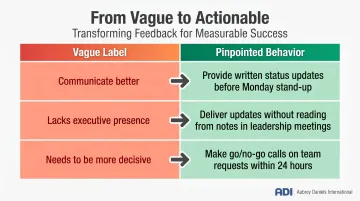
Each rewritten version is something a leader can practice, a coach can observe, and an organization can measure. ADI's Precision Leadership Survey and behavior-based assessments are built on this process, identifying which pinpointed behaviors have the highest leverage on performance outcomes and translating them into coachable action plans.
Prioritize, Don't Catalog
Trying to improve everything at once is a reliable path to improving nothing. The most effective approach is to identify the one or two behavioral areas where current patterns are most consistently undermining team performance or trust — and where a targeted behavior change would produce the broadest positive impact.
Multi-source (360-degree) feedback is the most reliable way to identify those areas. Because leaders are often unaware of how their behavior is experienced by others, structured multi-source feedback provides a more accurate picture than self-assessment alone.
Making Leadership Improvement Stick
New leadership behaviors — like all behaviors — need to be reinforced to be sustained. Building in that reinforcement is a structural requirement, not an optional add-on.
Who Reinforces the Leader?
Leaders get reinforced too. Direct reports who respond positively to changed leadership behavior, peers who notice the shift, coaches who provide specific feedback on what's working — these are all reinforcement sources. Leaders who try to sustain behavior change without any of these feedback loops are fighting against the current.
Building upward feedback mechanisms into the regular rhythm of work creates the conditions for sustained change. ADI's Stop-Start-Continue and Precision Leadership surveys provide structured vehicles for this.
Redesign the Environment, Not Just the Habits
External feedback helps — but the environment that triggers old behaviors also needs to change. Leaders need to examine and modify the conditions driving those defaults. That might mean restructuring how meetings are run, building explicit time for coaching conversations into the weekly schedule, or changing how performance conversations are initiated.
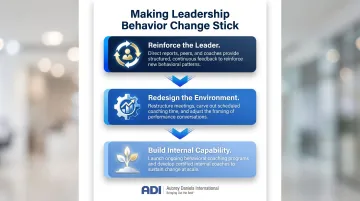
When environmental cues stay the same, default behaviors keep getting triggered. ADI's consulting engagements address this by identifying structural disconnects — misaligned incentives, communication patterns, performance metrics — and working with organizations to remove them before they pull leaders back toward old patterns.
Build Internal Capability for the Long Term
Organizations that invest in structured, ongoing behavioral coaching — rather than one-time training events — see far more durable improvement. The Center for Creative Leadership consistently emphasizes treating leadership development as a process rather than an event.
ADI's certification programs are designed with this in mind: preparing internal trainers and coaches to sustain the behavioral coaching capability inside the organization, so the organization keeps improving long after any single engagement ends.
Frequently Asked Questions
How do you improve leadership behavior?
Identify specific, observable behavioral gaps rather than general "skill" deficits. Then understand what's currently reinforcing the ineffective patterns, and deliberately practice new behaviors in a context where they'll be reinforced — ideally with structured coaching and feedback built in.
What are some key areas of improvement for leaders?
The highest-leverage behavioral areas are: reinforcing effective team behavior consistently, setting specific and measurable expectations, giving timely behavioral feedback, delegating with developmental intent, and building genuine self-awareness about how your behavior is experienced by others.
What are five behaviors that good leaders demonstrate?
Observable behaviors of effective leaders include:
- Providing specific, timely positive reinforcement when the right behaviors occur
- Setting clear, measurable behavioral expectations
- Delivering honest, immediate feedback — corrective as well as positive
- Delegating with developmental purpose, not just task transfer
- Following through consistently on accountability so that standards carry real meaning
What are some leadership development opportunities?
High-impact options include:
- Structured coaching with behavioral feedback loops
- Multi-source (360-degree) assessments
- Deliberate on-the-job practice with reinforcement built in
- Peer leadership cohorts for shared accountability
- Science-backed training programs focused on behavior change, not just knowledge transfer
What is the 70-20-10 rule for leadership development?
The model holds that 70% of development comes from on-the-job experiences, 20% from learning through others (coaching, feedback, observation), and 10% from formal training. This is why behavioral practice in real work contexts matters far more than training events alone, and why post-training coaching support drives lasting change.