Introduction
What if the qualities that make someone an effective leader aren't something you're born with, but something you can deliberately learn and practice? Behavioral leadership theory is built on exactly that premise—and it challenges an assumption that has shaped how organizations hire, promote, and develop leaders for decades.
The "Great Man" theory of leadership held that leaders were exceptional individuals defined by innate traits: charisma, intellect, dominance. If you didn't have those traits, leadership wasn't for you. Behavioral theory flipped that assumption on its head.
That shift carries real weight for organizations building leadership pipelines today. Whether leadership is trait-based or behavior-based determines whether you discover leaders or develop them—a difference with direct implications for succession planning, inclusion, and performance across large organizations.
This article covers the definition and origins of behavioral leadership theory, its core behavioral types, the real strengths and meaningful limitations practitioners should understand, and how organizations can move from knowing the right behaviors to actually sustaining them.
TLDR
- Behavioral leadership theory holds that effective leadership depends on learned, observable behaviors—not fixed personality traits.
- The theory emerged from Ohio State and University of Michigan studies in the 1950s, building on Kurt Lewin's earlier work from the 1930s–40s.
- Key behavioral types include task-oriented, people-oriented, and participative leaders—each suited to different situations.
- Core strengths: leadership is trainable and measurable. Core limitation: context-dependence means no single behavioral style works everywhere, and knowing effective behaviors doesn't guarantee consistent execution.
- Closing that gap requires reinforcement systems that embed the right behaviors over time, not just one-time training.
What Is Behavioral Leadership Theory?
Behavioral leadership theory is a framework that defines leadership effectiveness by what leaders do, not who they are. Where trait-based approaches—and the Great Man theory before them—focused on identifying the personality characteristics that distinguish leaders from followers, the behavioral approach concentrates on observable actions: the specific things leaders say and do that influence team performance and outcomes.
This distinction has real consequences. Trait-based thinking limits organizations to selecting for leadership. A behavioral framework opens the door to developing it.
The Two Core Behavioral Categories
Most behavioral leadership frameworks rest on two foundational categories:
- Task-oriented behaviors — setting goals, defining roles, structuring processes, scheduling work, coordinating activity, and maintaining performance standards
- People-oriented behaviors — building relationships, demonstrating trust and respect, attending to team member well-being, and creating conditions for collaboration
Effective leaders typically don't live at either extreme. They blend both, shifting emphasis based on what the situation demands.
Foundational Studies That Shaped the Theory
Three bodies of research established the framework's empirical foundation:
Ohio State Leadership Studies (1950s): Researchers Hemphill and Coons developed the Leader Behavior Description Questionnaire (LBDQ) to measure how leaders actually behaved in practice. The studies identified two primary dimensions: Initiating Structure (task focus: defining roles, planning, directing) and Consideration (people focus: mutual trust, warmth, respect for team members).
Leaders who scored high on both dimensions tended to be most effective—a finding that reinforced the value of blending task and people focus rather than choosing between them.
University of Michigan Studies (1950s): Running concurrently with the Ohio State work, Michigan researchers identified comparable dimensions—job-centered versus employee-centered leadership—reinforcing the task vs. people distinction and emphasizing the importance of interpersonal relationships to long-term performance.
Kurt Lewin's Leadership Research (1930s–40s): Lewin's earlier experimental work identified three core leadership styles that anticipated the behavioral frameworks that followed:
| Style | Description | Observed Impact |
|---|---|---|
| Authoritarian | Leader makes decisions; expects compliance | Higher short-term output; lower satisfaction |
| Democratic | Participative decision-making | Stronger positive group outcomes in experiments |
| Laissez-faire | Hands-off; delegates autonomy | Variable; often lower performance without structure |
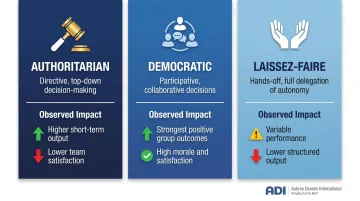
Lewin's work was among the first to demonstrate that behavior, not personality, drives group outcomes. The Ohio State and Michigan programs built directly on that foundation.
Key Behavioral Leadership Types
Behavioral theory doesn't prescribe a single ideal leadership style. It identifies a spectrum of behavioral types that leaders can study, practice, and adapt. Most modern frameworks trace their lineage back to the Ohio State and Michigan foundations.
Task-Oriented Leaders
Task-oriented leaders prioritize goal clarity, process structure, role definition, and output. They excel in environments where deadlines, compliance, or technical precision are non-negotiable—manufacturing operations, regulatory projects, turnaround situations.
The trade-off is predictable: strong on results, weaker on team morale. Sustained task-only leadership tends to suppress intrinsic motivation and can drive disengagement over time.
People-Oriented Leaders
People-oriented leaders invest in relationship-building, mentoring, recognition, and team member well-being. They communicate well, build trust, and tend to drive stronger retention and engagement.
The risk cuts the other way: a high-relationship environment can make it harder to address underperformance directly. Harmony becomes a competing priority with accountability.
Participative (Democratic) Leaders
Participative leaders actively involve team members in decision-making and delegate based on individual strengths. This style tends to generate stronger engagement and creative problem-solving—but it takes more time and coordination than top-down approaches. It works best when team capability is high and timelines allow for collaborative process.
The Blake-Mouton Managerial Grid
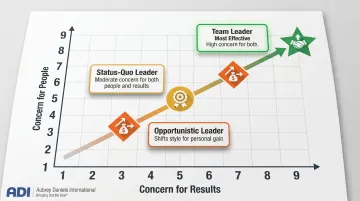
Blake and Mouton's Managerial Grid, developed in the early 1960s, maps leadership styles along two axes: concern for people and concern for results, each scored on a 1–9 scale. Five styles emerge from the grid; three are most relevant to behavioral leadership development:
- Status-quo (5,5): Moderate concern for both people and results, producing acceptable but rarely exceptional performance
- Opportunistic: Style-shifting driven by self-interest rather than team or task needs
- Team Leader (9,9): High concern for both people and results, widely considered the most effective behavioral profile
In practice, the Team Leader style means setting high standards and investing in the people expected to meet them. Performance is addressed directly—without sacrificing the relationships that make sustained effort possible. That balance is where behavioral leadership delivers its strongest results.
Strengths of Behavioral Leadership Theory
Behavioral theory has held up over decades because it offers practical advantages that trait-based frameworks simply can't match—especially for organizations focused on developing leadership at scale.
Leaders Can Be Developed, Not Just Discovered
The most consequential strength is its democratizing premise. Because leadership effectiveness depends on learned behaviors, organizations can build leaders from within rather than searching externally for people who already have the right traits.
The data supports this direction. SHRM research shows that employees promoted internally have substantially higher retention probabilities than those who aren't: approximately 70% versus 45% at the three-year mark. Internal development isn't just philosophically appealing—it produces measurable retention and performance outcomes.
Observable, Measurable, and Trainable
Unlike personality traits, behaviors can be observed, measured, and tracked over time. The LBDQ used frequency ratings from team members to assess how leaders actually behaved—not self-reported intentions. That makes behavioral assessment actionable in ways that trait inventories aren't.
If you can measure a behavior, you can identify gaps, design targeted training, and track whether interventions are working. This gives HR and organizational development teams an actionable framework rather than an abstract personality profile.
Flexible Across Roles and Contexts
Behavioral theory gives leaders a practical toolkit rather than a fixed identity. A leader can apply task-oriented behaviors during a compliance-critical project, then shift to a people-oriented approach when rebuilding a team after a difficult period. The theory's recognition that different behaviors suit different contexts makes it adaptable in ways that single-style frameworks are not.
That flexibility also changes who gets considered for leadership in the first place.
Supports Broader Leadership Pipelines
Because behavioral theory is skills-based rather than trait-based, it removes the implicit barriers that trait-focused selection creates. Leadership development becomes about what someone does: not demographic characteristics, personality type, or "executive presence" defined by subjective criteria. Organizations that make this shift find they can draw from a wider, more diverse pool of candidates—and retain the leaders they develop because the path forward is visible and learnable.
Weaknesses and Limitations
Behavioral theory is genuinely useful, but practitioners who apply it without understanding its limitations will run into predictable problems.
Knowing Behaviors ≠ Executing Them Effectively
The most commonly cited limitation: identifying which behaviors are associated with effective leadership doesn't guarantee a leader can enact them skillfully, at the right moment, or consistently under pressure.
Most leadership training addresses the "what" — here are the behaviors effective leaders demonstrate. It rarely addresses the "why" at a mechanistic level: what conditions prompt those behaviors, what consequences sustain them, and what makes them collapse under pressure.
Without that mechanistic understanding, behavioral training produces awareness. Not durable change.
Context-Dependence and Cultural Variability
Behavioral leadership theory was largely developed from Western organizational research. The GLOBE project—a large cross-national study drawing on data from roughly 17,300 managers across 951 organizations—found that leadership attributes and behavioral effectiveness vary substantially across cultures. A behavior that signals confidence and decisiveness in one cultural context may be read as dismissive or disrespectful in another.
This doesn't invalidate behavioral theory, but it does mean that behavioral frameworks developed in one cultural context can't be exported without adaptation.
Ignores Situational Contingencies
Behavioral theory describes what leaders do. It doesn't fully account for when certain behaviors are appropriate given team composition, task complexity, or crisis conditions. Two models emerged specifically to address this gap:
- Fiedler's Contingency Model (1967): Leader effectiveness depends on the match between leadership style and situational favorability
- Hersey and Blanchard's Situational Leadership: Different leader behaviors are prescribed based on follower readiness
Neither model replaces behavioral theory. Both extend it by adding the situational variables it originally left out.
Behavioral Theory in Practice: From Knowing to Doing
Organizations invest heavily in leadership training built around behavioral theory—and still see inconsistent results. The reason is straightforward: behavior change isn't driven by knowledge alone. It's driven by the antecedents that prompt behavior and the consequences that follow it. Change the knowledge without changing the environment, and old behaviors return.
This is the core distinction between behavioral awareness and genuine behavior change. Leaders can leave a workshop knowing exactly which behaviors correlate with high performance and still revert to previous habits when the organizational environment doesn't reinforce the new ones.
What Sustainable Implementation Requires
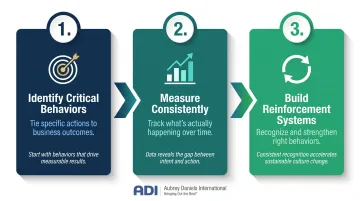
Moving from theory to sustained behavior change requires three things working together:
- Identify the critical behaviors tied to specific business outcomes—not general competencies, but precise actions that drive results
- Measure those behaviors consistently so leaders and their managers can see what's actually happening
- Build reinforcement systems that recognize and strengthen the right behaviors over time, rather than only addressing deficiencies
This is the difference between a training event and a performance system.
How ADI Approaches This Gap
ADI (Aubrey Daniels International) has spent over 45 years applying exactly this principle across more than 400 organizations globally. Their Performance Management approach operationalizes behavioral science through three core elements—measurement, feedback, and positive reinforcement—implemented systematically rather than in isolation.
The Behavioral Roadmapping process works backward from desired business results to identify the specific leader and frontline behaviors that drive those outcomes. Rather than broad directives, leaders get precise behavioral targets.
The Applications of Behavioral Leadership workshop—a 4-day program for managers, supervisors, and team leaders—goes beyond awareness to teach the science of why people do what they do. Using tools like the PIC/NIC Analysis®, leaders learn to understand and shape the consequences that actually drive performance.
The results from this approach are concrete:
- A pharmaceutical sales division moved from 52nd out of 55 in product sales to 1st place
- A railroad freight division cut lost-time injuries by 60% within a year
- A glass manufacturing facility set 16 new productivity records and increased plant throughput by 11%
When behavioral theory is paired with a rigorous consequence system, organizations don't just train new behaviors—they build the conditions that keep those behaviors in place.
Frequently Asked Questions
What is the behavioral theory of leadership?
Behavioral leadership theory holds that effective leadership is determined by observable, learned behaviors rather than innate traits or personality. Because behaviors can be taught and practiced, anyone can develop leadership effectiveness with training and consistent practice.
Who developed the behavioural theory of leadership?
The Ohio State University studies (Hemphill and Coons, 1950s) and University of Michigan studies are the primary contributors, with Kurt Lewin's earlier work in the 1930s–40s serving as an important precursor. Blake and Mouton later expanded the framework with the Managerial Grid in the early 1960s.
What are the main behavioral leadership theories?
Key frameworks include:
- Ohio State Leadership Studies — Initiating Structure and Consideration
- University of Michigan Studies — job-centered vs. employee-centered behaviors
- Kurt Lewin's three leadership styles — authoritarian, democratic, laissez-faire
- Blake and Mouton's Managerial Grid — task vs. people orientation plotted on a grid
What are the key leadership behaviors in behavioral theory?
Behavioral theory groups leadership behaviors into two categories: task-oriented (structuring work, clarifying roles, setting goals) and people-oriented (building relationships, motivating, developing team members). Effective leaders draw on both, shifting emphasis based on what the situation demands.
What are the advantages of behavioral theory of leadership?
The main advantages are:
- Leadership becomes developable, not dependent on innate traits
- Observable behaviors provide measurable criteria for assessment and improvement
- Leaders gain flexibility to adapt their approach across different situations and teams
What is Kurt Lewin's behavioral theory of leadership?
Lewin's framework (1930s–40s) identified three leadership styles—authoritarian (directive, top-down), democratic (collaborative, participative), and laissez-faire (hands-off)—and was among the first to study how leadership behavior, rather than personality, shapes group performance and outcomes.