The issue isn't that leaders lack goals or ambition. It's that most have never been taught the specific, observable actions that translate intention into execution. Research by Ram Charan and Geoffrey Colvin found that 70% of CEO failures stemmed not from flawed strategy but from inability to execute. More recent analysis shows 67% of strategies fail due to poor execution. The pattern is clear: knowing what to achieve matters far less than knowing how to drive the behaviors that produce achievement.
"Drive Results & Performance" is not a personality trait or a motivational attitude. It is a behavioral competency — a cluster of specific, observable, learnable actions that leaders either consistently demonstrate or don't. This article breaks down what this competency means in behavioral terms, what it looks like in practice, why so many leaders fall short, and how organizations can develop it at scale using a science-based approach.
TLDR:
- Drive Results is a behavioral competency — specific, observable actions leaders take to achieve outcomes through others
- Managers account for 70% of variance in employee engagement, making leadership behavior the highest-leverage intervention
- Behavioral indicators include setting clear expectations, providing real-time feedback, and using positive reinforcement instead of fear-based accountability
- Consequences control 80% of behavior; most leaders focus only on antecedents (goals, instructions) and ignore what reinforces performance
- Building this competency requires systemic development — training alone fails; organizations must align feedback, measurement, and reinforcement systems
What Are Leadership Behavioral Competencies?
Leadership behavioral competencies are the observable, repeatable behaviors — not personality traits or credentials — that determine how effectively a leader performs in practice. They're what you consistently do, not who you are or what you know.
This distinction matters because it shifts focus from static qualities to learnable actions. You can't train someone to be "driven" as a personality trait, but you can teach and reinforce the specific behaviors that produce results. As DDI's leadership research emphasizes, competencies are "specific, measurable behaviors and abilities that define what great leadership looks like in action" — distinct from inherent personal attributes like resilience or charisma.
Why behavioral competencies matter:
- Visible in action — you can observe when a leader demonstrates them or doesn't
- Trackable over time through frequency, quality, and consistency of execution
- Teachable through structured reinforcement, unlike fixed personality traits
Consider the difference between these two statements:
- "Sarah is a natural leader" (trait description — not actionable)
- "Sarah sets specific performance expectations, provides weekly feedback, and recognizes progress publicly" (behavioral description — actionable and measurable)
"Drive Results & Performance" sits within a broader leadership competency framework alongside communication, collaboration, and decision-making. What makes it distinct is that it's uniquely outcome-oriented — it sits at the intersection of goal execution, accountability, and team motivation.
Where other competencies shape how leaders interact, this one determines whether organizational priorities actually become measurable results.
According to Korn Ferry's widely adopted Lominger 38 Competencies framework, "Drives Results" means "consistently achieving results, even under tough circumstances. Has a strong bottom-line orientation. Persists in accomplishing objectives despite obstacles and setbacks."
Defining the competency is the starting point. The harder question — the one this article addresses — is which specific behaviors actually produce those results, and how leaders can build them deliberately.
Drive Results & Performance: What This Competency Actually Means
Drive Results & Performance is a behavioral competency cluster: the consistent pattern of behaviors a leader uses to translate organizational goals into measurable outcomes through the actions of others, not their own effort alone.
That distinction matters more than most leadership frameworks acknowledge. A high-performing individual contributor drives results through personal execution. A high-performing leader drives results by creating conditions where others execute at a high level — and that requires an entirely different set of behavioral skills.
This competency is not about:
- Working harder or longer hours
- Pushing teams through pressure or fear
- Measuring activity (hours worked, meetings attended)
- Relying on charisma or motivational speeches
This competency is about:
- Establishing clear expectations and accountability structures
- Creating feedback loops that sustain high performance
- Removing obstacles that prevent execution
- Reinforcing the specific behaviors that produce results
Leaders who "drive results" through fear or compliance may see short-term gains. But decades of applied behavioral research show that punishment-based management reliably produces burnout, turnover, and disengagement — and the gains erode quickly. Lasting performance improvement runs on positive reinforcement, not pressure.
Activity vs. Results: A Critical Distinction
That reinforcement gap shows up most clearly in how leaders measure performance. Many default to activity metrics — effort, attendance, hours logged — rather than tracking the behaviors that actually drive outcomes. Activity-focused leadership asks: "Are people working hard?" Results-focused behavioral leadership asks: "Are people doing the right things, in the right way, to produce the outcomes we need?"
Leaders with this competency shift their attention from outputs (reports submitted, calls made) to behavioral indicators that predict performance — the specific actions that, when done consistently, generate the desired business results.
How This Competency Scales Across Leadership Levels
The behavioral patterns remain consistent whether you're a frontline supervisor or a senior executive. What changes is scope:
- Frontline managers focus on individual and small-team behaviors
- Mid-level leaders align cross-functional behaviors and remove systemic obstacles
- Executives shape organizational systems, cultures, and reinforcement structures
Regardless of level, the core behaviors are the same: clarity, accountability, feedback, and reinforcement.
The Research Link: Manager Behavior Predicts Performance
Gallup research estimates that managers account for at least 70% of the variance in employee engagement scores across business units. This finding, based on two decades of research involving 27 million employees, confirms what behavioral science has long demonstrated: managerial behavior is the dominant variable in team performance.
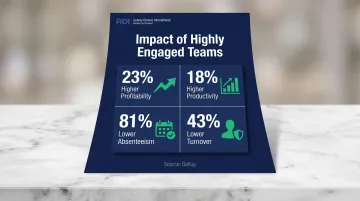
The business impact is substantial. Gallup's 10th employee engagement meta-analysis, covering 112,312 business units, found that highly engaged teams show:
- 23% higher profitability
- 18% higher productivity
- 81% lower absenteeism
- 43% lower turnover in low-turnover organizations
Companies that double their rate of engaged employees achieve 147% higher earnings per share than their competition.
For organizations focused on sustainable performance improvement, this data points to a clear priority: manager behavior is where the highest-leverage investment lives.
The Behavioral Indicators That Define This Competency
Behavioral indicators are the observable "proof points" of a competency — what you would see a leader doing (or not doing) day to day. Without these indicators, the competency remains abstract and unassessable.
Setting Clear and Specific Performance Expectations
Driving results starts with articulating exactly what success looks like — in measurable terms — so team members understand how their daily behavior connects to those outcomes.
What this looks like:
- "By Friday, complete the client audit with zero discrepancies in the compliance section" (specific)
- NOT: "Do your best on the audit" (vague)
Vague directives leave employees guessing. Clear expectations eliminate ambiguity and create shared accountability.
Tracking Progress and Providing Real-Time Feedback
High-performing leaders don't wait for annual reviews to address performance. They monitor leading indicators, check in consistently, and provide feedback close in time to the behavior they want to reinforce or correct.
The timing matters. Key findings from Gallup research make the case clearly:
- 80% of employees who receive meaningful feedback in the past week are fully engaged — far outpacing those reviewed annually
- Employees who receive weekly feedback are 3.6 times more likely to be motivated to do outstanding work
- Only 14% of employees strongly agree that performance reviews inspire them to improve — and traditional reviews make performance worse roughly one-third of the time
The takeaway: shift from delayed, formal reviews to frequent, informal feedback delivered when it matters.
Holding Accountability Without Punitive Management
There's a critical difference between accountability rooted in positive consequences (recognizing progress, reinforcing improvement) and accountability that relies on threat and punishment.
Behavioral science research consistently shows that positive reinforcement builds the discretionary effort that drives exceptional performance. Fear-based accountability creates minimum-compliance cultures where employees do just enough to avoid consequences, not enough to excel.
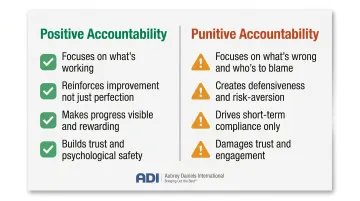
Positive accountability:
- Focuses on what's working and why
- Reinforces improvement, not just perfection
- Makes progress visible and rewarding
- Builds trust and psychological safety
Punitive accountability:
- Focuses on what's wrong and who's to blame
- Creates defensiveness and risk-aversion
- Drives short-term compliance, not sustained commitment
- Damages trust and engagement
Leaders who understand this distinction shape cultures where people want to perform, not where they're afraid not to.
Coaching and Removing Obstacles to Performance
Identifying and removing performance barriers — unclear processes, insufficient resources, skill gaps — is what separates a results-driving leader from one who simply monitors outcomes and assigns blame when things go wrong. The shift is from asking "why didn't you hit the target?" to "what's in the way, and how do I help clear it?"
Recognizing and Reinforcing High Performance
Deliberate, timely recognition of desired behaviors is one of the most underused and highest-impact tools a leader has.
Gallup research shows that only one in three workers strongly agree they received recognition or praise for doing good work in the past seven days. Employees who do not feel adequately recognized are twice as likely to say they will quit within the next year.
Consistently catching and reinforcing the right behaviors shapes cultures where high performance becomes the norm, not the exception. Recognition doesn't require elaborate programs — consistency and specificity are what make it work.
Effective recognition:
- Is timely (within days, not months)
- Is specific (names the behavior, not just the outcome)
- Is genuine (not formulaic or performative)
- Is public when appropriate (visibility reinforces desired behaviors across the team)
The Science Behind Why Some Leaders Drive Results — and Others Don't
Most leaders are never taught the science of behavior. They manage by intuition, precedent, or pressure — approaches that produce inconsistent results at best.
The ABC Model: Antecedents and Consequences
A foundational principle of behavioral science is that all behavior is a function of its antecedents (what comes before) and consequences (what follows). Leaders who understand this principle get far more consistent results from their teams.
Antecedents include:
- Goals, instructions, policies
- Meetings, emails, training
- Expectations and directives
Consequences include:
- Recognition, praise, rewards
- Feedback (positive or corrective)
- Accountability (supportive or punitive)
Here's the critical insight: antecedents control approximately 20% of behavior. Consequences control approximately 80%.
Most leaders focus almost exclusively on antecedents — setting goals, communicating expectations, sending reminders — and neglect the consequence side of the equation. This is why well-communicated goals still fail to produce sustained results.
Reinforced behavior gets repeated. Ignored or punished behavior fades. To change performance, change the consequences that follow the behaviors you care about.
Discretionary Effort: The Performance Gap Most Leaders Never Unlock
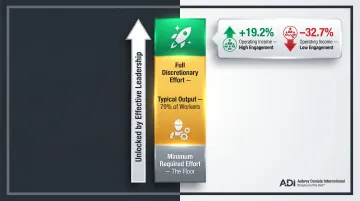
Research from Towers Perrin's Global Workforce Study found that only 21% of workers give full discretionary effort on the job. This study surveyed approximately 90,000 employees across 18 countries, revealing that nearly 80% of the global workforce is not living up to their full potential.
Discretionary effort is the gap between the minimum performance required to keep a job and the maximum an employee is capable of giving. Leaders who understand behavior and create reinforcing work environments unlock that gap consistently — and the financial impact is significant: high-engagement companies in the Towers Perrin study saw 19.2% operating income growth, while low-engagement companies saw a -32.7% decline.
Why High Performers Fail as Leaders
Leaders who are high performers individually often rely on the same internal motivators that drive their own behavior — ambition, personal standards, fear of failure — and incorrectly assume those motivators work for everyone on their team.
The research bears this out: CEB/Gartner found that 60% of new managers fail within the first 24 months in their new role, and 60% receive no training when making that transition.
Most never learned to identify the reinforcers that matter to each individual. What motivates you may not motivate your direct report. Effective leaders diagnose what consequences actually drive behavior for each person on their team, then create those consequences deliberately.
How to Build the Drive Results Competency in Your Leadership Culture
Because "Drive Results & Performance" is a behavioral competency, it can be systematically developed — but only when development moves past awareness training into sustained behavior change.
Knowledge of what to do is not sufficient. Leaders need practice, feedback, and reinforcement of the right behaviors over time to build fluency.
Why One-Time Training Fails
Harvard Business Review research by Beer, Finnstrom, and Schrader found that only 12% of employees apply new skills from training programs to their actual jobs. American companies spent $160 billion on employee training in the U.S. in 2015, yet only 1 in 4 senior managers reported that training was critical to business outcomes.
The authors call this "the great training robbery." The problem isn't the content — it's the lack of systemic support for behavior change after the training ends.
What Effective Competency Development Looks Like
Building the Drive Results competency at scale requires:
- Define observable behavioral standards — specify what "driving results" looks like at each leadership level with concrete, measurable actions, not vague aspirations.
- Track leader behavior, not just outcomes — measure whether leaders are providing weekly feedback, recognizing high performance, and removing obstacles.
- Build real-time coaching processes — feedback delivered six months after the fact makes behavior change nearly impossible; it needs to be close in time to the behavior.
- Align organizational systems to reinforce the target behaviors — if the broader environment rewards short-term compliance over sustainable performance, individual leaders will struggle regardless of training quality.
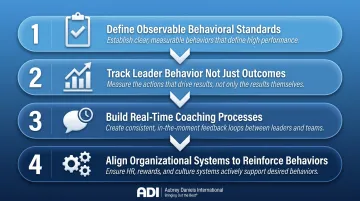
Each of these four elements is addressed in ADI's behavior-based Performance Management approach. Through tools like Precision Leadership and structured behavioral roadmapping, organizations translate abstract competencies into observable, coachable actions — embedding the right behaviors into how performance is managed, measured, and reinforced across the organization.
The Role of Organizational Culture
Culture is not a standalone initiative. It's the sum of which behaviors get reinforced, which get ignored, and which get punished. Sustained competency development requires that the systems, feedback loops, and consequence structures surrounding leaders actively support the behaviors you want to see — not undermine them.
Organizations that succeed do more than train leaders. They redesign the work environment so that high-performance leadership becomes the default, not the exception.
Frequently Asked Questions
What are the key leadership behavioural competencies?
Leadership competency frameworks typically include clusters like driving results, communicating effectively, developing others, decision-making, and building trust. The most impactful are those tied to observable, measurable behaviors — not broad personality traits — making them both developable and assessable.
What are the 4 behavioural leadership styles?
The four behavioral leadership styles from situational leadership are directing, coaching, supporting, and delegating. These styles describe how a leader adapts their approach based on follower readiness. Behavioral competencies, by contrast, describe what a leader consistently does to drive outcomes regardless of style.
What is the difference between a leadership behavioral competency and a leadership trait?
Traits describe who a leader is (confident, resilient, driven) and are relatively stable over time. Behavioral competencies describe what a leader consistently does in observable, learnable actions. Competencies, unlike traits, can be deliberately developed, objectively measured, and systematically improved through practice and feedback.
Why do some high-performing individual contributors fail to drive results as leaders?
High-performing individuals typically succeed through their own motivators and work habits. Leading others requires a different skill entirely: understanding what reinforces someone else's behavior. Most are never taught how to diagnose that or how to build consequences that sustain desired performance.
How can organizations measure whether their leaders have the Drive Results competency?
Assess this competency through behavioral observation, 360-degree feedback tied to specific indicators, and structured assessments of what leaders actually do. The focus should be on leading behaviors — feedback frequency, recognition patterns, coaching actions — rather than lagging business outcomes alone.