According to the National Safety Council, preventable work injuries cost U.S. employers $181.4 billion in 2024 — including $54.9 billion in wage and productivity losses and $36.8 billion in medical expenses. That figure doesn't include the harder-to-quantify costs: turnover, disengagement, regulatory scrutiny, and reputational damage.
"Safety culture" gets discussed frequently, but its value is often described in abstract terms. This article focuses on what a positive safety culture actually produces — measurable outcomes tied to cost, risk, employee behavior, and organizational resilience — and what goes wrong when it's missing.
Key Takeaways
- A positive safety culture is a shared set of values and behaviors that treats safety as a genuine commitment, not just a policy obligation.
- Organizations with strong safety cultures see measurable reductions in injury rates, workers' compensation costs, and regulatory exposure.
- Safety culture directly shapes employee engagement, retention, and performance — people who feel genuinely protected do better work and stay longer.
- Behavior-based safety culture is self-sustaining — it shapes how people act when no one is watching, which compliance-driven programs never achieve.
- Building it requires visible leadership commitment, consistent reinforcement of safe behaviors, and systems that make safe choices the default.
What Is a Positive Safety Culture?
A positive safety culture is the collective attitudes, beliefs, and behaviors within an organization that consistently prioritize the well-being of every person at work — not because rules require it, but because it's genuinely valued.
This is distinct from a compliance culture, where safety is reactive and rule-driven. In a compliance culture, people follow the rules when someone is watching. In a safety culture, they follow them when no one is.
Where It Applies
Positive safety culture is relevant across every industry where humans perform work and face risk — manufacturing, construction, utilities, mining, healthcare, transportation, even office environments where risk isn't immediately visible. The specific hazards differ; the behavioral dynamics don't.
What It Actually Does
Safety culture isn't an end in itself. It's the environment that makes consistently safe behavior both natural and expected. That environment is what drives injury reduction, operational stability, and the kind of employee trust that translates into discretionary effort.
The distinction matters because organizations often invest in safety programs — training, equipment, procedures — without addressing the behavioral conditions that determine whether those programs actually work.
As ADI's Safe by Accident (Agnew & Daniels) makes clear, a low incident rate is no guarantee an organization is genuinely safe. Without the underlying culture, good results often reflect luck more than design.
Why Positive Safety Culture Matters: Key Business Outcomes
The three advantages below focus on outcomes organizations can actually track. They also compound — each one reinforces the others when culture is built deliberately rather than reactively.
Advantage 1: Reduced Injuries, Costs, and Regulatory Exposure
A positive safety culture reduces incident frequency and severity by shaping behavior before accidents happen. When employees at every level feel empowered to report hazards and raise concerns without fear of retaliation, near-misses surface early and risks get addressed before they escalate.
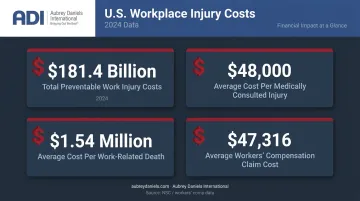
The cost equation is significant:
- $181.4 billion — total cost of preventable U.S. work injuries in 2024 (NSC)
- $48,000 — average cost per medically consulted injury
- $1.54 million — average cost per work-related death
- $47,316 — average workers' compensation claim cost for 2022–2023 accidents
Over 60% of CFOs report that each $1 invested in injury prevention returns $2 or more, according to OSHA's Business Case for Safety and Health. Organizations with strong safety cultures spend more upfront on prevention but far less on workers' compensation, incident investigations, downtime, fines, and legal liability.
Regulatory exposure adds another layer. OSHA maximum penalties as of January 2025 reach $165,514 per willful or repeated violation — plus $16,550 per day for failure to abate. A single serious incident can trigger inspections, investigations, and citation timelines that consume months of leadership attention.
The performance gap is documented: OSHA Voluntary Protection Program participants average DART rates 52% below their industry averages, with 2021 federal site data showing VPP participants 57% below BLS DART averages. That gap reflects what a sustained safety management culture — not just policy — actually produces.
KPIs impacted: TRIR, DART rates, workers' compensation costs, OSHA citation rates, days away from work, near-miss reporting volume.
Advantage 2: Higher Employee Engagement, Retention, and Productivity
Employees who believe their organization genuinely cares about their safety are more engaged, more loyal, and more productive. Physical and psychological safety are foundational to discretionary effort — the effort people choose to give beyond the minimum required.
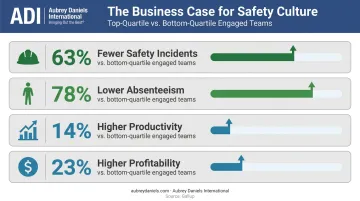
The Gallup data on this is direct: top-quartile engaged teams have 63% fewer safety incidents, 78% lower absenteeism, 14% higher productivity, and 23% higher profitability than bottom-quartile teams. Safety culture and engagement aren't parallel concerns — they're the same concern expressed differently.
The retention cost is concrete:
- SHRM reports average cost-per-hire of nearly $4,700
- In high-turnover industries like healthcare, construction, and manufacturing, the full cost of replacing a frontline worker — including onboarding and ramp time — often runs 3–4x that number
- A 2020 peer-reviewed study of mine workers found safety climate was directly and negatively related to turnover intention
ADI's work with organizations across these sectors consistently shows that safety engagement is discretionary behavior — it cannot be mandated, only earned. When leaders build trust through positive reinforcement and treat near-misses as learning opportunities rather than blame events, employees contribute voluntarily rather than minimally.
That same dynamic drives productivity. Workers not managing anxiety about hazards or morale problems focus better and make fewer errors. One PMC-indexed occupational health study found a perceived safe workplace correlated with 1.82 times higher odds of optimal sleep and 1.56 times higher odds of meeting physical activity guidelines — both of which directly affect cognitive performance and error rates.
KPIs impacted: Employee retention rate, absenteeism, engagement scores, productivity metrics, error/defect rates.
Advantage 3: Organizational Resilience and Reputational Strength
Organizations with embedded safety cultures recover faster from incidents and hold their footing under pressure. They're also better positioned to attract clients, talent, and partners. Safety culture builds institutional habits — consistent reporting processes, clear accountability — that hold when a crisis hits.
Several dimensions of this matter:
- Insurance premiums are directly tied to safety performance through experience rating (EMR). Organizations with strong safety records pay substantially less for workers' compensation coverage, and that differential compounds over time.
- Contract eligibility is increasingly gated on safety records. California State University's trade contractor prequalification, for example, requires three years of OSHA 300/300A data and a minimum safety composite score, with EMR thresholds for smaller firms. Government and institutional clients increasingly use similar criteria.
- ESG reporting now requires OHS disclosures under GRI 403, effective January 2021. Organizations with weak safety cultures face growing disclosure obligations that make their track records visible to investors, partners, and customers.
A serious workplace incident also carries an operational continuity cost that rarely shows up in prevention budgets. OSHA requires fatality reporting within 8 hours. Citation timelines can extend six months. Production stoppages, investigations, and leadership distraction during that window cost far more than any preventive investment.
KPIs impacted: Insurance premium rates, audit outcomes, customer retention, bid win rates, employer brand scores.
What Happens When Safety Culture Is Weak or Absent
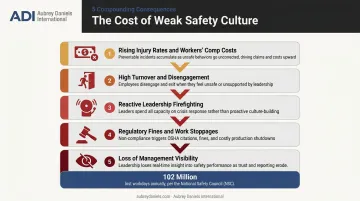
The pattern in low-safety-culture environments is consistent: incidents get treated as isolated events rather than systemic signals. Near-misses go unreported because employees fear blame. Safety practices exist on paper but not in daily behavior. Problems compound invisibly until they become catastrophic.
The measurable consequences include:
- Rising injury rates and workers' compensation costs that erode margins over time
- High turnover, absenteeism, and disengagement — particularly among frontline workers who feel most exposed
- Reactive firefighting that consumes leadership attention without addressing root causes
- Regulatory scrutiny, fines, or work stoppages that disrupt operations and damage reputation
- Difficulty scaling or delegating because no shared behavioral norms exist
This deterioration compounds in ways that aren't always visible until it's too late. NSC data shows 102 million days were lost to work injuries in 2024, including effects of prior-year injuries — and estimates that 54 million additional days will be lost in future years from permanent disabilities incurred in 2024 alone. Weak safety culture doesn't plateau. It tends to deteriorate as near-miss reporting drops, trust erodes, and management loses visibility into real conditions on the floor.
The Behavioral Science Behind Lasting Safety Culture
Most organizations try to build safety culture through rules, warnings, and consequences for violations. Behavioral science shows this approach has a fundamental limitation: antecedents — signs, policies, and training — influence behavior initially, but it's consequences that sustain it.
Reinforcement, Not Just Rules
When safe behaviors are consistently acknowledged and positively reinforced, those behaviors become habits. When safe behaviors are ignored and only unsafe behaviors trigger a response, the culture trains employees to see safety as bureaucratic rather than meaningful.
ADI's Safe by Accident?, co-authored by ADI's Judy Agnew, addresses exactly this dynamic. Drawing on applied behavior analysis, it shows how reinforcement patterns shape workplace safety and identifies seven common leadership practices that actively undermine safety culture — with guidance on what to do instead.
The core finding: positive reinforcement is required for sustained behavior change. Punishment and compliance pressure produce minimum behavior; reinforcement produces discretionary effort.
The "Safe by Accident" Trap
Many organizations have good safety records not because of strong culture but because hazards haven't combined in the wrong way yet. True safety culture means safety is built into how people think and act by default — not just when being observed or reminded. The distinction between these two states is invisible in lagging indicators, which is precisely why so many organizations discover their culture problem only after a serious incident.
Leading vs. Lagging Indicators
Organizations that measure only lagging indicators — injury rates after they happen — miss the behavioral signals that predict future incidents. A behavior-based safety culture tracks leading indicators: safe and at-risk behaviors, near-miss reporting rates, observation data, and quality of safety interactions.
ADI's Behavioral Roadmapping process defines these leading indicators at each organizational level, establishing what genuine safety engagement looks like from the C-suite to the frontline. Measurable behaviors that predict incidents before they happen include:
- Supervisors conducting meaningful safety conversations rather than compliance check-ins
- Operators actively assessing hazards instead of completing forms by rote
- Executives using safety tours to learn from the frontline rather than to inspect it
How to Strengthen Your Organization's Safety Culture
Building a positive safety culture isn't a one-time initiative. It requires consistent application of a few foundational practices that reinforce safe behaviors over time.
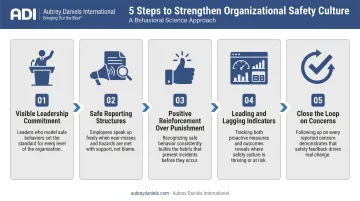
Start with visible leadership commitment — leaders must model safe behaviors, acknowledge and reinforce safe choices, and treat safety concerns as valuable signals. Leaders set the behavioral norms that everyone else follows.
Create safe reporting structures — employees need to surface hazards, near-misses, and concerns without fear of blame. High near-miss reporting volume is a sign of cultural health, not failure.
Shift from punitive to positive reinforcement — recognize safe behaviors with the same energy typically reserved for production achievements. This is the behavioral mechanism that makes culture durable.
Use leading indicators alongside lagging ones — track the behaviors and conditions that predict incidents before they occur. ADI's PIC/NIC Analysis® identifies the behavioral root causes of incidents and the contextual factors that enable at-risk behavior.
Close the loop on reported concerns — safety culture erodes when insights are collected but not acted on. Visible follow-through on reported hazards builds the trust that sustains proactive reporting.
ADI's Safety Leadership programs put these practices into action through structured assessment, customized training, behavioral roadmapping, and follow-up coaching. The goal is a measurable shift from reactive compliance to daily decision-making where safety is the default — not the exception.
Conclusion
A positive safety culture is a measurable operational asset — one that reduces costs, strengthens performance, and builds the organizational resilience that protects long-term growth. Organizations that treat it as a compliance exercise or a morale initiative miss the compounding returns that come from treating it as a strategic priority.
The advantages build on each other. Fewer incidents reduce costs and regulatory exposure. Higher engagement reduces turnover and improves productivity. Stronger resilience protects market access and brand reputation. When culture is applied consistently, these effects compound: early investment pays increasing dividends over time.
The difference between organizations that truly achieve safety and those that merely avoid violations comes down to behavior — what people do when no one is watching. Policies set expectations. Culture determines whether those expectations are actually met. Behavioral science gives organizations a systematic way to close that gap, at every level, every day.
Frequently Asked Questions
Why is a positive safety culture important?
A positive safety culture shapes the behaviors that prevent incidents before they happen — reducing injury rates, costs, and regulatory liability while improving employee trust and performance. Unlike policies alone, culture influences what people do consistently, not just when they're being observed or reminded.
What are the 3 C's of safety culture?
The 3 C's are commonly described as Commitment, Competence, and Communication. Leadership must be genuinely committed to safety, employees must have the skills to work safely, and open communication must flow freely so hazards are identified and resolved before they escalate. Some frameworks, including HSE's, add a fourth element: Co-operation.
What is the difference between safety culture and safety climate?
Safety culture refers to the deep-rooted values, beliefs, and behavioral norms around safety that persist over time. Safety climate is a snapshot of employees' current perceptions and attitudes at a given moment. Strong culture produces a consistently positive climate — but climate can shift quickly when leadership behaviors change.
What role does leadership play in building safety culture?
Leaders set the behavioral norms for the entire organization through what they visibly prioritize, reinforce, and respond to. Safety culture cannot be delegated — it takes shape from what leaders consistently do, not just what they say.
How do you measure the effectiveness of a safety culture?
Effective measurement combines lagging indicators — injury rates, workers' compensation claims, OSHA citations — with leading indicators like near-miss reporting volume and employee survey scores on safety trust. A healthy safety culture shows sustained improvement across both categories over time.
What happens to organizations with a poor safety culture?
Organizations with weak safety cultures typically see rising incident rates, high turnover, and regulatory penalties — compounded by a reactive cycle where employees stop reporting early warning signs. Trust erodes, and management loses visibility into real conditions on the floor, making the situation progressively harder to reverse.