Introduction
Most organizations fail not because their strategies are flawed, but because they cannot execute them. According to Project Management Institute research, only 50% of projects meet modern success criteria—37% deliver only partial results, and 13% fail entirely. More striking: 35% of senior executives cite the disconnect between planning and execution as the primary obstacle to transformation.
The barrier is rarely the strategy itself. It's the behaviors that either support or undermine it every day.
Team execution coaching bridges this divide by translating strategy into consistent, measurable action. Unlike executive coaching—which focuses on individual leadership development—team execution coaching targets the collective behaviors that drive organizational results.
It's built for team leaders, managers, and organizational coaches who need more than buy-in. They need daily follow-through.
When coaches understand what drives and sustains behavior, they can produce consistent performance that motivational tactics alone rarely achieve. This article covers best practices grounded in behavioral science, practical performance tips, and methods for making execution gains last beyond the next all-hands meeting.
Key Takeaways
- Team execution coaching aligns individual behaviors with team goals through systematic reinforcement
- Behavioral science, specifically identifying what reinforces action, drives sustainable performance results
- Best practices: set clear behavioral expectations, deliver timely feedback, monitor behavior frequency, coach to strengths
- Avoid coaching outcomes instead of behaviors, relying on pressure tactics, and abandoning feedback loops post-intervention
- Sustainable improvement requires embedding coaching into daily management, not one-time fixes
Why Most Business Teams Fall Short on Execution
The execution gap is well-documented. Harvard Business Review reports that 67% of well-formulated strategies fail due to poor execution. 95% of employees don't understand their organization's strategy, according to research by Kaplan and Norton.
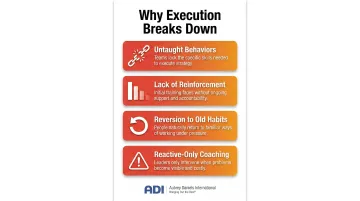
Root causes stem from behavioral breakdowns:
- Teams can't execute behaviors they haven't been taught to recognize or perform
- Desired behaviors fade without regular reinforcement from managers
- Employees revert to old habits when correct execution goes unnoticed
- Coaching that only reacts to problems misses the chance to reinforce progress
Traditional motivation-focused approaches produce temporary spikes, not lasting change. Inspirational speeches and annual goal-setting sessions lack the behavioral follow-through that sustained execution requires.
Research from Harvard Business School documented in "Goals Gone Wild" shows that goal-setting without monitoring and behavioral support can narrow focus, distort risk preferences, and even increase unethical behavior. What organizations need is systematic behavioral coaching — not another round of strategy sessions.
The Behavioral Science Foundation of Team Execution Coaching
Applied Behavior Analysis and the ABC Model
Effective team execution coaching is grounded in Applied Behavior Analysis (ABA), the science of understanding how behavior is shaped by its consequences. The foundation is the ABC model:
- Antecedents: What prompts the behavior (instructions, environmental cues, deadlines)
- Behavior: The specific, observable action
- Consequences: What happens immediately after, which determines if the behavior repeats
According to the OBM Network, Organizational Behavior Management applies these principles to workplace performance. Unlike intuition-based coaching, the ABC framework provides reliable, testable methods for changing behavior.
Positive Reinforcement Drives Consistency
Reinforcement that immediately follows desired behavior increases the likelihood it will recur. Meta-analysis research examining 96 performance feedback applications found that feedback consistently produces large effect sizes on workplace performance. The catch: results only hold when feedback is delivered with proper timing, specificity, and source credibility.
The distinction between positive reinforcement and generic praise matters. Frequency, specificity, and timing are critical. Gallup research shows that 80% of employees who received meaningful feedback in the past week are fully engaged—and employees are 3.6 times more likely to be motivated to do outstanding work when managers provide daily feedback versus annual reviews.
Discretionary Effort: The Performance Multiplier
That consistent reinforcement is what converts compliant performance into something far more valuable. Discretionary effort is the difference between what employees must do to keep their jobs and what they willingly do when engaged and reinforced. Positive reinforcement is the only mechanism through which organizations earn this extra effort. Negative reinforcement — managing by exception — suppresses it, motivating only enough to avoid consequences.
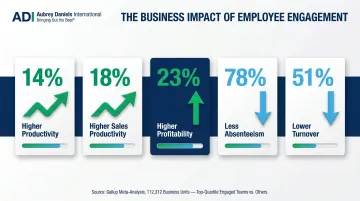
The impact is measurable. Gallup's meta-analysis of 112,312 business units found that highly engaged teams (top quartile) demonstrate:
- 14% higher productivity
- 18% higher sales productivity
- 23% higher profitability
- 78% less absenteeism
- 51% lower turnover
The Power of Pinpointing
Coaching "be more accountable" fails because it's vague. Coaching "submit project status updates every Friday by 3pm" works because it's specific, observable, and measurable. This is called pinpointing—identifying exact behaviors that drive results.
ADI's Performance Management methodology, developed over 45+ years of applying behavioral science in business settings, structures this process systematically. Rather than coaching traits or attitudes, effective coaches focus on what people actually do — the specific actions that can be observed, measured, and directly tied to outcomes. That shift from vague to precise is where performance improvement becomes reliable.
Best Practices for Team Execution Coaching
Align Expectations Before You Coach Behaviors
Begin with clarity. Every team member must understand what excellent execution looks like in behavioral terms.
Translation process:
- Identify the team outcome (e.g., "reduce project delays")
- Pinpoint behaviors that produce it (e.g., "communicate blockers in daily standups," "update task status within 24 hours")
- Connect individual roles to team outcomes and outcomes to organizational strategy
When people see the direct "line of sight" between their daily actions and business results, they stop waiting to be managed — they execute because the purpose is clear. ADI's approach emphasizes designing organizational systems, work processes, and leadership practices to reinforce these behaviors consistently.
Use Reinforcement Strategically, Not Randomly
Timing and ratio determine whether new behaviors stick or fade. Most coaches underestimate how much schedule matters.
Reinforcement schedules:
- Continuous reinforcement — reinforce every instance during early skill acquisition to build the behavior quickly
- Intermittent reinforcement — shift to variable schedules once the skill is established to make it durable and harder to lose
Based on B.F. Skinner's research on schedules of reinforcement, coaches should reinforce consistently during learning phases, then shift to variable schedules to sustain performance long-term.
Deliver specific, behavior-focused feedback:
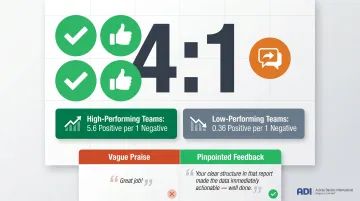
❌ Vague: "Great job on that project."
✅ Pinpointed: "The way you caught that scope change before it escalated kept the whole project on track—that's exactly the proactive communication we need."
ADI recommends a 4:1 ratio — at least four positive comments for every corrective one. Zenger and Folkman's research puts data behind this: high-performing teams received 5.6 positive comments for every 1 negative, while low-performing teams averaged 0.36:1 (roughly 3 negatives for every positive).
Build a Feedback Loop That Drives Real-Time Correction
Brief, frequent check-ins focused on behaviors outperform monthly or quarterly reviews. Gallup recommends feedback frequency of a few times per week for most jobs.
Effective check-ins include:
- Behavioral observation (what specifically happened)
- Specific acknowledgment of correct execution
- Collaborative problem-solving for gaps
Coach failures without damaging psychological safety:
- Address the behavior, not the person
- Use data to make corrections objective and improvement-oriented
- Frame gaps as learning opportunities, not character flaws
Develop Individuals While Strengthening the Team
Individual development and team cohesion aren't competing priorities — they reinforce each other. Developing each person's execution capabilities (skills, confidence, behavioral habits) directly strengthens the team's ability to coordinate and deliver consistently.
Team performance is the aggregate of individual behaviors working in aligned patterns. Coaches must:
- Identify individual strengths and assign roles accordingly
- Reinforce behaviors that support teammates (sharing information, offering help, acknowledging contributions)
- Create peer-to-peer reinforcement systems where team members recognize each other's execution
How to Make Execution Improvements Stick
The Sustainability Problem
Many teams see performance gains during active coaching that erode afterward. This happens because the reinforcement environment reverts—not because the team forgot what to do.
Design self-sustaining reinforcement:
- Embed recognition into team rituals (standup shout-outs, weekly wins)
- Build reinforcement into Standard Operating Procedures and control plans
- Create visible performance tracking that provides ongoing feedback
Shift from Coach-Driven to Leader-Driven Reinforcement
The goal of team execution coaching is to build coaching capability in the team's own leaders. Gallup research shows that managers account for 70% of the variance in team engagement—making frontline manager coaching essential for sustainability.
ADI's certification programs help organizations build that internal capability at scale, making behavioral coaching a standard part of how managers lead—not a skill that lives only with an outside consultant.
Data and Accountability Structures Sustain Execution
Between formal coaching sessions, these keep reinforcement alive:
- Track behavior frequency and progress with visible dashboards teams can reference daily
- Build peer recognition into team rhythms so acknowledgment doesn't depend on a manager
- Run brief behavioral reviews to spotlight what's working and course-correct what isn't
Measuring the Impact of Your Team Execution Coaching
Two-Tier Measurement Approach
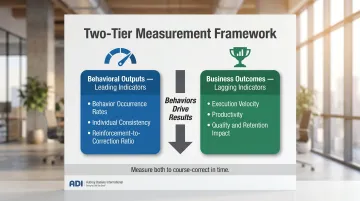
Measure both behavioral outputs and business outcomes:
Behavioral outputs (leading indicators):
- Are pinpointed behaviors occurring at target rates?
- How consistently are individuals executing?
- What is the reinforcement-to-correction ratio in team interactions?
Business outcomes (lagging indicators):
- Are those behaviors producing results?
- What is team execution velocity (time from decision to action)?
- What are the bottom-line impacts (productivity, quality, safety, retention)?
Measuring outcomes alone is not enough. By the time outcome data surfaces, the opportunity to correct the underlying behaviors has already closed.
Key Metrics to Track
- Count specific pinpointed behaviors — for example, status updates submitted on time
- Track what percentage of team members execute at target levels consistently
- Measure execution velocity: how quickly the team moves from decision to completed action
- Monitor reinforcement ratios: positive feedback versus corrective feedback in team interactions
A workplace coaching meta-analysis found an aggregate effect size of Hedge's g = 0.44, a medium positive effect across skill development, well-being, and goal attainment outcomes. ROI data from the International Coaching Federation puts the average return at 700% on the coaching investment.
Use Data to Refine Coaching
Measurement closes the feedback loop for coaches:
- If behaviors aren't occurring, antecedents may need adjustment (clearer instructions, better tools)
- If behaviors occur but results lag, the pinpoints may be wrong
- If reinforcement ratios are too low, increase positive feedback frequency
Frequently Asked Questions
What are the 5 C's of high performing teams?
Gallup identifies five tactics: Common Purpose, Connection, Communication, Collaboration, and Celebration. Each translates to execution behaviors—teams with common purpose align actions to shared goals, connection builds trust that enables coordination, and celebration reinforces successful execution.
What are the 7 traits of a high performing team?
Google's Project Aristotle identified five key team dynamics: Psychological Safety, Dependability, Structure and Clarity, Meaning, and Impact. Execution coaching reinforces each—coaching clarifies structure, feedback builds dependability, and recognition creates meaning.
What is the 70/30 rule in coaching?
The 70/30 rule means the coachee speaks 70% of the time while the coach speaks 30%. In team execution conversations, this plays out through questions that help individuals surface their own behavioral barriers rather than receiving top-down direction.
What is the 80/20 rule in coaching?
The Pareto Principle applied to coaching: 80% of team execution results often stem from 20% of critical behaviors. Effective coaches identify and pinpoint the highest-leverage behaviors to reinforce first, rather than trying to improve everything at once. Focus creates faster, more sustainable gains.
What does execution mean in football?
In football, execution means players carrying out their assigned roles with precision and coordination. The business parallel is direct: in both contexts, execution is translating a plan into consistent, aligned action under pressure—and results depend on performing the playbook reliably, not just knowing it.
Ready to build a coaching culture that drives sustainable execution? Aubrey Daniels International brings over 45 years of applied behavioral science to help organizations close the gap between strategy and consistent team performance. Reach us at info@aubreydaniels.com or call 1-678-904-6140 to learn how our Performance Management methodology and coaching certification programs can make execution a reliable habit in your organization.