Introduction
US organizations spent $98 billion on training in 2024, yet performance rarely improves in proportion to that investment. The reason isn't a lack of effort — it's a structural problem. Most training programs stop at knowledge delivery and never reach the point where new knowledge becomes new behavior on the job.
The gap between "employees completed the training" and "employees perform differently" is where most L&D initiatives break down. Attendance doesn't equal behavior change, and comprehension doesn't equal competence. Satisfaction scores — the most common post-training metric — tell you almost nothing about whether performance actually shifted.
This article walks through a step-by-step, behaviorally grounded approach to designing training that actually moves performance metrics — covering what to do before, during, and after training, plus the variables that determine whether any of it sticks.
Key Takeaways
- Training improves performance only when it changes on-the-job behavior — not just what employees know.
- The first step is diagnosing why performance is falling short — skill gap or reinforcement gap — before selecting any training solution.
- Manager reinforcement after training determines whether new behaviors actually stick.
- Most programs fail by skipping behavior practice, on-the-job application support, and accountability follow-through.
- Lasting improvement requires a system — feedback, positive reinforcement, and behavioral accountability working together.
How to Improve Employee Performance Through Training and Development
Step 1: Diagnose the Performance Gap Before Designing Any Training
Not every performance problem is a training problem. Before selecting a solution, determine the actual root cause.
Two distinct gap types require different interventions:
- Skill/knowledge gap — the employee genuinely doesn't know how to perform the task. Training can help.
- Reinforcement/motivation gap — the employee knows what to do but doesn't do it consistently because the environment doesn't reinforce it. Training won't fix this.
Applying training to a reinforcement problem wastes resources and frustrates employees who already know what's expected.
Practical diagnostic methods:
- Review performance data and output metrics to identify where and when gaps occur
- Observe employee behavior directly on the job — what actually happens, not what's reported
- Conduct structured interviews with managers to understand context and patterns
- Survey employees to surface environmental barriers, unclear expectations, or conflicting incentives
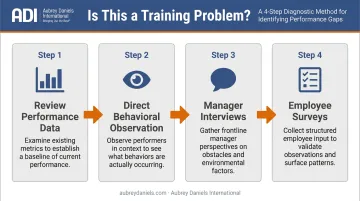
ADI's organizational assessments use this exact approach — interviews, focus groups, and direct behavioral observation — to determine whether performance issues stem from skill deficits, motivational factors, or environmental constraints before any training recommendation is made.
Once you've confirmed a genuine skill gap, the next step is defining exactly what success looks like.
Step 2: Define Clear, Measurable Behavioral Outcomes
Vague objectives like "employees will understand safety procedures" are useless as performance targets. Understanding isn't behavior. If you can't observe it and measure it, you can't manage it.
What a behavior-based learning objective looks like:
"The employee will accurately complete X task in Y minutes without prompting, within the first week on the floor."
That's specific. It's observable. It's measurable. It also makes it possible to assess whether training actually worked.
ADI's Behavioral Roadmapping process works backward from desired business results to define the critical few behaviors at each organizational level that drive those results — connecting learning objectives directly to on-the-job performance rather than leaving transfer to chance.
When writing behavioral objectives, specify:
- The observable action (what the employee will do)
- The context (under what conditions)
- The proficiency standard (how well, how fast, how consistently)
With clear objectives in hand, you can make an informed decision about delivery format.
Step 3: Select Training Methods That Match the Skill Being Developed
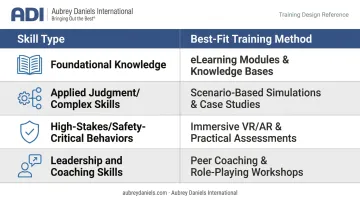
Format matters. Using the wrong method for the skill type wastes time and produces poor transfer.
| Skill Type | Best-Fit Training Method |
|---|---|
| Foundational knowledge | E-learning, instructor-led workshops |
| Applied judgment, complex skills | On-the-job training, coaching, mentoring |
| High-stakes or safety-critical behaviors | Simulation, role-play, behavioral rehearsal |
| Leadership and coaching skills | Applications-based workshops, feedback practice |
The fluency principle: A single training event builds awareness. Fluency — the ability to perform accurately and automatically under real job conditions — requires repeated, spaced practice over time. Research by Cepeda et al. synthesizing 839 assessments across 317 experiments confirms that distributed practice consistently outperforms massed practice for long-term retention.
ADI's fluency-based learning approach puts this into practice. In one medical insurance engagement, redesigning new hire training around fluency-building reduced time to reach seasoned-underwriter performance from 26 weeks to 3 weeks — with a 31% improvement in Average Handle Time and a 43% gain in After Call Wrap performance.
Choosing the right format is only half the equation. How the training is delivered determines whether skills actually transfer.
Step 4: Design Active Practice and Application Into the Training Itself
Passive exposure — lectures, slide decks, videos without interaction — produces awareness, not competence. Employees need to practice the target behavior during training, not just receive information about it.
What effective active practice looks like:
- Employees perform the target behavior (not just discuss it) during the session
- Corrective feedback is delivered in real time, not days later
- Practice scenarios progressively mirror actual job conditions
- Difficulty increases as proficiency develops
ADI's workshops are designed as working sessions, not passive presentations. The Applications of Behavioral Leadership workshop, for example, is built entirely around skill practice.
Participants work through behavioral coaching scenarios, apply the PIC/NIC Analysis® to real performance challenges, and leave with a behavioral roadmap tied to their specific organizational context.
Accommodate varied learning approaches — visual, auditory, kinesthetic, and reading-based formats — to maximize engagement across a diverse workforce and improve transfer rates across different roles and learning styles.
Even the best-designed training won't hold without what comes next.
Step 5: Build Reinforcement and Accountability Into the Post-Training Period
This is where most training programs fail entirely.
Saks and Belcourt's research across 150 organizations found that 62% of employees apply training immediately after completion, but only 34% are still applying it one year later. Without structured reinforcement, trained behaviors revert to old habits within weeks.
The manager's role in this phase is non-negotiable:
- Observe employees applying new skills in real work situations
- Provide specific, immediate positive feedback when the behavior occurs
- Prompt the behavior when it lapses — don't wait for performance reviews
- Connect the new behavior to meaningful consequences
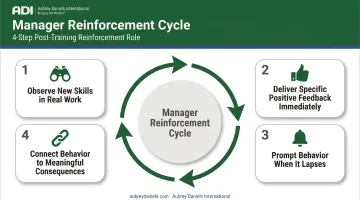
ADI builds this into every implementation. All workshop programs are reinforced through post-training coaching and support — delivered either by ADI consultants or by internally certified coaches.
The Precision Leadership® system gives managers structured tools for real-time behavioral feedback, upward feedback surveys, and coaching debriefs that produce specific action steps rather than generic improvement goals.
What You Need Before Designing a Training Program
Three prerequisites determine whether training has any chance of producing lasting results:
Manager commitment to reinforce new behaviors — Without it, program effectiveness is limited regardless of training quality. This is a structural requirement, not a soft preference.
Baseline performance data established before training begins — Identify the specific metrics expected to change: output rates, error rates, quality scores, time-to-proficiency. You need a starting point to measure improvement against an objective benchmark.
Employee readiness confirmed in advance — Verify that targeted employees have the prerequisite skills to benefit from planned training. Also identify environmental barriers — unclear expectations, insufficient tools, conflicting incentives — that need to be removed before training is delivered.
Key Variables That Determine Whether Training Actually Improves Performance
The same training content can produce dramatically different outcomes across teams. These variables explain why.
Reinforcement Environment
Training fails when employees return to a work environment where new behaviors go unnoticed or unrewarded. The behavioral science principle is straightforward: consequences drive behavior.
A meta-analysis of 72 organizational studies (N = 13,301) by Stajkovic and Luthans found that behavioral management interventions improved task performance by 16% overall. When money, feedback, and social recognition were combined, performance improved by 45%. That's not a training effect — that's a reinforcement environment effect.
When the environment provides immediate, positive consequences for performing a trained skill, behavior becomes consistent. Without that reinforcement, relapse to old habits is nearly inevitable.
Manager Behavior After Training
Manager behavior post-training may matter more than the training itself. Managers who don't actively observe, prompt, and positively reinforce newly trained skills undo training effects quickly.
Supervisor support is one of the most consistently identified factors in training transfer research — documented across Baldwin and Ford's foundational transfer model and a meta-analysis of 89 empirical studies by Blume and colleagues. Preparing managers to reinforce new behaviors is a core component of training program design, not an optional add-on.
Frequency and Spacing of Practice
A single training event produces awareness. Fluency — accurate, automatic performance under real job conditions — requires distributed practice with progressively increasing challenge.
Employees who reach fluency demonstrate measurable advantages:
- Perform reliably under pressure without supervisor prompting
- Maintain accuracy while multitasking or handling competing demands
- Sustain performance gains without continuous oversight
Those who don't reach fluency tend to revert when conditions get hard.
Alignment Between Training Content and Actual Job Behaviors
Fluency only pays off when employees are practicing the right things. Training that teaches generic principles without mapping to specific behaviors in the employee's role produces knowledge that rarely transfers — employees leave informed but not equipped to act differently.
Training designed around precise, job-specific behavioral outcomes — the exact tasks, decisions, and interactions employees face daily — produces higher on-the-job application rates.
Common Mistakes Organizations Make with Employee Training
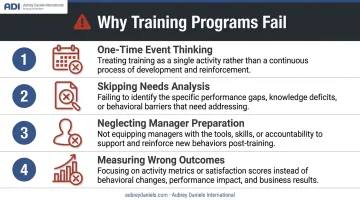
Most training programs fail for predictable reasons. Here are the four most damaging mistakes L&D teams make — and why they matter:
Treating training as a one-time event. Attending a session does not equal behavior change. Performance improvement requires ongoing reinforcement, coaching, and practice cycles — not a single workshop followed by business as usual.
Skipping the needs analysis. Generic or off-the-shelf programs may check a compliance box, but they won't move performance metrics. Only 54% of organizations evaluate training at Level 3 (behavior), and they apply that measurement to just 34% of programs, according to ATD research.
Neglecting manager preparation. Organizations invest heavily in employee training while skipping training for the managers who must reinforce new behaviors on the job. It's one of the most common — and most costly — oversights in L&D design.
Measuring the wrong outcomes. Completion rates and satisfaction scores reflect training inputs, not performance outputs. 93% of organizations collect participant satisfaction data, yet only 30% are proficient at using learning data for actual business decisions, per ATD's 2025 research. Without Kirkpatrick Levels 3 and 4 measurement, you can't know whether training worked.
When Training Alone Is Not Enough to Drive Lasting Performance Change
If a performance gap stems from an environmental, motivational, or management issue — employees know what to do but don't do it consistently — training will have no meaningful impact. The root cause is in the behavioral consequences surrounding the work, not in the employee's knowledge base.
This is where Performance Management as a system becomes essential. Sustainable improvement requires understanding the antecedents and consequences that drive or inhibit the specific behaviors needed for results. Reshaping those consequences is a consulting and organizational change challenge, not a training one.
ADI has spent over 45 years applying Applied Behavior Analysis to business performance across 400+ organizations globally. When training isn't the answer, ADI's behavioral consulting and Precision Leadership® technology focus on the reinforcement environment and management behaviors that determine whether any performance improvement actually sticks.
In one natural gas operation, addressing the reinforcement environment directly (rather than adding more training) increased observable safe behavior from 50% to 75% within weeks and eliminated ongoing high-risk behaviors through positive intervention alone.
Before investing in another training program, conduct a behavioral assessment of the work environment. Identify what consequences are reinforcing the wrong behaviors, or failing to reinforce the right ones, and address those first.
Frequently Asked Questions
How can training improve employee performance?
Training improves performance by closing skill gaps, building confidence, and equipping employees with the specific behaviors required for their role. Lasting improvement, but it only follows when training is paired with on-the-job reinforcement and active manager support — otherwise trained behaviors fade within months.
What are the 7 training methods?
The seven methods are on-the-job training, mentoring, e-learning, instructor-led classroom training, simulation, coaching, and job rotation. The most effective method depends on the nature of the skill gap — foundational knowledge benefits from structured learning, while complex applied skills develop through coaching and experience.
What is the 70-20-10 rule for employee development?
The 70-20-10 model holds that 70% of development comes from on-the-job experience, 20% from coaching and social learning, and 10% from formal training. In practice, formal programs must be paired with structured experience and feedback to drive real performance change — not just knowledge transfer.
How do you measure whether training has improved employee performance?
Measurement should focus on behavioral outcomes and performance metrics — output quality, error rates, productivity — established at baseline before training begins. Completion rates and post-training satisfaction scores measure inputs, not performance change.
Why do employees fail to apply what they learned in training?
Transfer fails for four common reasons:
- Managers don't reinforce new behaviors when they occur
- The work environment inadvertently rewards old habits
- Training didn't include sufficient practice
- Training content wasn't mapped to actual job tasks
Any one of these is enough to prevent transfer.
What is the role of a manager in employee training and development?
Managers are most critical not during training but after it. Managers observe employees applying new skills, deliver immediate positive feedback when trained behaviors occur, and prompt the behavior when it lapses. That consistent follow-through is the primary mechanism through which training investment converts into sustained performance improvement.