Introduction
Most culture change initiatives fail—not because leaders lack good intentions, but because they focus on values posters and town halls instead of what actually drives culture: the daily behaviors that get reinforced. Research shows that less than one-third of organizational transformations succeed at improving and sustaining performance, with Kotter's research indicating that more than 70% of needed change either fails to launch or fails to be completed.
The uncomfortable truth? Culture isn't changed through communications campaigns. As Harvard Business Review research demonstrates, values campaigns, wellbeing programs, and mission statements feel performative when systems don't align. Culture changes when the systems that shape daily behavior—particularly performance management—change.
Performance management is one of the most powerful tools for reshaping culture at scale—yet results vary widely based on whether organizations use it to drive genuine behavioral change or simply reinforce compliance. What follows is a practical guide to doing it right: the behavioral science behind why PM works, how to implement it step by step, and the pitfalls that derail even well-intentioned efforts.
Key Takeaways
- Culture is built from repeated behaviors; changing culture means changing what gets reinforced every day
- Annual reviews rarely drive culture change — continuous, behavior-focused performance management does
- Start by identifying specific, observable high-impact behaviors, then build consistent reinforcement systems around them
- Leadership behavior is the most powerful signal—if managers don't model and reinforce target behaviors, initiatives stall
- Track behavioral leading indicators — coaching frequency, peer recognition rates — to confirm culture is shifting
Why Performance Management Is the Right Lever for Culture Change
Culture is the pattern of actual behaviors that get encouraged, tolerated, or discouraged through daily management practices. What gets reinforced gets repeated — and performance management is the primary system through which organizations do the reinforcing.
Culture Is a Pattern of Behavior, Not a Set of Values
Most culture change efforts fail because they target attitudes and mindsets directly, when reality works the opposite way: behavior precedes and shapes mindset. Behavior is a function of its consequences. If performance management systems don't deliver meaningful consequences for the right behaviors, culture doesn't change.
Dr. Aubrey Daniels introduced the term "Performance Management" to describe how to systematically motivate people to behave in ways the business needs. His work, grounded in nearly a century of Applied Behavior Analysis research pioneered by B.F. Skinner, established that identifying what truly reinforces people is what unlocks exceptional performance.
Daniels founded Aubrey Daniels International and published the foundational text Performance Management in 1982, followed by the bestselling Bringing Out the Best in People in 1992 — translating behavioral science into practical management tools leaders could apply immediately.
What managers measure, recognize, coach, and correct tells every employee what behaviors are actually expected — more clearly than any mission statement ever could. That signal, repeated daily across every level of the organization, is what culture is made of.
How Performance Management Shapes Behavior at Scale
Performance management acts as the organizational mechanism through which culture either solidifies or shifts. It answers a simple question for every employee: "What does this organization actually value?"
The gap between minimum acceptable performance and what employees choose to give when they feel positively reinforced is called Discretionary Effort—and cultures that unlock it consistently outperform those relying on compliance-based management. Gallup's meta-analysis of 2.7 million employees across 112,312 business units shows that top-quartile engagement organizations achieve:
- 23% higher profitability
- 18% higher productivity
- 81% lower absenteeism
- 43% lower turnover in low-turnover organizations
- 64% fewer safety incidents
Yet U.S. employee engagement fell to just 31% in 2024—a 10-year low. The difference between high- and low-performing cultures isn't values alignment; it's whether performance management systems activate discretionary effort through positive reinforcement or suppress it through fear and compliance.
How to Change Organizational Culture Through Performance Management
Culture change through performance management is not a one-time program—it's a disciplined, sequenced process. Success requires four essential steps, implemented systematically and sustained over time.
Step 1: Identify the Specific Behaviors That Define Your Desired Culture
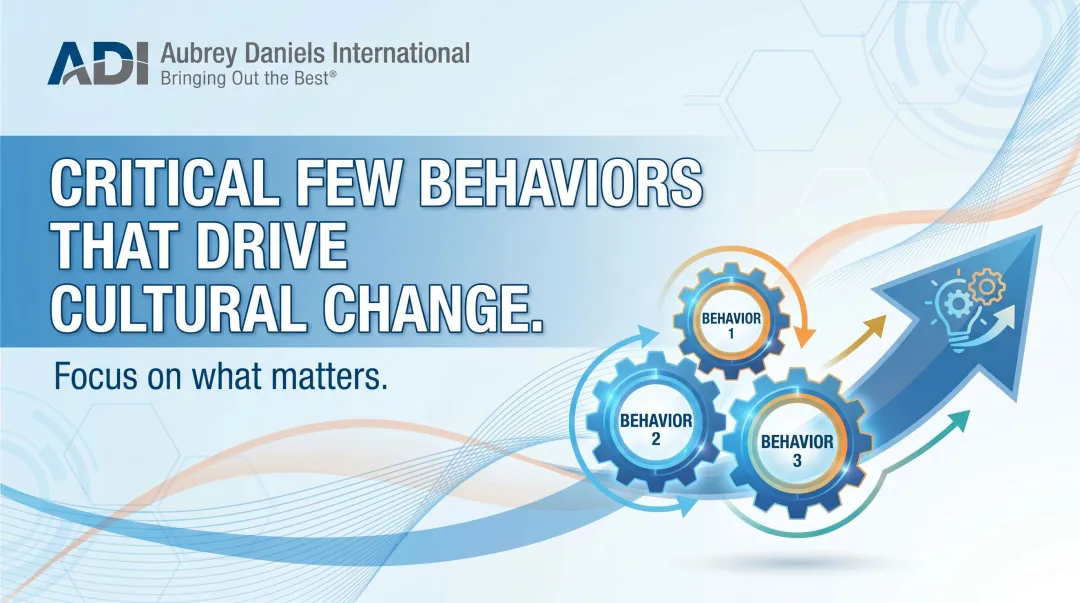
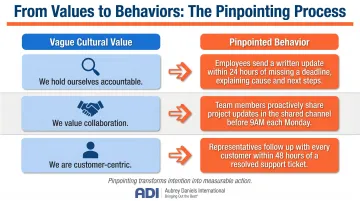
Vague cultural values like "accountability," "collaboration," or "innovation" don't change behavior. Specific, observable actions do.
Behavior pinpointing translates abstract values into concrete behaviors that can be coached and reinforced. For example:
- "Accountability" becomes "team members flag project risks in the weekly standup before they escalate"
- "Collaboration" becomes "engineers share design feedback within 24 hours when tagged by cross-functional teammates"
- "Customer-centricity" becomes "review the client history and company profile prior to calling the customer"
As ADI's Francisco Gomez explains, pinpointing clarifies for performers what specific behaviors to do more of, less of, or differently—removing subjectivity and creating alignment across the organization.
Prioritization is critical. Harvard Business Review research emphasizes starting with one high-impact behavior rather than overhauling everything at once. Identify the 2-3 behaviors whose consistent adoption would most visibly shift the culture and drive business outcomes.
Example in practice: In one construction equipment company, behavior pinpointing led operators to focus on shutting down loaders instead of letting them run idle between jobs—saving $16,500 per month in fuel costs through one clearly defined behavior change.
Step 2: Set Behavior-Based Performance Expectations
Expectations must shift from outcome-only metrics ("hit the quarterly target") to behavioral expectations ("conduct structured coaching conversations with each direct report bi-weekly").
Only 46% of employees clearly know what is expected of them—down 10 percentage points from 56% in March 2020. Clarity of expectations is the foundation of engagement, yet most performance management systems fail to provide it.
Behavioral expectations give managers something concrete to reinforce and employees something concrete to do. For expectations to drive culture change, they must be:
- Specific: Define exactly what good performance looks like in behavioral terms
- Visible: Employees can see when they're meeting expectations and when they're not
- Connected to purpose: Link behaviors to clear organizational outcomes, not compliance checkboxes
Research shows employees who understand their job expectations are 8.6 times more likely to be engaged. Without clear behavioral standards, performance becomes subjective, reinforcement becomes inconsistent, and culture change stalls.
Step 3: Build Positive Reinforcement Into Daily Management Practices
Reinforcement drives behavioral change — but most organizations confuse recognition with reinforcement. They're not the same thing.
Positive reinforcement means adding something valued when the desired behavior occurs. For reinforcement to change behavior, it must be:
- Immediate: Delivered as close to the behavior as possible
- Specific: Naming exactly what the person did right
- Personally meaningful: Aligned with what the individual values
Generic annual bonuses or company-wide recognition emails don't function as reinforcement because they're too delayed and disconnected from specific behaviors. Culture-shifting reinforcement is built into daily management practices instead:
- Managers catching people doing the right behaviors and acknowledging them promptly
- Check-ins structured around behavioral feedback, not just progress-against-numbers reviews
- Peer recognition systems that reinforce collaborative behaviors in real time
Research in the Journal of Organizational Behavior Management found that positive reinforcement led to a 17% increase in employee performance, while negative consequences resulted in only a 1% increase.
Yet only 23% of employees strongly agree they receive the right amount of recognition. Those who do are 4 times more likely to be engaged. The data is clear — the delivery gap is what separates organizations that talk about culture change from those that actually achieve it.
Step 4: Measure Behavioral Leading Indicators, Not Just Outcome Metrics
Culture change shows up in behavioral data long before it appears in business outcomes. Lagging indicators—revenue, retention, engagement scores—tell you what happened. Behavioral leading indicators tell you whether culture is actually changing right now.
Examples of behavioral leading indicators include:
- Frequency of manager-to-employee coaching conversations
- Rate of cross-team knowledge sharing or collaboration requests
- Speed of issue escalation when problems are identified
- Participation rates in peer recognition programs
- Manager feedback quality scores from direct reports
McKinsey's Organizational Health Index demonstrates that healthy organizations—measured through behavioral dimensions like leadership quality, decision-making effectiveness, and frontline listening—deliver 3x total shareholder returns and show an 18% increase in EBITDA after one year.
A behavioral dashboard might track:
- Number of weekly coaching conversations conducted by each manager
- Percentage of employees who received specific behavioral feedback in the past week
- Cross-functional collaboration frequency (meetings, shared projects, knowledge transfers)
- Time between problem identification and escalation
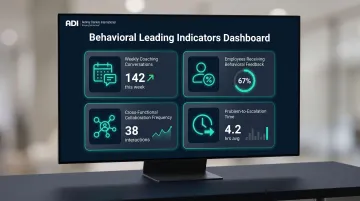
Monitoring these indicators allows for real-time course correction. If coaching conversations aren't happening, reinforcement isn't being delivered, and culture isn't changing—regardless of what your quarterly engagement survey says.
What You Need Before Starting
Even the most well-designed PM-for-culture-change process will stall if three foundational conditions aren't in place.
Leadership Alignment and Behavioral Modeling
Leaders must be the first to adopt and visibly demonstrate target behaviors. Employees interpret leadership behavior as the real culture signal, not official communications.
McKinsey research shows that when senior leaders role-model behavior changes, transformations are 5.3 times more likely to succeed. A senior leader who endorses culture change in a town hall but models contradictory behavior in day-to-day management will undermine the entire effort.
Leadership alignment means:
- Demonstrating target behaviors personally, not just endorsing them
- Holding each other accountable to the same behavioral standards
- Making those behaviors visible and consistent across the organization
Current-State Assessment
You can't change what you don't understand. Before introducing new expectations, establish a behavioral baseline: what behaviors currently exist and what consequences reinforce them?
Tools like behavioral assessments or culture surveys focused on observable practices—not just attitude scores—are critical starting inputs. ADI's surveys and assessments provide this behavioral baseline, measuring current reinforcement patterns, manager coaching effectiveness, and the gap between stated and actual cultural norms.
Without a baseline, you can't measure progress or know whether interventions are working.
Manager Capability for Behavior-Based Coaching
Managers do the daily work of reinforcing culture change. If they lack the skills to identify, name, and reinforce specific behaviors—rather than just rate outcomes—the system fails.
Upskilling managers in behavior-based coaching is a prerequisite, not an afterthought. This includes:
- How to pinpoint and define observable behaviors
- How to deliver immediate, specific, meaningful reinforcement
- How to structure coaching conversations around behaviors, not just results
- How to use behavioral data to guide performance discussions
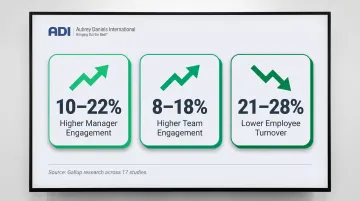
Gallup research across 17 studies found that training managers in strengths-based, meaningful conversations produced measurable gains across the board.
That includes 10-22% higher manager engagement, 8-18% higher team engagement, and 21-28% lower turnover — outcomes that compound directly into cultural change.
Key Variables That Determine Whether PM Drives Culture Change
Two organizations can follow the same PM process and get very different culture outcomes depending on how well they manage these variables.
Reinforcement Ratio and Timing
Culture shifts when positive reinforcement outpaces corrective feedback in day-to-day management.
Research by Zenger and Folkman analyzing 60 management teams found that high-performing teams maintained a ratio of approximately 5.6 positive comments for every negative one. Medium-performing teams averaged 1.9:1, while low-performing teams had 0.36:1—roughly three negative comments for every positive one.
The exact ratio may vary by context, but the behavioral pattern holds across studies: more positive-to-corrective interactions consistently produce higher performance.
Even well-intentioned managers often default to corrective feedback, which produces compliance cultures rather than high-performance ones. Without deliberate attention to reinforcement ratio, PM systems reinforce existing cultural patterns instead of transforming them.
Consistency Across the Management Chain
Culture change collapses when senior leaders reinforce target behaviors but middle managers don't—or vice versa.
The entire management chain must apply the same behavioral standards. When one manager reinforces collaboration while another rewards individual heroics, employees learn that stated values are negotiable—and trust in the process erodes fast.
This requires:
- Aligned expectations at every management level
- Shared understanding of what behaviors look like in practice
- Accountability systems that ensure consistency
Specificity of Behavioral Expectations
Precision in behavioral expectations directly determines consistency in cultural outcomes.
The more clearly behaviors are defined, the more reliably they can be reinforced and tracked. "Be more customer-focused" means different things to different people. "Ask the customer open-ended questions about their needs during follow-up calls" is specific enough to observe, coach, and reinforce. Values slogans don't drive cultural consistency — behavioral definitions do.
Cadence of Feedback and Reinforcement
Annual or quarterly feedback cycles are too slow to shape culture.
Gallup research shows that 80% of employees who received meaningful feedback in the past week are fully engaged, and employees are 3.6 times more likely to be motivated to do outstanding work when receiving daily feedback versus annual feedback only.
Daily and weekly reinforcement touchpoints establish new behavioral patterns as the cultural norm. Culture is built through repeated micro-interactions — and how frequently those interactions happen determines whether new behaviors stick or fade.
Common Mistakes Leaders Make When Using PM for Culture Change
Launching Culture Change as a Communications Campaign Instead of a Behavioral Intervention
Informing people about desired values through town halls, emails, and posters does not change behavior. Culture change requires altering the consequences that follow behavior—not just the messaging around it.
When only 3% of transformations succeed when both line managers and frontline employees are not engaged, the lesson is clear: communication without behavioral consequences is ineffective.
Measuring Culture Change Using Attitude Surveys Alone
Relying exclusively on annual engagement scores or values-alignment surveys misses the behavioral signals that indicate whether culture is actually shifting.
Attitude surveys tell you how people feel about the culture. Behavioral metrics tell you what the culture actually is. If coaching conversations aren't happening, feedback isn't being delivered, and collaboration behaviors aren't increasing, culture isn't changing—even if survey scores temporarily improve.
Behavioral metrics worth tracking include coaching conversation frequency, peer recognition rates, and cross-functional collaboration incidents — signals that reveal whether culture is moving, not just how people feel about it.
Using Performance Management as a Punitive Tool
PM systems built around identifying and punishing poor performers create fear-based cultures where employees minimize risk and protect themselves, eroding the very behaviors that drive results.
Google's Project Aristotle, which studied 180 teams over two years, identified psychological safety as the number one factor distinguishing effective teams. Fear of embarrassment or punishment suppresses speaking up, idea sharing, and risk-taking: precisely the behaviors that define discretionary effort. Behavioral science is clear — when punishment dominates, people do just enough to avoid consequences, not enough to drive performance forward.
Expecting Culture Change to Happen Within a Single Review Cycle
Culture change through performance management is a multi-year process, not a project with an end date.
Practitioner research suggests that with focused effort on 1-2 specific areas, an organization can feel very different within 12 months. However, deeply embedded cultural norms require 18-36 months of consistent reinforcement to stick.
Realistic timeframe expectations:
- 6-12 months: Meaningful behavioral shifts become observable with consistent reinforcement
- 18-24 months: New behaviors begin to feel like "how we do things here"
- 2-3+ years: Culture change becomes sustainable and self-reinforcing
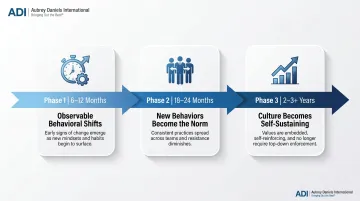
Leaders who treat culture change as a quarter-over-quarter initiative will reset the clock every time pressure mounts. Sustained behavioral reinforcement — not periodic campaigns — is what makes the new culture stick.
Frequently Asked Questions
How long does it take to change organizational culture through performance management?
Meaningful behavioral shifts can emerge within 6-12 months with consistent reinforcement, but sustainable, organization-wide culture change typically takes 2-3 years or more. The timeline depends on organizational size, complexity, and the depth of behavioral shift required.
What is the difference between performance management and culture change?
Performance management is the system of goal-setting, feedback, and reinforcement that shapes daily behavior. Culture change is the long-term outcome: when those behavioral patterns become the consistent norm across the organization. The two are connected when PM is deliberately designed to reinforce the behaviors that define the desired culture.
Can you change culture without changing performance management?
Changing culture without redesigning the PM system is rarely successful. Performance management communicates what behaviors are actually rewarded — and that's what employees read as "the real culture," regardless of what values are officially stated.
What role does positive reinforcement play in organizational culture?
Positive reinforcement is the primary mechanism through which cultures are built and sustained. Behaviors reinforced promptly and specifically become habitual, spread across teams, and eventually define how work gets done. Without it, culture change produces compliance — not lasting shift.
How do you measure whether organizational culture is actually changing?
Measure culture change through behavioral leading indicators: coaching conversation frequency, peer recognition rates, and cross-team collaboration patterns. These should accompany lagging indicators like engagement scores or retention rates. Behavioral data signals change earlier and more accurately than attitude surveys alone.
Why do most organizational culture change initiatives fail?
Most initiatives fail because they focus on communicating values rather than changing the behavioral consequences employees experience daily. Without altering what gets reinforced, recognized, and corrected in performance management, the existing culture's behavioral patterns persist regardless of the stated change agenda.