According to the FRA, human errors account for more than one-third of all train accidents in the U.S. railroad industry. A peer-reviewed study analyzing U.S. freight train data from 2000 to 2016 found that human factors caused 1,510 accidents, resulting in 551 casualties and over 9,200 derailed cars. The paperwork existed. The rules existed. The incidents happened anyway.
That gap — between having safety rules and being a safe organization — is a culture problem, not a compliance problem. Closing it requires understanding and systematically shaping employee behavior through positive reinforcement, leadership modeling, and behavioral measurement. Training and rulebooks are starting points, not solutions.
Key Takeaways
- Safety culture and safety compliance are not the same thing: compliance updates paperwork; culture changes what people actually do.
- Compliance-first programs produce surface-level behavior; lasting safety requires reinforcing the right actions consistently.
- The Antecedent-Behavior-Consequence model gives safety leaders a scientific foundation for driving real culture change.
- Leadership shapes culture through daily, observable behavior, not speeches or policy announcements.
- Safety culture strength should be measured by leading behavioral indicators, not just injury rates.
What a True Safety Culture Looks Like in Rail Operations
RSSB defines safety culture as "the way things are done when no one is watching" — and that definition captures something important: genuine culture operates independently of supervision. It lives in the shared beliefs, values, and habitual behaviors that make safe actions the default — not the exception.
This is fundamentally different from a safety program or compliance framework. A program can be implemented and audited. Culture is what persists when the auditors leave.
Observable Markers of a Strong Rail Safety Culture
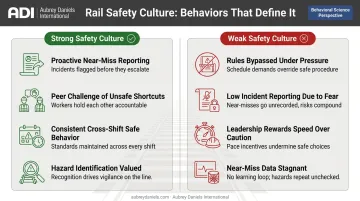
Strong safety cultures in rail look like this in practice:
- Employees proactively flag near-misses without fear of punishment or blame
- Frontline workers challenge unsafe shortcuts from peers and supervisors alike
- Safe behavior stays consistent across shifts, locations, and seasons — not just during audits
- Hazard identification is treated as valuable information, not an inconvenience
ADI worked with a division of an international freight rail line operating across 12 U.S. states and Quebec. Within one year of implementing behavior-based safety strategies, the division saw a 36% drop in injury rate and a 60% reduction in lost-time days. Peer-to-peer safety observations became standard practice.
That cultural shift produced a milestone the division had chased for a decade: a sustained zero injury rate for an entire month, recognized with the industry's Harriman Award for railroad employee safety.
What Weak Safety Culture Looks Like
Weak safety cultures are just as recognizable — and the patterns tend to repeat across organizations:
- Rules exist on paper but get bypassed under production pressure
- Incident reporting is low — not because incidents are rare, but because employees fear blame
- Leadership talks about safety but visibly rewards speed over caution
- Near-miss data stays flat even as hazardous conditions accumulate
These patterns are particularly dangerous in rail, where the environment is dynamic and high-autonomy by nature. Workers operate in remote locations, overnight shifts, and complex crew handoffs — settings where errors have catastrophic consequences and supervisors can't be present for every decision. Procedures matter, but procedures don't make decisions. People do.
Why Compliance-First Safety Programs Fall Short
Many rail organizations equate safety investment with regulatory adherence: FRA rules, OSHA requirements, mandatory training hours. Both are necessary — but neither is sufficient on their own.
Compliance governs minimum behavior. Culture governs what actually happens.
The Punishment Trap
When the primary consequence of a safety violation is discipline or termination, employees learn to avoid detection — not to avoid risk. U.S. DOT testimony before Congress stated that harassment, intimidation, and retaliation against railroad employees who report injuries were "deeply engrained in railroad culture", with many workers reluctant to seek medical attention for fear of retaliation. The same testimony noted that a GAO study concluded audited railroads were systematically underreporting injuries and accidents.
Punishment-driven safety cultures produce predictable outcomes:
- Suppressed incident reporting to avoid consequences
- Hidden workarounds that never surface for review
- A workforce managing appearances rather than managing risk
The Metro-North case shows how this plays out at scale. After five significant accidents between 2013 and 2014 — six fatalities total — NTSB found an overemphasis on on-time performance, an ineffective Safety Department, and a weak safety culture. Reduced FRA presence had coincided with deteriorating track conditions, a clear indicator that safety behavior depended on external oversight rather than internalized values.
The Check-the-Box Training Problem
Annual training events increase knowledge temporarily but rarely change habitual behavior on the job.
Research shows that knowledge transfer alone doesn't produce sustained behavioral change. What matters is what gets reinforced after training. Without consistent positive reinforcement for applying new skills in the field, employees revert to familiar patterns within weeks. ADI observed this directly with a natural gas operation where employees had systematically eliminated several documented safety steps they considered redundant — not out of recklessness, but because the consequences for cutting corners were neutral while the consequences for being slower were real.
Compliance-driven safety culture is also fragile. When oversight decreases, new employees join, or production pressure intensifies, the gaps widen. Without internalized values driving behavior, the system simply waits for conditions to erode it.
Using Behavioral Science to Build Genuine Rail Safety Culture
Applied behavior analysis (ABA) offers a grounded framework for understanding why people do what they do — and how to change behavior reliably. In safety terms, this means identifying what triggers safe behaviors and what consequences sustain or extinguish them.
The ABC Model in Rail Safety
The ABC model — Antecedent, Behavior, Consequence — maps behavior systematically:
| Component | Definition | Rail Example |
|---|---|---|
| Antecedent | What precedes the behavior | Pre-shift safety briefing, lockout/tagout signage |
| Behavior | The observable action | Following lockout/tagout procedures correctly |
| Consequence | What follows the behavior | Recognition, discipline, or nothing at all |
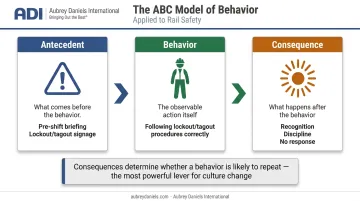
Most rail organizations invest heavily in antecedents: training, signage, policies, toolbox talks. They neglect the consequence side. That's the problem. Antecedents set up behavior; consequences determine whether it repeats.
The FRA/Volpe evaluation of the Amtrak-Chicago Clear Signal for Action program found that a behavior-based safety approach produced measurable increases in safe behavior, reduced injury-rate variability, and improved management-worker relations. Observers were trained to deliver feedback positively and to interview employees about barriers to safe practices — addressing consequences, not just antecedents.
The Power of Positive Reinforcement
The common "safety by exception" model provides feedback only when something goes wrong. Employees receive recognition for speed, output, and throughput — and silence for working safely. Silence is not neutral. In behavioral terms, it extinguishes the behavior over time.
When safe behavior is consistently recognized and reinforced, employees are more likely to repeat and sustain it. This is the core argument in Safe by Accident? Leadership Practices that Build a Sustainable Safety Culture, co-authored by ADI's Judy Agnew and Dr. Aubrey Daniels.
The book's central thesis: a low incident rate doesn't mean an organization is safe. Many organizations go months without incidents not because safety culture is strong, but because hazards haven't yet intersected with opportunities for harm. They're safe by accident — not by design.
Making Safe Behavior the Path of Least Resistance
In rail operations, cutting corners is often the path of least resistance under time pressure. Production quotas, peer norms, and fatigue all function as competing reinforcers — rewarding shortcuts more immediately than safe behavior.
A behavioral approach identifies those competing reinforcers and restructures them. Rather than asking workers to value safety as an abstract principle, ADI's approach creates conditions where safe behavior pays off immediately and consistently — so workers choose it not out of attitude, but because the environment is designed to support it.
How Leaders Reinforce Safe Behavior Every Day
In a genuine safety culture, leadership is not a speech. It's a pattern of daily, observable behavior.
Leaders who spend time on the floor, ask specific questions about near-misses, and recognize safe actions publicly send behavioral signals that shape what the entire workforce treats as normal. When leaders enforce safety rigorously during audits but loosely under production pressure, they signal that safety is situational. That signal spreads fast.
Leadership Behaviors That Build or Erode Safety Culture
Behaviors that build culture:
- Praising an employee who flags a hazard before stopping to ask about production
- Stopping a job when safety conditions are unclear, regardless of schedule impact
- Following up visibly when near-miss reports are submitted
- Using coaching conversations to reinforce safe behavior, not just correct unsafe behavior
Behaviors that erode culture:
- Rewarding speed or output over caution, even implicitly
- Allowing unsafe shortcuts when under pressure and calling it "judgment"
- Ignoring near-miss reports without visible follow-up
- Treating safety conversations as box-checking rather than genuine engagement
These behaviors aren't abstract — their impact is measurable. ADI worked with Norfolk Southern to build exactly this kind of leadership-driven safety culture. By engaging leaders in a coaching process grounded in behavioral science, the company improved its injury ratio per 200,000 man-hours within a single quarter, with more than 30,000 employees contributing to positive improvements. Mark Manion, then Executive Vice President and COO of Norfolk Southern, described it plainly: "There is no question that it's a more engaged workforce. And in some cases it has been really dramatic."
Building Safety Leadership at Every Level
Culture doesn't change from a single senior leadership initiative. It changes when every level of management — from executive to frontline supervisor — has the skills to observe, reinforce, and coach safe behavior in real time.
ADI's Precision Leadership and Safety Leadership programs equip managers at each level with behavioral observation tools, coaching skills, and structured feedback processes. The result is more effective safety interactions at every level: specific, consistent, and grounded in positive reinforcement.
Building Reporting Systems That Employees Actually Use
Organizations with strong safety cultures have high near-miss reporting rates — not because more incidents occur, but because employees trust that reporting leads to improvement, not blame.
Several behavioral barriers consistently suppress reporting:
- Fear of discipline or retaliation
- Peer pressure to handle incidents informally
- Belief that reports disappear without action
- The time cost of documentation with no visible return
Addressing these barriers requires changing the consequences of reporting — making it consistently safe, appreciated, and visibly useful.
Design Features of Effective Reporting Systems
- Offer anonymity for employees who aren't yet confident the system is safe
- Act on reported hazards quickly, so reporters see their submissions matter
- Close the loop visibly — show what changed as a direct result of specific reports
- Recognize employees who surface risks before they become incidents
The FRA's Confidential Close Call Reporting System (C3RS) demonstrates this model at industry scale. C3RS is a voluntary, confidential program where reports go to NASA as an independent third party. Peer Review Teams — including labor, management, and FRA representatives — review de-identified submissions and identify corrective actions. Employees receive protection from discipline and FRA enforcement for events they report through the system.
The reach and results are significant. All Class I freight railroads agreed to participate as of March 2023, and Volpe's evaluation found C3RS contributed to a 31% decrease in derailments at participating sites.
The same dynamic plays out at the organizational level. One transportation client ADI worked with saw near-miss reporting climb from 2–3 reports per month to 150–180 per month after applying a behavioral approach to their reporting system — a 60x increase that signals a genuine shift in psychological safety, not a tweak to the submission form.
Measuring Safety Culture Progress Beyond Injury Rates
Injury rates tell you what has already gone wrong. They're subject to underreporting, obscured by luck, and by the time they rise, the behavioral conditions that caused the incident have been present for some time.
Lagging indicators are necessary. They can't be the primary measure of culture strength.
Leading Behavioral Indicators That Actually Reflect Culture
| Indicator | What It Measures |
|---|---|
| Near-miss reporting frequency | Psychological safety and trust in the system |
| Supervisor-to-worker safety observation rate | Leadership engagement in real-time safety |
| Ratio of positive to corrective safety conversations | Whether safety culture is reinforcement-based or punishment-based |
| Employee safety survey scores | Perceived norms, not just stated policies |
| Behavioral observation compliance rates | Whether safe behaviors are habitual across shifts |
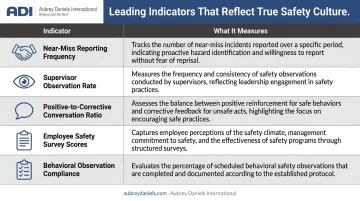
OSHA distinguishes leading indicators as proactive, preventive, and predictive measures that reflect safety activity effectiveness, distinct from lagging metrics that only capture outcomes after the fact.
RSSB's research project T852 specifically examined leading and lagging indicators in rail, noting the need for effective deployment of proactive measures in managing railway safety.
ADI's Assessment Approach
That same logic — measure what predicts outcomes, not just what follows them — shapes how ADI structures its safety culture work.
ADI uses a Safety Culture Survey, available across 26 countries in 12 languages, that measures proactive versus reactive safety management, leadership engagement, consequence management, and psychological safety around reporting. Safety Pulse Checks (brief 6–8 question surveys) allow organizations to track progress on specific initiatives without waiting for annual survey cycles. Site assessments combine behavioral observation, interviews, and document review to identify what's actually happening in the work environment, separate from what the policy manual says should happen.
The output is a behavioral roadmap: specific actions at every organizational level — from frontline supervisors to senior leadership — that move leading indicators in the right direction and close the gap between policy and practice.
Frequently Asked Questions
What are examples of safety culture in rail operations?
Workers voluntarily reporting near-misses without fear of retaliation, supervisors stopping work when safety conditions are unclear regardless of schedule pressure, consistent PPE use across all shifts and locations, and crews conducting peer safety observations as routine practice rather than a mandated check.
What is the difference between safety compliance and safety culture?
Compliance is adherence to minimum rules and regulations — necessary, but externally driven and dependent on oversight. Safety culture is the set of internalized values and habitual behaviors that make safe actions the default, sustained even when no supervisor is watching or enforcement is present.
How does leadership behavior impact safety culture in rail?
In rail environments, leaders set the tone through what they visibly model, reinforce, and let slide daily. When supervisors consistently recognize safe behavior and address shortcuts — even under tight schedule pressure — crews learn that safety is a real priority. Inconsistent follow-through sends the opposite message.
Why do traditional safety training programs often fail to produce lasting behavioral change?
Training changes knowledge but not necessarily behavior. Without consistent reinforcement of safe actions after training, employees revert to habitual patterns shaped by their actual work environment. Lasting change requires pairing training with consequence management strategies that sustain new habits over time.
How can rail organizations measure the strength of their safety culture?
Track a mix of leading indicators — near-miss reporting rates, behavioral observation data, supervisor coaching frequency, and psychological safety surveys — alongside lagging metrics. Leading indicators let organizations spot and address behavioral risk before incidents happen.