Introduction
Organizations worldwide invest billions in employee engagement programs, yet global engagement stands at just 20% — the lowest level since 2020. This gap between investment and results points to a fundamental misunderstanding: most companies treat engagement as an attitude to measure rather than a behavior to shape.
The cost is concrete. Disengagement drains $10 trillion in productivity globally, representing 9% of GDP. The pattern behind most failed initiatives is the same: surveys without action, recognition without reinforcement, programs launched without the behavioral systems to sustain them.
This article delivers what actually works — science-backed strategies leaders can implement immediately, the specific manager behaviors that account for 70% of engagement variance, and the reinforcement systems that turn short-term gains into lasting performance.
Key Takeaways
- Engagement means emotional investment and behavioral commitment to work—not just satisfaction or showing up
- Engaged teams show 23% higher profitability and 78% lower absenteeism—the business case is clear
- Managers drive 70% of engagement variance through daily behaviors like feedback, recognition, and development conversations
- Effective engagement requires positive reinforcement, role clarity, growth pathways, and consistent follow-through—not annual surveys
- ADI's Performance Management approach applies 45+ years of behavioral science research to build measurable, sustainable engagement systems
What Employee Engagement Really Means (and What It Isn't)
Employee engagement is the degree to which employees are emotionally invested in, enthusiastic about, and behaviorally committed to their work and organization. This goes far beyond satisfaction (feeling content with your paycheck and benefits) or compliance (doing the bare minimum required). Gallup defines engagement as "the involvement and enthusiasm of employees in their work and workplace," emphasizing that engaged employees perform better because they're emotionally connected.
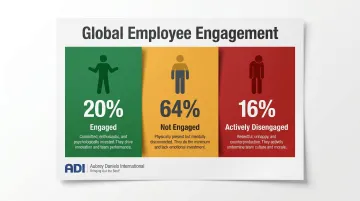
Research distinguishes three employee categories:
- Engaged (20% globally) - Committed, enthusiastic, and take initiative as psychological owners
- Not Engaged (64% globally) - Present but disconnected, going through the motions
- Actively Disengaged (16% globally) - Resentful, acting out unhappiness, undermining engaged colleagues
These categories point to a critical distinction: engagement versus organizational commitment. Engagement reflects enthusiasm for the work itself; commitment reflects dedication to the organization. The ideal is both — and the gap between them reveals real business risk. Engaged but uncommitted employees are high performers who will leave for better opportunities. Committed but disengaged employees are loyal but consistently underperform.
Research from Clemson University found that employees who are neither engaged nor committed scored negatively in 14 of 15 HR themes. That combination — low engagement and low commitment — represents the most damaging profile for organizational performance.
Why Employee Engagement Is a Business Imperative
The performance gap between engaged and disengaged teams is enormous. Gallup's 11th edition Q12 Meta-Analysis—covering 736 studies across 347 organizations and 3.35 million employees—quantifies the difference:
| Outcome | Engaged vs. Disengaged |
|---|---|
| Profitability | 23% higher |
| Sales productivity | 18% higher |
| Customer engagement | 10% higher |
| Absenteeism | 78% lower |
| Turnover (high-turnover orgs) | 21% lower |
| Turnover (low-turnover orgs) | 51% lower |
| Safety incidents | 63% lower |
| Quality defects | 32% lower |
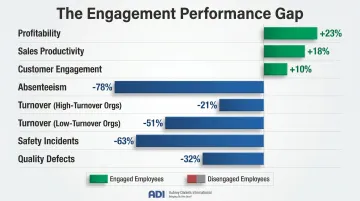
Business units at the 99th percentile of engagement have nearly five times the success rate of those at the 1st percentile. Units at the highest engagement level have an 83% chance of above-average composite performance versus only 17% at the lowest level.
The cost of disengagement is equally clear: $10 trillion globally in lost productivity (9% of GDP), with the U.S. alone accounting for approximately $2 trillion annually.
The true performance multiplier is discretionary effort: the voluntary energy, creativity, and initiative employees contribute beyond the minimum required. Engaged employees provide this effort willingly; disengaged employees withhold it.
Organizations that manage by exception — stepping in only when performance falls below standard — suppress discretionary effort because nothing reinforces doing more than required. Behavioral science research shows that negative reinforcement produces "just enough behavior to stop the threats," while positive reinforcement is the only mechanism that earns discretionary effort.
What Actually Causes Low Employee Engagement
Most engagement programs fail because they misdiagnose the root problem. Treating engagement as an attitude to survey rather than a behavior to shape explains why scores may tick up after a new initiative launches, then flatten. Sustained performance change requires understanding what drives behavior — not just measuring how people feel about it.
Unclear Expectations
Only 47% of U.S. employees strongly agree they know what is expected of them at work. When employees don't understand exactly what outstanding performance looks like or how their work connects to organizational goals, motivation erodes regardless of perks or pay. Role clarity is the foundational element of Gallup's engagement hierarchy—without it, higher-level needs like recognition and growth remain unmet.
The Reinforcement Gap
Many workplaces rely more on punishing consequences than positive reinforcement. When criticism, micromanagement, and error-focused feedback dominate, employees shift into avoidance mode — doing just enough to stay out of trouble. The result is minimum-required behavior, not discretionary effort.
Common patterns that signal a reinforcement gap:
- Feedback delivered only when something goes wrong
- Recognition limited to annual reviews or milestone awards
- Managers who intervene on errors but rarely acknowledge strong performance
- Informal coaching absent between formal check-ins
Poor Manager Behaviors
Managers who provide infrequent check-ins, inconsistent feedback, failure to recognize contributions, and lack of career development conversations directly predict disengagement. Gallup research shows that 80% of employees who receive meaningful feedback in the past week are fully engaged, yet only 25% strongly agree they receive valuable feedback from people they work with.
Organizational-Level Failures
Engagement initiatives siloed in HR, survey-without-action cycles that erode trust, and lack of executive role modeling all signal to employees that the organization doesn't genuinely value their experience. McKinsey's review of 20+ academic articles consistently found that the number one driver of survey fatigue is the perception that the organization will not act on results—not survey length or frequency.
Proven Strategies to Improve Employee Engagement
Establish Behavioral Clarity
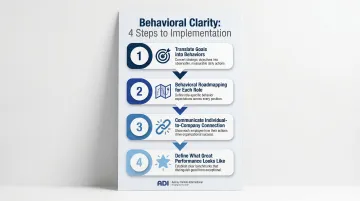
Define expectations in terms of specific, observable behaviors and outcomes—not vague values statements. Connect individual roles to team and organizational goals through transparent communication. Employees who understand how their daily work contributes to larger objectives are more motivated.
Implementation steps:
- Translate organizational goals into specific behaviors required at each level
- Use behavioral roadmapping to define what success looks like for each role
- Communicate the connection between individual work and company outcomes regularly
- Ensure every employee can answer: "What does great performance look like in my role?"
Build a Culture of Positive Reinforcement
Gallup and Workhuman research found that 61% of employees are engaged when receiving both weekly feedback and recognition, compared to only 38% with weekly feedback alone. This represents a 23-percentage-point engagement gap—the difference between recognition-rich and recognition-poor environments.
Effective reinforcement is:
- Timely — given immediately after the behavior, not days or weeks later
- Specific — names exactly what the employee did, not just what outcome resulted
- Genuine — reflects authentic appreciation, not a scripted program requirement
- Frequent — weekly at minimum; daily recognition is even more effective
Ineffective praise is generic ("good job"), delayed (recognition months after the achievement), or performative (recognition programs that feel like checking boxes). Positive reinforcement drives repeated engagement. Punishment and criticism, by contrast, suppress exactly the discretionary effort you're trying to build.
Prioritize Growth and Development
Employees disengage when they feel stuck. Research shows that development opportunities are one of the five essential drivers of engagement. Only 31% of U.S. employees strongly agree there is someone at work who encourages their development.
Create visible growth pathways through:
- Strengths-based role alignment that lets employees do what they do best daily
- Learning opportunities tied to career progression
- Regular development conversations (not just annual reviews)
- Cross-functional projects that build new skills
For organizations that want a structured approach to building these pathways, ADI's Performance Management framework draws on over 45 years of applied behavioral science research to help design engagement systems with results you can actually measure.
Foster Psychological Safety and Belonging
Employees engage more deeply when they feel safe to voice opinions, make mistakes, and be themselves. Google's Project Aristotle found that psychological safety was the most important factor distinguishing high-performing teams—even brilliant employees need psychologically safe environments to contribute fully.
Manager behaviors that build safety:
- Asking for input before making decisions
- Acknowledging mistakes and modeling vulnerability
- Responding constructively to questions and concerns
- Ensuring all voices are heard in meetings
Behaviors that erode safety include punishing messengers, dismissing concerns, showing favoritism, and creating fear of failure.
Align Work With Meaning and Purpose
Gallup and Stand Together research shows employees with strong work purpose are 5.6 times as likely to be engaged. Fifty percent of employees with strong purpose are engaged versus only 9% with low purpose.
Yet 45% of employees work primarily for a paycheck, and only 18% describe their job as personally meaningful. Closing that gap requires more than a mission statement on the wall.
Communicate purpose in ways employees actually feel:
- Storytelling that connects individual work to customer or community impact
- Regular updates showing how employee contributions made a difference
- Inviting customers or beneficiaries to share their experiences
- Ensuring employees understand the "why" behind their tasks
The Manager's Role: Where Engagement Is Won or Lost
Gallup research confirms that managers account for at least 70% of the variance in employee engagement scores across business units. Managers control the daily conditions—clarity, feedback, recognition, growth conversations—that most directly determine whether employees feel engaged.
What High-Engagement Managers Do Differently
High-engagement managers share a consistent set of behaviors that set them apart:
- Hold regular one-on-one conversations focused on employee growth, not just task status
- Deliver specific, behavioral feedback rather than vague praise or criticism
- Advocate for their people with senior leadership
- Individualize their approach based on what actually reinforces each person
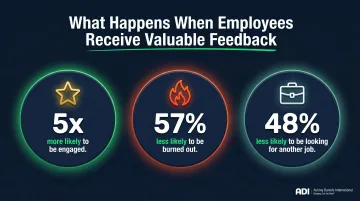
Employees who receive daily feedback are 3.6 times more likely to strongly agree they're motivated to do outstanding work compared to those receiving annual feedback. Employees who rate their feedback as valuable are:
- 5x more likely to be engaged
- 57% less likely to be burned out
- 48% less likely to be looking for another job
The Promotion Failure Mode
Organizations promote high-performing individual contributors into management without equipping them with the behavioral coaching skills needed to develop engagement in others. Technical skill does not predict management effectiveness. Companies fail to choose the right manager talent 82% of the time, and bad managers cost businesses billions annually.
The solution is equipping managers with evidence-based behavioral coaching techniques that turn engagement from a vague goal into learnable, repeatable behaviors. That's the basis of ADI's Precision Leadership approach — structured development that teaches managers how to apply behavioral science principles so they can build consistently engaged, high-performing teams.
How to Measure and Sustain Engagement Over Time
Measure Effectively, Not Just Frequently
Gallup's Q12 Survey is the most rigorously validated engagement survey available, based on 736 studies across 3.35 million employees. It measures four hierarchical levels of employee needs:
- Basic Needs - Role clarity, materials/equipment
- Individual Contribution - Strengths, recognition
- Teamwork - Opinions count, mission, quality peers
- Personal Growth - Progress discussions, learning opportunities
Ineffective measurement relies on "percent favorable" scoring that inflates results and masks declining trends, or overuses pulse surveys without follow-through, creating action gaps that erode trust.
The Action-After-Measurement Imperative
McKinsey's research shows engagement trust is built or destroyed based on whether organizations visibly act on what employees share. When organizations share and act on results, employees participate more in future surveys and report higher trust in leadership— a cycle that compounds over time.
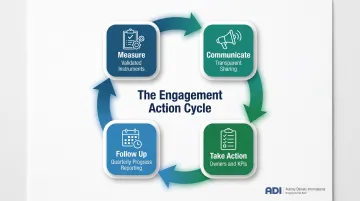
Simple action cycle:
- Measure - Use validated instruments tied to specific engagement drivers
- Communicate - Share results transparently across the entire organization
- Take Action - Create structured action plans with owners, KPIs, and milestones
- Follow Up - Report progress quarterly and adjust based on results
Treat Engagement as a System, Not an Event
That action cycle only works when it's embedded in how managers operate daily — not triggered once a year by a survey. Sustaining engagement means shifting from event-based reviews to continuous coaching built on consistent behavioral reinforcement.
Effective ongoing practices include:
- Replacing annual reviews with frequent, future-oriented coaching conversations
- Providing strengths-based feedback tied to observable behaviors
- Running regular progress check-ins that acknowledge effort, not just outcomes
- Using behavioral science principles to identify what actually reinforces each individual
ADI's work with organizations across manufacturing, healthcare, and financial services consistently shows that engagement holds when managers treat it as a daily discipline — not an HR initiative.
Frequently Asked Questions
What is the difference between employee commitment and engagement?
Engagement reflects enthusiasm for the work itself; commitment reflects dedication to the organization. The highest-performing employees have both. Engaged but uncommitted employees are flight risks who will leave for better opportunities. Committed but disengaged employees are loyal but deliver lower performance.
What are the 4 pillars of employee engagement?
Gallup's Q12 framework organizes engagement into four hierarchical levels: Basic Needs, Individual Contribution, Teamwork, and Personal Growth. Each level builds on the previous — employees need basic needs met before recognition matters, and recognition met before growth opportunities become motivating.
What are the 4 types of employee engagement?
The engagement-commitment matrix identifies four types: Engaged and Committed (high performers who stay), Engaged but Not Committed (flight risks), Committed but Not Engaged (loyal but low-output), and Neither Engaged nor Committed (actively disengaged, shown to undermine performance across 14 of 15 HR metrics).
What are employee engagement tools?
Tools fall into two categories: measurement tools (engagement surveys, pulse checks, structured 1:1 frameworks) and enablement tools (coaching models, recognition programs, performance management systems). Neither category works without consistent manager follow-through and behavioral reinforcement.
How can employers enhance employee engagement and commitment?
The core levers are clear expectations, consistent positive reinforcement from managers, meaningful growth pathways, and organizational follow-through on feedback. Gallup research shows employees receiving weekly feedback and recognition are 61% engaged versus 38% with feedback alone — a 23-point gap that demonstrates how much reinforcement frequency matters.
What are the 3 R's of employee retention?
The 3 R's — Respect, Recognition, and Reward — represent the dimensions through which employees feel genuinely valued. Employees who experience all three are far less likely to leave and more likely to give discretionary effort. Recognition is the active ingredient: it's what makes respect and reward felt, not just stated.