Introduction
Organizations are hemorrhaging productivity and talent — and the culprit isn't compensation. According to Gallup's 2026 State of the Global Workplace report, low employee engagement cost the global economy approximately $10 trillion in lost productivity in 2025, equivalent to 9% of global GDP. Only 20% of employees worldwide were engaged at work, marking the lowest level since 2020.
Most organizations treat engagement as a morale or culture metric — something to measure through annual surveys and address with office perks. This fundamentally misses the point.
Engagement isn't a feeling employees have about their workplace. It's a behavioral phenomenon directly tied to performance output and retention, driven by the consequences employees experience daily.
That distinction matters because it changes where leaders intervene. Sustainable engagement is built through understanding what genuinely reinforces people — and that understanding, applied consistently, is what ADI's behavioral science approach has delivered across 400+ organizations. When you identify what drives discretionary effort (the difference between showing up and giving your best), you gain the most direct lever available for improving both performance and long-term retention.
Key Takeaways
- Employee engagement is a behavioral pattern of discretionary effort and commitment, not simply a satisfaction score
- Disengagement costs organizations through reduced performance, increased turnover, and erosion of organizational capability
- Trust, meaningful work, growth, recognition, and manager relationships are the primary drivers of sustained engagement
- Managers have the greatest daily influence on engagement — through how they respond to and reinforce employee behavior
- Sustainable engagement requires consistent, behavior-specific reinforcement — not annual surveys or one-time initiatives
What Real Employee Engagement Looks Like
Engagement Is Behavioral, Not Emotional
Real engagement shows up in behavior, not surveys. It's a consistent pattern of discretionary effort — the difference between doing what's required and consistently going beyond it because the work environment reinforces that behavior.
Most organizations see three distinct behavioral categories in their workforce:
- Actively engaged employees who invest extra effort, take initiative, and advocate for the organization
- Passively present employees who meet minimum requirements without ownership or emotional investment
- Actively disengaged employees who undermine performance through withdrawal, negativity, or resistance
The middle group — the passively present — is often the largest and most overlooked. In the U.S., this segment represents approximately 52% of the workforce, compared to just 31% engaged and 17% actively disengaged.
The Business Case Is Bottom-Line Critical
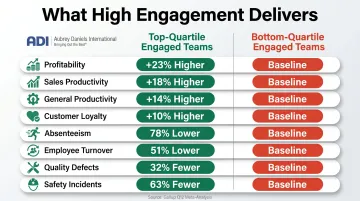
Engagement isn't a soft HR concern — it's a profitability driver. Gallup's Q12 meta-analysis, covering 3.3 million+ workers and 100,000+ teams, found that top-quartile engagement teams dramatically outperform bottom-quartile teams:
| Business Outcome | Top vs. Bottom Quartile Difference |
|---|---|
| Profitability | 23% higher |
| Sales Productivity | 18% higher |
| General Productivity | 14% higher |
| Customer Loyalty | 10% higher |
| Absenteeism | 78% lower |
| Turnover (low-turnover orgs) | 51% lower |
| Quality Defects | 32% fewer |
| Safety Incidents | 63% fewer |
Discretionary Effort: The Performance Multiplier
ADI defines Discretionary Effort as the additional performance contribution that engaged employees willingly give beyond the minimum required. This effort cannot be mandated or pressured out of people — it can only be reinforced.
When organizations build environments that consistently reinforce meaningful contributions, discretionary effort scales. When employees choose to give their best rather than their minimum, organizations gain initiative, innovation, problem-solving, and ownership — all behaviors that dramatically improve results but sit outside formal job descriptions.
Engagement Is Built by the Work Environment
Engagement is not a fixed trait employees arrive with. It's built — or eroded — by the consequences and reinforcement they experience in their work environment every day.
Employees who receive consistent positive reinforcement for meaningful contributions increase their effort. Those who face indifference, punishment for speaking up, or recognition only for outcomes beyond their control withdraw. The environment creates the behavior pattern we call engagement.
The Key Drivers of Employee Engagement
Trust in Leadership
Trust functions as a foundational driver of engagement. Employees engage more fully when they believe senior decision-makers act with transparency, fairness, and genuine concern for the workforce.
The gap between trust and its absence is stark. Only 23% of employees globally trust their organization's leaders, according to a 2025 Gartner survey — yet employees who do trust their leaders are 2.6 times more likely to be fully engaged and 2 times more likely to stay with their current employer for the next year.
Broken trust leads to withdrawal, not just dissatisfaction. Employees stop contributing ideas, stop taking initiative, and stop caring about outcomes beyond their immediate responsibilities.
Meaningful Work and Purpose Alignment
Employees need to see how their individual role connects to something larger than their task list. When work feels purposeful, it functions as a powerful intrinsic reinforcer.
Younger workforce segments rate meaningful work particularly highly:
- 86% of Gen Zs and 89% of Millennials say having a sense of purpose is important to overall job satisfaction and well-being
- 50% of Gen Zs and 43% of Millennials have rejected work assignments based on personal ethics or beliefs
- 44% of Gen Zs and 40% of Millennials have rejected employers on the same basis
For these workforce segments, purpose directly shapes career decisions — making it a concrete retention and performance variable, not a soft benefit.
Growth Opportunities
When employees perceive a clear learning trajectory and internal mobility path, they're more likely to stay and contribute at higher levels. 94% of employees say they would stay at a company longer if it invested in their career development.
When employees see no growth path, the pattern is predictable: they start searching elsewhere, pull back their discretionary effort, and disengage long before they formally resign.
Psychological Safety
Employees who fear judgment, ridicule, or punishment for speaking up disengage faster than almost any other factor. Only 43% of respondents in a McKinsey Global Survey report a positive team climate — identified as the single most important driver of psychological safety.
Psychological safety functions as a behavioral prerequisite for engagement. Without it, employees withhold ideas, avoid risks, and stop offering candid feedback — and organizations forfeit the adaptive performance required to improve and change.
The Manager-Employee Relationship
Managers control the immediate consequences of employee behavior: recognition, feedback, task assignment, autonomy, and support. This makes them the primary behavioral reinforcers in any organization.
70% of the variance in team-level engagement is determined solely by the manager, according to Gallup research. That single variable outweighs organizational policy, benefits packages, and senior leadership visibility combined.
ADI's behavior-based Performance Management framework applies most directly here, helping managers systematically identify and reinforce the specific behaviors that drive performance and engagement.
Strategies to Drive Performance and Retention Through Engagement
Build a Culture of Consistent, Behavior-Specific Positive Reinforcement
Move beyond vague annual praise. Train leaders to identify, acknowledge, and reinforce specific high-value behaviors frequently and immediately.
Why timing and specificity matter:
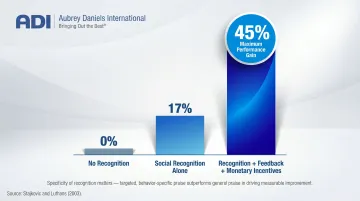
- Research by Stajkovic and Luthans (2003) found that social recognition alone improved performance by 17%, and when combined with feedback and monetary incentives, produced a 45% improvement in task performance
- Thornock (2016) found that immediate feedback following implementation most effectively promotes learning and future performance
- General praise ("good job") has little behavioral impact; specific recognition ("Your detailed handoff notes prevented three potential errors this week") reinforces the exact behavior you want repeated
Provide Clear, Ongoing Feedback That Connects Behavior to Outcomes
Employees who understand what they're doing well and why it matters perform with more confidence and engagement.
Effective feedback is:
- Specific: Identifies the exact behavior, not just the outcome
- Timely: Delivered close to the behavior, not weeks later in a review
- Future-focused: Research by Gnepp et al. (2020) found that managers were motivated to improve when feedback conversations focused on future actions rather than past performance
Ineffective feedback is:
- Evaluative and judgmental rather than developmental
- Delayed until formal review cycles
- Vague and outcome-focused rather than behavior-specific
Invest in Purposeful Learning and Development Pathways
Create L&D experiences that connect to real job responsibilities and visible career outcomes, not compliance box-checking. Employees experience growth as a reinforcer when development directly enhances their capability and trajectory.
ADI's Applications of Behavioral Leadership workshop teaches participants to capture discretionary effort through positive reinforcement, evaluate performance objectively, and apply the science of consequences — skills that transfer directly to daily work and career advancement.
Address Disengagement Warning Signs Before They Become Turnover
Behavioral indicators signal a reinforcement breakdown in the work environment. Watch for:
- Drop in initiative or volunteering for projects
- Increased absenteeism or late arrivals
- Reduced collaboration or withdrawal from team activities
- Declining quality or attention to detail
- Decreased communication or participation in meetings
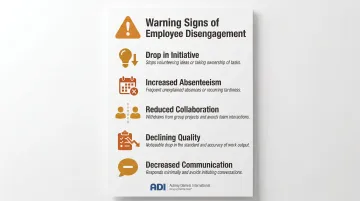
These behaviors indicate that the work environment has stopped reinforcing engagement. Intervene by identifying what consequences have shifted and rebuilding positive reinforcement.
Strengthen the Connection Between Performance and Recognition Systems
Ensure compensation, advancement, and recognition structures reward the behaviors the organization actually wants to see more of. Misaligned incentive systems are a leading cause of engagement failure.
When top performers receive visible recognition and advancement for the right behaviors, those behaviors spread. But if political maneuvering or tenure consistently outweigh results, discretionary effort evaporates — and disengagement follows.
Gallup research shows that employees receiving high-quality recognition are 9 times as likely to be engaged and 65% less likely to be actively looking for another job. Yet only 22% of employees report receiving the right amount of recognition.
Turnover is expensive. Gallup estimates replacement costs at:
- 200% of salary for leaders and managers
- 80% of salary for technical roles
- 40% of salary for frontline workers
Those numbers make the business case clear: fixing recognition gaps isn't a soft initiative. It's one of the highest-return investments an organization can make.
The Manager's Role in Sustaining Engagement
Managers Are the Single Most Influential Variable
Managers shape the daily reinforcement environment employees experience. They are more influential than organizational policy, benefits, or senior leadership visibility because they control the immediate consequences of behavior.
70% of the variance in team-level engagement is determined by the manager alone. This means engagement is largely a function of manager capability, not corporate programs.
Three Critical Manager Behaviors Directly Support Engagement
1. Recognizing and reinforcing specific efforts consistently
Managers who regularly acknowledge specific high-value behaviors create environments where employees know their contributions matter. Recognition must be frequent, specific, and tied to behaviors the organization values.
2. Setting clear behavioral expectations
Employees need to know what success looks like. Clarity eliminates ambiguity, reduces anxiety, and enables employees to self-correct. Gallup data shows that only 46% of employees strongly agree they know what is expected of them at work — down 10 percentage points from 2020.
3. Creating space for employees to voice ideas and concerns
Employees who feel heard and respected engage more fully. Managers who invite input without negative consequences build psychological safety — and surface insights that improve how work actually gets done.
Developing Manager Capability Requires Intentional Training
These three behaviors don't come naturally to most managers — they require deliberate skill-building. Structured learning experiences that teach behavioral science principles and provide applied practice are what close the gap.
ADI's consulting approach builds those skills through methodologies like Precision Leadership® and Precision Coaching®, which help managers:
- Identify the specific behaviors that drive performance outcomes
- Deliver targeted behavioral coaching that accelerates improvement
- Build accountability through reinforcement rather than punishment

When organizations treat manager development as a strategic investment rather than a scheduling obligation, engagement gains become durable — not dependent on culture campaigns or top-down mandates.
Measuring Engagement and Spotting Warning Signs
Annual Surveys Alone Are Insufficient
Engagement is dynamic and behavioral — it can shift within weeks based on reinforcement conditions. Annual engagement surveys provide only an intermittent snapshot that fails to allow for dynamic course corrections.
SHRM characterizes traditional annual surveys as "intermittent episodic snapshots" and calls for continuous, real-time assessment using pulse surveys, sentiment trackers, and feedback loops. Gallup recommends surveying at minimum every six months.
The stakes are real: U.S. engagement dropped 2 percentage points between 2023 and 2024 — 3.2 million fewer engaged employees in a single year. That kind of shift doesn't happen slowly. It happens when reinforcement conditions change and no one catches it in time.
Most Meaningful Behavioral Warning Signs
Watch for these indicators at the team and individual level:
- Reduced discretionary contributions: Employees stop volunteering, offering ideas, or taking initiative
- Increase in unplanned absences: Higher absenteeism or sick day usage signals withdrawal
- Diminished communication: Less participation in meetings, shorter responses, reduced interaction
- Departure of high performers: Loss of top talent indicates systemic reinforcement issues
- Decline in quality or productivity: Performance drops suggest consequences no longer support high effort
Each of these points to a systemic reinforcement issue. The diagnostic question isn't about the employee — it's about the environment: what changed, and what stopped working as a reinforcer?
Effective Engagement Measurement Combines Multiple Data Sources
Catching these signals early requires more than a single data source. Effective measurement draws from three layers:
- Pulse surveys and sentiment tools that surface employee perceptions and flag emerging themes
- Direct behavioral observation to track actual effort levels and discretionary contributions over time
- Performance trend data — productivity, quality, safety incidents, and retention — that confirms or challenges what surveys report
ADI's structured, science-based frameworks like the Discretionary Effort Graph® and Precision Leadership® Survey help organizations diagnose what is driving or suppressing engagement in their specific context, enabling targeted interventions rather than generic programs.
Frequently Asked Questions
What are the 5 drivers of employee engagement?
The most consistently cited drivers are trust in leadership, meaningful work, growth opportunities, recognition, and manager relationships. These work because they function as positive reinforcers — giving employees a concrete reason to contribute beyond the minimum.
What are the 4 pillars of employee engagement?
The four commonly referenced pillars are connection, clarity, contribution, and appreciation. Together, they shape the conditions that make discretionary effort a natural outcome rather than a forced one.
What are the 5 C's of employee engagement?
The 5 C's are Communication, Culture, Clarity, Connection, and Compensation/Recognition. When these elements work together, they create a consistent environment where employees are reinforced for performance and participation.
What are good questions for an employee engagement survey?
Include questions covering clarity of role expectations, quality of feedback received, sense of purpose, manager support, and growth opportunities. The best surveys are paired with behavioral follow-through — measurement alone doesn't improve engagement; action on the data does.
What are the 4 types of employee engagement?
The four types are actively engaged, passively engaged, actively disengaged, and burned out. Where an employee falls depends on the reinforcement history they've built up in your organization — what happened when they put in effort over time.
What are the 3 C's of meaningful work?
The 3 C's of meaningful work are Contribution (impact on outcomes), Connection (to purpose and people), and Challenge (opportunity to grow and solve problems). These elements create intrinsic reinforcers that sustain engagement beyond what external rewards alone can achieve.
Sustainable engagement is built through consistent, behavior-specific reinforcement — the kind that makes discretionary effort worth giving and retention a natural result. Organizations that understand this behavioral foundation move beyond measuring engagement to systematically creating it.
For over 45 years, ADI has helped organizations apply behavioral science to unlock performance and retention through genuine engagement. Contact us at 1-678-904-6140 or info@aubreydaniels.com to learn how behavior-based engagement strategies can transform your results.