Introduction
Most organizations spend significant resources on leadership development and see limited return. U.S. companies collectively spend $102.8 billion annually on training, yet research from Saks and Belcourt found that reported application of training fell from 62% immediately after training to just 34% after one year. The programs aren't failing because the content is wrong. They're failing because behavior change requires more than a training event.
For HR leaders, L&D professionals, and senior managers building or overhauling leadership pipelines, the challenge isn't finding good programs. It's creating a structure that connects development to business outcomes, sustains behavior change, and scales across leadership levels.
A strategic roadmap addresses that structure directly. Unlike a training calendar or individual development plan, it connects every development activity to measurable business outcomes.
The 5 steps below cover how to build that roadmap — starting with business strategy alignment and ending with how to measure whether behavior change actually sticks.
Key Takeaways
- A strategic leadership development roadmap ties leader capability-building directly to business outcomes, not training completions or skills checklists.
- Most programs fail because they treat development as content delivery rather than behavior change.
- The 5 steps: align to business strategy, assess behavioral gaps, define target behaviors, design sequenced experiences, measure and sustain progress.
- Reinforcement after behavior is what separates lasting change from short-term results.
- Measurement must be built into the roadmap from day one, not added later.
What Is a Strategic Leadership Development Roadmap?
A strategic leadership development roadmap is a structured, sequenced plan that connects leader capability-building to business priorities. It identifies the specific behaviors leaders must demonstrate and maps how those behaviors will be developed and sustained over time.
That's distinct from two things organizations often confuse it with:
- A training calendar — which lists programs by date without linking them to business outcomes or behavioral targets
- An individual development plan — which focuses on one person's goals, activities, and timeline
What makes a roadmap strategic is that it operates at the organizational level. It accounts for multiple leadership levels — frontline supervisors, mid-level managers, senior leaders — and is designed to produce measurable business impact, not just learning activity.
A roadmap governs the system. It ensures development scales across cohorts, roles, and timeframes while maintaining direct alignment to organizational priorities. Without that system-level structure, even well-designed programs become isolated events — producing temporary momentum and little sustained change.
Why Most Leadership Development Programs Fall Short
The Content Delivery Trap
Most programs are built around content: workshops, courses, reading lists, webinars. Content is easy to design, schedule, and track. The problem is that exposure to content doesn't reliably produce behavior change.
McKinsey data shows that only 40% of companies report their learning strategy is aligned with business goals. That means the majority of development activity happens in a vacuum — disconnected from the organizational priorities it's supposed to serve. When leaders can't connect learning to their real work, engagement drops and transfer collapses.
The Missing Behavioral Layer
Without a behavioral framework, organizations default to tracking what's easy to count: course completions, attendance rates, satisfaction scores. These are activity metrics. They tell you whether leaders showed up, not whether they changed how they lead.
The evidence behind this is consistent: ADI's 45+ years of applied behavioral science research shows that the rate of performance improvement is directly related to the amount of positive reinforcement for that improvement. Behavior is maintained by consequences in the environment — not by training events. When development programs skip reinforcement structures, newly learned behaviors fade. Leaders fall back on old habits.
How a Roadmap Fixes This
A well-designed roadmap addresses these failures directly by:
- Connecting each development experience to a specific business outcome
- Setting behavioral targets leaders can demonstrate on the job, not just recall in a classroom
- Designing reinforcement into the program from the start — not bolted on after the fact
- Measuring progress at the behavioral level, so you know whether leadership actually changed
The 5 Steps to Build a Strategic Leadership Development Roadmap
Each step builds on the previous one. Skipping steps — particularly the assessment and behavioral definition work — is the primary reason roadmaps fail to deliver results.
Step 1: Align Leadership Goals to Business Strategy
Start with the right question: What does the organization need leaders to do differently to achieve its most critical goals?
Work backward from business outcomes (growth targets, transformation initiatives, retention goals, operational performance) to identify the leadership behaviors that enable them. This reverse-engineering approach is central to how ADI structures its Behavioral Roadmapping engagements: defining desired business results first, then identifying the critical behaviors required at each organizational level to produce them.
Involve senior stakeholders early. Their input determines whether the roadmap earns executive sponsorship and budget. Without visible commitment at the top, even technically sound roadmaps stall during implementation.
Specificity matters here. The difference between a useful alignment goal and an unhelpful one:
| Vague Goal | Business-Aligned Goal |
|---|---|
| "Develop better communicators" | "Leaders who deliver real-time performance feedback that reduces rework and improves team output" |
| "Build strategic thinking" | "Senior managers who facilitate structured problem-solving sessions generating cross-functional solutions" |
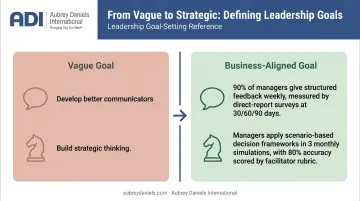
That specificity becomes the behavioral target for everything that follows.
Step 2: Assess Current Leadership Capabilities and Behavioral Gaps
Assessment establishes a realistic baseline — covering not just what skills leaders have, but what behaviors they consistently demonstrate and what factors drive or inhibit those behaviors.
ADI uses a combination of tools to do this:
- Precision Leadership Survey (Upward Feedback) — gives leaders specific direction on which practices their teams find effective and which get in the way
- 360° Survey — gathers multi-rater input from managers, peers, and direct reports to surface gaps between leader intent and perceived impact
- Stop-Start-Continue Survey — translates direct-report feedback into actionable behavioral opportunities
- Site assessments — interviews, focus groups, behavioral observation, and data review to identify what organizational systems inadvertently reinforce the wrong behaviors
The last point is often missed. Many assessments capture self-reported competency ratings without examining what actually reinforces each leader's current behavior. If a manager is consistently rewarded for hitting short-term numbers and never recognized for developing their team, the assessment needs to surface that.
The reinforcement environment sustains the wrong behavior regardless of what the training catalog says. Assessing systems alongside skills is what makes the difference.
Step 3: Define the Target Leadership Competencies and Behaviors
Assessment findings and business goals now need to translate into a defined set of target behaviors — specific, observable, and measurable.
This is where behavioral pinpointing matters. The clearer the behavioral target, the easier it is to coach toward, measure, and reinforce. Vague competency definitions don't give leaders, coaches, or managers anything concrete to work with.
Compare these two definitions of the same competency:
- Vague: "Demonstrates strategic thinking"
- Pinpointed: "Regularly facilitates structured problem-solving sessions that generate actionable cross-functional solutions within defined timeframes"
The second version can be observed, coached, and tracked. The first can't.
Build in multi-level differentiation. What a frontline supervisor needs to demonstrate differs significantly from what a VP needs. Target behaviors should be tiered by leadership level.
ADI's behavioral roadmapping framework cascades expected behaviors from executives through mid-level managers to frontline leaders. This tiering maintains relevance and prevents one-size-fits-all content from disengaging leaders at both ends of the pipeline.
Step 4: Design and Sequence Development Experiences
With behavioral targets defined, design should follow — not precede — them. The question isn't "what programs do we have?" but "what experiences will build these specific behaviors?"
Match learning modalities to the behaviors you're developing:
- Formal workshops for foundational behavioral frameworks
- Coaching for real-time application and skill refinement
- Stretch assignments for developing judgment under pressure
- Peer cohorts for cross-functional influence and accountability
- Action learning projects for complex, multi-stakeholder challenges
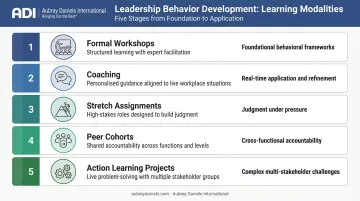
Sequencing matters. A meta-analysis of 335 independent samples and 26,573 employees found that spaced, multi-method development programs outperform single-session approaches for behavioral transfer.
Foundational skills (self-awareness, feedback delivery, behavioral observation) should precede advanced leadership challenges like change leadership and cross-functional influence.
ADI's Applications of Behavioral Leadership workshop illustrates this sequencing: it runs four days, teaches a 5-step change process, and integrates coaching practice throughout. Behavioral skill development requires application, not just instruction. The follow-up coaching component is explicitly designed to reinforce the behaviors introduced during training.
Build reinforcement architecture into every experience. For each development component, the roadmap should specify:
- What behaviors leaders will practice during the experience
- How managers will recognize and reinforce those behaviors back on the job
- What feedback mechanisms will be in place to sustain momentum
Behavior that isn't reinforced extinguishes. That's a systems design problem, not a training design one.
Step 5: Measure Progress and Sustain Behavioral Change
Measurement built in from the start looks different from measurement added as an afterthought. A well-constructed roadmap establishes both types of indicators:
Leading indicators (track in real time):
- Are leaders demonstrating the targeted behaviors on the job?
- Are managers actively reinforcing those behaviors?
- Are coaches observing and providing feedback regularly?
Lagging indicators (track over time):
- Are team performance metrics improving?
- Are retention and engagement scores shifting?
- Is the succession pipeline strengthening?
CIPD found that only 50% of organizations have a process for assessing learning impact, and just 7% strongly agree they have a process for supporting learning transfer. Building measurement in from the start puts a roadmap in the minority that actually tracks what matters.
The sustainability challenge is real. Organizations often see initial behavior change after development, then watch it fade. This happens because behavior is maintained by consequences in the environment, and most environments don't change when a training program ends.
The Saks and Belcourt data makes this concrete: training application drops from 62% immediately after training to just 34% after one year.
Sustaining progress requires deliberate structure in the 6–12 months following initial development:
- Manager check-ins explicitly tied to behavioral goals
- Peer accountability structures within leadership cohorts
- Refresher coaching touchpoints at defined intervals
- Progress dashboards tracking behavioral metrics, not just completions
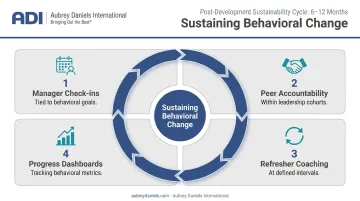
ADI's approach embeds sustainability into the implementation design rather than treating it as a separate phase. The follow-up coaching component provides positive accountability and skill refinement specifically to ensure that new behaviors become habits — not just temporary post-training effects.
Common Mistakes That Derail Leadership Development Roadmaps
Three patterns consistently undermine otherwise well-designed roadmaps — and all three are avoidable.
Treating the roadmap as a static document is the first. Leadership needs, business strategy, and individual progress all shift. A roadmap built once and shelved quickly becomes irrelevant. Build in a regular review cadence — quarterly works for most organizations.
Tracking completion instead of behavior change is a close second. Attendance rates tell you who showed up to training. They don't tell you whether anything changed on the job. The metrics that actually matter are behavioral observation data, manager feedback on applied skills, and measurable business outcome shifts. These take more effort to collect, but they're the only indicators that the roadmap is working.
The third mistake is sidelining the manager. If a developing leader's direct manager doesn't recognize and reinforce the target behaviors back on the job, even the best development experience fades quickly. DDI research identifies manager support as one of the top three predictors of leadership behavior change. The manager isn't a passive bystander here — manager enablement needs to be a core component of the roadmap itself.
Frequently Asked Questions
How do you create a strategic leadership development roadmap?
Start by aligning development goals to business priorities, then assess current capability and behavioral gaps. Define specific, observable behavioral targets, design sequenced development experiences to close those gaps, and build in measurement and reinforcement systems from the outset.
What are the 5 pillars of strategic leadership?
The five pillars are vision and direction-setting, strategic alignment, decision-making, people development, and driving change. Each pillar translates into specific observable behaviors that can be defined, developed, and reinforced — making them measurable targets rather than abstract leadership qualities.
What is the difference between a leadership development plan and a leadership development roadmap?
A development plan is individual-focused — it captures one person's goals, activities, and timelines. A roadmap governs the system across multiple leadership levels, cohorts, and timeframes, connecting individual growth to organizational strategy at scale.
How do you measure the success of a leadership development roadmap?
Use leading indicators (behavioral change on the job, frequency of target behaviors, reinforcement activity) to track progress in real time, and lagging indicators (business outcome improvements, retention, succession pipeline strength) to validate long-term impact.
What are the most common mistakes in leadership development planning?
The top mistakes are confusing training activity with behavior change, failing to tie development to specific business outcomes, and neglecting the ongoing reinforcement required to sustain new leader behaviors after initial training ends.
How long does it take to see results from a leadership development roadmap?
Early behavioral indicators can appear within weeks when reinforcement systems are in place. Meaningful business-level outcomes typically require 6–18 months.