Introduction
Applied Behavior Analysis is most often associated with autism therapy — but that association undersells both its scope and its origins. ABA is a scientific framework rooted in universal laws of behavior that operate wherever humans act: on factory floors, in executive teams, and across every layer of an organization.
The Association for Behavior Analysis International is clear on this point: ABA is not a therapy for autism — it's a science with a data-based decision-making framework applicable across every domain of human performance.
That distinction matters for anyone responsible for improving how people perform. This article covers two foundational frameworks every practitioner and leader should understand:
- The 7 dimensions of ABA — the criteria that define rigorous, meaningful practice
- The core behavioral principles — the mechanisms that explain how and why behavior changes
These principles apply whether you're running a safety program in a manufacturing plant, coaching a sales team, or redesigning how work gets done. What changes is the application — not the science.
TL;DR
- ABA is a scientific discipline formally established by Baer, Wolf, and Risley in 1968 — not a single therapy technique
- Seven defined dimensions — including Applied, Behavioral, Analytic, and Generality — determine what counts as legitimate ABA practice
- Positive reinforcement is the most important and widely applied principle in behavior analysis
- The ABC model (Antecedent, Behavior, Consequence) is the foundational tool for understanding why any behavior occurs
- These principles drive measurable performance improvement in workplace and organizational settings
What Is Applied Behavior Analysis?
Baer, Wolf, and Risley's 1968 paper in the Journal of Applied Behavior Analysis formally established ABA as a scientific discipline. Their framework defined both the dimensions of rigorous practice and the expectations practitioners must meet — and researchers have built on that foundation for more than five decades since.
ABA is the systematic study and improvement of socially significant behavior using empirically validated methods. The Behavior Analyst Certification Board describes it as "a science based on the use of learning principles to improve lives," with applications spanning education, organizational management, safety, gerontology, and more.
ABA helps answer three questions:
- How does behavior work?
- How does the environment influence behavior?
- How does learning occur?
These questions apply across virtually every human context. ABA is a scientific framework of principles and methods — one that works in clinical, educational, and organizational settings alike.
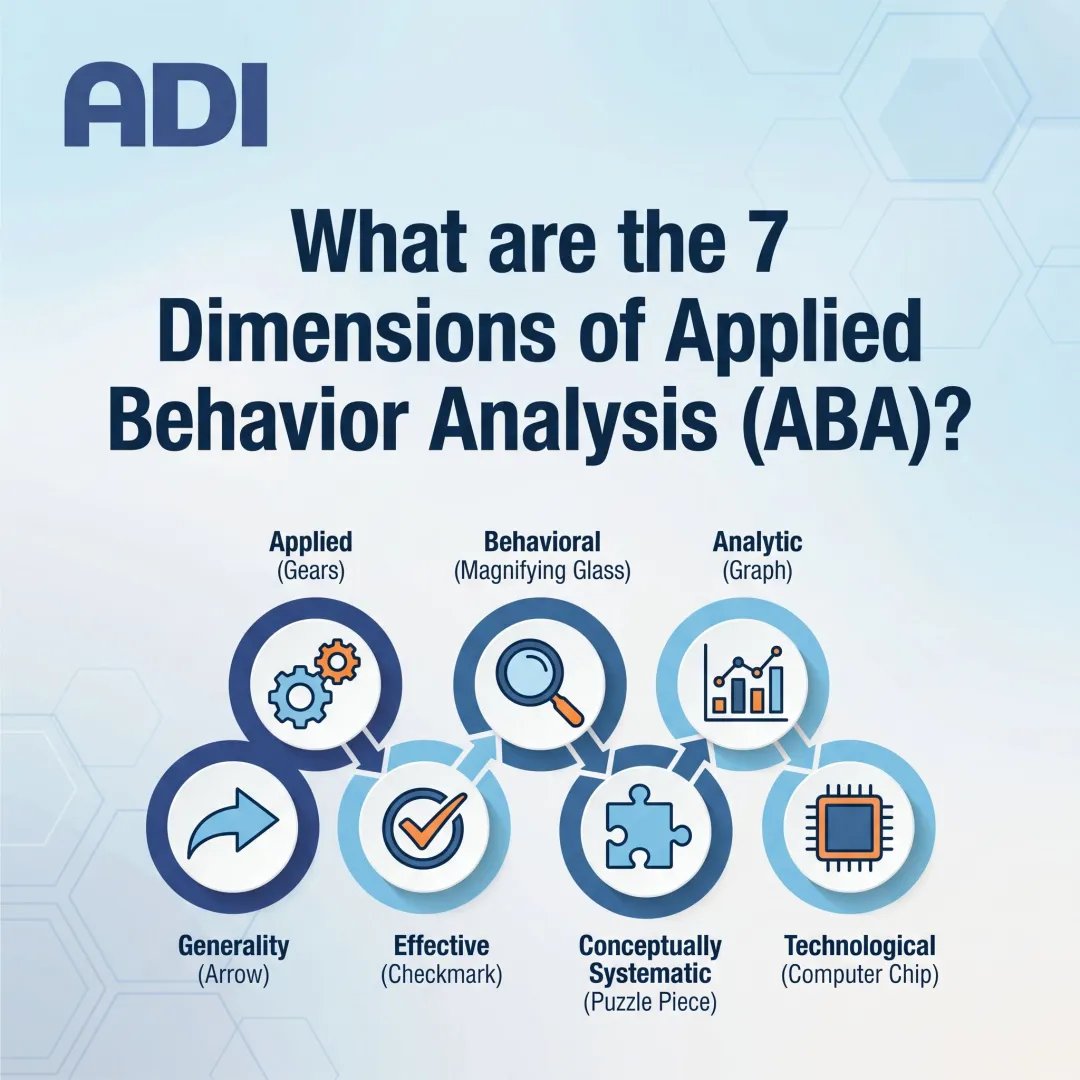
The 7 Dimensions of ABA
Baer, Wolf, and Risley didn't just define ABA — they specified the criteria any practice must meet to legitimately call itself ABA. These seven dimensions serve as both a quality standard and an accountability framework. Any intervention that doesn't meet all seven falls short of the standard.
Applied
The "applied" dimension means interventions must target behaviors of real social significance. It's not enough to measure something convenient — the behavior change must genuinely matter to the individual in their actual life or environment. A technically sound intervention that targets irrelevant behavior is still a failed intervention.
Behavioral
ABA focuses on what can be observed and measured — not internal states or vague personality traits. Observable behavior makes progress trackable and outcomes verifiable. This grounding in measurement is what allows practitioners to test whether an intervention is actually working.
Analytic
Data must demonstrate that the intervention itself caused the behavior change — not some external variable. Correlation isn't enough. The analysis must establish that the procedure produced the effect — which is what separates behavioral science from anecdote-driven practice.
Technological
Procedures must be described with enough specificity that any trained practitioner can implement them consistently. If outcomes depend more on who's delivering the intervention than on what the intervention actually is, the method isn't sufficiently described. Replicability across practitioners is the standard.
Conceptually Systematic
Interventions must connect to established behavioral principles, not invented ad hoc. Every technique should trace back to the science of behavior analysis — this ensures coherence across the practice and prevents drift toward methods that sound reasonable but lack empirical grounding.
Effective
Statistical significance isn't the bar. ABA holds itself to a higher standard: interventions must produce meaningful, socially significant improvements in real-world performance. A statistically detectable change that doesn't improve how someone functions in daily life or on the job doesn't meet this dimension.
Generality
A skill learned in one context that disappears in another hasn't truly been learned. Behavior changes must transfer across settings, people, and time. Lasting, generalizable change is the goal. When improvement only holds up during structured sessions, the work isn't finished.

The Core Behavioral Principles of ABA
The ABC Model
Every behavioral analysis starts with the same three-part framework: Antecedent → Behavior → Consequence.
- Antecedents are the events, instructions, or conditions that precede behavior
- Behavior is the observable action itself
- Consequences determine whether the behavior increases or decreases in the future
A simple example: a manager asks an employee to submit reports by Friday (antecedent). The employee submits on time (behavior). The manager acknowledges the effort with specific, genuine feedback (consequence). That positive consequence makes on-time submission more likely going forward.
Consequences are where the real leverage lives. They shape future behavior far more powerfully than antecedents alone.
Reinforcement
Cooper, Heron, and Heward's foundational ABA text states plainly that "positive reinforcement is the most important and most widely applied principle of behavior analysis."
Two types matter:
- Positive reinforcement — adding something valued after a behavior to increase its future occurrence (praise, recognition, a reward)
- Negative reinforcement — removing something aversive to increase a behavior (eliminating a frustrating process when an employee completes a task correctly)
Both types increase behavior. Negative reinforcement is frequently misunderstood as punishment — it isn't. Positive reinforcement remains the stronger tool for lasting change because it builds behavior people choose to repeat, not just behavior they perform to escape discomfort.
Extinction
Extinction means withholding the reinforcement that previously maintained a behavior. Over time, the behavior decreases.
A few practical cautions:
- Extinction bursts are common — behavior often temporarily increases before it decreases
- Spontaneous recovery can occur — the behavior may resurface even after appearing to stop
- Extinction alone is rarely sufficient — the most effective approach pairs extinction with differential reinforcement of an alternative (DRA), giving the person a better-reinforced option to replace the behavior being reduced
Extinction works best as one part of a broader strategy — reduce the unwanted behavior while simultaneously building a stronger replacement.
Shaping and Chaining
When extinction narrows what someone does, shaping builds what comes next. Shaping means reinforcing successive approximations toward a target behavior — each step closer to the goal gets acknowledged, gradually moving performance toward the desired outcome rather than waiting for the perfect final form.
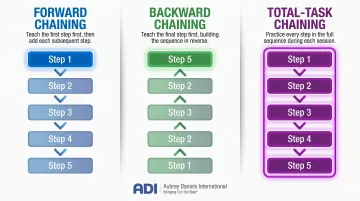
Chaining addresses complex, multi-step behaviors by breaking them into sequential components and teaching each step. Three standard approaches:
- Forward chaining — teach the first step first, progress sequentially
- Backward chaining — teach the final step first, add preceding steps in reverse
- Total-task chaining — practice the entire sequence in every session
Chaining is particularly useful for job tasks, safety procedures, and any skill that requires a consistent sequence of actions.
Prompting and Generalization
A prompt is any cue or assistance that helps elicit a correct response. Over time, prompt fading systematically reduces that assistance, transferring stimulus control from the prompt to the natural environment so the learner eventually responds independently without needing the cue.
Generalization is the ultimate test of whether behavior has truly been learned: does it transfer to new settings, different people, and novel situations? ABA literature is emphatic that generalization must be deliberately planned — it rarely happens spontaneously. Strategies include:
- Using multiple trainers and environments during instruction
- Training with varied examples and materials
- Building in natural contingencies that will sustain behavior after formal training ends
Planned generalization is what separates a behavior that holds under real-world conditions from one that only shows up when someone is watching.
From Clinic to Workplace: How ABA Principles Apply to Business Performance
The principles of behavior analysis aren't clinical tools — they're laws of behavior that operate wherever humans act. Managing employee performance without understanding what drives behavior leaves results largely to chance.
The ABC model maps directly onto organizational settings:
| ABC Component | Organizational Example |
|---|---|
| Antecedent | Job expectations, manager instructions, workplace policies |
| Behavior | Measurable actions employees take |
| Consequence | Feedback, recognition, pay, advancement — or their absence |
Most organizations invest heavily in antecedents — writing clearer policies, setting better goals, improving communication. What they under-invest in is consequences. Yet consequences exert the most powerful influence on future behavior.
Reinforcement as the Driver of Discretionary Effort
Employees who experience meaningful, timely positive consequences for desired behavior are more likely to sustain and increase that behavior. ADI defines discretionary effort as "the level of effort people could give if they wanted to, but above and beyond the minimum required."
Backed by over 45 years of applying behavioral science to organizations, ADI's position is direct: the only way organizations earn discretionary effort is through positive reinforcement.
ADI's Performance Management approach — a term Dr. Aubrey Daniels coined and introduced to the business world — is built on exactly that. The methodology implements measurement, feedback, and positive reinforcement in sequence, treating performance improvement as a science rather than a personality trait.
Putting Analytical Rigor Into Practice
Effective organizational performance improvement requires the same rigor that ABA demands in clinical settings:
- Define behaviors in observable, measurable terms — vague goals like "be more proactive" can't be reinforced consistently
- Collect data on the critical few behaviors that drive results at each organizational level, using ADI's behavioral roadmapping process
- Build plans specific enough that any manager can execute them reliably, not just those with natural coaching instincts
ADI's PIC/NIC Analysis® is a practical example of this applied analytical rigor: a tool for examining the consequences that maintain or undermine specific behaviors, revealing which consequence patterns are sustaining the wrong behaviors — and which desired behaviors lack reinforcement entirely.

What Makes ABA-Based Approaches Effective in Any Setting
Three factors consistently determine whether ABA-informed approaches work — in clinics, classrooms, or organizations.
1. Individualization of reinforcers
What one person finds motivating, another finds neutral or even aversive. Identifying what actually functions as a reinforcer for a specific individual is a prerequisite for meaningful behavior change, not an afterthought.
ADI's Applications of Behavioral Leadership workshop teaches leaders precisely this skill: uncovering natural reinforcers that sustain performance gains over time.
2. Consistency across environments and implementers
Inconsistent consequences undermine behavior change. When different managers respond differently to the same behavior, the signal gets muddled.
ADI's Trainer Certification and Coach Certification programs address this directly, building consistent internal behavioral expertise across sites and levels so implementation quality doesn't vary depending on who's running the meeting.
3. Data over intuition
ABA-informed approaches change the intervention when data shows no improvement , not the person. If measurement shows the approach isn't working, the approach gets revised. ADI's assessment and scorecarding processes build this feedback loop into organizational practice, turning systematic adjustment into a repeatable discipline.
Frequently Asked Questions
What are the principles of applied behavior analysis?
ABA principles are evidence-based methods including reinforcement, extinction, prompting, shaping, chaining, and generalization, all grounded in the empirical science of behavior. They're used to increase helpful behaviors while reducing harmful or interfering ones across clinical, educational, and organizational settings.
What is the key principle of applied behavior analysis?
Positive reinforcement is the most fundamental principle. Behaviors followed by valued consequences are more likely to recur. Cooper, Heron, and Heward describe it as the most important and widely applied principle in the field — and the primary driver of lasting behavior change.
What are the 7 dimensions of applied behavior analysis?
The 7 dimensions established by Baer, Wolf, and Risley (1968) are: Applied, Behavioral, Analytic, Technological, Conceptually Systematic, Effective, and Generality. These dimensions define what counts as rigorous ABA practice and serve as the field's quality standard.
What are the 4 core principles of applied behavior analysis?
Four foundational ideas run through ABA: behavior is shaped by its environment; behavior is strengthened or weakened by its consequences; positive approaches produce more effective change than punishment-based ones; and consistent reinforcement is required to produce socially significant, lasting results.
What are the 5 core principles of applied behavior analysis?
The five most commonly referenced core principles are reinforcement, extinction, prompting and fading, shaping, and generalization. Each principle addresses a different stage — from building new behaviors to sustaining them in everyday environments.
What are the 4 components of behavioral skills training (BST)?
BST's four components are instruction, modeling, rehearsal, and feedback. It's a structured, ABA-based method for teaching new skills used in both clinical training and organizational development contexts, including leadership and safety training programs.