The gap between what leaders say the culture is and what employees experience each day remains invisible to leadership until the damage is already done. Rising turnover, declining engagement, and missed performance targets are symptoms of a deeper problem: organizations are measuring attitudes instead of the behaviors that actually shape culture.
This guide provides a practical, behavior-based framework for diagnosing organizational culture through observable signals and improving it through proven strategies grounded in applied behavioral science. Drawing on ADI's 45+ years applying behavioral science to organizational performance across 400+ companies globally, this article offers leaders a roadmap to close the culture gap—and sustain meaningful change.
Key Takeaways
- Culture is defined by behaviors consistently reinforced—not values statements alone
- Effective assessment combines surveys, behavioral observation, cross-functional metrics, and external feedback
- Most culture initiatives fail by targeting attitudes rather than the reinforcement patterns that drive behavior
- Sustainable change requires leaders to model, reward, and consistently reinforce desired behaviors at every level
- Culture improvement is ongoing—not a one-time project
What Organizational Culture Really Is (and Why Most Organizations Miss It)
Organizational culture is the sum of behaviors consistently practiced, rewarded, and modeled across your organization. The poster in the conference room doesn't define it. How employees actually behave when facing competing priorities, tight deadlines, or difficult conversations—and whether leadership reinforces or ignores those behaviors—does.
Edgar Schein, whose work defines modern organizational culture theory, describes culture as "a pattern of shared basic assumptions learned by a group" as it solves problems of external adaptation and internal integration. But here's the critical distinction behavioral science adds: culture operates at three levels—artifacts (what you see), espoused values (what leaders say), and underlying assumptions (what actually drives behavior). Most organizations focus exclusively on the first two and miss the third entirely.
The Espoused-Enacted Values Gap
A study of 689 companies analyzing 1.2 million employee reviews revealed an uncomfortable finding: there is no correlation between published cultural values and how well companies live up to them in employees' eyes. Four of nine measured values were negatively correlated with actual employee experience:
- Collaboration
- Customer orientation
- Execution
- Diversity
Organizations listing "integrity" or "collaboration" as core values often scored worse on those dimensions than companies that didn't mention them at all.
This gap exists because culture is built by what you reinforce, not what you write. When managers promote employees who cut corners, when high performers who violate values go uncorrected, when recognition systems reward individual achievement in organizations claiming to value teamwork—the actual culture forms around those patterns, not the stated ones.
Behavioral science is precise on this point: the behaviors that get rewarded—through recognition, promotion, attention, or simply being tolerated—become the culture, whether you intend them to or not. When employees see peers recognized for hustle over quality, or speed over safety, they learn what the organization truly values.
No mission statement corrects that signal.
Warning Signs Your Organizational Culture Needs Assessment
Culture problems don't announce themselves. They accumulate slowly—until they're expensive.
Key behavioral and operational warning signs include:
- Voluntary turnover rising, especially among high performers or within specific teams
- Engagement scores declining—or employees refusing to participate honestly in surveys
- Minimal discretionary effort, with little proactive problem-solving from the broader team
- Missed deadlines, quality issues, or safety incidents with no clear ownership
- Silos between departments, information hoarding, or passive-aggressive communication patterns
- Wide performance gaps across teams whose managers hold the same role
These symptoms point to deeper cultural misalignment. Poor communication and low recognition are rarely isolated problems—they indicate that the wrong behaviors are being reinforced, or that the right ones aren't being reinforced consistently.
What Disengagement Costs in Real Numbers
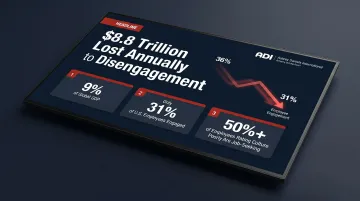
Disengaged employees cost the global economy $8.8 trillion annually in lost productivity—equal to 9% of global GDP. For a median-size S&P 500 company, employee disengagement translates to $228 million to $355 million per year in lost productivity.
In the U.S., only 31% of employees are engaged—down from a 36% peak in 2020. That decline represents approximately 8 million fewer engaged workers. Meanwhile, more than 50% of employees who rate their culture poorly are actively looking for another job.
These numbers make the case for early, systematic assessment—before attrition accelerates and costs become visible on the income statement.
How to Assess Your Organizational Culture
Most executives believe culture matters. Deloitte research shows that 87% say it's important and 82% believe it's a competitive advantage. Yet only 28% believe they understand their culture well—and fewer than 12% believe they "truly understand" it.
The gap exists because organizations rely too heavily on surveys that measure perception, not reality. Effective culture assessment requires multiple methods that capture what's actually happening.
Start with a Values-Behavior Alignment Check
Compare your stated organizational values against observable behavior. Ask:
- Are these values reinforced in hiring decisions? Do interview processes assess cultural fit behaviorally, or just technically?
- Are they reinforced in promotions? Do people who violate values still advance if they hit numbers?
- Are they reinforced in recognition? What behaviors get called out and celebrated publicly?
- Are they reinforced in corrective action? When someone violates a stated value, is there consequence—or silence?
If your organization lists "collaboration" as a value but only rewards individual performance, or claims "customer focus" but promotes managers who prioritize internal metrics over customer outcomes—you've found your gap.
Conduct Employee Surveys—the Right Way
Anonymous employee surveys (engagement surveys, pulse surveys, eNPS) capture how culture is experienced at the frontline. But anonymity is non-negotiable.
Research consistently shows that employees answer truthfully only when they trust their identities are protected. When workers distrust anonymity, they engage in "defensive silence" or "pro-social lying"—telling leaders what they want to hear.
Effective survey questions yield actionable insights:
- "Do you feel your contributions are recognized and valued?"
- "Does leadership consistently model our stated values?"
- "Do you have the resources and support needed to do your job well?"
- "Would you recommend this organization as a great place to work?"
Best practice: Gallup recommends requiring a minimum of five responses before reporting team-level data to protect anonymity. Conducting a survey and taking no action is worse than not surveying at all—it decreases engagement and increases turnover.
Track Cross-Functional Metrics
Surveys tell you how employees feel. Operational metrics tell you what's actually happening.
Key metrics that reflect cultural health:
- Voluntary turnover rate — particularly segmented by department, tenure, and performance level
- Absenteeism and sick leave usage — behavioral indicators of engagement and wellbeing
- Internal promotion rate — whether talent development is real or rhetorical
- Time-to-fill open roles — a proxy for employer brand and cultural reputation
- Productivity and quality indicators — output per employee, defect rates, customer satisfaction scores
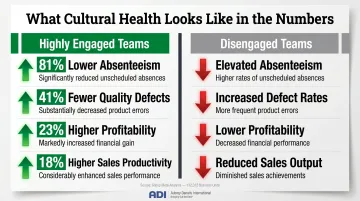
Gallup's meta-analysis of 112,312 business units shows that top-quartile engaged teams have 81% lower absenteeism, 41% fewer quality defects, 23% higher profitability, and 18% higher sales productivity compared to bottom-quartile teams. Track them consistently and you'll see cultural health reflected in the numbers before it shows up in a crisis.
Observe Behavioral Patterns Directly
Surveys and data are essential—but they don't capture everything. Direct behavioral observation examines the environment shaping employee behavior.
What to observe:
- What behaviors are visibly reinforced in meetings? Do managers publicly recognize contributions, or only point out problems?
- What do leaders pay attention to? Do they ask about safety, quality, customer experience—or only numbers?
- How are mistakes handled? With blame and punishment, or curiosity and problem-solving?
- How is recognition given—if at all? Is it specific and timely, or generic and rare?
ADI's culture assessments examine the behavioral environment directly — observing how procedures are actually followed (versus documented), whether employees feel psychologically safe raising concerns, and what informal norms govern daily work.
Review External Signals
Internal assessments have blind spots. Third-party sources surface what employees won't say directly.
Valuable external signals include:
- Employer review platforms — Glassdoor's 1.4 million employee reviews provide the largest publicly accessible repository of corporate culture data
- Exit interview patterns — aggregate themes across departing employees reveal systemic issues
- Recruiter and candidate feedback — what top talent says about your interview process and employer brand
Leading organizations like eBay and Starbucks triangulate internal survey data with external platforms. They use natural-language analysis to compare internal sentiment with external perception and surface cultural gaps that internal reports miss.
The Behavioral Science Lens: Why Most Culture Change Efforts Fall Short
Approximately 70% of organizational change initiatives fail. Not because of bad intentions—because they target the wrong thing.
Most culture improvement programs focus on changing attitudes, perceptions, or "mindsets." They invest in inspirational messaging, values workshops, and communication campaigns. These efforts feel productive but produce no lasting change because culture is defined by what people actually do, and what gets reinforced.
Behavior Is Shaped by Its Consequences
The core principle from Applied Behavior Analysis: behavior is a function of its consequences. When a behavior is followed by a positive consequence (recognition, success, peer approval, career advancement), it's more likely to be repeated. When it's followed by neutral or negative consequences (being ignored, criticism, extra work with no benefit), it diminishes.
This is why posting new values on the wall doesn't change culture. If employees still see corner-cutting rewarded, collaboration ignored, and innovation punished by added bureaucracy—the reinforcement pattern hasn't changed. And neither will the behavior.
Meta-analysis research shows that Organizational Behavior Modification—systematically applying positive reinforcement to desired behaviors—produces an average 17% increase in task performance. For most organizations, that kind of performance lift is the difference between a culture change program that sticks and one that fades within a year.
Positive Reinforcement Drives Sustained Change
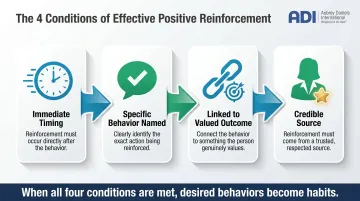
Positive reinforcement is not praise for its own sake. It's the timely, specific, and meaningful recognition of behaviors you want to see repeated.
Effective positive reinforcement:
- Happens immediately after the desired behavior
- Is specific about what the person did (not generic "good job")
- Connects the behavior to a valued outcome (safety, quality, customer impact)
- Comes from a credible source (direct manager, peer, leadership)
When these conditions are met consistently, desired behaviors become habits. When reinforcement is inconsistent, sporadic, or nonexistent—even well-designed culture programs fail.
Discretionary Effort: The Difference Between Compliance and Commitment
Every organization has employees who do the minimum required—and others who bring their best. The difference is discretionary effort: the voluntary contribution of energy, creativity, problem-solving, and persistence beyond what's formally expected.
A culture that consistently reinforces the right behaviors is the primary driver of discretionary effort at scale. Gallup's research demonstrates that highly engaged teams—where employees are bringing discretionary effort—show 23% higher profitability, 81% lower absenteeism, and 66% higher employee wellbeing.
Discretionary effort can't be mandated. It can only be earned—through a reinforcement environment where contributions are recognized, growth is supported, and doing the right thing is consistently rewarded.
ADI's Behavior-Based Approach
With over 45 years applying Applied Behavior Analysis to business performance, ADI's organizational culture consulting goes beyond measuring employee sentiment. The work focuses on identifying the reinforcement patterns that drive current behavior through behavioral observation, consequence analysis, and targeted interventions. When what gets reinforced day-to-day changes, behavior follows. And when behavior changes, how people experience their work changes with it.
How to Improve Your Organizational Culture: A Behavior-Based Approach
Most culture change efforts fail because they stay at the level of values statements and aspirational messaging. Lasting change requires defining specific behaviors, aligning reinforcement systems, and measuring progress consistently.
Define and Operationalize the Behaviors You Want to See
Culture change fails when it stays abstract. "We value respect" is not actionable. "Managers provide specific positive feedback to direct reports at least weekly" is.
Identify 3–5 key behaviors that, if performed consistently across the organization, would represent your desired culture. These must be:
- Observable — you can see or hear the behavior happening
- Measurable — you can count frequency or quality
- Specific — clear enough that two people would agree whether it happened
- Linked to outcomes — connected to business results (safety, retention, quality, customer satisfaction)
Examples of well-defined cultural behaviors:
- "Leaders ask open-ended questions in problem-solving meetings before offering solutions"
- "Employees report near-misses within 24 hours without fear of blame"
- "Managers conduct one-on-one check-ins with each direct report weekly"
- "Teams publicly recognize peer contributions in weekly standups"
ADI's Behavioral Roadmapping methodology helps organizations define these leading indicators and link them to performance outcomes at every level.
Align Reinforcement Systems with Desired Culture
Your culture is shaped by your reinforcement systems—whether you designed them intentionally or not.
Audit existing systems against your target behaviors:
- Recognition programs — do they reward the behaviors you want, or just results?
- Performance reviews — do they assess how work gets done, or only what gets delivered?
- Promotion criteria — do high performers who violate values still advance?
- Manager feedback practices — is positive reinforcement specific, timely, and frequent?
- Onboarding and training — do new hires see desired behaviors modeled and reinforced from day one?
If these systems reward the wrong behaviors (or fail to reinforce the right ones), culture will not change—no matter how inspiring the messaging. One organization discovered their quota-based call center metrics forced employees to choose between quality service and meeting targets. Restructuring metrics to focus on behavior-based measures (available time on phone, not call volume) produced a 50% improvement within one week.
Make Leadership Behavior the Anchor
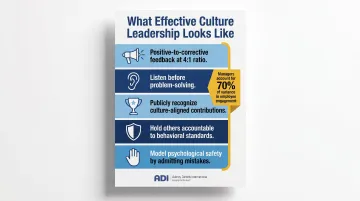
Managers account for 70% of the variance in employee engagement. That statistic has been reconfirmed across industries and remains one of the most robust findings in organizational research.
The largest driver of an employee's experience is their direct manager's behavior. Cultural change requires leaders at every level to model and reinforce target behaviors—not just communicate about them.
What effective leadership behavior looks like:
- Providing specific positive feedback more frequently than corrective feedback (minimum 4:1 ratio)
- Asking questions and listening before problem-solving
- Publicly recognizing contributions aligned with desired culture
- Holding peers and direct reports accountable to behavioral standards
- Admitting mistakes and modeling psychological safety
Leaders shape culture through what they do and what they reinforce or ignore—not through announcements or values statements. When senior leaders skip the behaviors, the signal travels downward fast: managers stop enforcing standards, and employees stop taking values seriously.
Build Feedback Loops and Psychological Safety
Culture improvement stalls when employees can't flag problems or push back on decisions without risking their standing. Structured feedback channels give people a reliable way to do both.
Create structured feedback channels:
- Upward feedback systems — where employees can evaluate manager behavior confidentially
- Peer-to-peer recognition platforms — making positive reinforcement a team norm, not just top-down
- Regular check-ins — weekly one-on-ones between managers and direct reports to monitor engagement in real time
- Suggestion systems with accountability — where employee ideas are reviewed, responded to, and implemented (or declined with explanation)
Psychological safety doesn't mean comfort. It means employees believe they can speak up, ask questions, admit mistakes, or challenge ideas without being punished, humiliated, or ignored. Research from McKinsey shows that change efforts are four times more likely to succeed when informal influencers—highly networked employees beyond formal leadership—actively support them. Listening systems help you identify and engage those influencers.
Measure, Adjust, and Sustain
Culture improvement is not a one-time project. It's an ongoing discipline.
Establish regular measurement intervals:
- Pulse surveys — short (5–10 questions) quarterly to track sentiment trends
- Deep-dive engagement surveys — comprehensive annual assessments benchmarked over time
- Behavioral observation reviews — quarterly check-ins with managers to assess whether target behaviors are increasing
- Operational metrics — monthly tracking of turnover, absenteeism, promotion rates, and productivity
After every survey cycle, identify 2–3 "quick wins"—immediately actionable changes that demonstrate leadership is listening and responding. SHRM research confirms that surveying frequently without taking action destroys trust and reduces future response rates.
Benchmark results both externally (against industry competitors) and internally (against your own historical data) to measure the rate of improvement. Then adjust reinforcement systems, leader behaviors, and feedback mechanisms accordingly.
Frequently Asked Questions
How do you assess organizational culture?
Use a multi-method approach: anonymous employee surveys to capture frontline experience, values-behavior alignment reviews, cross-functional metrics (turnover, retention, productivity), direct behavioral observation of what gets reinforced day-to-day, and external signals from review platforms and exit interviews.
How to improve an organization's culture?
Identify 3–5 specific, observable behaviors representing your desired culture. Align all reinforcement systems (recognition, promotion, feedback, performance reviews) to reward those behaviors consistently. Ensure leaders at every level model and reinforce target behaviors daily—culture flows from what gets rewarded, not what gets said.
What are the 4 C's of company culture?
The 4 C's framework includes Collaboration, Communication, Commitment, and either Culture-fit or Creativity. Each dimension maps to observable team behaviors—how people share information, engage discretionary effort, and align with organizational values—giving leaders a practical lens for evaluating cultural health.
What are the warning signs of a toxic organizational culture?
High voluntary turnover (especially among top performers), low discretionary effort, poor cross-functional communication, lack of accountability for mistakes or missed deadlines, employees feeling unrecognized or unheard, and managers who don't model stated values. These behavioral indicators signal deeper reinforcement problems.
How long does it take to change organizational culture?
Culture change takes months to years depending on organization size and scope. Early wins can appear within weeks, but embedding new norms requires sustained leadership commitment—not one-time interventions—over 3–5 years.
What is the role of leadership in shaping organizational culture?
Leaders shape culture primarily through the behaviors they model and the behaviors they reinforce or ignore—not through values statements or announcements. Managers account for 70% of variance in team engagement, making their daily behavior the most powerful driver of cultural change at scale.