The gap between capital invested and productivity gained isn't a technology problem. It's a systems problem.
Sustainable mining performance depends on three interconnected levers: technology and data, equipment and maintenance, and — most critically — the human and organizational dimension. Most operations over-invest in the first two and underestimate the third. This article covers actionable strategies across all three, with particular focus on the workforce and cultural factors that separate high-performing mines from the rest.
Key Takeaways
- Technology and real-time data reveal performance gaps; closing them requires deliberate behavior change
- Operator behavior compounds across thousands of cycles into major production differences
- Siloed departmental KPIs create a situation where every team hits its targets while the mine misses its goals
- Positive reinforcement drives lasting behavior change — monitoring and punishment alone won't sustain it
- Mines that treat safety as a behavioral system consistently outperform those that treat it as compliance
What Is Mining Performance Optimization?
Mine optimization is the systematic process of maximizing value extracted from a resource while minimizing costs, downtime, and waste. The goal is recovering more value at a lower cost per unit — across equipment, processes, planning, and people.
Why It's Harder to Sustain Than to Start
Most operations understand this in principle. In practice, performance improvement initiatives follow a familiar pattern: new technology is deployed, productivity ticks up, then gradually reverts. Technical fixes address the tools. They don't change the behaviors surrounding those tools — and that's where performance quietly erodes.
What actually separates high-performing mines from the rest comes down to behavior. Two operations with identical equipment and software can produce very different results depending on:
- How consistently operators apply correct technique
- How supervisors respond to performance data
- Whether teams align toward shared outcomes or optimize locally at the mine's expense
- Whether safety functions as a behavioral system or just a compliance checklist
The most competitive mining operations treat optimization as a unified performance system: technology, workforce engagement, cross-functional alignment, and safety culture working together rather than managed separately.
Use Technology and Data to Drive Mining Efficiency
The Metrics That Matter
Every mining operation should track a consistent set of operational metrics. Without them, improvement is guesswork:
- Effective shift time — actual productive hours versus scheduled time, using a Time Usage Model to distinguish productive work from delays and non-operating periods
- Equipment utilization (OEE) — defined by SAIMM as availability × utilization of availability × productivity × quality
- Truck cycle times and payload efficiency — Caterpillar defines fill factor as the percentage of rated volume actually used; an 87% fill factor means 13% of capacity is wasted every cycle
- Fuel burn per tonne moved — Mining3's research shows payload variance has the most significant impact on diesel energy consumption, GHG emissions, and operating costs in surface haul-truck operations
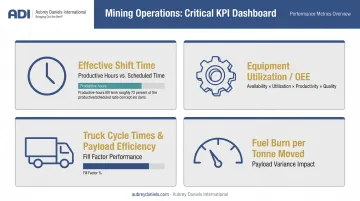
Each metric points to a different root cause. Low effective shift time typically traces back to crew readiness or handover breakdowns. Utilization gaps usually indicate unplanned downtime. And when payload efficiency lags, the culprit is most often operator technique — not equipment.
Predictive Maintenance and Unplanned Downtime
Unplanned equipment failures are among the most disruptive cost drivers in mining. Deloitte's maintenance research indicates that poor maintenance strategies can reduce an asset's productive capacity by 5% to 20% — a costly hit when spread across an entire truck or shovel fleet.
Predictive maintenance technology addresses this by detecting wear patterns before failures occur, allowing maintenance to be scheduled rather than reactive. A 2025 underground haul-truck study found that travel-time prediction models reduced prediction error by up to 34% on ascending routes and 18% on descending routes — directly supporting extraction-rate forecasting and queue-downtime reduction.
Data Only Works When People Trust It
Those travel-time models and fleet management platforms generate enormous volumes of data. But that data only drives results when the people using it actually trust it.
Supervisors who don't understand what a metric means — or doubt its accuracy — won't use it to coach. Operators who see data as a surveillance tool will work around it. Building that trust is partly a training challenge and partly a supervisory behavior challenge. Both require deliberate investment, not just a software rollout.
The Human Factor: How Workforce Behavior Shapes Mining Performance
The Performance Gap No Equipment Upgrade Can Close
Technology reveals where performance gaps exist. It's worker behavior that determines whether those gaps actually close.
Consider bucket fill factor. Two operators running the same machine can produce meaningfully different outputs based purely on technique and attention, not equipment capability. Research on rope-shovel operators in surface coal mining shows significant performance variation between individuals running identical machines — variation attributable to the operator, not the equipment.
Across hundreds of cycles per shift, that variation accumulates into substantial differences in daily tonnage, fuel consumption, and cost per tonne.
Discretionary Effort: The Lever Most Operations Ignore
ADI defines Discretionary Effort as the level of effort people could give if they wanted to — above and beyond the minimum required to keep their job. In mining, it shows up in small, repeated behaviors:
- Filling the bucket completely rather than partially
- Following the optimal haul route every cycle, not just when observed
- Conducting a thorough pre-shift inspection rather than a cursory one
- Reporting a near-miss instead of letting it pass
None of these behaviors can be mandated through rules alone. They're voluntary. Across thousands of cycles per shift and hundreds of workers, however, they compound into the difference between a top-quartile operation and an average one.
The only way to consistently earn discretionary effort is through positive reinforcement — creating conditions where workers experience genuine recognition for the right behaviors, not just consequences for the wrong ones.
Why Punitive Management Fails in Mining Environments
Penalty-based supervision produces compliance at best. At worst, it produces resentment, workarounds, and a workforce that does the minimum while appearing to do more. Organizational behavior research confirms that management relying primarily on threats and punishment misses the more durable mechanisms for performance change — consequences that are positive, immediate, and certain.
Threats can stop a behavior, but they don't build a new one. A miner who cuts corners out of fear will revert the moment supervision disappears. A miner who fills the bucket correctly because that behavior is recognized will keep doing it across shifts, supervisors, and seasons.
What Effective Performance Management Looks Like on the Floor
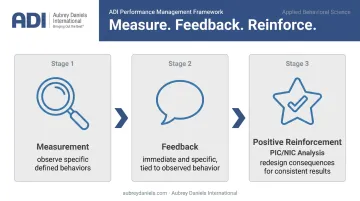
ADI's Performance Management approach, grounded in Applied Behavior Analysis, gives mining leaders a practical framework for identifying what reinforces each individual worker and driving higher performance. The methodology focuses on three elements implemented in sequence: measurement, feedback, and positive reinforcement.
In practice, this means supervisors who:
- Observe specific, defined behaviors rather than general performance impressions
- Provide immediate, specific feedback tied to what they actually saw
- Use data to coach, not to assign blame — treating behavioral variability as a systems question, not a character question
ADI's PIC/NIC Analysis® is a core supervisory tool that helps leaders understand the consequences shaping any given behavior (positive, immediate, certain versus negative, future, uncertain) and redesign those consequences to produce the desired result consistently.
The Supervisory Multiplier
Front-line supervisors are the most powerful variable in daily mining performance. Gallup research finds that the manager or team leader accounts for 70% of variance in team engagement — a cross-industry finding with direct implications for any operation where crew behavior drives output cycle by cycle.
A supervisor who consistently reinforces correct haul discipline and safe technique produces a fundamentally different crew than one who only appears when something goes wrong.
ADI's Behavioral Leadership Training and Coaching for Rapid Change® process build exactly these habits: brief, daily coaching interactions around mission-critical behaviors that deliver immediate operational impact without overwhelming a supervisor's schedule.
Break Down Siloed KPIs to Maximize Mine-Wide Profitability
When Every Team Wins and the Mine Loses
Mining operations are full of locally rational decisions that undermine overall performance:
- Geology optimizes the resource model for a given cut-off grade
- Mine engineers maximize tonnes moved per shift
- Processing minimizes energy costs per tonne treated
- Maintenance minimizes reported downtime on their tracked assets
Each function hits its target — and the mine still underperforms. That's the siloed KPI problem, and it's structural.
The cut-off grade issue illustrates it clearly. AusIMM's "Break-even is broken" analysis argues that optimizing on break-even cut-off grade is fundamentally flawed. The correct objective — as established in mine economics literature — is maximizing NPV over the life of the mine, which requires dynamically adjusting cut-off grades based on economic conditions and processing capacity, not locking in a tonnage-maximizing threshold that reduces long-term value.
Value-Chain Thinking in Practice
The solution is aligning every function around the mine's single most important outcome: maximum metal recovery at lowest cost per unit.
Blast fragmentation quality is a clear example of how one function's decisions ripple across the entire operation. Research from Springer's mining and processing review shows that fragmentation quality cascades through energy consumption, productivity, mineral recovery, and operational costs from mining all the way through processing.
A blasting decision that saves cost in the drill-and-blast budget can cost two to three times that amount in crusher throughput and grinding efficiency downstream.
Mine-to-mill integration — the principle of linking mining and processing as a single system rather than optimizing each separately — exists to capture these cross-functional gains. Without deliberate integration, those gains stay on the table while individual departments report green metrics.
Three Practical Steps to Break Down Silos
- Shift to mine-wide metrics — track cost per tonne recovered, not cost per tonne moved, so no function can claim a local win that harms overall performance
- Build cross-functional accountability teams spanning geology, mining, and processing, with shared ownership of the mine's headline performance numbers
- Redesign incentive structures so local wins are rewarded only when they contribute to overall mine performance — ADI's Profit-Indexed Performance Pay™ approach distributes compensation based on both organizational profitability and individual contribution, creating natural cross-functional incentives
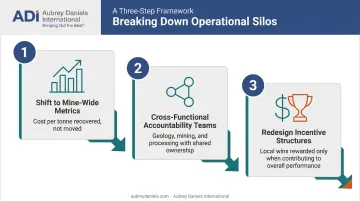
The structural changes matter. But redesigning KPI frameworks and announcing new incentive systems doesn't change behavior on its own. Leaders must actively reinforce cross-functional collaboration — sharing data early, surfacing problems rather than hiding them, accepting short-term local cost for mine-wide gain.
Without consistent reinforcement of these behaviors, teams revert to protecting their own numbers. The structure sets the conditions; leaders determine whether those conditions actually drive change.
Build a Culture of Safety and Continuous Improvement
Safety Culture as a Performance Lever
Safety and productivity aren't in competition. NIOSH's mining-specific research on safety climate and worker performance establishes a direct link between safety climate constructs and how workers perform on the job — not just how safely they behave.
ADI frames safety explicitly as the gateway to production, quality, and cost. A workforce that reports near-misses, raises concerns without fear of blame, and follows procedures when no one is watching is also a workforce that applies discretionary effort to operational behaviors. The same psychological safety that supports a near-miss report also supports an operator flagging an inefficient process.
The Campbell Institute notes that near-miss reporting drops when workers don't believe management will act on it. That breakdown — workers deciding silence is safer than transparency — doesn't stay contained to safety. It spreads to every performance conversation on the site.
Making Continuous Improvement Self-Sustaining
That same erosion of trust affects improvement efforts. Continuous improvement programs fail for the same reason safety programs do: launched with energy, they generate early gains, then revert when initial reinforcement disappears.
Improvement becomes self-sustaining when it's treated as a behavioral system, not a project. That means supervisors consistently recognizing when a worker identifies a waste, suggests a process change, or improves their own cycle technique — not just acknowledging improvements when they show up in monthly reports.
ADI's Behavioral Lean methodology integrates behavioral science directly into Lean practice. Instead of layering training onto an existing Lean program, it embeds feedback and reinforcement loops that build new process habits and prevent old ones from returning. The rate of improvement is proportional to the amount of reinforcement for improvement behavior.
Building Internal Capability for Long-Term Sustainability
One-time training events don't build cultures. ADI's work in industrial and mining environments focuses on building the internal capability that makes behavioral systems self-sustaining. Through Trainer Certification and Coach Certification programs, mining organizations develop their own internal resources to deliver behavioral leadership and safety training without ongoing external dependency.
For mining clients specifically, ADI offers:
- BBS Prime® — comprehensive safety culture transformation for organizations ready for full-scale implementation
- BBS Quick-Launch® — rapid deployment for sites that need measurable gains quickly
- BBS Readiness Assessment — ensures the organization is set up for sustainable change, not a short-lived compliance initiative
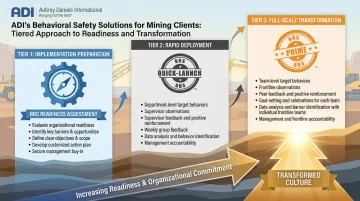
The goal is an organization where every worker, supervisor, and manager continuously looks for ways to improve — and where that instinct is reinforced consistently, not just celebrated in a quarterly report.
Frequently Asked Questions
What is mine optimization?
Mine optimization is the systematic process of improving every aspect of a mining operation: planning, equipment, processes, and workforce — to maximize value recovered per unit of cost. It covers not just technical efficiency but the behavioral and organizational systems that determine whether those improvements are applied consistently.
How do you improve productivity in mining?
Four levers drive the biggest gains:
- Track and act on operational metrics like utilization and cycle times
- Improve worker and supervisory behaviors through positive reinforcement
- Break down departmental silos with shared mine-wide metrics
- Reduce unplanned downtime through predictive maintenance
Technology and data show where the gaps are. People and leadership are what close them.
How do you maximize mining profit?
Profitability improves when you reduce cost per tonne through operational efficiency, align all teams around mine-wide value metrics, and manage cut-off grades dynamically to maximize NPV. Backing all of this is a workforce culture that reduces waste at the cycle level, across every shift.
Why is workforce behavior important in mining performance?
The same equipment operated by different workers can produce significantly different outputs depending on technique, discipline, and preparation. Sustained behavior change — driven by positive reinforcement and behavioral coaching rather than punitive supervision — closes that gap at scale and keeps it closed.
How do you build a continuous improvement culture in mining?
Continuous improvement becomes cultural when leaders consistently recognize and reinforce improvement behaviors, not just announce improvement programs. What gets reinforced gets repeated. Embedding feedback and recognition into everyday supervisory practice — not just quarterly reviews — is what makes the culture stick.