Introduction: The Engagement Crisis Hidden Beneath Every Mining Operation
Twelve-hour shifts. Fly-in fly-out rotations that keep workers away from family for weeks at a time. Physically hazardous conditions where a single lapse in attention can be fatal. These are the realities that define mining work — and they create one of the most challenging employee engagement environments of any industry.
Most mining companies invest heavily in safety systems, equipment, and operational technology. The human side — whether workers actually want to perform well — most operations treat as secondary to production targets. Yet Gallup research consistently finds that disengaged employees cost organizations 18% of their annual salary in lost productivity alone.
That gap is expensive. Disengaged workers cut corners, underreport near-misses, and drag down the engagement of everyone around them. No compliance checklist fixes that.
This post covers why engagement is uniquely hard to build in mining, what disengagement actually costs, and what the behavioral science research says about building a workforce that's genuinely invested in outcomes rather than just technically present.
Key Takeaways
- Mining engagement ranks near the bottom of industry benchmarks — linked directly to higher injury rates, attrition, and lost productivity
- Most engagement programs fail because they change awareness, not behavior
- Effective programs tie safety culture to positive reinforcement, build frontline leadership skills, and create visible career pathways
- Sustaining engagement requires tracking leading behavioral indicators year-round, not relying on annual survey snapshots
Why Employee Engagement Is Uniquely Challenging in Mining
Mining doesn't just have an engagement problem. It has structural conditions that actively produce disengagement.
Gallup's 2017 State of the American Workplace found that combined construction and mining workers had an engagement rate of 34% — barely above the national average of 33%, with 51% not engaged and 16% actively disengaged. The actively disengaged group is particularly costly: these workers aren't just checked out, they're often working against the organization's interests.
The Structural Barriers
Three conditions make mining uniquely resistant to engagement:
- FIFO and remote arrangements cut workers off from family, community, and consistent team relationships — the 2022 WA MARS study found 44.4% of Australian miners reported moderate to very high psychological distress, versus 27.2% nationally
- Rotating shift schedules undermine crew cohesion, which is the foundation of trust, safety participation, and voluntary effort
- Compliance-first cultures teach workers to follow directives — but rarely build the discretionary effort that separates high-performing operations from average ones
The difference between compliance and genuine engagement matters more in mining than almost anywhere else. A compliant worker fills out the hazard assessment form. An engaged worker actually thinks through the hazards — and flags the one that wasn't on the form.
The Talent Pressure Compounding Everything
Deloitte's 2026 Mining and Metals Outlook projects that more than half the U.S. mining workforce — roughly 221,000 workers — will retire by 2029. ICMM and WEF data from 2021 show that 48% of mining and metals employees need reskilling or upskilling within four years, with 20% at risk of displacement from automation.
Younger workers entering the industry carry different expectations around purpose, development, and inclusion. Operations that can't meet those expectations will struggle both to engage the workers they have and to replace the ones walking out the door.
The Real Cost of Disengagement in Mining
Disengagement in mining carries a measurable price — in safety incidents, turnover costs, and productivity lost to workers who are present but checked out.
Safety
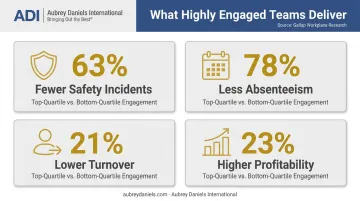
Gallup's Q12 Meta-Analysis, 11th Edition (updated 2024) found that top-quartile engagement business units experience 63% fewer safety incidents than bottom-quartile units — along with 78% less absenteeism and 23% higher profitability. These are cross-industry numbers, but in mining, where a single incident can kill, the safety gap is especially consequential.
An engaged worker reports the near-miss. A disengaged worker figures it wasn't serious enough to bother. Over time, that difference accumulates into incident rates.
Retention and Productivity
The same Gallup analysis shows turnover reductions of 21% in high-turnover organizations when engagement improves. In mining, where recruiting and onboarding a single skilled operator can cost tens of thousands of dollars, retention is a direct financial lever.
Key engagement outcomes from the Gallup data:
- 63% fewer safety incidents in top-quartile vs. bottom-quartile engagement units
- 78% less absenteeism in highly engaged workforces
- 21% lower turnover in high-turnover industries when engagement improves
- 23% higher profitability tied to stronger engagement
AngloGold Ashanti tracked this directly: employee engagement rose from 69% in 2014 to 76% in 2019, surpassing a 70% large-company benchmark — backed by $5.6 million invested in learning and development. That result came from a deliberate strategy, not circumstance.
The Hidden Cost: Active Disengagement
The metric most operations ignore is the cost of actively disengaged workers who stay. Gallup estimates not-engaged and actively disengaged employees cost the global economy $8.8 trillion in lost productivity — equivalent to 9% of global GDP.
In a mining operation, actively disengaged workers don't just underperform. They erode the engagement of their crew, resist safety changes, and undermine the culture that safety programs are trying to build. Corrective action forms don't reach the behavioral patterns driving that erosion — which is exactly where the real intervention needs to happen.
Best Practice #1: Build an Engagement Culture Rooted in Behavioral Reinforcement
Most safety and engagement programs are built almost entirely on antecedents — posters on the wall, policies in the handbook, awareness campaigns, toolbox talks. These influence behavior briefly, then fade. What sustains behavior over time is what follows it.
Lasting engagement requires changing the consequence environment: specifically, using positive reinforcement to strengthen the behaviors the organization actually needs.
What This Looks Like in Practice
In mining, behavior-based engagement means:
- Supervisors catching workers doing things right and providing specific, immediate positive feedback — not waiting for something to go wrong
- Recognition programs tied to observable safety behaviors (proactively flagging a hazard, helping a new crew member through a procedure) rather than lagging indicators like days without incidents
- Peer recognition systems that make desired behaviors visible and valued across the team
- Near-miss reporting treated as a positive contribution, not a trigger for investigation
The last point deserves emphasis. In blame-oriented safety cultures, workers quickly learn to avoid supervisors and conceal problems. That directly kills engagement and, more dangerously, eliminates the early-warning data that prevents fatalities. When reporting near-misses is rewarded rather than punished, the behavioral environment shifts: workers stop hiding problems and start solving them.
ADI's Behavioral Approach
Aubrey Daniels International (ADI) has been applying this science to mining and heavy industry for over 45 years. Their work with FMC Corporation's Green River facility offers a clear picture of what a shifted behavioral environment actually produces.
As one FMC leader noted: "People are reinforcing their peers and tracking their own performance... and we're talking about miners! These are not soft people."
Self-managed, peer-driven safety participation like that is the direct result of a systematically reinforcing work environment — not a culture campaign or a new poster.
ADI's Performance Management technology — grounded in Applied Behavior Analysis and Organizational Behavior Management — provides a scientific framework for identifying which behaviors drive safety and productivity, then reinforcing those behaviors through positive consequences. Their Precision Leadership methodology extends this into a structured performance system: defined valued behaviors, measurement, feedback, and positive accountability from frontline crews to site managers.
Where to Start
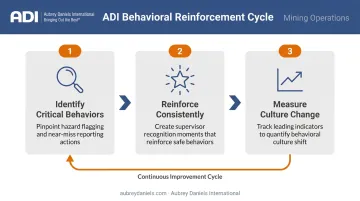
Train frontline supervisors first. Have them identify two or three specific, observable behaviors that signal genuine engagement:
- Proactively flagging a hazard before it becomes an incident
- Volunteering to walk a new crew member through a procedure
- Reporting a near-miss rather than letting it go unrecorded
Then build a daily habit of providing specific positive recognition for those behaviors. ADI's Behavioral Roadmapping process formalizes this structure: working backwards from desired business results to identify the critical behaviors required at each level, then building the consequence systems to reinforce them consistently. Hundreds of small reinforcement moments across a crew compound into measurable culture change.
Best Practice #2: Develop Leaders Who Drive Engagement Through Daily Behavior
Company-wide engagement programs don't engage people. Immediate supervisors do.
Gallup research consistently shows managers account for 70% of the variance in team engagement — a figure that applies to every industry, but lands with particular weight in mining. When crews work in relative isolation from senior leadership, the frontline supervisor is the entire behavioral tone of the operation.
Leadership Behaviors That Build or Break Engagement
The behaviors that matter aren't complicated, but they require consistency.
Supervisors who build engagement tend to share a common pattern:
- Being physically present at the worksite, not managing from an office
- Listening to worker concerns without dismissing or deflecting them
- Following through on commitments made to the crew
- Treating every worker with visible respect and dignity
Those who destroy it tend to repeat a different pattern:
- Blame-oriented incident investigations that put workers on the defensive
- Decisions made without any worker input
- Only speaking to the crew when something's gone wrong
- Micromanagement that signals distrust
A study of 1,955 U.S. mine employees found that supervisor communication had a statistically significant correlation with behavioral safety compliance (r = 0.37, p < 0.01). Workers in environments with stronger supervisor communication were demonstrably more likely to follow safe procedures — not because they were told to, but because the relationship supported it.
Two-Way Communication as Non-Negotiable
Workers in physically dangerous environments are particularly sensitive to whether leadership actually listens. When workers raise safety concerns and hear nothing back, engagement drops fast. Effective communication practices at mining sites include:
- Pre-shift and post-shift dialogue that surfaces concerns before they become incidents
- Anonymous feedback mechanisms for remote or fly-in/fly-out sites
- Leadership town halls that address difficult questions directly, not just positive updates
ADI's Supervisor's Guide to Safety Leadership is a one-day workshop designed specifically for frontline supervisors in hazardous environments. It addresses exactly these behaviors: building working relationships with direct reports, providing specific positive and constructive feedback, and developing practical action plans for improving safety engagement at the site level.
Inclusion as an Engagement Strategy
Inclusive leadership — ensuring workers of all backgrounds and experience levels feel respected and valued — directly predicts engagement and retention. In mining, where workforce diversity is expanding and talent pipelines are under pressure, culturally sensitive onboarding, multilingual communication, and accessible workplaces are also retention strategies — not separate from operational performance, but part of it.
Best Practice #3: Support Well-Being, Career Development, and Purpose
Well-Being in Mining Is an Engagement Risk
The mental health data from mining is stark. The 2022 WA MARS study found 32.61% of FIFO workers reported high or very high psychological distress, compared to 17.21% in a general benchmark group. The Minerals Council of Australia estimated mental-health-related absenteeism and presenteeism costs the industry $320–$450 million per year.
Despite those numbers, roughly 50% of miners with high mental health service needs didn't seek help in the prior year. Access is part of the problem — remote sites make traditional EAP services difficult to use.
Practical responses include:
- Structured fatigue management programs with defined recovery time built into rosters
- Telehealth mental health options accessible from remote sites
- Roster designs that protect sleep — the same WA MARS study found shifts of 12 hours or more consistently associated with higher psychological distress
- Normalizing help-seeking as a sign of professionalism, not weakness

Career Pathways as Engagement Infrastructure
Workers who see no future at a company disengage or leave. In mining, concrete development structures give frontline workers a reason to stay invested:
- Clear technical training ladders that show progression from entry-level to specialist roles
- Mentorship programs pairing newer workers with experienced operators
- Visible leadership development pipelines that make advancement feel attainable
This connects directly to ADI's concept of discretionary effort — defined as the level of effort people could give above the minimum required, if they choose to. Discretionary effort can't be mandated. It's earned when workers see genuine growth potential and feel fairly treated.
ESG as Shared Purpose
Younger workers entering mining increasingly evaluate employers on environmental responsibility and community investment. AusIMM research from 2021 found that young Victorians' concerns about environmental impacts were a significant barrier to considering mining careers. Companies that involve their workforce in sustainability initiatives and community engagement programs create a sense of shared purpose that sustains engagement beyond pay — a real edge in a competitive talent market.
Measuring and Sustaining Engagement in Mining
Annual surveys capture a snapshot of how workers felt during survey week. By the time results are processed and presented, the behavioral conditions that drove the scores have already shifted. For mining operations, where conditions change by shift, that lag makes annual surveys insufficient as a primary engagement measure.
What to Track Instead
A more useful engagement measurement approach combines:
Leading behavioral indicators:
- Near-miss reporting volume and quality (higher = more engagement, more psychological safety)
- Voluntary participation in safety committees and improvement programs
- Supervisor communication scores from regular upward feedback
- Internal promotion rates as a proxy for career pathway effectiveness
Lagging indicators (tracked as context, not as the primary signal):
- Total Recordable Incident Rate
- Voluntary turnover rate
- Absenteeism trends
- Output and quality metrics
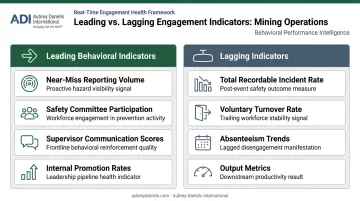
The goal is a real-time picture of engagement health, not a once-a-year report that shapes next year's planning cycle.
Diagnostic tools like ADI's Precision Leadership Survey and Safety Culture Survey establish that baseline — translating workforce feedback into specific coaching priorities and behavioral targets. Re-administering at scheduled intervals shows whether leadership changes are producing results and where course corrections are needed. For sites building internal capacity, ADI's Trainer Certification and Coach Certification programs equip on-site resources to sustain these practices across rotating shifts without depending on ongoing external delivery.
Frequently Asked Questions
What are the 4 P's of employee engagement?
The four drivers are Purpose, People, Process, and Pay (or Perks). In mining, Pay establishes the baseline — but Purpose, People, and Process are what determine whether workers are genuinely engaged or simply showing up.
What are the 3 C's of employee engagement?
The 3 C's are Connection, Contribution, and Career. Mining environments put all three under pressure — FIFO isolation erodes connection, compliance-driven cultures suppress contribution, and limited career visibility makes deliberate development programs a necessity.
Why is employee engagement typically lower in mining than other industries?
Remote locations, rotating shifts, and compliance-driven management cultures create conditions where workers rarely receive recognition and career pathways lack visibility. FIFO isolation compounds the problem by severing the community connections that sustain overall well-being.
How does employee engagement directly impact safety in mining?
Engaged workers follow safety protocols more consistently, report near-misses more readily, and look out for their colleagues. Gallup's research shows top-quartile engagement workplaces experience 63% fewer safety incidents than bottom-quartile ones. Engagement is a direct safety strategy.
What role does the frontline supervisor play in mining employee engagement?
The immediate supervisor is the single largest driver of individual engagement. Their daily behaviors — whether they recognize good work or only address problems, whether they listen or dismiss — determine how engaged their crew will be. No company-wide program overrides a poor frontline supervisor.
How long does it take to see results from a mining employee engagement program?
Behavioral changes can appear within weeks when positive reinforcement is applied consistently. Measurable improvements in safety reporting and retention typically emerge within three to six months. Sustainable culture change requires ongoing commitment, not a single program launch.