This guide clarifies when occupational safety training is legally required, which topics OSHA mandates, how requirements shift by industry, what happens when employers fail to comply, and why meeting minimum compliance standards is only the starting point for building a workplace that's genuinely safe.
TLDR
- Federal OSHA doesn't mandate OSHA 10/30 for most employers — but hazard-specific training is legally required wherever workplace risks exist
- Training obligations are triggered by job duties and hazards, not blanket mandates
- Annual retraining applies to bloodborne pathogens, respiratory protection, and other high-risk standards
- Penalties for violations reach $165,514 per willful offense as of 2025
- Compliance-only training rarely changes behavior; lasting safety culture requires positive reinforcement and behavioral follow-up
Is Occupational Safety Training Required by Law?
Yes — occupational safety training is legally required under the Occupational Safety and Health Act of 1970, but the requirement is triggered by workplace hazards, not a universal mandate. If your workers face risks that could cause injury, illness, or death, training is obligatory. Two statutory provisions establish this obligation:
Section 5(a)(1) — The General Duty Clause requires employers to furnish workplaces "free from recognized hazards that are causing or are likely to cause death or serious physical harm." Even where no specific OSHA standard exists, this clause obligates employers to protect workers from known risks — and training is central to that obligation.
Section 5(a)(2) requires compliance with all promulgated OSHA standards. Over 100 of these standards contain explicit training requirements tied to specific hazards like confined spaces, hazardous chemicals, or electrical safety.
OSHA Outreach Training Is Voluntary at the Federal Level
OSHA 10-Hour and OSHA 30-Hour Outreach Training are voluntary awareness programs under federal law. The cards don't expire, and federal OSHA does not require them for general employment. What IS legally required is hazard-specific training that corresponds to the risks workers encounter in their roles.
However, eight states have gone further by mandating OSHA 10 or OSHA 30 for certain projects:
| State | Requirement | Scope |
|---|---|---|
| Connecticut | OSHA 10 | Public works projects ≥ $400,000 |
| Massachusetts | OSHA 10 | All public works projects |
| Missouri | OSHA 10 | All public works; within 60 days of starting |
| Nevada | OSHA 10 (workers), OSHA 30 (supervisors) | All construction; renewal every 5 years |
| New Hampshire | OSHA 10 | Public works projects ≥ $100,000 |
| New York | OSHA 10 | Public works projects ≥ $250,000 |
| Rhode Island | OSHA 10 | Public works projects ≥ $10,000 |
| West Virginia | OSHA 10 | Public works projects ≥ $50,000 |
Private employers in other states may also require these courses as internal workplace standards. Beyond which courses apply, OSHA also dictates how training must be structured and who it must reach.
Training Must Be Accessible and Role-Specific
OSHA's 2010 Training Standards Policy Statement mandates that training be delivered in a language and vocabulary employees can understand. That requirement goes beyond translation — it covers literacy as well:
- Workers who don't speak English must receive instruction in their native language
- Workers who aren't literate cannot be handed written materials and considered trained
- Employees only need training for hazards relevant to their specific job duties
- Supervisors must be trained on all standards applicable to the workers they manage
What Types of Occupational Safety Training Does OSHA Require?
OSHA mandates training under numerous standards within 29 CFR Part 1910 (General Industry). The scope and frequency vary by standard, but certain topics apply broadly across most workplaces.
Hazard-Specific Training Required for Most Workplaces
The following training topics apply across most industries:
- Emergency Action Plans (29 CFR 1910.38): Required when employers establish emergency evacuation procedures; applies to employees assigned specific roles during emergencies
- Fire Safety/Fire Extinguisher Training (29 CFR 1910.157): Mandated annually for employees expected to use portable fire extinguishers
- Hazard Communication/HazCom (29 CFR 1910.1200): Applies to any employee who works with hazardous chemicals; requires training at initial assignment and when new chemical hazards are introduced
- Personal Protective Equipment (29 CFR 1910.132–138): Required before employees use PPE in environments where hazard elimination alone is insufficient
- Bloodborne Pathogens (29 CFR 1910.1030): Mandates annual training for workers with occupational exposure to blood or other potentially infectious materials (healthcare, first responders, custodial staff)
- Respiratory Protection (29 CFR 1910.134): Required before respirator use and annually thereafter; applies when workers are exposed to airborne contaminants
- Lockout/Tagout (29 CFR 1910.147): Applies to employees who service or maintain machinery where unexpected startup or energy release poses a risk of serious injury or death
- Hearing Conservation (29 CFR 1910.95): Required annually for employees exposed to noise levels of 85 decibels or higher over an 8-hour time-weighted average
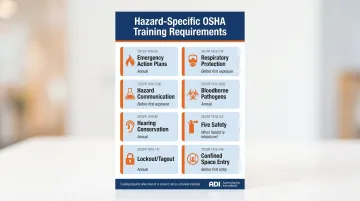
These standards share a common principle: training is required when the hazard is present, not as a blanket mandate for all employees.
Role-Specific and Situational Training Requirements
Beyond the broadly applicable standards above, some training requirements activate only when specific roles or operational conditions are present:
- Powered Industrial Truck/Forklift Operator Training (29 CFR 1910.178): Required before operation; performance evaluations every three years; refresher training required after observed unsafe behavior, incidents, or significant workplace changes
- Confined Spaces (29 CFR 1910.146): Applies to workers authorized to enter permit-required confined spaces before initial assignment and when duties, hazards, or procedures change
- Electrical Safety (29 CFR 1910.330–335): Mandated for workers exposed to electrical hazards from energized parts
When Retraining Is Required
OSHA requires retraining beyond initial hire in specific circumstances:
- Job duties or assigned tasks change
- New hazards, substances, or equipment are introduced
- An employee's behavior indicates training was not retained
- Workplace conditions or procedures render previous training obsolete
Compliance, in other words, is ongoing. If a worker's behavior on the floor signals that training didn't stick, OSHA expects employers to act — not wait for the next scheduled cycle.
How OSHA Training Requirements Vary by Industry
Not all workplaces fall under the same rulebook. Depending on your industry, you may answer to a completely different agency — or face OSHA standards that go well beyond the general baseline.
Industries Regulated Outside OSHA
The following sectors are governed by agencies other than OSHA:
- Mining: Mine Safety and Health Administration (MSHA) under 30 CFR Parts 46 and 48 requires 24-hour new miner training and 8-hour annual refresher training
- Aviation: Federal Aviation Administration (FAA) administers crew and maintenance safety training
- Maritime/Mariners: U.S. Coast Guard governs vessel safety training and mariner credentialing
- Nuclear Facilities: Department of Energy (DOE) maintains separate training requirements
Workers in these sectors still have rights under the OSH Act but follow their home agency's training rules.
Industry-Specific OSHA Standards
High-risk sectors have dedicated OSHA standards beyond General Industry (29 CFR 1910):
- Construction (29 CFR 1926): Includes fall protection, scaffolding, excavation competent person requirements, and crane operator certification
- Shipyards (29 CFR 1915): Contains maritime-specific confined space, fire safety, and hazard communication training
- Agriculture (29 CFR 1928): Covers tractor rollover protection and field sanitation unique to agricultural operations
Construction and shipyard work carry significantly broader obligations than general office environments due to higher inherent risks.
State-Plan States Add Another Layer
Twenty-two states operate OSHA-approved state plans covering both private and public sectors, with another 7 covering public-sector workers only. State plans must be "at least as effective" as federal OSHA but may impose stricter requirements.
California (Cal/OSHA) provides the clearest example. Title 8, Section 3203 mandates every employer establish a written Injury and Illness Prevention Program (IIPP) covering new hires, new assignments, newly introduced hazards, and supervisors.
Cal/OSHA also requires heat illness prevention training under Section 3395 for all outdoor workers before high-heat assignments, a standard with no federal counterpart. Multi-state employers should audit state-specific requirements in each jurisdiction before assuming federal compliance is sufficient.
How Often Must Employees Be Retrained?
Training frequency varies by standard. Some require training only at initial assignment; others mandate annual or three-year cycles.
Standards Requiring Annual Retraining
- Bloodborne Pathogens (29 CFR 1910.1030)
- Respiratory Protection (29 CFR 1910.134)
- Asbestos (29 CFR 1910.1001)
- Hearing Conservation (29 CFR 1910.95)
- Fire Extinguisher (29 CFR 1910.157)
Forklift Training: Three-Year Performance Evaluations
Powered Industrial Truck operators must receive a performance evaluation at least every three years (29 CFR 1910.178). Refresher training is triggered by five specific events:
- Unsafe operation observed
- Accident or near-miss
- Poor evaluation result
- Assignment to a different truck type
- Workplace condition changes
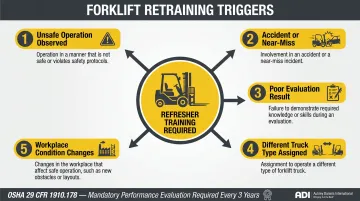
Event-Driven Retraining Triggers
Even where no fixed schedule exists, retraining is required when:
- Workplace conditions change
- Procedures or equipment are updated
- New hazards emerge
- An employee's performance suggests the original training was inadequate
When no retraining schedule is specified, provide training before first exposure to the hazard — not after an incident reveals the gap.
OSHA Outreach Cards: No Expiration, but Refreshers Matter
OSHA 10 and OSHA 30 cards carry no federal expiration date. That said, most safety professionals recommend refreshing outreach training every few years to stay current with evolving regulations. Some states with mandates (Connecticut, Nevada) require renewal every five years.
What Happens If Employers Don't Comply with OSHA Training Requirements?
OSHA inspectors review training records and directly assess workers' understanding during site visits. Violations result in citations and financial penalties.
2025 Penalty Maximums
Effective January 15, 2025, OSHA civil penalties are:
| Violation Type | Maximum per Violation |
|---|---|
| Serious | $16,550 |
| Willful | $165,514 |
| Repeat | $165,514 |
| Failure to Abate | $16,550 per day beyond abatement date |
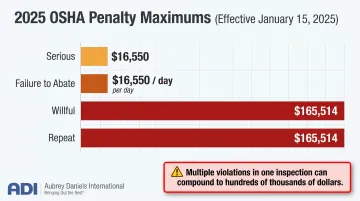
Penalties are assessed per violation. A single inspection revealing multiple training deficiencies can result in cumulative fines reaching hundreds of thousands of dollars.
The Broader Cost of Non-Compliance
The financial hit from OSHA penalties is just the start. Non-compliance also drives:
- Increased workers' compensation claims: The National Safety Council reports the total cost of work injuries in 2024 was $181.4 billion, including $54.9 billion in wage and productivity losses and $36.8 billion in medical expenses
- Lost productivity: The cost per medically consulted injury averages $48,000; the cost per death is $1,540,000
- Legal liability: Injured workers may pursue civil claims beyond workers' comp
- Reputational damage: Safety violations can affect customer contracts, insurance rates, and public perception
The ROI of Compliance
Those costs make the business case for training hard to ignore. OSHA and the American Society of Safety Professionals cite a $4-$6 return for every $1 invested in workplace safety programs. A peer-reviewed study published in Science (Levine et al., 2012) found Cal/OSHA inspections saved an average of $355,000 in injury claims over four years and achieved a 26% reduction in workers' compensation costs.
That return compounds over time — well-trained workers have fewer incidents, and fewer incidents mean lower claims, lower premiums, and less lost time.
Why Compliance Alone Isn't Enough: Making Safety Training Actually Work
Completing a course satisfies a legal checkbox, but it doesn't guarantee workers will behave safely on the job. Research consistently shows that **knowledge acquisition does not automatically translate to behavior change** in the field.
The Human Behavior Factor
H.W. Heinrich's foundational research (Industrial Accident Prevention, 1931) concluded that approximately 88% of workplace accidents result from unsafe acts (human behavior), 10% from unsafe conditions, and 2% from unpreventable causes. While modern safety science has refined these ratios, the core finding remains: human behavior is the dominant driver of workplace incidents. Compliance-only training that fails to change behavior leaves the primary risk factor unaddressed.
The Knowledge-Behavior Gap
A landmark meta-analysis by Burke et al. (2006) analyzed 95 studies encompassing 20,991 participants to assess the effectiveness of worker safety training methods. Key findings:
- The most engaging training methods (behavioral modeling, hands-on practice, simulations with dialogue) produced knowledge effect sizes three times greater than passive methods (d = 1.46 vs. d = 0.55)
- Behavioral performance and actual injury reduction were also strongest with high-engagement methods
- Passive, lecture-based, or distance-learning-only safety training significantly underperforms interactive approaches
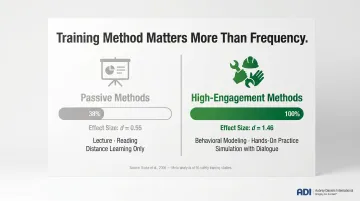
The implication: method matters more than frequency. A highly engaging annual program will outperform a passive quarterly program.
The Behavioral Science Perspective
What workers do (or don't do) in hazardous situations is shaped by the consequences and feedback they receive in their environment, not just by information received in training. In Safe by Accident?, Judy Agnew and Dr. Aubrey Daniels make this case directly — sustainable safety cultures are built by addressing behavioral drivers, not by layering on more training hours.
Effective safety cultures require positive reinforcement of safe behaviors, consistent feedback, and a clear understanding of what motivates or discourages safe practices in specific work contexts. ADI's PIC/NIC Analysis® helps organizations map how workplace consequences actually shape behavior on the floor — identifying gaps that training alone can't close.
Characteristics of Training That Changes Behavior
Addressing those behavioral gaps starts with how training is designed and delivered. Safety training that produces genuine behavior change must:
- Target specific job tasks, not generic hazard categories
- Match workers' language, literacy level, and learning style
- Include on-the-job coaching and feedback after the session ends
- Get backed by supervisory behavior — if leaders ignore unsafe acts, training loses credibility
- Build toward automatic competency through practice, not just passive lecture exposure
Compliant vs. Genuinely Safe
Organizations with the lowest injury rates don't just meet OSHA's minimum training requirements. They use behavioral data to identify where safe behaviors are breaking down, retrain proactively, and build a culture where safety is reinforced positively — not enforced through discipline alone. The goal isn't a workforce that follows rules when observed — it's one that works safely when no one is watching.
Frequently Asked Questions
Does everyone need OSHA training?
Not all employees require the same training. Workers only need training relevant to the specific hazards their job exposes them to. Supervisors, however, must be trained on all standards applicable to the workers they manage.
What trainings are mandatory in California for employees?
California operates under Cal/OSHA, which requires every employer to establish an Injury and Illness Prevention Program (IIPP) that includes employer-provided safety training. Additional mandatory topics include heat illness prevention, harassment prevention, and hazard-specific training aligned with federal OSHA standards and state additions.
What happens if you don't complete mandatory training?
Employees who lack required training may be restricted from certain tasks or work environments. Employers face OSHA citations, financial penalties reaching $165,514 per willful violation, and legal liability for incidents involving untrained workers.
What is the difference between OSHA 10 and OSHA 30?
OSHA 10 is an awareness course for entry-level workers covering rights and general hazards. OSHA 30 is aimed at supervisors and managers, offering broader and deeper coverage of safety topics. Neither is federally mandated, but eight states require one or both for construction or public works projects.
How often do employees need to retake OSHA safety training?
Frequency depends on the specific standard:
- Annually: bloodborne pathogens, respiratory protection, asbestos, hearing conservation
- Every three years: forklift performance evaluations
- As needed: whenever job duties, equipment, or workplace hazards change