Introduction
Financial services organizations face a paradox: an industry built on trust and long-term relationships often struggles to maintain the same with its own workforce. High-pressure environments, relentless regulatory change, and emotional labor create compounding engagement barriers that most generic HR programs simply weren't designed to address.
The business cost is real. Poor mental health alone costs US employers an estimated $5,600 per employee annually, with financial services consistently ranking among the highest-affected sectors. Add absenteeism, voluntary turnover, and lost productivity, and disengagement becomes a profitability problem — not just a culture concern.
Those profitability pressures extend well beyond retention. In a compliance-heavy, relationship-driven industry, workforce engagement directly shapes customer experience, regulatory culture, and institutional reputation. Perks and annual surveys rarely produce the behavioral change needed to shift any of those outcomes.
This article covers what makes engagement uniquely difficult in financial services, how genuine engagement differs from short-term motivation, and actionable best practices. It also addresses the outsized role of managers and how to measure progress through behavioral indicators — not just perception scores.
Key Takeaways
- Compliance fatigue, emotional labor, and organizational silos create engagement barriers that generic programs miss entirely.
- Engaged employees produce discretionary effort — proactively flagging risks, building client relationships, mentoring peers without being asked.
- High-impact practices target behavior directly: personalized development, specific recognition, wellbeing support, and flexible work.
- Managers account for at least 70% of team-level engagement variation, making their daily behaviors the most powerful lever available.
- Tracking behavioral indicators like absenteeism, internal mobility, and voluntary turnover gives leaders earlier signals than annual surveys.
Why Employee Engagement Is Uniquely Challenging in Financial Services
Compliance Fatigue
Continuous regulatory change doesn't just add workload — it shifts how employees think. When the primary focus becomes avoiding mistakes rather than contributing ideas, creativity and intrinsic motivation deteriorate. Thomson Reuters' 2023 Cost of Compliance survey found that 45% of compliance practitioners don't monitor compliance costs across their organizations, and the report explicitly identifies low staff morale as a conduct risk linked to personal liability pressure. This is a feedback loop: regulatory burden increases stress, which increases morale risk, which compounds compliance failures.
Emotional Labor and Wellbeing Costs
Customer-facing financial services employees regularly manage sensitive client situations — debt, loss, financial anxiety — while maintaining professionalism. This emotional regulation accumulates over time. When employees "surface act" (suppressing genuine emotions to perform positivity), burnout accelerates.
When they "deep act," genuinely connecting with client needs, outcomes improve — but the effort still builds. The financial toll on employers is measurable: Deloitte UK's 2024 analysis puts the cost of poor mental health at £2,613 per employee in the UK financial services sector. That figure doesn't capture absence rates or burnout prevalence, just the baseline productivity and turnover cost.
These wellbeing costs don't exist in isolation. Organizational structure shapes how much stress employees absorb and how much agency they have to manage it.
Silos and Autonomy Deficits
Hierarchical decision-making structures and departmental silos strip employees of the autonomy that drives intrinsic motivation. Deloitte's 2023 survey of 700 US financial services professionals found 55% believe in-office workers hold more decision-making power — a signal that perceived access to authority is unevenly distributed. Accenture's 2023 banking report reinforces this, noting that organizational silos make collaboration difficult and put critical data out of reach.
The Turnover Reality
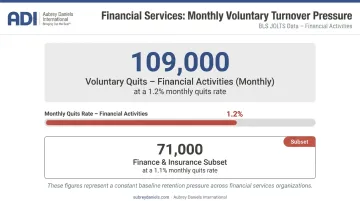
Current BLS JOLTS data (April 2026) puts voluntary quits in financial activities at 109,000 — a 1.2% monthly quits rate. Finance and insurance specifically recorded 71,000 quits at a 1.1% rate. These numbers represent a baseline, not an alarm — but they underscore that retention pressure is constant, and engagement is the most effective preventive investment.
From Motivation to Discretionary Effort: The Engagement Difference
Most financial services firms invest heavily in compensation and incentives. Bonuses spike performance temporarily. Then the spike fades.
That's the motivation trap: externally triggered performance lifts don't build the psychological connection to work that produces sustained results. Engagement goes further — it's what turns a competent employee into one who genuinely wants to do the work well, and acts on that without being prompted.
What Discretionary Effort Looks Like
Aubrey Daniels International (ADI) defines discretionary effort as "the level of effort people could give if they wanted to, but above and beyond the minimum required." The critical phrase is if they wanted to — leaders earn it through the environment they create.
In financial services, discretionary effort shows up as:
- Proactively flagging compliance risks before they escalate
- Building deeper client relationships beyond transactional interactions
- Mentoring junior colleagues without being asked
- Actively contributing ideas in process improvement discussions
- Reporting near-misses in operational processes rather than staying silent
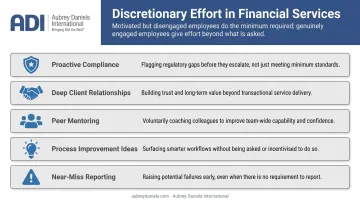
Motivated-but-disengaged employees do their jobs adequately. Engaged employees protect the institution's reputation — because they genuinely care about the outcome.
Deloitte's 2023 FS survey found 80% of respondents frequently or sometimes volunteer ideas to improve products or help colleagues with tasks outside their job descriptions — a strong behavioral indicator of discretionary effort in action.
Why This Matters for Financial Services Specifically
In a compliance-heavy, relationship-driven industry, the gap between technical rule-following and genuine protection of clients and the institution is significant. A workforce that technically complies is not the same as one that actively prevents harm.
Gallup reports that financial services organizations it has partnered with achieve an average NPS of 50, compared to an industry average of 16. That 34-point gap translates directly to client retention, referrals, and revenue — the measurable return on a workforce that's genuinely invested in outcomes.
Best Practices for Employee Engagement in Financial Services
Invest in Meaningful Career Development
Generic training modules — especially compliance certifications — don't signal investment in an employee's future. They signal obligation. The distinction matters to employees.
Effective career development in financial services means:
- Creating personalized development pathways tied to individual goals and strengths, not just role requirements
- Building visible career ladders with clear milestones so employees can see where they're headed
- Actively communicating available growth opportunities to branch and frontline employees, who consistently perceive fewer development options than their corporate counterparts
- Asking employees directly what skills they want to build — not assuming organizational needs and individual aspirations align
ADI's leadership development work with financial services clients consistently identifies the absence of performance management systems as a primary engagement barrier. One regional bank ADI worked with had operated for over a century without ever dedicating meaningful resources to manager or employee development. The result was a culture that managed the downside rather than proactively engaging people. The turning point came when leadership began holding structured development conversations at every level — not as annual reviews, but as ongoing practice.
Support Employee Wellbeing Beyond Financial Wellness
Financial services organizations routinely spend significant resources on clients' financial health while underinvesting in the mental and physical health of their own people. That gap has real consequences for retention and performance.
Concrete wellbeing practices that move the needle include:
- Regular manager check-ins focused on how the employee is doing — not just what they're delivering
- Access to mental health resources that employees actually use (which requires destigmatizing the conversation at the leadership level)
- Sustainable work-life boundaries enforced by organizational policy, not just stated in handbooks
- Wellness programs shaped by employee input — programs designed without employee involvement rarely reflect what employees actually need
Compliance professionals face particular wellbeing risk. Thomson Reuters' data identifies low staff morale as a conduct risk in compliance functions, which means wellbeing investment in these roles is simultaneously a regulatory risk management strategy.
Build Cross-Functional Collaboration to Break Down Silos
When employees only understand their own function, they struggle to connect their work to the broader organizational mission. That disconnection drives disengagement.
Practical collaboration-building approaches:
- Cross-department shadowing that lets retail banking employees spend time with wealth management teams and vice versa
- Joint problem-solving projects that require teams to work toward shared outcomes rather than parallel deliverables
- Structured internal networking that builds relationships before cross-functional work demands them
ADI's work with financial services clients consistently addresses how well departments like retail banking and wealth management coordinate. Breaking down silos strengthens compliance culture too: teams that communicate across functions spot risks earlier and share knowledge more readily than those working in isolation.
Create Flexible Work Arrangements That Support Engagement
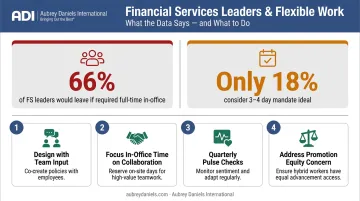
A 2023 Deloitte and Workplace Intelligence survey found that 66% of financial services leaders working remote or hybrid would likely leave their firm if required to work in the office full time. Caregivers face even higher risk — they're 1.3 times more likely than non-caregivers to resign if remote work is eliminated.
Only 18% of financial services professionals consider a 3-4 day in-office mandate ideal. Most prefer choosing when to work remotely.
Practical flexibility recommendations:
- Design hybrid policies with team input, not for teams
- Focus in-office time on collaboration and development activities — the things that actually benefit from proximity
- Pulse-check employees quarterly on how work arrangements affect their engagement and performance
- Address the promotion-equity concern: 63% of FS employees believe in-office workers are promoted more often, which creates a structural disincentive to use flexible arrangements
The Role of Leaders and Managers in Driving Engagement
Gallup research finds that managers account for at least 70% of variance in team-level engagement scores across business units. No other single variable comes close. In financial services, where compliance culture and client relationships are shaped daily at the frontline level, that influence runs directly through the manager.
Transparent Goal Communication
Employees who understand the why behind business decisions — not just what's changing — are significantly more likely to be engaged. When leaders communicate strategic direction as a done deal rather than a context-building conversation, they miss the opportunity to connect employees' roles to outcomes that matter.
Practically, this means leaders should:
- Explain decisions in terms of how they affect the team's work and goals
- Connect individual roles to organizational mission explicitly, not assumed
- Share what they know, including what they don't know, rather than waiting until messaging is polished
Consistent Manager Check-Ins
Regular one-on-one conversations — focused on the employee's needs, progress, and concerns rather than status updates — are among the highest-leverage, lowest-cost engagement behaviors available to managers. Their frequency correlates directly with psychological safety and perceived career growth.
ADI's Behavioral Leadership training specifically develops this capability. Participants learn to deliver objective feedback, identify behavioral causes of performance challenges, and run coaching interactions that are brief but substantive. One participant described it as "the most useful training I have experienced in my 20 years" — specifically because it translated behavioral science into daily manager habits.
Two-Way Feedback Loops
Top-down communication doesn't signal that voices matter. Employees need structured and informal channels to share feedback — and more critically, they need to see visible action on what they share. Closing the loop is what transforms feedback from an HR exercise into a genuine trust-building mechanism.
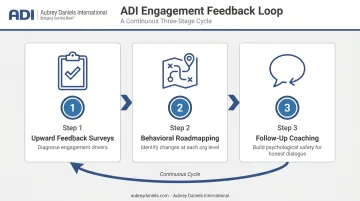
ADI's approach to feedback loops includes:
- Upward feedback surveys that diagnose engagement drivers
- Behavioral Roadmapping to identify what changes are needed at each organizational level
- Follow-up coaching that builds the psychological safety required for honest conversation
Building a Behavior-Based Recognition and Reinforcement Culture
Most recognition programs fail for a simple reason: they're too delayed, too generic, and too disconnected from the specific behavior they're meant to reinforce. An "Employee of the Month" award that arrives six weeks after the behavior it supposedly recognizes creates no meaningful behavioral change. In behavioral science terms, reinforcement works best when it is immediate, specific, and meaningful to the individual.
Why Generic Recognition Falls Flat
The gap between a bonus and genuine recognition comes down to specificity, not just timing. When an employee receives recognition that names exactly what they did and why it mattered to the team or client, it creates a much stronger connection between the behavior and the outcome. Generic recognition treats all employees as interchangeable, which signals the opposite of what engagement requires.
The Financial Services Application
Recognition in financial services should call out:
- Compliance excellence — proactively identifying a risk before it escalated
- Client relationship behaviors — going beyond transactional service to genuinely problem-solve for a client
- Cross-team collaboration — contributing expertise outside one's functional lane
- Peer development — mentoring or supporting a colleague's growth
Sales performance alone is an incomplete recognition target. It captures outcome, not behavior — and in a regulated industry, how results are achieved matters as much as the results themselves.
ADI's work in performance management is grounded in Applied Behavior Analysis, which identifies the specific reinforcers that drive each individual's discretionary effort. The core insight is that "when you understand behavior and can identify what reinforces people, you can obtain exceptional performance."
Organizations that apply this systematically — through ADI's Precision Leadership approach, upward feedback surveys, and manager coaching — create recognition cultures that are measurable, sustainable, and tied directly to business outcomes. For financial services clients like M&T Bank, ADI's leadership survey results showed a direct correlation with employee engagement scores.
Manager-driven recognition alone, however, rarely generates enough volume. Peer recognition systems extend reach and frequency across the organization — and that scale is what sustains behavioral change over time.
How to Measure Employee Engagement in Financial Services
Annual engagement surveys capture a single moment. Point-in-time scores miss the early signals — rising absenteeism, internal transfer requests, declining participation in optional activities — that precede retention problems by months. More frequent, behaviorally focused measurement gives you something actionable.
Move Beyond Annual Surveys
More useful measurement approaches include:
- Pulse surveys run quarterly or monthly on focused topics
- Behavioral indicators: voluntary turnover rates, internal mobility, absenteeism trends, participation in development programs
- Manager check-in data: qualitative signals from one-on-one conversations, aggregated at the team level
- Upward feedback surveys: ADI's Precision Leadership Survey, for example, measures leadership behaviors that directly drive engagement — and has demonstrated a strong positive correlation with employee engagement scores at M&T Bank
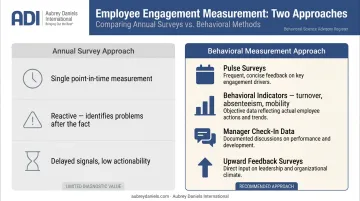
ADI's Pulse Check Survey is designed specifically to track initiative progress over time — measuring behavioral change rather than just shifts in perception, which makes it especially useful for organizations in the middle of a culture or leadership program.
Connect Metrics to Business Outcomes
Gallup reports that financial services organizations partnering with them achieve an average NPS of 50, versus an industry average of 16. When engagement data is tracked alongside customer satisfaction, compliance outcomes, and productivity metrics, it stops being an HR concern and becomes an operational priority. Leaders pay attention when the numbers connect to what they already care about: client retention, compliance incident rates, team productivity, and voluntary turnover costs.
Frequently Asked Questions
What are the 5 C's of employee engagement in the financial services industry?
The 5 C's typically include Connection, Contribution, Communication, Culture, and Career. In financial services, this means helping employees feel connected to organizational mission, supported by a psychologically safe culture, and invested in through visible career growth — not just role fulfillment.
What are the 4 pillars of employee engagement in the financial services industry?
The four pillars are commonly identified as leadership, communication, recognition, and development. In financial services, communication is especially high-stakes — it builds trust during regulatory change. Recognition matters too, reinforcing the behaviors that protect clients and the institution rather than just rewarding output.
What are the 3 C's of employee engagement in the financial services industry?
The 3 C's — Clarity, Connection, and Contribution — give leaders a practical shorthand. Employees need clarity about expectations and strategy, genuine connection to colleagues and organizational purpose, and visible evidence that their work contributes to outcomes that matter.
What are the 4 types of employee engagement in the financial services industry?
The four types are actively engaged, engaged, disengaged, and actively disengaged. In financial services, actively disengaged employees represent a compliance and reputational risk — they may technically meet requirements while undermining team culture or client relationships. Actively engaged employees are the ones who proactively flag risks and build client trust without being asked.
How does employee engagement affect customer experience in financial services?
Engaged employees bring more patience, consistency, and proactive problem-solving to client interactions — the behaviors that drive loyalty. Gallup reports that financial services organizations it has partnered with achieve an average NPS of 50 versus an industry average of 16, reflecting what a high-engagement workforce looks like in client outcomes.
What role does manager behavior play in financial services employee engagement?
Managers account for at least 70% of team-level engagement variation, making them the most powerful engagement lever in any organization. In financial services, the highest-impact behaviors are consistent one-on-ones focused on employee needs and specific recognition tied to concrete actions — paired with communication that connects daily work to broader organizational strategy.