Introduction
Manufacturing has an engagement problem that shows up on the floor every single day.
According to Gallup, only 25% of manufacturing workers were engaged — placing the industry among the lowest of any sector in the US. Meanwhile, the national average sits at 31%, itself a 10-year low.
That gap isn't abstract. It shows up in quality defects that escape inspection, near-misses that go unreported, and experienced operators who quietly stop trying.
Those behaviors translate directly into operational consequences — and unlike office-based disengagement, manufacturing disengagement has no lag time. A distracted assembler, an operator skipping a safety check, a supervisor who stopped giving feedback months ago — these create real costs in the same shift they occur.
The 9 strategies in this article address engagement as what it actually is: a behavioral science challenge. The goal isn't employee satisfaction scores — it's Discretionary Effort, defined by Aubrey Daniels International (ADI) as the level of effort people could give if they wanted to, above and beyond the minimum required. Each strategy below is designed to pull that lever — consistently, at scale, on the floor.
Key Takeaways
- Manufacturing has one of the lowest employee engagement rates in the US — the impact shows up directly in safety incidents, quality defects, and output.
- Engagement is a leadership problem, not an HR program. The causes are behavioral, and the fixes have to be too.
- Managers account for at least 70% of variance in team engagement — investing in supervisor capability is the highest-leverage move.
- Small, consistent changes in how supervisors interact with workers drive more engagement than any single program or initiative.
- Sustainable gains require measuring behavioral leading indicators — tracking what people do, not just how they feel on an annual survey.
Why Employee Engagement Is Uniquely Challenging in Manufacturing
Manufacturing environments create structural barriers that most engagement approaches were never designed to handle.
The Physical Environment Works Against Connection
Shift rotations fragment team continuity. Noise makes casual conversation difficult. Repetitive tasks on a production line make it easy for workers to feel invisible. Doing the same motion thousands of times with no visibility into the bigger picture is a recipe for disengagement.
Most Engagement Platforms Weren't Built for the Shop Floor
Recognition tools, communication apps, and pulse surveys are almost universally designed for workers with company email and a desk. The majority of manufacturing workers have neither. When every engagement initiative assumes computer access, frontline employees are structurally excluded from company culture.
The Leadership Layer Dilutes Everything
As plants scale, the personal connection between senior leaders and floor workers disappears. Messages get filtered through multiple management layers. Inconsistent supervisor behavior across shifts creates pockets of engaged and disengaged teams within the same facility — sometimes separated by nothing more than a different start time.
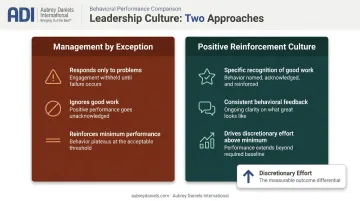
These structural problems compound at the supervisor level. ADI's work across manufacturing clients surfaces a common root cause: leaders are promoted for technical expertise, then left without the behavioral tools to actually motivate people. The result is management by exception — reacting to problems while ignoring good work — which is exactly the environment that kills discretionary effort.
The Real Cost of Low Engagement in Manufacturing
The business case for engagement isn't soft. Gallup's Q12 meta-analysis found that top-quartile engagement business units, compared to bottom-quartile, achieved:
| Outcome | Top-Quartile Advantage |
|---|---|
| Safety incidents | 63% fewer |
| Quality / defects | 32% better |
| Productivity | 14% higher |
| Absenteeism | 78% lower |
| Turnover (high-turnover orgs) | 21% lower |
These are cross-industry findings, and they hold particular weight in manufacturing, where each of these outcomes maps directly to operational cost.
The mechanism behind the numbers matters. ADI's behavioral science framework shows that when employees don't receive positive reinforcement for good work, they reduce their discretionary effort — the voluntary, above-minimum performance that separates adequate output from exceptional output.
Organizations that manage by exception (responding only when something goes wrong) create environments where there's no incentive to do more than the minimum. The root cause is a reinforcement problem, not a motivation problem.
9 Ways to Boost Employee Engagement in Manufacturing
1. Reinforce the Right Behaviors Through Recognition
Recognition is the primary mechanism for sustaining the behaviors you want to see repeated — not a morale initiative, not a perk.
A meta-analysis of 72 organizational studies by Stajkovic and Luthans found that social recognition alone improved task performance by 17%. When combined with feedback and financial incentives, the improvement reached 45%.
The distinction between effective and ineffective recognition is specific:
- Generic praise ("great job today") provides little behavioral value — it doesn't tell the employee what to repeat
- Behavior-linked feedback ("you caught that dimension variance before it reached final inspection — that's the standard we need") reinforces the precise action that drives results
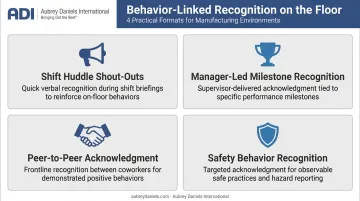
Practical formats for manufacturing floors:
- Shift huddle shout-outs tied to specific observed behaviors
- Manager-led milestone recognition for safety streaks or quality records
- Peer-to-peer acknowledgment built into team check-ins
- Safety behavior recognition programs that call out near-miss reports, not just incident-free periods
ADI's behavior-based performance improvement approach helps manufacturing organizations design recognition systems grounded in behavioral science — ensuring reinforcement is timely, specific, and calibrated to drive the right behaviors at the right frequency. ADI's case study with a glass manufacturer illustrates the impact: machine utilization rose from 65% to 85.6%, with 16 new productivity records set, after implementing behavior-linked leadership and recognition practices.
2. Build Frontline Manager Coaching Capability
Gallup's research is unambiguous: managers account for at least 70% of the variance in team engagement scores. In manufacturing terms, this means the biggest engagement lever isn't a company-wide program — it's the supervisor running the morning shift huddle.
The problem is structural. Most manufacturing supervisors are promoted because they're technically excellent. They know the equipment, the process, the quality specs. What they typically haven't been trained to do is observe behavior, deliver specific feedback, and use positive reinforcement to shape performance.
What coaching looks like on the shop floor:
- Brief daily check-ins that acknowledge what's going right, not just what needs fixing
- Behavior-specific feedback conversations ("I noticed you slowed the line to double-check the calibration — that's exactly the judgment call we need")
- Questions before directives — asking an operator what they think is causing a variance before telling them
- Modeling the safety and quality behaviors expected of the team
ADI's Precision Leadership technology addresses this directly. The program equips frontline supervisors with a science-backed framework — combining upward feedback surveys, behavioral roadmapping, and follow-up coaching — to develop the manager behaviors that drive engagement consistently across every shift.
In one food manufacturing engagement, ADI's assessment found that first-line supervisors were not skilled in day-to-day performance management, and excellent performance frequently went unrecognized. Post-implementation, leaders at every level were actively recognizing performance — and the organization has sustained those practices for over 14 years.
3. Create Clear Career Development Pathways
Repetitive tasks become demotivating fast when employees see no path forward. McKinsey research on frontline workers found that more than 70% had applied for advancement opportunities, but only 17% reported frequent manager conversations about career progression. That gap is a disengagement driver hiding in plain sight.
Manufacturing organizations that make growth visible retain more people. Practical approaches include:
- Skills passports and cross-training matrices that give workers a visual map of what they've mastered and what's next
- Internal job posting systems that prioritize current employees for openings before going external
- Mentorship pairings between experienced operators and newer hires
- Apprenticeship programs or community college partnerships that signal investment in employee futures
The Manufacturing Institute and APA found that 83% of manufacturing workers stayed because they enjoyed their work, and 79% cited stability and job security as retention drivers. Employees who can see a future with the organization invest more in their current role. Visible growth pathways are one of the clearest signals that the company takes their development seriously.
4. Foster Open, Two-Way Communication
When employees feel heard and acted upon, they develop psychological ownership — a direct precursor to engagement. When feedback disappears without visible follow-up, trust erodes and participation drops permanently.
Practical communication structures for manufacturing:
- Daily shift huddles with a consistent agenda that includes team input, not just top-down announcements
- Manager presence on the floor — not inspection tours, but genuine conversations about what's working and what isn't
- Anonymous digital feedback options for workers reluctant to speak up in group settings
- Town halls where leadership shares business progress, acknowledges employee suggestions by name, and explains what actions followed
ADI's PIC/NIC Analysis® framework helps leaders understand why certain communication patterns produce honest dialogue while others create silence. When feedback is met with blame or frustration, employees learn to stop offering it. Psychological safety — the confidence that raising a concern won't have negative consequences — is the foundation that makes two-way communication real rather than performative.
5. Prioritize Both Physical and Psychological Safety
Safety and engagement reinforce each other directly — you can't fully have one without the other.
Gallup's data shows top-quartile engaged workplaces experience 63% fewer safety incidents. The relationship runs both ways: engaged employees follow safety protocols more diligently, and workers in psychologically safe environments are more able to engage fully with their work.
The underappreciated half of safety is psychological. When employees don't feel safe raising concerns or reporting near-misses without fear of blame, safety information stops flowing upward. Quality problems go unreported. Hazards accumulate.
ADI's behavior-based safety approach addresses this directly. After implementing ADI's safety leadership program, Clark Pacific experienced a 78% reduction in injuries alongside a 500%+ increase in near-miss reporting. That increase in reporting isn't a bad sign — it's evidence that psychological safety improved. Employees started believing that speaking up led to learning, not punishment.
For manufacturing leaders, the practical implication is clear: eliminating blame-based responses to incidents isn't soft management. It's the mechanism that gets honest information to the surface before it becomes a recordable event.
6. Invest in Onboarding and Ongoing Training
The Manufacturing Institute and APA found that 69% of manufacturing workers under 25 cited training as a reason to stay. Onboarding is where the employee relationship is established — and where most manufacturers lose people before they ever get productive.
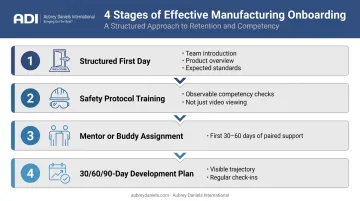
What effective manufacturing onboarding includes:
- Structured first-day experience — not just paperwork and badge photos, but a clear introduction to the team, the product, and the expected standards
- Safety protocol training with observable competency checks — not just watching a video, but demonstrating the behavior
- Mentor or buddy assignment for the first 30-60 days
- 30/60/90-day development plan that gives new hires a visible trajectory and regular check-ins
ADI's fluency-based learning approach takes this further, using accuracy and speed drills to build mastery rather than just familiarity. For a medical insurance client, this approach reduced time-to-competency from 26 weeks to 3 weeks post-training.
The principle applies directly to manufacturing: a new operator who achieves fluency faster contributes sooner, makes fewer errors, and builds the confidence that makes them want to stay.
7. Run Regular Surveys and Act on Results
Annual engagement surveys are better than nothing. They're also almost always too late.
By the time an annual survey captures a problem, the people who felt it most strongly have often already left. High-frequency pulse checks — short, mobile-accessible, focused on behavioral indicators — give leaders actionable data while they can still do something with it.
Survey design principles for manufacturing:
- Mobile-accessible format — floor workers don't have company email; surveys need to reach them where they are
- Short question sets (5-10 questions maximum) to maximize participation among busy frontline workers
- Behavioral questions — "How often does your manager acknowledge your work specifically?" outperforms "Are you satisfied with recognition?"
One critical principle: surveys only improve engagement when results are shared transparently and followed by visible action. ADI's organizational surveys are specifically designed to translate responses into coaching action plans for people, systems, and processes — not just dashboards that sit in an HR folder.
A simple cadence that works:
- Monthly pulse surveys by shift and site
- Quarterly manager feedback reviews
- Annual deep-dive engagement assessment
Each level requires a defined response protocol so employees see the connection between what they said and what changed.
8. Support Employee Wellbeing and Work-Life Balance
BLS data shows manufacturing full-time workers have an absenteeism rate of 3.3% — and the Manufacturing Institute found that 24% of manufacturing respondents reported chronic work stress. Fatigue, burnout, and physical strain don't just affect individuals; they suppress the discretionary effort that plants need to perform.
Practical wellbeing initiatives suited to manufacturing:
- Fatigue-aware scheduling — rotating shifts with adequate recovery time, avoiding back-to-back night-to-day transitions
- Employee Assistance Programs (EAPs) that workers are actually told about and encouraged to use
- Flexible break structures where operationally possible
- Ergonomic assessments for high-repetition stations
- Team-based wellness challenges that create social connection alongside physical health benefits
The connection between wellbeing and engagement isn't incidental. When physical and mental demands consistently exceed what workers can sustainably give, discretionary effort disappears first. Plants that address fatigue and stress see measurable gains in attendance, attention, and output — not just survey scores.
How to Measure and Sustain Your Engagement Strategy
Leading vs. Lagging Indicators
Most manufacturing organizations measure engagement through lagging indicators: turnover rate, absenteeism, safety incident frequency. These tell you what already happened.
Leading behavioral indicators tell you where you're heading:
| Leading Indicators | Lagging Indicators |
|---|---|
| Recognition frequency per shift | Turnover rate |
| Manager check-in completion rates | Absenteeism rate |
| Near-miss reporting rates | Safety incident frequency |
| Survey participation rates | Quality defect rates |
| Upward feedback scores | Productivity output |
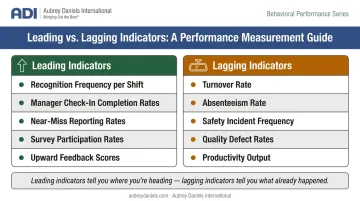
ADI's behavioral roadmapping process identifies the critical few behaviors at each organizational level that drive results — then builds measurement around those behaviors rather than end outcomes alone.
Engagement Is a Management System, Not a Project
Organizations that treat engagement as an initiative — a launch, some posters, a survey — see short-lived results. Those that embed engagement behaviors into daily operational rhythms sustain those gains.
That means:
- Huddle recognition moments aren't optional — they're part of the shift start
- Manager coaching conversations happen on a defined cadence, not when there's time
- Teams receive survey results within a set window, with visible follow-up actions
ADI's Precision Leadership implementation builds this kind of system: behavioral roadmaps, upward feedback surveys, follow-up coaching, and performance scorecards that create accountability at every level. Long after any external support is gone, leaders have the clarity and habits to sustain the gains on their own.
Frequently Asked Questions
What is the biggest driver of employee engagement in manufacturing?
The manager relationship. Gallup research shows managers account for at least 70% of variance in team engagement. When supervisors consistently recognize specific behaviors, communicate clear expectations, and create psychological safety, engagement follows. When they don't, no company-wide program compensates for it.
How does low engagement affect manufacturing safety?
Disengaged employees pay less attention to safety protocols and are significantly less likely to report near-misses or raise hazards. Gallup's data shows top-quartile engaged workplaces experience 63% fewer safety incidents than bottom-quartile.
How do you measure employee engagement in a manufacturing plant?
Combine behavioral leading indicators (recognition frequency, check-in completion rates, near-miss reporting, survey participation) with lagging outcomes (turnover, absenteeism, incident rates). Use short mobile-accessible pulse surveys for floor workers without company email, run them monthly rather than annually.
Why do recognition programs often fail in manufacturing?
Most recognition programs fail because they're generic, infrequent, and disconnected from specific behaviors. Effective recognition must be immediate, specific to an observable behavior, and consistent. "Employee of the Month" programs violate nearly every one of those principles.
What role do frontline supervisors play in manufacturing employee engagement?
Supervisors are the most direct engagement lever available. Their daily behaviors — coaching, feedback, recognition, listening — either build or erode team engagement every shift. Developing supervisor capability in behavioral leadership should be a top priority in any manufacturing engagement strategy.
How long does it take to see results from an engagement program in manufacturing?
Behavioral leading indicators — recognition frequency, survey participation, manager check-in rates — can show measurable improvement within 30-90 days of consistent implementation. Lagging outcomes like reduced turnover and fewer safety incidents typically take 6-12 months to appear at a measurable scale.