EHS leaders who've seen this pattern firsthand tend to reach the same conclusion: when the procedures and technology are identical, the difference has to be culture.
That conclusion is exactly where ADI's work begins. With over 45 years applying Applied Behavior Analysis to workplace performance, ADI has documented that transforming electrical safety culture is not primarily a knowledge problem—it's a behavior problem. Workers generally know what LOTO requires. They know PPE is non-negotiable. What determines whether they actually do those things consistently is the behavioral environment surrounding them: what gets reinforced, what gets ignored, and what leaders model under pressure.
The 7 steps that follow translate behavioral science into a practical framework any EHS leader can implement—without needing a psychology degree or a complete organizational overhaul.
Key Takeaways
- Electrical safety culture is a behavior problem, not a knowledge problem—people often know what to do but don't consistently do it.
- Leadership commitment must be behavioral and observable, not just stated in policy.
- Positive reinforcement converts safe actions into lasting habits—yet it remains the most commonly missing element in safety programs.
- Track leading indicators—near-miss reports, stop-work usage, behavioral compliance rates—not just injury counts.
- Sustainable culture change takes years of consistent reinforcement, not a single initiative.
Why Most Electrical Safety Programs Fail to Create Real Culture
Most organizations treat electrical safety as a compliance obligation. Post the OSHA 29 CFR 1910 Subpart S requirements. Complete annual NFPA 70E training. Conduct inspections. Check the boxes.
The problem isn't that compliance is wrong. It's that compliance programs work almost entirely on antecedents—the rules, signs, training, and policies that set the stage for behavior. What they mostly ignore is consequences: what actually happens to workers immediately after they perform a safe or unsafe act.
The ABC Model: Where Behavior Actually Lives
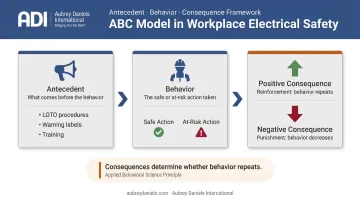
Behavioral science explains the gap through a simple framework: Antecedent → Behavior → Consequence (ABC).
Antecedents (training, warning labels, LOTO procedures) prompt behavior. But consequences determine whether that behavior repeats. An unsafe shortcut persists not because workers are reckless, but because the immediate consequence—saving five minutes, no visible negative outcome—is far more powerful than the distant, uncertain possibility of an injury.
Compliance programs load up on antecedents. Behavioral safety programs manage consequences.
Why Fear-Based Safety Doesn't Stick
When workers follow safety rules primarily to avoid punishment—OSHA citations, manager criticism, post-incident blame—they comply when observed and cut corners otherwise. The result is performative safety, not genuine commitment.
Research underscores the cost of this dynamic. Studies have found that organizations with poor safety climates can have injury underreporting rates as high as 81%, according to Probst et al. When workers fear blame, near-miss reporting goes underground, removing the leading indicators that EHS leaders depend on.
The Distinction That Matters
Consider lockout/tagout:
- Compliance culture: Worker completes LOTO because the procedure requires it.
- Behavioral safety culture: Worker stops a colleague from skipping a LOTO step because they personally care about that person going home safe.
That gap—safety as a rule versus safety as a shared value—is exactly what the 7 steps are designed to close.
Closing that gap requires more than updated procedures. ADI's Judy Agnew, co-author of Safe by Accident? Take the Luck Out of Safety, has documented that many widely used safety management practices are actually counter-productive to building high-performance safety culture. The behavioral principles that drive production and quality excellence drive safety excellence too — when applied with the same rigor.
Steps 1–3: Building the Behavioral Foundation
Step 1: Conduct a Behavioral Safety Culture Assessment
Before launching any initiative, diagnose where your culture actually stands—not where you assume it stands.
A proper assessment goes well beyond injury rate benchmarking. ADI's Safety Culture Survey, implemented across 26 countries and 12 languages, evaluates the behavioral environment across dimensions that standard audits miss:
- Proactive vs. reactive safety management — does the organization anticipate hazards or respond after incidents?
- Consequence management — how does the organization respond to both safe and at-risk behaviors?
- Reporting conditions — do workers feel safe raising concerns without fear of blame?
- Leadership engagement — are leaders consistently modeling and reinforcing safety?
The output positions the organization on a safety culture continuum and identifies specific behavioral and cultural gaps to target. Without this baseline, you're targeting symptoms rather than root causes.
Step 2: Secure Visible, Behavior-Specific Leadership Commitment
Leadership commitment must be behavioral, not declarative. An executive who issues a safety memo but skips floor walk-throughs sends a louder message than any written statement. The same goes for a leader who verbally champions safety, then overrides it under deadline pressure.
What behavioral leadership commitment actually looks like:
- Conducting regular, unscripted floor observations
- Asking workers specific questions about electrical hazards they've identified
- Publicly recognizing safe behaviors with specific feedback ("I noticed you verified voltage before starting—that's the standard")
- Never visibly prioritizing production over a safety concern
The business case is straightforward. According to the National Safety Council, the average cost per workplace death reached $1,540,000 in 2024, with each medically consulted injury averaging $48,000. NFPA data from 2023 recorded 142 workplace deaths from electrical exposure and 2,270 nonfatal electrical injuries.
Against those numbers, the case for investing in a behavioral safety culture program makes itself.
ADI's Safety Leadership workshop—a 2-day working session for leaders—teaches the PIC/NIC Analysis® for identifying behavioral root causes, and specifically develops the coaching skills that replace reactive, compliance-driven management with proactive reinforcement.
Step 3: Build a Psychologically Safe Environment for Reporting
Psychological safety—the belief that reporting a near-miss or raising a hazard won't result in blame or retaliation—is the behavioral prerequisite for every other step.
Without it, three things happen: near-miss reports dry up, stop-work authority goes unused, and EHS leaders make decisions based on data that understates actual risk.
Practical actions that build reporting culture:
- Clearly differentiate honest errors (learning opportunities) from willful violations (which warrant consequences)
- Celebrate near-miss reporters publicly and specifically—make reporting feel like the right thing to do
- Respond to hazard reports with visible, timely action so workers see that speaking up produces results
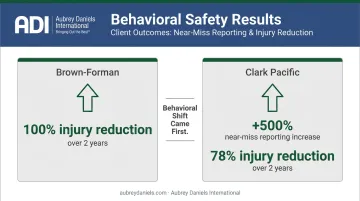
ADI has documented this dynamic with clients. Two examples illustrate the pattern:
- Brown-Forman: Near-miss reporting increased sharply alongside a 100% injury reduction over two years
- Clark Pacific: Near-miss reporting rose more than 500% while injuries dropped 78%
In both cases, the behavioral shift came first. The injury outcomes followed.
Steps 4–5: Embedding Safe Behaviors Into Daily Work
Step 4: Replace Compliance-Based Training with Behavior-Based Learning
Traditional lecture-based electrical safety training addresses knowledge. It rarely changes behavior.
The reason is straightforward: knowledge and behavior are different things. Workers can correctly answer every question on an NFPA 70E assessment and still skip a LOTO step when rushed. The Ebbinghaus forgetting curve—replicated in peer-reviewed research—shows how rapidly passively learned information decays. An annual training event doesn't build behavioral fluency; it builds temporary awareness.
What behavior-based learning looks like instead:
- LOTO practice on actual equipment, not slides
- PPE selection exercises under realistic time pressure
- Stop-work decision-making in simulated production scenarios
- Monthly skills stations rather than annual compliance events
- Peer-led toolbox talks built around your facility's actual near-misses
ADI's fluency-based learning approach—developed through behavioral science principles—is designed so employees respond correctly under real conditions, not just in a training room. The goal is behavioral fluency: automatic, reliable performance when it counts.
How to measure training effectiveness behaviorally:
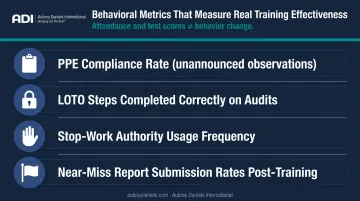
Attendance and test scores tell you what workers know. These behavioral metrics tell you whether training is actually changing what they do:
- PPE compliance rates during unannounced observations
- LOTO steps completed correctly on audits
- Stop-work authority usage frequency
- Near-miss report submission rates post-training
Measuring behavior closes the feedback loop on training. But measuring safe behavior without reinforcing it is where most programs stall.
Step 5: Use Positive Reinforcement to Sustain Safe Behaviors
In ADI's work with safety culture programs across industries, positive reinforcement is consistently the most underused lever available to safety leaders.
Positive reinforcement is the mechanism that converts a one-time safety action into a sustained habit. This isn't a management preference — it's a scientific principle. Behaviors followed by meaningful positive consequences increase in frequency; those that go unrecognized gradually extinguish.
Most organizations provide abundant negative consequences for safety failures — investigations, citations, corrective feedback. They provide almost no positive reinforcement for safe behaviors performed correctly every day.
What effective positive reinforcement looks like in practice:
- A supervisor catches a worker correctly using test-before-touch on a panel and immediately provides specific, sincere recognition
- A team completing a complex energized work permit process correctly gets acknowledged at the next shift meeting
- A worker who suggests a safer job procedure sees it implemented and gets credit
Timing, specificity, and sincerity are all critical. Generic "Safety Star of the Month" programs fail on all three counts — they're delayed, non-specific, and often feel arbitrary.
ADI's analysis of these programs finds they violate every principle of effective reinforcement: only one person receives recognition, the timing is distant from the behavior, and the criteria are rarely tied to specific observable actions.
ADI describes the outcome of systematic positive reinforcement as Discretionary Effort — where workers go beyond minimum compliance because they genuinely want to contribute to a safe culture. A division of an international rail line that implemented ADI's behavioral safety approach saw a 36% drop in injury rate within one year, alongside a cultural shift from reactive to proactive that employees themselves described as transformational.
Steps 6–7: Measuring and Sustaining Your Safety Culture
Step 6: Track Behavioral Leading Indicators, Not Just Incident Rates
Incident rates are lagging indicators. They tell you what already went wrong. A true behavioral safety culture is measured by leading indicators that predict performance before incidents occur.
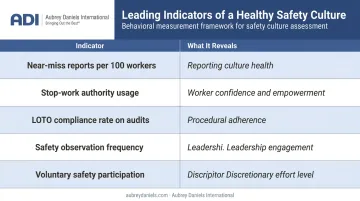
Key leading indicators to track:
| Indicator | What It Reveals |
|---|---|
| Near-miss reports per 100 workers | Reporting culture health |
| Stop-work authority usage | Worker confidence and empowerment |
| LOTO compliance rate on audits | Procedural adherence |
| Safety observation frequency | Leadership engagement |
| Voluntary safety participation | Discretionary effort level |
These metrics belong in operational meetings—not just EHS meetings. When safety performance becomes part of the broader business conversation, it signals to every level of the organization that safe behavior is genuinely valued.
OSHA defines leading indicators as proactive measures that reveal the effectiveness of safety activities. The Campbell Institute reinforces that leading indicators serve as early warning signs of potential events—before lagging indicators have anything to report.
Step 7: Create Feedback Loops for Continuous Improvement
Culture change works through continuous behavioral feedback—structured, repeated, and adjusted over time.
ADI recommends structured review cycles that generate specific behavioral interventions—not generic directives, but targeted actions like "increase positive reinforcement frequency in the maintenance department" or "redesign the near-miss report form to reduce submission friction."
ADI's Safety Pulse Checks—brief 6–8 question surveys—provide cost-effective progress monitoring between comprehensive assessments. Re-administering surveys at scheduled intervals gives leaders actionable data on where the culture is improving and where it's drifting.
What each review cycle should produce:
- Specific behaviors that have improved vs. regressed
- Identification of which reinforcement systems are working
- Clear next actions, not general awareness goals
- Public recognition of measurable cultural progress
When behavioral metrics improve—more near-misses reported, higher LOTO compliance, increased stop-work usage—leaders must reinforce that progress explicitly. Organizations that skip this step lose momentum and risk backsliding.
Warning Signs Your Safety Culture Is Backsliding
Culture erosion typically shows up in behavior long before it appears in injury rates. Watch for these signals:
- Near-miss reporting frequency declining month over month
- Observed PPE compliance rates dropping
- Safety topics being removed or shortened in operational meetings
- Workers expressing cynicism about safety initiatives
- Leaders skipping safety walk-throughs under production pressure
These behavioral signals typically precede incident spikes by weeks or months. The CSB's investigation of the BP Texas City explosion—which killed 15 workers and injured 180—identified process safety culture deficiencies, production pressure, and cost-cutting as contributing factors. Each of those factors showed up first as behavioral change, not as injury data.
When backsliding appears, resist the instinct to launch a new safety program. Initiative fatigue is real, and another program announcement rarely changes behavior. Instead, run a targeted diagnostic: which specific behaviors have changed, and what in the consequence environment shifted?
That question reliably points to the same root cause: a change in reinforcement. A leader who previously recognized safe behaviors stopped doing so. A production push created implicit permission to skip safety steps. Fix the consequence environment first.
Frequently Asked Questions
What is the difference between electrical safety compliance and electrical safety culture?
Compliance focuses on meeting minimum regulatory requirements—OSHA, NFPA 70E—through rules, training, and enforcement. Culture reflects the shared behaviors and norms that determine how workers act when no one is watching. Compliance sets the floor; culture determines how far above it your team actually operates.
Why do most electrical safety training programs fail to change behavior?
Traditional training addresses knowledge but ignores the behavioral environment—specifically, what consequences follow safe or unsafe actions. Without positive reinforcement and practice-based learning, workers gain awareness but rarely apply it consistently on the job.
How long does it take to transform an electrical safety culture?
Meaningful behavioral change typically emerges within 6–12 months of consistent reinforcement, but a fully self-sustaining safety culture generally requires 3–5 years of sustained effort. The rate of progress depends heavily on leadership consistency and the quality of the reinforcement system.
What role does positive reinforcement play in workplace electrical safety?
Positive reinforcement—providing meaningful, immediate recognition when workers perform safe behaviors—is the primary mechanism that converts safety training into lasting habits. Without it, safe behaviors extinguish over time because workers receive no signal that their safe actions matter.
How do you measure electrical safety culture improvement?
Track behavioral leading indicators rather than lagging injury data. Key metrics include near-miss reporting rates, stop-work authority usage, PPE compliance, safety observation frequency, and voluntary safety participation. These reveal cultural health before incident rates do.
What is the most common reason electrical safety culture transformations fail?
Lack of sustained leadership commitment, paired with over-reliance on rules and training while neglecting consequences. When leaders stop modeling and reinforcing safe behavior—or when consequences are exclusively punitive—the culture defaults back to minimum compliance.