Introduction
Communication failures drive more than half of all fatal incidents in oil and gas operations. Analysis of 184 fatal accidents from the IOGP database found that Crew Resource Management failures—encompassing communication, coordination, and teamwork—were present in 57% of all cases. The UK Health and Safety Executive estimates that approximately 90% of offshore oil and gas accidents involve a human factors element, with 52% of accident reports specifically coding communication as a contributing factor.
These failures carry measurable costs. The 1988 Piper Alpha disaster, rooted in shift handover and permit-to-work communication breakdowns, resulted in 167 fatalities and approximately £1.7 billion (roughly $2.2 billion USD) in financial losses. In 2024 alone, IOGP member companies reported 32 fatalities across 4.16 billion hours worked, with the offshore Fatal Accident Rate increasing 122% year-over-year.
This article examines five behavioral and cultural practices that determine whether safety communication actually changes on-the-ground behavior — covering how information is delivered, reinforced, and embedded into daily operations.
Key Takeaways
- Standardized messaging eliminates ambiguity and ensures consistent understanding across shifts, roles, and locations
- Blame-free two-way communication is essential for surfacing near-misses before they become incidents
- Behavior-based training builds habits, not just knowledge — but only when supervisors reinforce it on the job
- Multi-channel delivery is the only reliable way to reach dispersed, rotating oil and gas workforces
- Near-miss reporting rates reveal safety program effectiveness better than lagging injury counts
Best Practice 1: Use Clear, Standardized Safety Messaging
Vague or inconsistent safety messaging creates dangerous ambiguity. When procedures vary across shifts, supervisors contradict each other, or instructions rely on unexplained jargon, workers either ignore the message or interpret it differently.
Research on frontline oil and gas workers found that experienced personnel rely on internalized knowledge rather than consulting procedures—even in high-impact scenarios where standardized protocols should govern behavior.
The Piper Alpha disaster provides a stark example. During shift handover, critical information about a condensate pump's maintenance status—with its safety valve removed and a blind flange loosely fitted—was never communicated to the incoming crew. When operators started the pump without checking the permit-to-work system, the resulting gas leak triggered the initial explosion. The Cullen Inquiry identified inadequate handover procedures and permit-to-work system failures as primary causes.
What Standardization Looks Like in Practice
Effective standardization means uniform formats across high-risk activities:
- Toolbox talks that follow a consistent structure regardless of who delivers them
- Permit-to-work procedures with checklists that don't vary by location or supervisor preference
- Pre-task briefings using standardized templates
- Incident reports captured in identical formats across all sites
IOGP's Life-Saving Rules exemplify this approach. The rules cover nine high-fatality-risk activities—bypassing safety controls, confined space entry, driving, energy isolation, hot work, line of fire, mechanical lifting, work authorization, and working at height—using plain language, visual communication, and multilingual formats. These rules are IOGP's most frequently downloaded guidance because they provide clarity that translates across diverse workforces.
Beyond Awareness: Antecedents and Consequences
Even well-designed standards like IOGP's rules depend on more than clear formats. Warning signs, posters, and pre-shift briefings are antecedents—they precede behavior, but they don't guarantee it. A worker may see the sign, attend the briefing, and still take shortcuts under time pressure or peer influence if there are no reinforcing consequences for compliance.
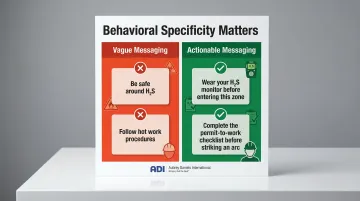
Actionable messaging specifies observable behaviors:
❌ "Be safe around H₂S"
✅ "Wear your H₂S monitor before entering this zone"
❌ "Follow hot work procedures"
✅ "Complete the permit-to-work checklist before striking an arc"
Accessibility and Comprehension
Understanding a message and acting on it are two different things. Messages must be:
- Plain language: Avoid unnecessary jargon; define technical terms when required
- Visual: Use diagrams, symbols, and color coding for quick recognition
- Multilingual: Oil and gas workforces are diverse; U.S. extraction employment is 24% Hispanic, and global operations span multiple languages
Accessible messaging gets workers to the threshold of safe behavior. Whether they cross it depends on what the operational environment reinforces.
Best Practice 2: Build a Two-Way Communication Culture
Safety communication cannot be one-directional. Workers who observe hazards, procedural gaps, or near-misses must feel both empowered and safe to report them. Yet research shows that 98-99% of near-misses go unreported in process industries. Against a theoretical ratio of 100 near misses per accident, most facilities report fewer than one near miss per accident—implying almost no proactive hazard identification.
Why Workers Stay Silent
Workers don't report safety concerns when:
- Previous reports were dismissed or ignored: No visible action was taken
- Reporting led to discipline: Workers fear being blamed for the hazard they identified
- Peers ridicule reporting: "Naming parts after the dummy who broke it" discourages future reports
- Safety bonuses discourage reporting: Incentive structures tied to low incident rates punish transparency
- Reporting systems are confusing: Multiple overlapping systems (occupational, process safety, environmental) create friction
Each of these barriers traces back to the same root cause: workers learned, through experience, that reporting wasn't worth the risk. Supervisor response to those first reports is the deciding factor. When reporting produces positive acknowledgment, visible corrective action, and follow-up communication, reporting rates increase. When it produces blame, silence, or retaliation, reporting stops — and stays stopped.
Practical Two-Way Mechanisms
Organizations that increased near-miss reporting ratios saw dramatic loss reduction:
| Organization | Before | After | Outcome |
|---|---|---|---|
| AMOCO Oil | 1:1 ratio | 80:1 in one year | Identified "suspended crane loads slipping" as top near-miss; changed behavior before fatality |
| SABIC | Low ratio | 77:1 | Operating losses dropped 90% within 12 months |
| U.S. Paper Company (3 mills) | Low ratio | 20:1 | Operational losses dropped 95% |
| U.S. Paper Company (4th mill, punitive culture) | Low ratio | Stayed at 0.2:1 | No improvement |
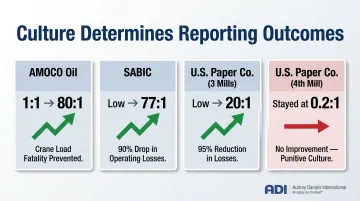
The fourth mill is the most telling data point. The reporting system was identical — but the culture was punitive, and workers didn't use it. Infrastructure without behavior change produces no return.
Effective two-way mechanisms include:
- Structured near-miss reporting systems with clear definitions and low-friction submission processes
- Anonymous hazard reporting to reduce fear of identification
- Pre-shift safety dialogues where workers ask questions and raise concerns, not just receive instructions
- Management walk-arounds designed to invite questions rather than deliver directives
- Visible follow-through: Close the loop by communicating what action was taken in response to worker reports
Psychological Safety as Lived Experience
"No-blame culture" as a policy statement is meaningless unless leader behavior demonstrates it consistently. Psychological safety is built when workers see that raising concerns produces positive outcomes—not when it's listed in a policy manual.
This is the core of what behavioral science brings to safety culture work. ADI's Judy Agnew, co-author of Safe by Accident, has spent years helping organizations apply this principle practically — shifting from shame-and-blame dynamics to manager behaviors that actively reinforce reporting as the right call, every time it happens.
Best Practice 3: Train for Behavior Change, Not Just Awareness
The most common mistake in oil and gas safety training is treating it as an information transfer exercise. Compliance checkboxes, slide presentations, and annual certifications measure what workers know, not what they actually do on the job. Multiple major incident investigations, including Deepwater Horizon, Montara, and Petrobras, identified training and competency gaps as root causes.
The Knowledge-Behavior Gap
Workers may accurately recall a safety procedure and still take shortcuts under time pressure, peer influence, or when consequences feel remote. Research on frontline oil and gas workers found that experienced personnel are less likely to seek external information sources, even in high-impact scenarios, because they rely on personal knowledge and internalized routines. Knowledge, on its own, does not prevent accidents.
What Behavior-Based Training Looks Like
Effective training builds both skill and behavioral habit:
- Scenario-based practice in realistic conditions that simulate actual work environments
- Competency demonstration under observation, not just written tests
- Spaced repetition to reinforce learning over time
- Fluency-building where correct safe behaviors become automatic and effortless
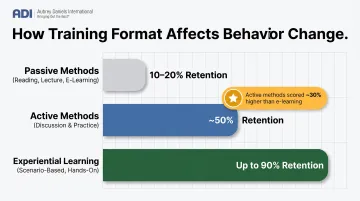
Research comparing training methods found that active methods involving discussion and practice scored approximately 30% higher in effectiveness than e-learning or lecture-based formats. Passive methods (reading, hearing) yield 10-20% retention, while experiential learning yields up to 90% retention.
The Post-Training Problem
Trained behaviors degrade rapidly without reinforcement in the work environment. Supervisors must recognize and reinforce safe behaviors on the job for training gains to transfer to daily practice. Most programs invest heavily in the training room and almost nothing in what happens after workers return to the floor.
Cross-industry evidence supports the fix. In a pharmaceutical organization using behavior-based coaching, managers shifted from "catching people doing something wrong" to providing positive reinforcement for correct behaviors — and performance improved measurably and sustainably. The same mechanism applies in oil and gas: workers need supervisors who actively coach and reinforce trained behaviors in real time, not just during formal sessions.
ADI applies Applied Behavior Analysis to redesign both training programs and the supervisor reinforcement systems that make those programs stick. For oil and gas organizations, this means building competency that holds under pressure — not just scores that satisfy an annual compliance requirement.
Best Practice 4: Use Multi-Channel Communication for Distributed Workforces
Oil and gas workforces are structurally challenging to reach. Texas alone accounts for 51.9% of U.S. oil and gas extraction employment, with operations spread across offshore platforms, remote pipeline sites, and rotating shifts. The ratio of specialist (contractor) employees to lead (operator) employees has grown to 2.1:1, and fewer than half of jobs in some regions are filled by local residents.
Relying on a single channel, whether email, bulletin boards, or shift briefings, will reliably miss large segments of the workforce.
Match Channel to Context and Urgency
Different safety messages require different delivery mechanisms:
Real-time emergencies:
- Mobile alerts or PA systems for evacuation or hazard warnings
- Radio communication for field personnel
Procedural updates:
- Supervisor briefings and toolbox talks
- Shift handover protocols with standardized checklists
Ongoing reminders:
- Digital displays in high-traffic areas
- Visual safety boards showing current hazards and observations
Regulatory and permit requirements:
- Formal written documentation
- Electronic permit-to-work systems with audit trails
Channel Redundancy Reinforces Behavior
Repeating the same safety message across multiple formats is deliberate reinforcement, not redundancy. Shift handover periods represent less than 5% of operations staff time but account for approximately 40% of plant mishaps. Communication failures during these brief windows contributed directly to BP Texas City (brief, ambiguous shift logs), Buncefield (incomplete handover documentation), and Deepwater Horizon (fragmented communication across contractors).
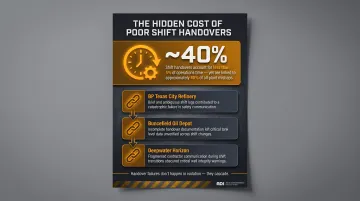
When critical instructions reach workers through multiple channels, the risk of missed messages during handovers, rotations, or connectivity outages drops significantly—and the behaviors those messages target are more likely to stick.
Best Practice 5: Measure Effectiveness and Improve Continuously
Total Recordable Injury Rate (TRIR) and Lost Time Injury Rate (LTIR) are lagging indicators—they measure what already happened. OSHA defines leading indicators as "proactive, preventive, and predictive measures that provide information about the effective performance of safety and health activities", while lagging indicators measure past events.
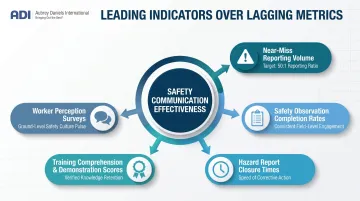
Leading indicators reveal whether current communication practices are shaping worker behavior before incidents occur. The metrics below are worth tracking consistently:
Leading Indicators to Track
Near-miss reporting volume:
- Theoretical optimal ratio: 100 near misses per accident
- Achievable target: 50:1
- Best-in-class examples: AMOCO (80:1), SABIC (77:1)
Safety observation completion rates:
- Frequency of supervisor observations
- Worker participation in peer observation programs
Hazard report closure times:
- How quickly reported hazards are investigated and resolved
- Percentage of overdue corrective actions
Training comprehension and demonstration scores:
- Not just attendance, but competency verification
Worker perception surveys:
- Confidence in reporting systems
- Clarity of safety messaging
- Trust in leadership response
Audit Safety Communication Systems
Audits should examine three core dimensions:
- Do workers understand what they're being told, or does jargon create gaps?
- Do observed on-site practices actually match the communicated procedures?
- Where do communication failures cluster—by location, shift, team, or task type?
One study of an offshore platform over seven days found 15 events that qualified as incidents but were never formally reported, along with three unplanned hydrocarbon releases and eight equipment failures. Audits reveal these invisible gaps.
Continuous Improvement Cycle
Audit findings and leading indicator data should feed directly back into how your organization communicates safety. That means revisiting:
- Messaging and training content when comprehension scores drop
- Supervisor coaching protocols when behavioral alignment gaps appear
- Reporting system design when near-miss ratios stagnate
The goal is a loop, not a launch. Each measurement cycle should produce a concrete change — even a small one — that gets tested and tracked in the next cycle.
Frequently Asked Questions
Why is communication important in the oil and gas industry?
Oil and gas operations involve high-hazard environments where a misunderstood instruction, delayed alert, or unreported near-miss can escalate to catastrophic incidents. Effective communication is the primary mechanism for coordinating safe behavior across complex, distributed operations.
How can we improve consultation and communication about work health and safety?
Shift from one-directional safety messaging to genuine dialogue. Establish structured reporting channels and ensure supervisors respond constructively to worker concerns. Train leaders to actively solicit input on hazards and procedural gaps, not just deliver instructions.
What are the 5 C's of communication?
The 5 C's are Clear, Concise, Correct, Complete, and Courteous. In oil and gas safety, clarity and completeness are critical — ambiguous instructions in high-risk tasks can trigger fires, equipment failures, or injuries within seconds.
What are the most common communication failures that lead to safety incidents in oil and gas?
Key failure patterns include inconsistent messaging across shifts, workers not reporting near-misses due to fear of consequences, safety briefings that deliver information without verifying understanding, and poor handover communication between rotating crews.
How do you build a speak-up safety culture in oil and gas?
A speak-up culture is built through consistent behavioral reinforcement. When workers who raise safety concerns receive positive, visible follow-through from leadership, reporting becomes routine. Dismissal or blame shuts it down fast.
What metrics should be used to measure safety communication effectiveness?
Use leading indicators over lagging ones: near-miss reporting frequency, safety observation completion rates, hazard closure times, training comprehension scores, and periodic worker surveys on message clarity and confidence in reporting systems.