Introduction
Energy sector organizations—from oil and gas operations to nuclear power and utilities—operate in some of the highest-stakes safety environments in any industry. The numbers make the stakes concrete: a single OSHA willful violation now carries a maximum penalty of $165,514 per violation, nuclear facilities face NRC penalties reaching $312,659 for Severity Level I violations, and BP's Texas City refinery accumulated over $84 million in OSHA penalties across multiple process safety management failures.
The global environmental health and safety (EHS) market is projected to grow from $52.26 billion in 2024 to $95.71 billion by 2033, with services—including consulting—representing 96.2% of that total.
Energy sector safety consulting costs vary widely. Hourly advisory engagements address specific compliance questions at one end of the range; multi-year behavior change programs that fundamentally transform safety culture sit at the other.
What follows covers pricing ranges, cost structures, the key factors that drive costs in energy-specific contexts, and how to budget for the level of support your organization actually needs.
TL;DR
- Typical cost range: Hourly rates span $75–$390 depending on credentials and specialization; project-based engagements range from $10,000 to $200,000+; retainer programs for sustained culture change can exceed $250,000 annually
- What drives costs up: Nuclear and offshore oil and gas complexity, specialized PSM credentials, behavioral safety programs, long-term culture change scope, and remote site logistics
- Lower vs. higher costs: Small renewable energy compliance projects sit at the lower end; multi-site oil and gas operators or nuclear facilities requiring deep behavioral programs sit at the upper end
- ROI on premium consulting: At $48,000 per medically consulted injury and high regulatory exposure, behavior-based programs averaging 39% accident reductions justify the investment
How Much Do Energy Sector Safety Consulting Services Cost?
Energy sector safety consulting fees range from $75/hour for targeted advisory work to $1M+ annually for long-term program partnerships. What you pay depends on engagement type, consultant credentials, project scope, and your specific energy subsector.
What goes wrong when cost is misunderstood:
- Underbudgeting leads to surface-level compliance work that doesn't address root behavioral causes
- Overspecifying features for simple compliance needs wastes budget
- Ignoring ongoing program costs after an initial assessment leads to performance regression
Typical Cost Range by Engagement Type
Energy safety consulting pricing structures fall into three primary models:
| Engagement Type | Typical Range | Best Fit |
|---|---|---|
| Hourly / Advisory | $75–$390/hour | Targeted compliance questions, incident response |
| Project-Based | $10,000–$200,000+ | Defined deliverables with a clear start and end |
| Retainer / Long-Term | $250,000–$1,000,000+/year | Sustained culture change and performance programs |
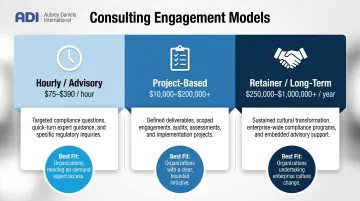
Rates vary based on consultant credentials, firm overhead, and specialization. According to BLS data, occupational health and safety specialists in oil and gas extraction earn a median of $125,190 annually—approximately 49% above the national median. That premium reflects what genuine energy sector expertise commands in the market.
Here's what each model includes, excludes, and suits best.
Hourly / Advisory Consulting
What's typically included:
- On-call expert guidance on regulatory interpretation
- Incident response support
- Brief assessments or compliance gap reviews
- Targeted answers to specific technical questions
What's excluded: Travel costs, comprehensive reports, on-site implementation support, follow-up reinforcement
Best for: Companies needing targeted expertise for a specific compliance question or short-term regulatory challenge such as interpreting new OSHA PSM guidance or responding to a minor regulatory finding.
Project-Based Consulting
What's typically included:
- Defined scope deliverables: risk assessments, safety management system audits, gap analyses
- Training program design and delivery
- Written reports with findings and recommendations
- Limited on-site days (typically 2-5 visits)
What's excluded: Ongoing implementation support, sustainment beyond delivery, behavioral observation systems, leadership coaching
Best for: Organizations with a clearly defined safety challenge—preparing for a regulatory inspection, designing a new safety program for a new site, or conducting a one-time PSM audit.
Retainer / Long-Term Program Partnerships
What's typically included:
- Ongoing advisory access and strategic guidance
- Periodic site visits (monthly or quarterly)
- Safety culture assessments and behavioral observation programs
- Leadership coaching and accountability structures
- Continuous improvement support with performance measurement
What's excluded: Technology platforms, capital equipment, legal representation
Best for: Energy operators moving beyond compliance toward a safety culture that actually reduces incidents. This model delivers the most value for organizations that have passed basic compliance thresholds but still see repeat incidents—because the problem is behavioral, not procedural.
Understanding these three models is a starting point. The next variable that shapes cost is where your organization sits on the risk and complexity spectrum.
Key Factors That Affect the Cost of Energy Sector Safety Consulting
Pricing in energy safety consulting is shaped by technical, operational, regulatory, and organizational variables that differ significantly from general industry consulting.
Subsector and Hazard Complexity
The energy subsector directly influences cost:
- Nuclear and offshore oil and gas command the highest rates due to NRC and BSEE regulatory frameworks, specialized expertise requirements (nuclear operations, PSM protocols), and catastrophic incident potential
- High-hazard process environments—refineries, LNG terminals, pipelines—require consultants with process safety management (PSM) credentials, narrowing the talent pool and raising rates
- Onshore utilities and renewables typically fall at the lower end of the range due to simpler regulatory frameworks and lower hazard severity
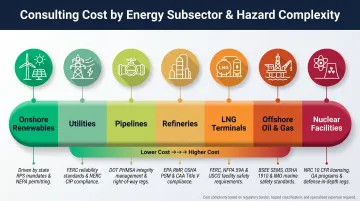
The regulatory penalty gradient mirrors the consulting rate gradient: OSHA serious violations carry $16,550 penalties, while NRC Severity Level I violations reach $312,659—a 19x difference that reflects the specialized expertise required.
Scope and Duration of Engagement
A one-time compliance audit differs fundamentally from a multi-year safety culture transformation program:
- Short engagements (1-3 months): Lower total cost but limited to immediate compliance needs
- Long engagements (12-36 months): Higher total investment but address behavioral and cultural drivers of incidents
Vague scopes are one of the most common sources of cost overruns in safety consulting. Well-defined engagements—with agreed deliverables, site visit assumptions, and milestone-based phasing—provide far better cost predictability for both sides.
Consultant Credentials and Specialization
Credentials and sector-specific experience drive day rates up but also correlate with faster diagnosis and higher-quality recommendations:
- CSP (Certified Safety Professional) holders earn approximately $30,000 more annually than non-certified professionals
- PSM specialists with deep process safety management experience command premium rates due to scarcity—BLS reports only approximately 1,120 OHS Specialists employed in oil and gas extraction nationally
- Behavioral safety certifications (BCBA, behavior-based safety program credentials) signal expertise in culture change, not just compliance
Boutique specialists with deep energy sector experience often charge more per hour but deliver more relevant insights than generalist EHS firms applying standardized frameworks.
Methodology: Compliance-Only vs. Behavior-Based Approaches
Consultants focused purely on regulatory compliance—checklist audits, documentation review—typically cost less per engagement but may not address the behavioral and cultural drivers behind repeat incidents.
Behavior-based safety consulting commands higher program investment but produces measurable, lasting improvements. Peer-reviewed research shows behavior-based interventions produce an average 39% reduction in workplace accidents across multiple industries. Firms like Aubrey Daniels International (ADI) apply over 45 years of behavioral science research to energy sector safety programs—using reinforcement-based behavior change methods to shift how employees and leaders actually work, not just what they document.
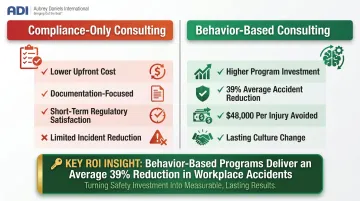
At $48,000 per medically consulted injury and $1.54 million per fatality, even modest incident-rate reductions from behavioral programs yield ROI that dwarfs the consulting investment.
Geographic Location and Site Accessibility
Remote or offshore sites add significant cost:
- Deepwater platforms, pipeline corridors, remote generation facilities: Travel, logistics, and per diem costs can add 30-50% to total engagement costs
- Multi-site operations: Consulting fees scale with the number of locations requiring on-site assessment and implementation support
Factoring in these site-access costs early—before proposals are finalized—prevents budget surprises and allows for more accurate comparisons across consulting bids.
Cost Breakdown: What You're Actually Paying For
The total cost of a safety consulting engagement extends beyond the quoted day rate. Energy companies should account for the full cost picture:
1. Initial scoping and assessment fees:
- Stakeholder interviews, document review, baseline incident data analysis
- Typically 10-15% of total project cost
2. Core consulting delivery:
- Site visits, workshops, program development, leadership coaching
- 60-70% of total project cost
3. Deliverable production:
- Reports, safety management system documentation, training materials
- 10-15% of total project cost; sometimes billed separately
4. Post-engagement follow-up and sustainment support:
- Reassessment, reinforcement visits, performance measurement
- 15-20% of total project cost
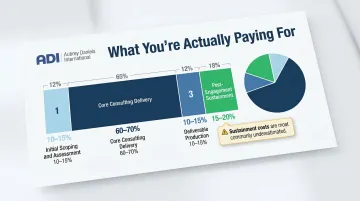
Sustainment costs are the line item most clients underestimate — or omit entirely from initial budgets. A well-designed safety program with no ongoing reinforcement will degrade within 6-12 months. Build follow-up visits and performance measurement into the original contract scope, not as an afterthought, to avoid paying for a full re-engagement later.
Budget-Friendly vs. Premium Energy Safety Consulting: What's the Difference?
Cost differences between lower-priced and higher-priced energy safety consulting reflect real differences in depth, methodology, and long-term impact—not just brand or firm size.
The gap shows up across four dimensions:
| Dimension | Budget Consulting | Premium Consulting |
|---|---|---|
| Scope of diagnosis | Standardized checklists, document review, compliance verification | Behavioral observations, leadership interviews, systems analysis, culture assessments |
| Methodology | Compliance-focused, regulatory checklist approach | Behavior- and culture-focused, root cause analysis, leadership development |
| Deliverables | Generic reports, compliance gap lists, standard recommendations | Customized implementation roadmaps, measurable KPIs, leadership coaching plans |
| Long-term value | Satisfies near-term audit requirement but may not reduce incident frequency | Demonstrates ROI through measurable reductions in recordable incidents, near-misses, and regulatory findings |
Choosing based on lowest hourly rate in high-hazard energy environments is a false economy. The cost of a single serious incident, regulatory fine, or process safety event typically dwarfs the difference between budget and premium consulting investment. OSHA's first-year refinery PSM inspections at 14 refineries resulted in 348 PSM citations—each carrying potential penalties up to $165,514.
How to Estimate the Right Safety Consulting Budget for Your Energy Operation
Your safety consulting budget should reflect the investment required to achieve a specific outcome — not simply the lowest number you can defend to leadership.
Key questions that should drive budget scoping:
- What specific outcome do you need — compliance certification, incident reduction, culture change, or a PSM program build?
- How many sites and employees fall within scope — a single facility or a multi-site operation?
- What does your current baseline look like — incident rates, safety management system maturity, recent regulatory findings?
- Can your internal team implement recommendations, or will you need ongoing consulting support?
Approach the RFP/Proposal Process Strategically
Once you've scoped the outcomes you need, use the proposal process to hold providers accountable. Request detailed proposals from multiple firms and require them to specify:
- Deliverables with clear acceptance criteria
- Methodologies (compliance audit vs. behavioral observation vs. culture assessment)
- Site visit assumptions (number of visits, days on-site, personnel interviewed)
- Sustainment options (ongoing support, reassessment schedules)
Compare on value delivered per dollar, not just day rate. A $200/hour consultant who delivers a high-quality behavioral safety assessment in 40 hours outperforms a $125/hour consultant who needs 80 hours for a generic compliance checklist.
Common Budgeting Mistakes to Avoid
Before finalizing your budget, watch for these three patterns that consistently derail safety consulting ROI:
- Scoping only the assessment phase — Assessments identify problems; implementation solves them. Budget for both phases from the start.
- Choosing a generalist firm to cut costs — Firms without PSM, nuclear, or offshore credentials will struggle with the specific demands of energy operations.
- Treating safety consulting as a one-time expense — Safety performance improvement is a continuous cycle. Build sustainment into your budget from day one.
Frequently Asked Questions
What are typical hourly rates for safety consultants in the energy sector?
Hourly rates range from $75–$390 depending on credentials and specialization. Independent consultants with CSP or PSM credentials typically charge $150–$250/hour, while senior specialists (CIH/CSP/CHMM with 30+ years in energy) at large firms can exceed $350/hour. Former OSHA or NRC officials with specialized regulatory expertise often charge around $200/hour.
What is the difference between hourly, project-based, and retainer pricing for safety consulting?
Hourly works for targeted advisory needs (regulatory interpretation, quick compliance questions). Project-based fits defined deliverables with clear scope (audits, gap analyses, program design). Retainers suit organizations needing continuous support (site visits, leadership coaching, culture measurement) and offer the best cost-per-outcome for long-term safety improvement goals.
How does the energy subsector affect safety consulting costs?
Nuclear and offshore oil and gas command the highest rates due to NRC and BSEE regulatory complexity, specialized expertise requirements, and catastrophic hazard potential. Onshore renewables and utilities typically fall at the lower end of the range, reflecting simpler regulatory frameworks and lower hazard severity.
When does behavior-based safety consulting deliver better ROI than standard compliance consulting?
Behavior-based consulting delivers stronger ROI when an organization has cleared basic compliance thresholds but still experiences repeat incidents, signaling a behavioral or cultural root cause rather than a procedural one. Research shows behavior-based interventions reduce accidents by approximately 39% on average, translating to significant cost avoidance at $48,000 per injury.
What should a safety consulting proposal for an energy company include?
A strong proposal should cover:
- Scope of work with specific deliverables
- Methodology description (compliance audit, behavioral observation, or culture change)
- Site visit assumptions (number of visits, days on-site)
- Consultant credentials and bios
- Timeline with milestones, pricing structure, and sustainment options
How do boutique safety consulting firms compare to large EHS firms for energy sector work?
Boutique firms often provide more direct access to senior specialists with deep energy sector experience and deliver more customized solutions. Large firms offer broader geographic reach, standardized systems, and enterprise-wide implementation capabilities. The right choice depends on whether the client needs specialized depth (boutique) or enterprise-wide scale (large firm).