Introduction
Manufacturing consistently ranks among the most hazardous industries in the United States. In 2023, the Bureau of Labor Statistics recorded 391 fatal work injuries in the manufacturing sector, with contact with objects and equipment accounting for 120 of those deaths. Beyond fatalities, manufacturers reported approximately 355,800 nonfatal injuries and illnesses that same year, with a total recordable case (TRC) rate of 2.8 per 100 workers—17% higher than the private-industry average.
Many factories invest in safety programs, yet results depend almost entirely on the consulting partner behind them. Choosing the wrong firm often means surface-level compliance checks with no real reduction in risk.
The right partner drives lasting behavioral change — making safe practices a daily habit rather than a policy requirement. This guide walks through the key criteria to evaluate before signing with any safety consulting firm.
Key Takeaways
- Define your factory's specific safety challenges before evaluating any firm
- Prioritize consultants with manufacturing experience and relevant credentials (CSP, OHST, SMP)
- Look beyond checklists—effective firms address the behavioral root causes behind incidents
- The right firm listens, customizes their approach, and fits your workplace culture
- Plan for a long-term partnership, not a one-time fix
What Does a Safety Consulting Company Do for a Factory?
A safety consulting company is an external firm that assesses workplace hazards, develops safety programs, provides employee training, supports regulatory compliance (OSHA, EPA, etc.), and helps build a culture of safety across your operation. In manufacturing contexts, these consultants bring specialized expertise that complements your internal team without the overhead cost of full-time hires.
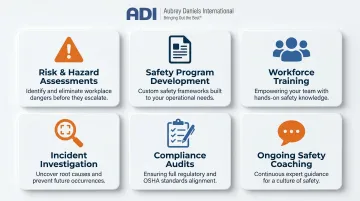
Most factory safety consultants cover six core service categories:
- Risk and hazard assessments – Identifying physical, chemical, and ergonomic hazards specific to your processes
- Safety program development and documentation – Creating written programs for lockout/tagout (LOTO), machine guarding, confined spaces, and other OSHA requirements
- Workforce training – Delivering site-specific instruction tailored to your equipment, procedures, and workforce
- Incident investigation – Analyzing root causes of injuries and near-misses to prevent recurrence
- Compliance audits – Evaluating your factory against OSHA standards and recommending corrective actions
- Ongoing safety coaching – Providing advisory support and behavioral reinforcement to sustain improvements
Benefits of Bringing in a Safety Consulting Firm for a Factory
External consultants offer a fresh perspective on hazards that internal teams—accustomed to daily routines—often miss. Because they work across multiple facilities and industries, they carry knowledge your in-house team may simply not have.
Key advantages of bringing in an outside firm include:
- Objective hazard identification – No internal blind spots or organizational biases shaping the assessment
- Regulatory expertise – Deep familiarity with OSHA standards, industry best practices, and compliance requirements
- On-demand access – Get specialized expertise when you need it, without the fixed cost of a full-time hire
- Cross-industry insight – Consultants draw on lessons from dozens of facilities, applying what actually works
Key Factors to Consider When Choosing a Safety Consulting Company for Your Factory
Choosing a safety consulting firm comes down to fit: the right firm's expertise, methodology, and engagement model align with your factory's specific hazards, workforce dynamics, and operational goals. The six factors below help you move from vague vendor comparisons to confident, criteria-driven decisions.
Manufacturing-Specific Experience
Ask whether the consulting firm has direct, hands-on experience in factory or industrial settings—specifically with hazards common to your industry such as machine guarding, lockout/tagout (LOTO), confined spaces, chemical handling, or ergonomics. A generalist firm that primarily serves construction or healthcare will lack the contextual knowledge to design effective solutions for your production floor.
What to verify:
- Request examples of past factory clients or case studies that demonstrate measurable safety improvements in a manufacturing environment
- Ask how many years of field experience their consultants have working on active production floors
- Confirm they understand your specific sub-sector (e.g., automotive assembly, food processing, metal fabrication)
If your factory operates in a high-risk sub-sector—such as cut stock/resawing lumber (TRC rate 8.1), iron foundries (6.7), or travel trailer manufacturing (6.7)—your injury rates are more than double the manufacturing average. You need consultants who understand those unique operational risks.
Credentials and Certifications of the Consulting Team
Verify that the firm's consultants hold recognized safety credentials relevant to your sector. Key designations include:
- Certified Safety Professional (CSP) – Requires a bachelor's degree, at least four years of professional safety experience, and passing a rigorous exam
- Occupational Hygiene and Safety Technician (OHST) – Requires three years of occupational safety experience and demonstrated competency
- Safety Management Professional (SMP) – Requires 10 years of safety management experience (formerly Safety Management Specialist/SMS, renamed March 2025)
Credentials should complement real-world experience, not substitute for it. Ask specifically about the experience and qualifications of the consultant who will be on-site with your team, not just the firm's most senior staff. A firm may have a CSP-credentialed principal, but if the person walking your floor is a junior associate with no manufacturing background, you won't get the value you need.
Approach to Safety: Behavioral vs. Compliance-Only
Compliance-focused consultants audit against regulatory checklists. Behavior-based consultants go further, investigating the underlying human behaviors and workplace conditions that cause incidents to recur.
A peer-reviewed meta-analysis of 13 studies found behavior-based safety interventions linked to an approximate 39% reduction in workplace accidents and injuries, with manufacturing as the most common setting studied. The approach works because it addresses why employees act unsafely, then uses positive reinforcement and management systems to drive lasting change.
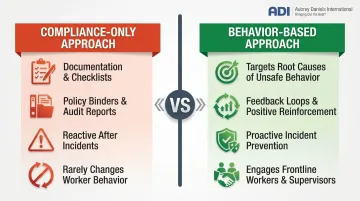
Compliance-only approach:
- Focuses on documentation and regulatory checklists
- Delivers policy binders and audit reports
- Reactive: addresses problems after incidents occur
- Rarely changes day-to-day worker behavior
Behavior-based approach:
- Targets root causes of unsafe behaviors through observation and analysis
- Applies feedback loops and positive reinforcement to build new habits
- Proactive—prevents incidents by changing habits
- Engages frontline workers and supervisors in the process
Consultants grounded in behavioral science—such as firms that apply Applied Behavior Analysis principles to workplace safety—can help factories not just check compliance boxes but build a workforce culture where safety becomes a shared habit.
Range of Services and Ability to Customize
Confirm that the firm offers services relevant to your factory's current stage—whether that's building a safety program from scratch, improving an existing one, conducting periodic audits, or delivering targeted workforce training. A consulting partner should be able to scale and tailor its offerings to your specific operational needs rather than delivering a generic, off-the-shelf program.
Key questions to ask:
- Will the firm provide customized written safety programs and site-specific Job Hazard Analyses (JHAs)?
- Can they adapt training materials to your workforce—including accommodations for language, literacy levels, and shift structures?
- Do they offer ongoing support beyond the initial engagement?
- Can they scale services as your operation grows or changes?
If a consultant arrives with a pre-packaged program before walking your floor, that's a red flag. Effective safety solutions are built on your specific hazards, processes, and workforce characteristics.
Responsiveness and Cultural Fit
Safety issues on a production floor can escalate fast. You need a partner who is accessible for urgent questions and can provide support when it matters. Ask whether they are available outside standard business hours and what their typical response time is for client concerns.
Equally important is cultural alignment. Assess whether the firm takes time to understand your factory's culture, leadership style, and workforce before proposing solutions. A consultant who listens first and customizes accordingly will build stronger buy-in from frontline workers and supervisors than one who arrives with a predetermined playbook.
Cultural fit indicators:
- They ask questions about your workforce demographics, shift structures, and management style
- They request tours and observations before making recommendations
- They involve frontline workers in the assessment process
- They adapt communication styles to match your organizational culture
Pricing, Contract Clarity, and ROI
Factory safety consulting typically follows three pricing models:
- Hourly consulting – Best for short-term, specific projects or ad-hoc support
- Project-based fees – Ideal for defined engagements like a one-time audit or training rollout
- Retainer arrangements – Often the best value for factories with ongoing compliance needs and continuous improvement goals
Don't evaluate on upfront cost alone. Consider the return on investment. OSHA penalties as of January 2025 reach $16,550 per serious violation and $165,514 per willful or repeated violation. The National Safety Council estimates the average cost per medically consulted work injury at $48,000 and per fatality at $1,540,000. OSHA's Safety Pays model shows indirect costs can multiply direct costs by 1.1x to 4.5x depending on severity.
A single serious incident or multi-citation inspection can cost hundreds of thousands of dollars. Ask the firm how they measure and report outcomes so you can track the return on your investment.
Red Flags to Watch For When Evaluating Safety Consulting Companies
Be wary of firms that offer generic, templated safety programs without conducting a site-specific assessment first. If a consultant is ready to deliver a binder of policies before they've walked your factory floor, their approach is not tailored to your operation.
Qualified consultants can explain their methodology clearly and set realistic expectations. Watch for these specific warning signs:
- Can't provide references from manufacturing or industrial clients
- Struggle to articulate how they assess your specific operation
- Make guarantees that don't hold up to scrutiny, such as promising zero OSHA citations
- Offer pre-packaged programs before conducting any on-site evaluation
Another pattern worth noting: firms that focus exclusively on management directives with no plan for frontline worker engagement. Safety programs that live only in policy binders rarely change behavior where it matters — on the production floor.
OSHA's Recommended Practices for Safety and Health Programs identify worker participation as a core element of effective safety management. A consultant who treats frontline employees as passive recipients, rather than active participants, is missing what the research consistently shows drives lasting results.
How ADI Can Help Your Factory Build Lasting Safety Performance
Aubrey Daniels International (ADI) is a consulting firm with over 45 years of experience applying the science of behavior to business performance, including workplace safety. ADI's approach is grounded in Applied Behavior Analysis (ABA), a research-backed discipline that identifies the behavioral drivers behind unsafe acts and safe ones — enabling leaders to reinforce the right behaviors rather than simply penalizing violations.
Judy Agnew, ADI's Senior Vice President and co-author of Safe by Accident?, brings both deep behavioral science expertise and practical, floor-level application. ADI's team works directly with factory leaders to design behavior-based safety strategies that produce measurable, sustainable reductions in incidents—not just short-term compliance scores.
ADI's key differentiators for factory safety decisions:
- Addresses root causes of unsafe behavior through Applied Behavior Analysis, not surface-level rule enforcement
- Uses positive reinforcement strategies to drive lasting habit change at the frontline
- Supports clients from strategy development through full execution on the production floor
- Builds internal behavioral coaching capability within your EHS team through certification programs
- Brings a proven global delivery track record across industrial and manufacturing environments
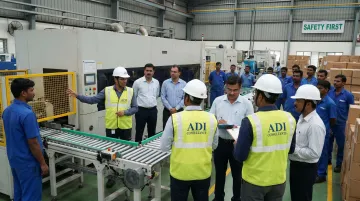
These capabilities translate directly into practice. ADI has served clients in Manufacturing, Automotive, Energy, Mining, and Utilities — delivering safety leadership training, behavioral observation programs, and culture transformation initiatives built around production floor realities.
Conclusion
The safety consulting firm you choose will shape your workforce culture, your OSHA record, and the day-to-day experience of every person on your floor. The right partner aligns with your factory's specific hazards, operating environment, and long-term safety goals — not just your next inspection date.
Review your safety program's effectiveness on a set schedule — not only after an incident or a regulatory visit. The most effective factory leaders treat this relationship as a continuous feedback loop: tracking outcomes, holding consultants accountable to metrics, and refining the approach as operations change. Firms like Aubrey Daniels International build safety culture from the behavioral level up, which means the improvements hold long after the engagement ends.
Frequently Asked Questions
How much does a safety consultant cost?
Costs vary by engagement model (hourly, project-based, or retainer) and scope. For factories, retainer arrangements offering ongoing support often deliver stronger ROI when weighed against the cost of a single serious incident or OSHA citation, which can reach $16,550 or more.
What is the difference between a compliance-focused and a behavior-based safety consultant?
Compliance-focused consultants primarily audit against regulatory standards and produce documentation. Behavior-based consultants investigate the human behavioral patterns that cause incidents and use reinforcement strategies to change how workers act on the floor, producing more durable safety outcomes over time.
When should a factory hire a safety consulting company?
Factories benefit from consulting support when building an initial safety program, after an incident or near-miss, in preparation for an OSHA inspection, or proactively when incident rates or near-miss frequency signals an underlying cultural issue.
What credentials should a safety consulting company have for factory work?
Look for CSP (Certified Safety Professional), OHST (Occupational Hygiene and Safety Technician), or SMP (Safety Management Professional). The consulting team assigned to your factory should have verifiable, hands-on manufacturing experience—not just the firm's senior leadership.
Can a safety consulting company replace an in-house EHS manager?
Safety consultants complement rather than replace an internal EHS team. Factories with active safety programs get the most value when internal leadership and external consultants work in tandem.
How do I know if a safety consulting company's approach will actually work in my factory?
Three things to verify before signing:
- Ask for references from comparable manufacturing clients
- Request a sample assessment or methodology walkthrough
- Look for firms that define measurable outcomes, not vague promises of "improved safety culture"