Introduction
Most performance problems don't have obvious solutions. Leaders launch initiative after initiative (training programs, restructuring efforts, new process rollouts) and still find the same problems resurfacing six months later. Engagement scores stay flat. Turnover climbs. Strategy stalls at the middle layer of management.
What's usually missing isn't a better plan. It's a structured approach to the human systems that determine whether any plan actually gets executed.
Organizational development (OD) consulting addresses exactly that gap. Yet for all its practical value, OD work is frequently overlooked — or misunderstood — by the executives and HR leaders who need it most.
This guide is written for decision-makers who want a realistic view of what OD consultants actually do, what distinguishes effective consulting from expensive report-writing, and how to measure whether an engagement produced lasting change rather than temporary momentum.
This guide covers:
- What OD consulting is and how it differs from general management consulting
- Core strategy areas where OD work drives the most impact
- Best practices that separate sustained results from one-time improvements
- The role of behavioral science in changing how people actually work
- How to measure whether an engagement produced real, lasting change
Key Takeaways
- OD consulting targets the human systems — leadership behavior, culture, and performance dynamics — that determine whether strategy actually gets executed
- Effective engagements start with behavioral diagnosis, not pre-packaged solutions
- Leadership alignment before implementation is the single most reliable predictor of whether an intervention sticks
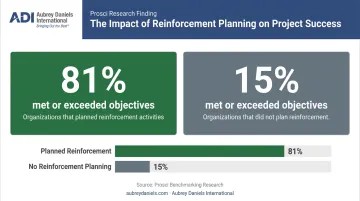
- Research shows 81% of organizations that planned reinforcement activities met or exceeded project objectives — versus 15% of those that didn't
- Impact should be measured at 6, 12, and 24 months post-engagement, not just at project close
What Is an Organizational Development Consultant?
OD consulting applies behavioral science, systems thinking, and structured diagnosis to improve organizational effectiveness — not just operational efficiency. The OD Network defines it as a planned, organization-wide effort using behavioral science knowledge to increase health and performance through deliberate intervention in organizational processes.
That distinction — deliberate intervention, not just analysis — is what sets OD apart.
OD Consulting vs. Management Consulting
The distinction matters. Traditional management consulting typically delivers strategy reports, operational analyses, and recommendations. The work product is the document.
OD consulting goes further by addressing the human systems — leadership behavior, communication patterns, cultural norms — that determine whether any strategy actually gets implemented. An OD consultant isn't just diagnosing what needs to change; they're working directly on the conditions that make change possible.
The Scope of OD Work
Those conditions span the full organizational system. OD consultants typically assess and intervene across:
- Organizational structure — roles, reporting lines, team design
- Leadership effectiveness — behavior, decision-making, modeling of values
- Culture alignment — the gap between stated values and actual norms
- Employee engagement — what's driving or suppressing discretionary effort
- Change management — how transitions are planned, communicated, and sustained
- Performance systems — whether metrics, incentives, and feedback loops reinforce the right behaviors
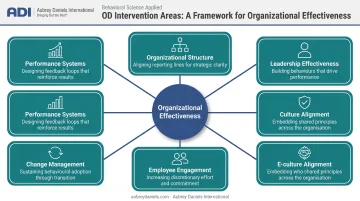
The breadth of scope is what separates OD from narrower functional interventions. Where a functional intervention addresses a single broken process, an OD engagement maps how that process connects to leadership behavior, cultural norms, and the reinforcement environment sustaining it.
Core Responsibilities and Strategy Areas
Organizational Diagnosis
Every effective OD engagement begins with diagnosis — and the most common mistake is skipping this phase. A consultant who arrives with a pre-built solution hasn't diagnosed anything; they've assumed.
ADI's diagnostic methodology uses a combination of culture surveys, structured site assessments, behavioral observation, focus groups, and performance data review to identify root causes rather than surface symptoms. High turnover might look like a compensation problem. A thorough diagnostic might reveal it's a leadership consistency problem, which no pay increase will fix.
The diagnostic phase answers a specific question: what behaviors and environmental conditions are currently producing these outcomes? Until that question has a rigorous answer, intervention design is guesswork.
Change Management Strategy
OD consultants play a central role in organizational transitions: mergers, restructuring, technology rollouts, cultural shifts. Their specific value is addressing what traditional project management misses — the human adoption problem.
Effective change management requires:
- Helping leaders communicate the "why" in a way that connects to employees' actual concerns
- Engaging stakeholders early enough that resistance is managed, not ignored
- Defining the specific behaviors that need to change at every level, not just the desired outcomes
- Building reinforcement structures that sustain new behaviors after the initial launch energy fades
ADI's approach to change management uses behavioral roadmapping — working backward from desired results to identify the critical behaviors required at each organizational level, then building the accountability and reinforcement systems to support them.
Leadership Development
Most leadership problems are behavior problems. Leaders default to what worked in their previous role, what's comfortable under pressure, or what their own managers modeled — not necessarily what the organization needs from them now.
OD consultants assess leadership capability gaps and design interventions that go beyond awareness. ADI's leadership development portfolio includes 360-degree feedback tools, the Precision Leadership Survey (upward feedback from direct reports), coaching programs, and workshops ranging from one-day introductory formats to four-day behavioral leadership intensives.
What separates effective leadership development from generic training is its connection to strategic execution. ADI's behavioral roadmapping process works backward from business results to define exactly which leadership behaviors need to change — ensuring development is directly tied to what the organization is trying to accomplish, not just best-practice frameworks.
Culture and Engagement Initiatives
Leadership behavior and organizational culture are inseparable — which is why culture change is a natural extension of leadership work. ADI defines culture as patterns of behavior reinforced, intentionally or not, by people, systems, and processes over time. The practical implication: culture change requires changing what gets reinforced, not just what gets stated in a values document.
OD consultants help organizations:
- Measure current culture through surveys and behavioral assessment
- Define the specific behaviors that characterize the desired culture
- Identify the organizational systems (incentives, processes, management practices) that inadvertently reinforce the wrong behaviors
- Design interventions that shift reinforcement patterns at the structural level
Gallup's Q12 meta-analysis puts numbers to the gap: top-quartile engagement business units show 23% higher profitability, 51% lower turnover in low-turnover organizations, and 78% lower absenteeism than bottom-quartile units.
Talent and Performance Systems
Beyond culture, OD consultants address the performance infrastructure — the measurement systems, feedback loops, and incentive structures that shape what employees actually do daily.
ADI's performance systems work includes:
- Designing and optimizing Performance Management Processes
- Assessing whether formal and informal systems are aligned with business objectives
- Building scorecards and incentive pay structures grounded in behavioral principles, including ADI's Profit-Indexed Performance Pay™ model
- Ensuring measurement systems motivate the right behaviors, not just track outcomes
The core diagnostic question: do your current systems make it easier for people to do what you want, or harder?
When Does Your Organization Need an OD Consultant?
Key Organizational Signals
Most organizations bring in OD consultants reactively — after something has clearly gone wrong. The better question is whether any of these patterns are present:
- Persistent performance gaps despite repeated training or process improvement efforts
- Initiative failure — strategies that look good on paper but stall in execution
- Leadership misalignment cascading into team-level confusion about priorities
- Declining engagement scores with no clear path to addressing root causes
- Cultural deterioration — employees saying "this place isn't the same anymore," increasing silos, rising turnover
- Rapid growth outpacing organizational structure and management capability
- Failed change initiatives where resistance was managed but gains weren't sustained
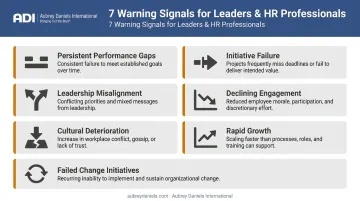
ADI's consulting conversations consistently surface one pattern: organizations have sound strategies but lack the accountability systems needed to translate those strategies into consistent behavior. Research backs this up — only 1 in 10 companies that design an effective strategy successfully implement it.
The Value of External Perspective
Internal teams are often too embedded in cultural norms and organizational politics to identify systemic patterns objectively. What looks like an individual performance problem from inside the organization frequently turns out to be a management consistency problem, a misaligned incentive, or a leadership behavior the entire organization has quietly adapted around.
External OD consultants bring structured methodology and an outside perspective that surfaces what internal stakeholders have long since normalized.
Proactive vs. Reactive Engagement
Reactive OD addresses a current crisis. Proactive OD builds organizational capacity before those crises develop — and the financial gap between the two approaches is measurable.
McKinsey research found that companies improving organizational health realized 18% increases in EBITDA after one year — and healthy organizations were 59% less likely to show signs of financial distress during disruption. Organizations that wait for crisis to engage OD consulting pay a premium in lost performance, turnover costs, and failed initiatives.
Best Practices for Effective OD Consulting
Start with Behavioral Diagnosis, Not Assumptions
Effective OD consultants resist the pull toward pre-packaged solutions. The diagnostic phase requires genuine investment in understanding the specific behaviors and environmental conditions driving current outcomes.
ADI's diagnostic approach uses the PIC/NIC Analysis® — a proprietary framework that maps the Positive, Immediate, and Certain versus Negative, Immediate, and Certain consequences shaping behavior in the current environment. This reveals why people behave as they do — and makes it possible to design interventions that produce real change.
Secure Leadership Alignment Before Implementation
OD interventions fail more often from misaligned leadership than from flawed design. If senior leaders are visibly skeptical, passively uninvolved, or modeling behaviors inconsistent with the change, even a well-designed intervention won't hold.
Best practice is building shared leadership ownership — not just sign-off — before anything rolls out to the broader organization. ADI's implementation model begins with leadership assessment and engagement, ensuring leaders understand the behavioral science behind the change and are prepared to model and reinforce new expectations.
Design for Behavior Change, Not Just Awareness
There's a meaningful difference between interventions that increase knowledge and interventions that change what people do. Training events and awareness campaigns have their place, but without structured reinforcement they don't produce sustained behavior change.
ADI explicitly designs for this distinction. Their safety training, for example, is built to develop "real skills and immediate application, not generic awareness." This requires:
- Reinforcement systems that reward the target behaviors
- Feedback loops that give performers timely, specific information on their progress
- Accountability structures that make new behaviors visible and consequential
Prosci research found that 81% of organizations that planned sustainment and reinforcement activities met or exceeded project objectives — compared to just 15% of those that didn't.
Build Internal Capability, Not Dependency
A well-designed OD engagement transfers skills and frameworks to internal teams during the engagement. The goal is organizational self-sufficiency, not a perpetual consulting relationship.
ADI offers Trainer Certification and Coach Certification programs specifically designed for this purpose — preparing internal resources to facilitate ADI's workshops and provide real-time coaching support after the engagement closes. This is particularly valuable for organizations with multi-site or international footprints where ongoing external delivery isn't practical.
Iterate Based on Data
Effective OD consulting is not linear. Best practice involves establishing measurement checkpoints throughout the engagement and adapting interventions based on what the data shows.
ADI's Coaching for Rapid Change® process includes brief daily coaching interactions and biweekly or monthly progress reviews — structured checkpoints where teams assess what's working, what isn't, and where to adjust. This iterative approach recognizes that organizations change as the engagement progresses, and rigid adherence to the original plan often misses that.
The Role of Behavioral Science in OD Consulting
Why Behavioral Science Is the Foundation
Organizational performance is the sum of what people do. And what people do is shaped by the environment around them — specifically, by what happens when they behave in particular ways.
This is the core insight of Applied Behavior Analysis (ABA). Baer, Wolf, and Risley's foundational 1968 work established the seven dimensions of applied behavior analysis, and the field has produced nearly a century of replicated findings on how consequences shape behavior. ADI's methodology is grounded in this research — not in motivational frameworks or personality typologies, but in the laws of behavior themselves.
The practical implication: if you want to change what an organization does, you have to change what the organization reinforces. Leadership messaging and training events rarely move the needle. Consequence systems do.
ABA Principles in OD Practice
ADI applies these core principles in practice:
- Positive reinforcement: Train leaders to identify and deliver reinforcement for the specific behaviors that drive results
- Antecedent management: Design expectations, tools, and processes to make target behaviors easy and natural
- Performance feedback: Deliver timely, specific information that helps performers calibrate toward goals
- Consequence analysis: Use the PIC/NIC Analysis® to determine whether the current environment makes desired behaviors likely or unlikely
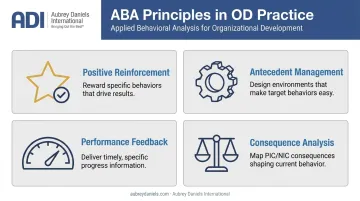
ADI's Performance Management framework ties all three together: measurement, feedback, and positive reinforcement, implemented systematically and in sequence.
Why Behavioral Science Produces Sustainable Change
One of the most persistent failures in OD consulting is that improvements erode after the engagement ends. New processes revert to old habits, leadership behaviors drift back to defaults, and engagement scores that briefly improved begin to slide.
This happens when interventions are built on awareness and intention rather than reinforcement and consequence. Behavioral science addresses this directly by embedding reinforcement structures into the organizational environment — ensuring that new behaviors continue to be rewarded long after the consultant has left.
The results speak to this durability: one automotive distributor has maintained their ADI-implemented Performance Management system for over 20 years — long past the end of the consulting engagement that introduced it.
How to Measure the Impact of OD Consulting
Key Metrics Categories
Effective OD impact measurement spans both quantitative and qualitative indicators:
Quantitative measures:
- Employee engagement scores (pre/post, tracked over time)
- Voluntary turnover rate
- Productivity metrics tied to the specific performance gaps addressed
- Safety incident rates (for safety-focused engagements)
- Leadership effectiveness ratings from upward feedback surveys
Qualitative indicators:
- Clarity of decision-making and role expectations
- Cross-functional collaboration patterns
- Leader-reported confidence in managing performance
- Cultural alignment between stated values and observed behaviors
Establish Baselines Before the Engagement Begins
Without pre-engagement data, it's impossible to demonstrate improvement. Yet many OD engagements begin without establishing clear measurement baselines — which makes it nearly impossible to separate the consultant's contribution from changes happening independently across the organization.
Effective OD consultants establish measurement frameworks at the outset, tied directly to the business outcomes the organization is trying to achieve. ADI's survey and assessment process creates this baseline — culture surveys, leadership surveys, and performance system assessments establish the current state that subsequent measurements can be compared against.
Measure Long-Term, Not Just at Project Close
With baselines in place, the next question is how long to keep measuring. OD impact should be evaluated at project close, then again at 6, 12, and 24 months post-engagement. Initial gains matter — but the real question is whether behavior change was embedded deeply enough to persist without external support.
Organizations that sustain improvement are those where new behaviors become reinforced by the environment itself — leadership practices, accountability structures, and performance systems that continue to reward the right behaviors after the consulting relationship ends.
ADI tracks client outcomes beyond engagement close, monitoring whether the performance changes their clients committed to are holding. The appropriate standard of accountability for OD consulting is whether behaviors actually changed — and whether those changes produced the intended business outcomes. Delivering a program is not the goal. Sustained performance improvement is.
Frequently Asked Questions
What is the difference between an organizational development consultant and a management consultant?
Management consulting typically focuses on strategy and operational efficiency, delivering analyses and recommendations. OD consulting targets the human and behavioral systems — leadership behavior, culture, and performance dynamics — that determine whether strategy gets executed. Where management consultants deliver a plan, OD consultants address the behavioral conditions that determine whether anyone follows it.
When should a company hire an organizational development consultant?
Common triggers include persistent performance gaps despite training efforts, failed change initiatives, leadership misalignment, rapid growth outpacing structure, and declining engagement scores. Proactive engagement — before a crisis forces the issue — consistently yields better outcomes and lower total cost than waiting until problems compound.
How long does an organizational development consulting engagement typically last?
Engagements range from a few months for targeted projects to multi-year partnerships for large-scale transformation. Sustainable behavior change requires more than a single workshop — well-structured engagements typically realize the majority of their value within the first 18 months.
What does an OD consultant actually do day-to-day?
Activities vary by phase but typically span behavioral observations, leadership workshops, data analysis, coaching, and progress tracking against defined metrics. The work moves through four stages over the engagement: diagnostic, design, implementation, and sustainability.
How do you measure the success of an OD consulting engagement?
Success is measured through both quantitative indicators (engagement scores, retention rates, productivity, safety metrics) and qualitative signals (leadership alignment, role clarity, decision-making speed). Most importantly, behavioral change should be tracked over time — at 6, 12, and 24 months post-engagement — not just at project close.
What qualifications should an organizational development consultant have?
Look for grounding in behavioral science or organizational psychology, not just general business credentials. ADI's consultants hold advanced degrees in Applied Behavior Analysis and Industrial/Organizational Psychology, backed by decades of cross-industry application. A proven methodology and a documented track record of measurable results are the qualifiers that matter most.