Introduction
Most organizations don't lack strategy. They lack the ability to execute it consistently — and that gap shows up in missed targets, disengaged employees, and leadership teams that keep solving the same problems year after year.
Internal teams often see the symptoms clearly: high turnover, stalled initiatives, inconsistent performance across departments. What they struggle to see is the root cause, because they're too close to it.
That's where an organizational development (OD) consultant comes in. Their job is to diagnose the specific behavioral, structural, and cultural conditions holding your organization back, then design targeted interventions to fix them.
The results aren't abstract. Gallup's State of the Global Workplace report estimates that low employee engagement costs the global economy $10 trillion in lost productivity annually. Meanwhile, Gartner research found that only 32% of mid-to-senior leaders report achieving healthy employee adoption during their last major change initiative.
This guide breaks down what an OD consultant actually does, the core responsibilities involved, and the specific business outcomes organizations can expect from a well-executed engagement.
Key Takeaways
- An OD consultant diagnoses organizational problems and designs targeted interventions to improve performance, culture, and effectiveness
- Their work spans diagnostics, change management, leadership development, performance systems, and employee engagement
- Measurable benefits include higher productivity, faster change adoption, stronger leadership, and reduced turnover
- OD delivers compounding returns when treated as an ongoing practice — results build on each other over time
- Organizations that skip OD pay for it through recurring problems, failed initiatives, and rising hidden costs
What Is an Organizational Development Consultant?
An organizational development consultant is a professional who applies behavioral and organizational science to help businesses identify performance gaps, design interventions, and build the conditions needed for sustained improvement. As SHRM describes it, OD is a science-based process for building organizational capacity to change and achieve greater effectiveness through improved strategies, structures, and processes.
When Organizations Bring in an OD Consultant
OD consultants are typically engaged when internal efforts hit a wall. Common trigger points include:
- Culture misalignment — behaviors across the organization don't match stated values or strategic goals
- Performance stagnation — output is flat or inconsistent, and managers can't pinpoint why
- Leadership effectiveness gaps — managers were promoted for technical skill, not people management ability
- Change initiative failures — restructuring, technology rollouts, or mergers aren't taking hold
- Strategic execution problems — sound plans that never fully translate into changed behavior at the front line
Organizations use both external consultants and internal OD practitioners — but the roles differ. External consultants bring an objective lens that internal teams, who are naturally close to the culture, often can't provide on their own. That outside perspective is frequently what unlocks progress when internal change efforts have stalled.
What OD Consulting Is Actually For
OD consulting exists to drive measurable improvement in how people work together and how the organization performs against real business metrics. The process is a means to that end, not an end in itself.
Firms like ADI (Aubrey Daniels International), which have applied the science of behavior to organizational performance for over 45 years, describe it this way: every engagement is designed around "the unique culture, practices, systems, and business environment that define your organization." That specificity matters — a generic intervention applied to a unique culture rarely sticks.
What Does an Organizational Development Consultant Actually Do?
The Diagnostic Phase
OD work begins with a structured assessment that goes well beyond a generic survey. A thorough diagnostic typically includes:
- Employee surveys designed to translate findings directly into coaching action plans
- Site assessments using interviews, focus groups, and direct behavioral observation
- Performance data review to identify patterns in output, turnover, absenteeism, and quality
- Leadership impact analysis to measure how management behavior shapes team performance
ADI's diagnostic process specifically examines what in the organization "contributes to and what detracts from high performance and a productive culture" to identify behavioral root causes, not surface-level metrics.
Intervention Design and Implementation
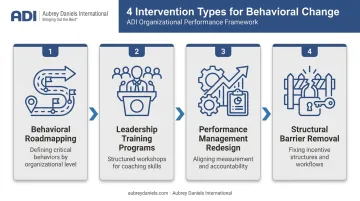
Once the diagnosis is complete, the consultant translates findings into a targeted action plan. Common interventions include:
- Behavioral roadmapping : defining the critical behaviors required at each organizational level to achieve specific business outcomes
- Leadership training programs : structured workshops that build coaching and people management skills
- Performance management system redesign : aligning measurement, feedback, and accountability structures
- Structural barrier removal: identifying incentive structures, workflows, or policies that inadvertently punish the behaviors the organization needs
Change Management Support
Implementation only works if people actually adopt new behaviors under pressure. OD consultants guide organizations through transitions — mergers, restructuring, technology adoption, culture shifts — by addressing the human side of change that most project plans ignore. This includes stakeholder engagement, building positive accountability systems, and ensuring employees understand and adopt new behaviors rather than reverting when pressure rises.
The Iterative Nature of OD Work
Unlike a one-off audit, OD consulting is cyclical. Consultants track outcomes, gather new data, and refine interventions based on what the evidence shows. ADI, for example, re-administers surveys at scheduled intervals to provide ongoing feedback to leaders and adjust interventions as behaviors evolve. Success is measured in observable outcomes: productivity trends, retention data, and the behavioral patterns those re-administered surveys reveal over time.
Key Benefits of Hiring an Organizational Development Consultant
Benefit 1: Measurable Improvement in Employee Performance and Engagement
One of the most direct benefits of OD consulting is closing the gap between what employees are capable of and what they're actually delivering. That gap is often wider than leadership realizes.
Gallup data makes the scale clear: top-quartile engagement business units outperform bottom-quartile units by 14% in productivity, 23% in profitability, and 78% less absenteeism. Yet only 31% of U.S. employees are currently engaged — the lowest level in a decade.
OD consultants create this benefit by:
- Analyzing performance data to identify behavioral and systemic barriers
- Redesigning feedback systems so employees receive clear, consistent direction
- Building environments where high performance becomes the norm, not the exception
- Targeting what reinforces or discourages specific desired behaviors
ADI's approach goes beyond engagement scores by conducting behavioral root cause analysis — examining how organizational systems, incentives, and management practices either support or suppress performance. Their client results reflect this: one national insurance firm's claims center saw a 50% decrease in customer complaints and a 50% increase in same-day closed claims after ADI restructured its performance measurement systems. A customer care center improved available time from 50% to 90% within one week.
KPIs impacted: employee engagement scores, productivity per employee, voluntary turnover rate, absenteeism, discretionary effort levels, output quality
When this matters most: high turnover environments, stagnant output, poor manager-employee relationships, post-merger culture clashes
Benefit 2: Faster and More Durable Change Adoption
Organizations face constant change — structural, technological, strategic. The problem is that most change initiatives fail. McKinsey research states that 70% of transformations fail, and less than one-third sustain improvements over time. Successful transformations captured only 67% of maximum financial benefits on average.
OD consultants specialize in addressing the human side of change that most project plans skip — which is usually what causes failure.
Prosci data shows that projects with excellent change management are up to 7x more likely to achieve their objectives, with 88% of participants meeting or exceeding goals in high-quality programs versus just 13% in poor programs.
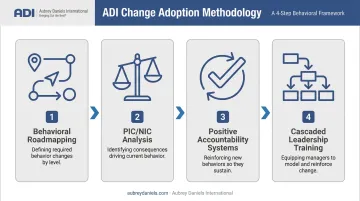
ADI's change adoption methodology centers on:
- Behavioral roadmapping — defining what behaviors must change at each level for the initiative to succeed
- PIC/NIC Analysis® — identifying what consequences are currently driving employee behavior, and what needs to change
- Positive accountability systems — building in reinforcement for new behaviors so they stick, rather than reverting when attention shifts
- Cascaded leadership training — ensuring managers can model and reinforce the change throughout the organization
A pharmaceutical sales division using ADI's methods maintained 100% workforce engagement through a 15-month transition, reduced turnover to near-zero, and improved its ranking from 52nd to 1st out of 55 divisions in key product sales.
KPIs impacted: change adoption rates, time-to-implementation, project ROI, post-change productivity, employee resistance indicators
When this matters most: mergers and acquisitions, technology rollouts, leadership transitions, rapid scaling, cultural transformation
Benefit 3: Stronger Leadership and a High-Performance Culture
The leadership gap in most organizations is larger than executives expect. Gallup estimates managers account for at least 70% of variance in employee engagement scores across business units, yet companies fail to select candidates with the right management talent 82% of the time.
The trust problem compounds this. DDI's 2025 Global Leadership Forecast found that trust in immediate managers fell to just 29% — a 37% decline since 2022. Separately, 40% of stressed-out leaders considered leaving their roles.
A core deliverable of OD consulting is building leadership capability that outlasts the engagement itself.
OD consultants address this through:
- Leadership assessments and 360° feedback that give leaders an objective view of their actual impact — often different from their self-perception
- Behavioral coaching frameworks that convert people skills from personality traits into organizational competencies
- Consistent, science-based processes for managing team behavior through performance feedback systems
- Culture-behavior alignment work ensuring leaders' actions reinforce the culture the organization is building
ADI's leadership survey data links higher survey scores directly to managers who drove measurable gains in employee engagement. When organizations improve leadership capability at scale, the effects compound: Gallup reports that organizations that increase talented managers and double engaged employees achieve 147% higher earnings per share than competitors.
KPIs impacted: leadership effectiveness scores, manager-to-employee engagement ratio, team performance consistency, retention of high-potential employees
When this matters most: leadership gaps, succession planning, rapid growth where leadership capability hasn't kept pace
What Happens When Organizational Development Is Skipped
Without a structured OD approach, organizations default to reactive problem-solving — addressing symptoms while root causes go untouched. Problems recur, costs compound, and what started as a performance issue becomes a business-level crisis.
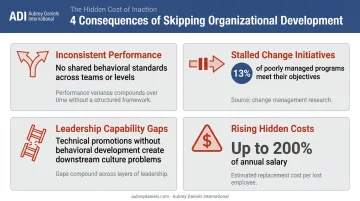
Specific patterns ADI and industry research consistently document:
- Inconsistent performance — results vary by manager or team because there's no shared behavioral standard for what "good" looks like by design
- Stalled change initiatives — without behavioral change management, momentum fades and employees revert to old habits; only 13% of poorly managed change programs meet their objectives
- Leadership capability gaps — technical skill gets managers promoted, but lacking behavioral awareness creates downstream culture and retention problems that compound over time
- Rising hidden costs — Gallup estimates replacement costs at up to 200% of salary for managers and leaders, 80% for technical roles, and 40% for frontline employees
A Deloitte Global Human Capital Trends report found that while 85% of leaders say building adaptability is critical, only 7% say their organizations are actually equipped to help their workforce grow and adapt. Without a deliberate OD investment, that gap doesn't close on its own.
How to Get the Most Value from an Organizational Development Consultant
OD consulting delivers the highest return when leadership is genuinely committed — not just to initiating the work, but to acting on findings and staying engaged through implementation.
A few principles that distinguish high-ROI engagements from low-ROI ones:
- Share honest data — consultants need access to real performance data, not sanitized versions. The diagnostic is only as useful as the information behind it
- Act on recommendations — the most common engagement failure is collecting a thorough diagnosis and then stalling on implementation
- Measure behavior change, not just attitudes — tracking survey scores alone misses whether actual on-the-job behavior has shifted
- Treat OD as iterative — the best results come from organizations that review outcomes regularly and adjust interventions based on what the data shows, not from treating it as a one-time project
Each of these principles depends on one underlying factor: the consultant's methodology.
Firms grounded in evidence-based behavioral science — like ADI, which builds every engagement on the science of behavior analysis — produce improvements that are measurable, practical, and built to outlast the engagement itself. As ADI puts it, the goal is that "long after ADI is gone, our clients have the clarity and confidence to build and sustain strong habits."
Frequently Asked Questions
What do organization development consultants do?
OD consultants assess organizational effectiveness, design targeted interventions, and guide change management efforts. Their work covers diagnostics (surveys, behavioral observation, interviews), performance system design, leadership development, and culture work — all aimed at improving how the organization functions and performs against business goals.
How much do organizational development consultants charge?
Fees vary widely depending on scope, but engagements typically price on a project, retainer, or time-and-materials basis. Costs scale with diagnostic depth, number of teams or sites involved, and the complexity of the intervention.
Is OD certification worth the investment?
For organizations evaluating consultants, certification signals methodological rigor and credibility. Real-world experience and a science-grounded approach matter just as much as credentials. ADI offers its own trainer and coach certification programs for organizations looking to build lasting internal behavioral expertise.
What is the difference between an OD consultant and an HR consultant?
HR consultants typically focus on policies, compliance, and talent processes. OD consultants take a broader, systems-level view — diagnosing the cultural, behavioral, and structural factors that affect how the organization performs across all levels.
When should a company hire an organizational development consultant?
The most common trigger points: persistent performance problems that internal fixes haven't resolved, a major change initiative (merger, restructuring, rapid growth), declining engagement scores, leadership gaps, or a recognized need to build a more intentional, high-performance culture. When those patterns persist despite internal efforts, an outside behavioral perspective tends to accelerate the path forward.