Introduction
In every organization, people are constantly being observed — and how they're perceived can shape careers as decisively as actual performance does. A team member who frames project results compellingly may advance faster than a quieter colleague whose contributions are equally strong but less visible. That gap between being effective and appearing effective is where impression management lives.
This guide covers what impression management means in organizational behavior, its theoretical roots in Goffman's work, and the five core strategies identified by Jones & Pittman. It also explores why it matters for career outcomes and leadership, when it becomes a liability, and how organizations can build cultures where genuine performance drives recognition — not just skilled self-presentation.
TL;DR
- Impression management is the deliberate — sometimes unconscious — process of controlling how others perceive you at work
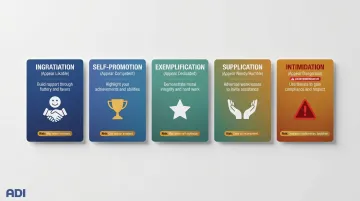
- Five core strategies drive it: ingratiation, self-promotion, exemplification, supplication, and intimidation
- Effective IM communicates genuine strengths; problematic IM fabricates or conceals them
- When organizations reward visibility over results, actual performance suffers
- Behavioral consistency — not polished self-presentation — is the foundation of sustainable leadership credibility
What Is Impression Management in Organizational Behavior?
Impression management (IM) is the process by which individuals attempt to influence how colleagues, supervisors, clients, and other stakeholders perceive them.
In organizational settings, the stakes are concrete: performance reviews, promotion decisions, team trust, and leadership credibility all hinge partly on how others perceive your competence, reliability, and values.
Conscious vs. Unconscious IM
Not all impression management is deliberate. It operates on two levels:
- Conscious IM — deliberate choices about how to present project results, when to speak up in meetings, or how to frame a setback
- Unconscious IM — ingrained behavioral patterns shaped by what has historically been rewarded or penalized in your workplace environment
As ADI's Applied Behavior Analysis framework makes clear, people do what they do because of what happens to them when they do it. Employees who receive praise, promotions, or visibility for certain self-presentation behaviors are more likely to repeat them — regardless of whether those behaviors reflect actual output.
That reinforcement dynamic also explains why impression management isn't always self-serving or dishonest — which is where the boundaries of IM matter.
What IM Is Not
Impression management is not inherently deceptive. The distinction worth drawing:
- Authentic IM — communicating genuine contributions strategically, bridging the gap between internal reality and external perception
- Impression falsification — concealing poor performance, taking credit for others' work, or building a reputation that doesn't match actual behavior
Who Engages in IM at Work?
Everyone. Research shows IM occurs at every organizational level:
- Entry-level employees directing IM tactics at supervisors and senior managers
- Subordinates whose IM behaviors influence supervisor performance ratings
- Top managers engaging in cooperative impression management as a collective organizational practice
The Theoretical Foundation: Goffman's Dramaturgical Model
Erving Goffman's dramaturgical model — first published in 1959 — frames social and professional life as theatrical performance. His core concepts map directly onto workplace behavior:
- Front stage — any interaction with colleagues, clients, or leadership; the public work persona
- Backstage — where behaviors are rehearsed, authentic reactions are processed, and the unguarded self exists
In practice, professionals constantly shift between these contexts. A board presentation is pure front stage. A candid team debrief after that presentation is backstage. The key organizational insight: when the gap between the two becomes too large, cognitive dissonance builds and trust erodes over time.
Social Identity Theory's Role
Social identity theory (Tajfel & Turner) extends Goffman's model by explaining why people manage impressions in the first place: association with valued groups and roles is itself an identity claim. In workplace terms, this shows up as:
- Aligning visibly with high-performing teams
- Participating in leadership initiatives for visibility rather than impact
- Adopting company values as self-presentation tools rather than genuine guides
Together, these frameworks reveal a practical challenge for organizations: impression management isn't just strategic posturing — it's often deeply tied to how employees see themselves. That's what makes it resistant to simple policy fixes, and why behavioral approaches tend to be more effective than top-down directives.
The 5 Key Strategies of Impression Management at Work
Jones & Pittman's 1982 taxonomy remains the standard framework in organizational behavior research. Each strategy serves a different purpose and carries different risks.
Ingratiation
Using flattery, agreement, and favor-doing to increase likability with supervisors or peers. Meta-analytic research shows ingratiation influences performance ratings, though effect sizes are stronger in lab settings (r = .33) than field settings (r = .21).
The catch: excessive ingratiation reverses the effect. Supervisors who notice consistent, unconditional agreement begin to discount the person's credibility entirely.
Self-Promotion
Proactively highlighting accomplishments and skills to build a reputation for competence. This matters most in large organizations where individual contributions can easily go unnoticed.
Effective self-promotion frames impact in context and includes team wins. Overclaiming damages trust quickly. Research shows self-promotion has stronger effects in interview settings (r ≈ .47) than on ongoing job performance ratings (r ≈ .15) — meaning it may help you get hired but won't sustain your reputation long-term.
Exemplification
Going above and beyond to project dedication and work ethic — staying late on high-visibility projects, volunteering for difficult tasks. When genuine, this builds admiration and can inspire others.
The risk: performative exemplification sets an unrealistic standard. Colleagues who can see through the theater often respond with resentment rather than respect.
Supplication
Signaling vulnerability or need for help to elicit assistance or sympathy. A leader who admits genuine uncertainty during organizational change builds relatedness and psychological safety — that's supplication working as intended.
Overused, though, it signals incompetence or starts to feel manipulative to the people being asked for help.
Intimidation
Projecting authority or dominance to shape how others respond. Research identifies intimidation as a counternormative IM strategy — one that negatively affects both likeability and performance ratings.
The organizational cost goes further than ratings. Intimidation-based leadership damages psychological safety, suppresses honest feedback, and reduces the discretionary effort that high-performing teams depend on.
Why Impression Management Matters for Organizational Behavior
Career Outcomes
Employees who manage their professional image effectively — communicating competence, reliability, and alignment with organizational values — tend to receive higher performance ratings and stronger promotion consideration. Research on ingratiation and career success shows positive associations between ingratiation and career advancement, though the relationship between self-promotion and career success is more complex and context-dependent.
The relationship is real, but it cuts both ways: organizations that lack objective performance measurement systems end up rewarding optics over output.
The Culture Dimension
In cultures that reward visibility over results, impression management stops being a communication tool and becomes a survival skill. The loudest voices get promoted over the most productive contributors — a reinforcement misalignment problem that no culture initiative alone will fix.
ADI's behavioral science framework addresses this directly: when organizations build consequence systems that reinforce actual performance outcomes rather than surface presentation, impression management naturally shifts toward authentic communication of genuine contributions. The core issue is that the reinforcement environment makes performative impression management more rewarding than real results.
Leadership Effectiveness
Leaders who manage impressions well — projecting calm under pressure, communicating vision consistently, demonstrating accountability — build trust that multiplies organizational impact. Authentic leadership research links behavioral integrity and consistency to higher follower trust, stronger team performance, and better organizational citizenship behaviors.
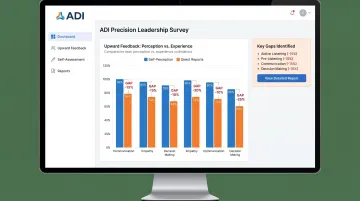
ADI's Precision Leadership Survey surfaces this gap: it provides upward feedback that reveals where leaders' self-perception diverges from how their direct reports actually experience their leadership. The tool helps leaders align their projected image with their genuine behavioral patterns by showing them specifically where the two don't match.
When Impression Management Becomes a Problem
The Depletion Effect
Experimental research shows that maintaining IM behaviors — especially ingratiation and self-promotion — consumes self-control resources by requiring ongoing suppression of authentic thoughts and feelings. When those resources are depleted, the likelihood of misrepresentation and counterproductive work behaviors increases.
The implication: employees who constantly perform an image that doesn't match their actual experience don't just feel tired. They become measurably more likely to cut corners.
Organizational Costs
When performative IM becomes pervasive, the organizational damage is systemic:
- Trust erodes when stakeholders eventually see the gap between presentation and performance
- Performance data distorts when appraisal systems capture impressions rather than outputs
- High performers disengage when they see peers advancing through skilled self-presentation rather than results
- Meritocracy breaks down, driving the most capable contributors to look elsewhere
The Psychological Toll
Sustained performance of an inauthentic identity carries measurable costs: stress, burnout, and cognitive dissonance. Employees maintaining a public image at odds with their private self report higher social anxiety and reduced job satisfaction. Surface acting — presenting emotions you don't feel — creates emotional dissonance that compounds into exhaustion over time.
Emotional intelligence can buffer some of this depletion. But individual coping strategies only go so far. Lasting relief requires changes to the organizational conditions that make performative impression management feel necessary in the first place.
How Leaders Can Navigate Impression Management Effectively
Ground IM in Behavioral Consistency
Effective impression management starts with alignment — what leaders project must match what they actually do. Three behaviors build that foundation:
- Acknowledge mistakes openly rather than managing them out of sight
- Ensure stated values and daily reinforcement patterns match
- Use self-disclosure strategically to build relatability, not to perform vulnerability
ADI's Precision Leadership approach targets the gap between intention and impact directly. Leaders learn to analyze their own behavioral patterns and receive objective feedback on where consistency breaks down — a far more durable skill than polished self-presentation.
Evaluate Performance, Not Impressions
The most reliable way to distinguish genuine performance from skilled IM is consistent behavioral data collected over time. Single high-visibility moments — a strong presentation, a well-timed comment in a meeting — tell you almost nothing reliable about actual performance.
Managers should build evaluation systems that track:
- Specific, measurable outputs tied to business outcomes
- Observable behaviors identified in advance as drivers of results
- Patterns across time rather than snapshots from peak-visibility moments
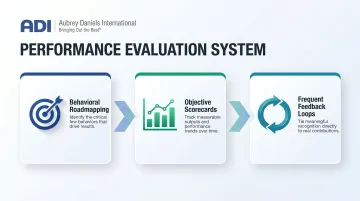
ADI's Performance Management methodology — built around measurement, feedback, and positive reinforcement — provides the structural foundation for this. Behavioral roadmapping identifies the critical few behaviors that drive results. Scorecards make performance visible and objective, while frequent feedback loops ensure recognition ties to real contributions rather than impressive moments.
Build a Culture That Makes Authentic Performance the Path of Least Resistance
The most sustainable solution is environmental. When organizations:
- Recognize specific behaviors frequently rather than celebrating results only at year-end
- Create psychological safety where mistakes become learning opportunities rather than impression management triggers
- Provide frequent, specific feedback so that genuine contributions don't go unnoticed
Employees no longer need to substitute impression management for actual performance. As ADI puts it: *the only way organizations can earn discretionary effort is through the effective use of positive reinforcement*. When the reinforcement environment rewards authentic contribution, that's what you get.
Frequently Asked Questions
What is impression management in organizational behavior?
Impression management in organizational behavior refers to the deliberate and sometimes unconscious strategies individuals use to shape how colleagues, supervisors, and stakeholders perceive them at work. It influences outcomes including career advancement, performance ratings, team trust, and leadership credibility.
What are the 5 strategies of impression management?
Jones & Pittman (1982) identified five core strategies: ingratiation, self-promotion, exemplification, supplication, and intimidation. Ingratiation builds likability; self-promotion signals competence; exemplification projects dedication; supplication conveys need; intimidation asserts authority.
Is impression management the same as deception or manipulation?
No. Impression management involves strategically communicating genuine qualities and contributions. It becomes problematic only when used to fabricate a false image, conceal poor performance, or manipulate others in ways that damage organizational trust.
How does impression management affect job performance ratings?
Employees who communicate their contributions effectively tend to receive higher ratings. However, when evaluation systems aren't anchored in objective behavioral data, organizations risk rewarding polished self-presentation over actual results — a reinforcement misalignment with real costs.
What is the difference between positive and negative impression management?
Positive IM means presenting genuine competencies in ways that resonate with your audience. Negative IM involves fabricating or concealing information to create a misleading perception — one that doesn't reflect actual performance or character.
How can managers identify impression management versus genuine performance?
Focus on consistent behavioral patterns and measurable outputs over time, not just memorable presentations. Structured evaluation systems tied to specific, observable behaviors reduce the influence of impression management on ratings.