Introduction
Picture this: a high-potential VP completes a six-month leadership development program. Strong assessment scores. Glowing facilitator feedback. Box checked. Three months later, their team is still frustrated, their communication style hasn't shifted, and the behaviors that prompted the investment in the first place are unchanged.
Was the program bad? Not necessarily. The more likely problem: the wrong development approach was chosen for the actual need.
Executive coaching and leadership mentoring are two of the most consistently conflated terms in talent development. Organizations use them interchangeably, budget for one when they need the other, and then wonder why results fall short. The distinction is practical, not semantic: each approach targets different needs, runs on a different timeline, and depends on a different kind of relationship to work.
What follows breaks down both approaches clearly — including when to use each and why behavioral science is what ultimately determines whether either one produces change that sticks.
Key Takeaways
- Executive coaching is structured, time-bound (3–12 months), and addresses specific behavioral or performance gaps
- Leadership mentoring builds long-term relationships around career development, organizational wisdom, and future-readiness
- Using the wrong approach for the wrong need delays results — sometimes significantly
- The two are not competitors; they serve different moments in a leader's development journey and can be combined strategically
- Lasting impact from either approach depends on behavioral change that is consistently reinforced over time
Executive Coaching vs. Leadership Mentoring: At a Glance
Here's how the two approaches compare across the dimensions that matter most:
| Dimension | Executive Coaching | Leadership Mentoring |
|---|---|---|
| Purpose | Close a specific behavior or performance gap | Build long-term leadership capacity and judgment |
| Duration | 3–12 months, defined endpoint | 1–3+ years, open-ended |
| Structure | Formal: goals, sessions, measurable outcomes | Relational: agenda driven by mentee's evolving needs |
| Who delivers it | External coach with behavioral expertise | Internal senior leader with organizational context |
| Primary focus | Targeted behavior change, skill development | Career navigation, culture, organizational wisdom |
| How success is measured | Pre/post assessments, performance metrics, stakeholder feedback | Retention, promotion rates, pipeline readiness, cultural integration |
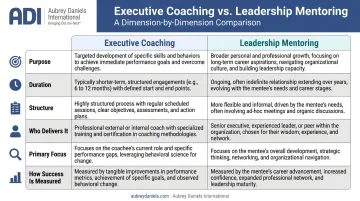
Terminology is applied inconsistently across organizations. What one company calls "coaching," another labels "mentoring." That ambiguity has real consequences: mismatched investments, misaligned expectations, and development programs that generate activity without producing change.
What Is Executive Coaching?
The International Coaching Federation defines coaching as "partnering with clients in a thought-provoking and creative process that inspires them to maximize their personal and professional potential." In practice, executive coaching is a structured, one-on-one engagement designed to help senior leaders improve specific leadership behaviors — communication, decision-making, executive presence, team alignment — within a defined timeframe.
How a Coaching Engagement Typically Works
A typical engagement follows this structure:
- Assessment — 360-degree surveys, behavioral interviews, and self-assessment to establish a baseline of how the leader's actions land with others
- Relationship mapping — identifying the leader's most critical business relationships and the spheres of influence requiring the most development
- Behavioral goal-setting — pinpointing the high-impact behaviors that will drive measurable improvement
- Structured sessions with real-time feedback — observation, direct feedback, and on-demand troubleshooting as new behaviors are practiced
- Outcome review — comparing pre- and post-engagement data against the original performance contract
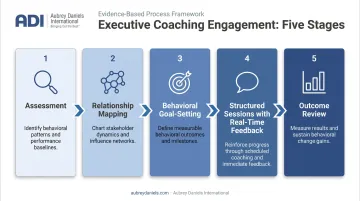
ADI's executive coaching process follows this structure, starting with 360° surveys and interviews to understand both the leader's self-perception and how others experience their leadership. Coaches then use tools like PIC/NIC Analysis® — a proprietary framework for understanding what consequences are currently reinforcing a leader's behavior — to identify what's driving current patterns and what needs to shift.
Why Behavioral Science Changes the Equation
Most leaders who struggle to change already know what they need to do differently. What they lack is understanding of why current patterns persist — and what would make new ones stick.
Research in operant conditioning shows that behavior persists when followed by positive outcomes and extinguishes when those outcomes are removed or inconsistent. A coaching engagement that doesn't account for what's reinforcing the leader's current behavior will produce short-lived results at best.
ADI's approach addresses this directly. Rather than focusing only on awareness and skill-building, the coaching process identifies natural reinforcers the leader can tap into to sustain new behaviors after the formal engagement ends.
What Organizations Can Expect
A 2023 meta-analysis of 20 randomized controlled trial studies found coaching produced an overall effect size of g = 0.43, with stronger effects for behavioral outcomes (g = 0.73) and goal attainment (g = 1.11). For organizations deciding where to invest in leadership development, that gap between behavioral outcomes and self-reported awareness is worth noting — it's where structured coaching earns its return.
Use Cases for Executive Coaching
Executive coaching is the right choice when:
- A leader is preparing for a C-suite transition and needs to close specific skill gaps quickly
- A performance issue is specific, observable, and tied to identifiable behaviors (communication, conflict management, team alignment)
- The development need is sensitive enough to require external objectivity and confidentiality
- The organization needs measurable ROI on a targeted leadership intervention within 6–12 months
- A leader is navigating organizational transformation and needs real-time behavioral support
A VP of Operations is three months from stepping into a Chief Operating Officer role. Her technical expertise is unquestioned, but stakeholder feedback consistently flags her communication style as too directive in cross-functional settings. A structured coaching engagement — beginning with 360° data, followed by behavioral goal-setting and observed practice — gives her the feedback loop and reinforcement structure needed to shift her approach before she steps into the higher-visibility role.
What Is Leadership Mentoring?
Where coaching zeroes in on a specific gap, mentoring takes the long view. The European Mentoring and Coaching Council defines mentoring as a learning relationship involving the sharing of skills, knowledge, and expertise between mentor and mentee through developmental conversations, experience sharing, and role modeling.
In practice, mentoring is less structured than coaching. The agenda is shaped by the mentee's evolving questions rather than a fixed performance contract. A mentor serves as a sounding board, organizational guide, career advocate, and connector — not an assessor of performance metrics.
What Mentoring Relationships Look Like in Practice
A typical mentoring relationship unfolds over months to years and covers ground that formal coaching rarely touches:
- How organizational politics actually work (versus how they're supposed to work)
- How to build visibility and influence beyond the immediate team
- How to navigate career crossroads with the benefit of someone who has been there
- What leadership looks like at the next level — not just the job description, but the judgment calls
Research from Eby et al. (2008) found workplace mentoring had meaningful positive effects, particularly for helping behaviors and organizational support outcomes. Separately, Baranik et al. (2010) found mentoring is associated with improved job satisfaction, organizational commitment, and perceived organizational support — findings that longer-term retention studies consistently support.
Modern Mentoring Formats
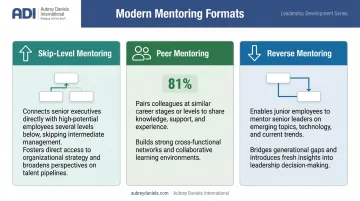
Senior-to-junior is one model. Three others have gained traction in leadership development programs:
- Skip-level mentoring — connects leaders with executives two or more levels up, offering a perspective that immediate managers can't provide
- Peer mentoring — research by Murrell et al. (2021) found that 81% of participants in peer mentoring programs rated it as effective for leadership identity work, including critical thinking and ethical decision-making
- Reverse mentoring — defined by Frontiers (2026) as younger employees guiding senior leaders through technological competencies, contemporary insights, and generational perspectives; particularly useful for closing digital fluency gaps at the executive level
Use Cases for Leadership Mentoring
Mentoring is the right investment when:
- New leaders need to learn organizational culture and unwritten rules alongside their formal responsibilities
- High-potential managers are 18–36 months from an anticipated promotion and need to build the judgment and visibility required for the next level
- Underrepresented leaders need structured access to senior networks and career capital
- The organization wants to strengthen succession pipelines and long-term bench strength
Representative scenario: A mid-level manager is stepping into her first cross-functional leadership role, managing peers she used to work alongside. A senior executive mentor who navigated a similar transition provides context about organizational dynamics, helps her think through relationship-building strategies, and advocates for her visibility in senior forums — none of which a structured coaching engagement is designed to provide.
Key Differences Between Executive Coaching and Leadership Mentoring
Surface-level distinctions are easy to list. The differences that actually drive outcomes come down to four dimensions — and understanding them changes how you deploy each approach.
Focus: Now vs. Career
Coaching asks: what needs to change in this leader's behavior, right now? Mentoring asks: who does this leader need to become over time? These are genuinely different questions — answering one doesn't answer the other. A leader can close a specific communication gap through coaching and still lack the organizational judgment and long-term perspective that mentoring builds.
Structure and Accountability
Coaching operates within a formal performance contract — stated goals, regular sessions, defined outcomes. There is accountability built into the structure by design. Mentoring is relational and adaptive. The mentee drives the agenda. The value comes from accumulated wisdom and perspective over time, not from hitting session milestones.
Who Delivers It (and Why That Matters)
These two require fundamentally different relationships:
- Coaching is most effective when delivered by a skilled external professional who brings objectivity and behavioral expertise. An internal manager can't provide the same neutrality.
- Mentoring is most effective when delivered by a respected internal senior leader who carries organizational context, institutional history, and network access that outside coaches cannot replicate.
The Behavioral Science Distinction
Both approaches fail for the same underlying reason: the development experience doesn't reinforce new behaviors consistently enough for them to become habitual. Applied Behavior Analysis research is clear on this — behavior is maintained by its consequences. Without a reinforcement structure supporting new behaviors, regression is predictable.
Rather than treating coaching or mentoring as awareness-building exercises, ADI's methodology focuses on identifying the specific consequences reinforcing a leader's current behavior and deliberately engineering conditions that reinforce new ones. ADI's PIC/NIC Analysis® helps coaches and leaders understand whether the consequences driving current behavior are positive or negative, immediate or delayed, certain or uncertain. That analysis reveals what needs to shift.
The goal is to uncover natural reinforcers that sustain new behaviors long after the formal engagement ends.
When to Use One, the Other, or Both
Choose Executive Coaching When:
- There is a specific, time-sensitive behavior or performance gap that needs to close within 6–12 months
- A leader is preparing for a high-stakes role transition (first C-suite role, board exposure, major organizational scope change)
- The development need requires external objectivity, confidentiality, or both
- The organization needs to demonstrate measurable behavioral change tied to a defined investment
Choose Leadership Mentoring When:
- The goal is broad capability building, cultural integration, or succession readiness over a 1–3 year horizon
- The organization needs to scale leadership development beyond a small executive population
- The priority is helping leaders build judgment, network, and long-term organizational belonging — not just specific skills
- Retaining high-potential employees and building a stronger pipeline are the strategic drivers
The Case for Both
The most effective leadership development architectures use both, sequenced intentionally based on the leader's developmental moment:
- A new C-suite leader might receive short-term coaching for immediate role-specific behavioral gaps alongside an ongoing mentoring relationship for cultural integration and organizational navigation
- A high-potential manager might receive mentoring over 2+ years to build judgment and visibility, followed by targeted coaching in the 6–12 months before a major promotion to close the specific skills the new role demands
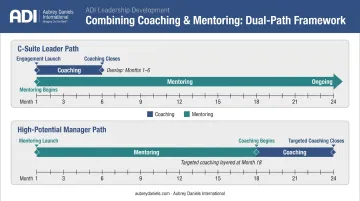
Organizations that ground this sequencing in behavioral science — understanding which reinforcers are active at each stage of a leader's development — build programs that sustain behavioral change well beyond the intervention itself.
ADI's behavioral roadmapping process helps organizations design this layered architecture. Starting from desired business outcomes, it works backward to identify the critical leader behaviors required at each level, then determines which interventions — coaching, mentoring, training, or some combination — will most reliably reinforce those behaviors over time.
Conclusion
Neither executive coaching nor leadership mentoring is universally superior. The right choice depends on the leader's developmental moment, the organization's timeline, and whether the goal is closing a specific performance gap or building long-term leadership capacity. Treating these as interchangeable is what leads to wasted budgets and disappointed stakeholders.
What ultimately determines the outcome of either approach is whether it changes behavior — and whether that change is sustained. Organizations that measure leadership development by attendance and activity metrics keep producing leaders who know more but act the same.
Those that ground their approach in the science of behavior, deliberately building reinforcement for new actions rather than just awareness of better ones, develop leadership bench strength that holds up when it matters.
A food manufacturer that partnered with ADI on behavioral leadership development is still using those evidence-based practices nearly 15 years after the initial engagement — not because the program was inspiring, but because the reinforcement structure was built to last.
If you're evaluating coaching or mentoring options, start by asking whether the approach is designed to change behavior or just inform it. The answer will tell you most of what you need to know.
Frequently Asked Questions
What is executive coaching and mentoring?
Executive coaching is a structured, time-bound process in which a skilled coach helps a leader close specific performance or behavioral gaps — typically over 3–12 months. Mentoring is a longer-term developmental relationship focused on career guidance, organizational wisdom, and future-readiness. Many organizations use both, at different stages of a leader's development.
What are the 5 C's of coaching and mentoring?
Several practitioners reference frameworks built around five principles — commonly including Conversation, Curiosity, Clarity, Commitment, and Capability — to structure effective coaching and mentoring interactions. These are practical tools, not a single standardized model; the specific C's vary by source and practitioner.
Can an executive have both a coach and a mentor at the same time?
Yes, and many senior leaders benefit from having both simultaneously. A coach addresses immediate performance or transition challenges within a defined structure, while a mentor provides broader career perspective, organizational navigation, and longer-range thinking that coaching isn't designed to cover.
How long does executive coaching typically last compared to leadership mentoring?
Executive coaching engagements typically run 3–12 months with a defined endpoint and performance contract. Mentoring relationships often span 1–3 years or more — a timeline that reflects the broader scope of building career judgment rather than closing a near-term gap.
What outcomes should organizations expect from executive coaching vs. leadership mentoring?
Coaching produces measurable improvements in specific leadership behaviors or performance metrics, observable within the engagement timeline. Mentoring's outcomes — stronger retention, higher promotion rates, deeper succession pipelines — are better evaluated over a 2–3 year horizon.
How is executive coaching different from leadership training?
Training delivers knowledge or skills to groups in a standardized format, regardless of individual context. Executive coaching is individualized, behavior-focused, and designed to produce measurable change in how a specific leader acts in their specific role — not just what they know.