Introduction
Most organizations already know engaged employees perform better. Yet U.S. employee engagement has fallen to 31% — the lowest level in a decade. The problem isn't awareness; it's execution. Organizations invest in perks, flexibility, and annual surveys, but engagement continues to slide because these tactics treat symptoms rather than root causes.
The real issue is behavioral. Engagement is a pattern of discretionary effort — and that pattern is shaped by consequences. When employees consistently receive meaningful feedback and recognition tied to their performance, discretionary effort follows. When those consequences are absent or inconsistent, engagement erodes regardless of how much is spent on wellness programs or employee perks.
This guide covers what engagement actually means, the research connecting it to business results, and how behavior-based performance management builds the conditions for discretionary effort that sticks.
Key Takeaways
- Engagement reflects behavioral commitment, not job satisfaction — it's discretionary effort employees choose to invest
- Engaged teams outperform disengaged peers: 23% higher profitability, 78% lower absenteeism, 63% fewer safety incidents
- Clarity, recognition, growth, and manager quality are essential engagement conditions
- Managers account for 70% of engagement variance and are the primary drivers of day-to-day behavioral reinforcement
- Sustainable engagement requires continuous behavioral feedback, not annual reviews or generic perks
What Employee Engagement Really Means (and Why Most Definitions Fall Short)
Most definitions of employee engagement confuse it with job satisfaction — how happy someone feels about their work environment. They're not the same thing. Engagement measures how much discretionary effort employees invest: the behavioral commitment to go beyond minimum requirements because they want to, not because they have to.
Discretionary Effort: The Performance Range That Matters
Every employee has a performance range — from "doing just enough to keep my job" at the bottom to "performing at my full potential" at the top. Engagement is what moves people toward that upper end. This framing is more useful than measuring attitude because it focuses on observable behaviors: persistence, initiative, quality of work, and collaboration.
From a behavioral science perspective, engagement is not a sentiment captured once a year on a survey. It's a pattern of behaviors that result from specific environmental conditions. When the workplace reinforces high performance with meaningful consequences — timely feedback, recognition, growth opportunities — engagement follows.
When those conditions are absent or inconsistent, engagement fades regardless of how employees "feel" about their jobs.
Why Perks and One-Off Recognition Don't Work
Many organizations try to buy engagement with flexible schedules, free snacks, or occasional recognition events. These tactics produce short-term spikes in morale but not sustainable behavioral change. Research shows that contingent motivation — consequences tied directly to specific behaviors — generates autonomic arousal and sustained performance, while non-contingent rewards do not. Without consistent reinforcement connected to meaningful work, engagement erodes.
The Current State: A Decade-Low Crisis
Only 31% of U.S. employees were engaged in 2024, matching 2014 levels and representing a 10-year low. This decline translates to approximately 8 million fewer engaged workers compared to the 2020 peak of 36%. The remaining 52% are "not engaged," and 17% are actively disengaged. The problem is urgent, measurable, and growing.
The Proven Link Between Employee Engagement and Organizational Performance
Gallup's 11th Q12 meta-analysis — covering 183,806 business units across 347 organizations in 53 industries — provides clear evidence that engagement drives measurable performance outcomes.
Top-quartile engaged teams outperform bottom-quartile teams by:
- 78% lower absenteeism
- 63% fewer safety incidents
- 51% lower turnover (in low-turnover organizations)
- 32% fewer quality defects
- 23% higher profitability
- 18% higher productivity (sales)
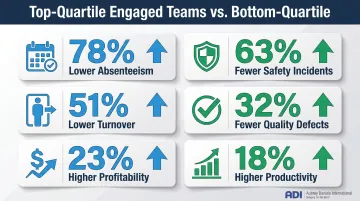
These aren't sentiment scores. They're operational metrics that directly impact the bottom line.
The Bidirectional Relationship: Engagement Drives Performance, Performance Drives Engagement
Engagement and performance reinforce each other. When employees receive timely, meaningful feedback, it strengthens their commitment. When engagement is high, discretionary effort improves output. Over time, these forces compound — and whether the cycle accelerates or stalls comes down to the behavioral conditions leaders create day to day.
The Financial Cost of Disengagement
Disengaged and actively disengaged U.S. employees cost approximately $1.9 trillion in lost productivity annually. Globally, the figure reached approximately $10 trillion in 2025, or 9% of global GDP. For most organizations, that cost is largely invisible — it shows up as missed targets, higher turnover, and slower recovery from disruption.
Engagement as a Competitive Advantage
Companies with engaged workforces saw up to 147% higher earnings per share (EPS) compared with competitors. Beyond EPS, engaged organizations show measurable resilience: talent stays longer, performance holds during disruption, and teams adapt faster when conditions shift.
The Key Components of Employee Engagement
Research consistently identifies foundational conditions that make engaged behavior possible. These aren't perks — they're the environment in which discretionary effort thrives.
Core Engagement Conditions
Five conditions consistently predict whether employees engage or withdraw:
- Clarity of expectations — Employees disengage when they can't predict what success looks like. Shifting or vague expectations remove the foundation for discretionary effort.
- Access to resources — Tools, materials, and support aren't perks; without them, frustration replaces performance.
- Timely, specific recognition — Generic praise delivered months late doesn't move behavior. Recognition works when it's immediate and tied to a specific action.
- Growth opportunities — Skill-building, challenging assignments, and visible career paths signal that an employee's potential matters to the organization.
- Quality manager relationships — Psychological safety — the condition that lets employees take initiative and raise concerns — flows almost entirely from how managers behave day-to-day.
The Outsized Role of Managers
That last condition — manager relationships — carries more weight than the other four combined. Managers account for 70% of the variance in team engagement, according to Gallup. Managers shape the immediate reinforcement environment: they are the most direct source of feedback, recognition, and psychological safety employees experience day-to-day.
Yet manager engagement itself sits at only 31%, meaning managers are faring no better than the general workforce. This creates a compounding problem: disengaged managers cannot create engaged teams.
How Performance Management Shapes Employee Engagement
Reframing Performance Management
Performance management is not annual reviews, ranking systems, or corrective action. It is the ongoing, systematic management of behavior and consequences to produce the results the organization needs. Dr. Aubrey Daniels introduced the phrase "Performance Management" specifically to describe how to motivate people to enthusiastically do what the business needs them to do, grounded in Applied Behavior Analysis.
The Behavioral Science of Consequences
Behavior is a function of its consequences. When employees receive positive, meaningful reinforcement immediately after performing well, the behavior strengthens and recurs. When high performance goes unnoticed (or is met with criticism), engagement and discretionary effort erode.
Most organizations inadvertently use more negative consequences than positive ones. This suppresses the very behavior they want. Employees learn to avoid mistakes rather than pursue excellence, and discretionary effort vanishes.
Antecedents vs. Consequences
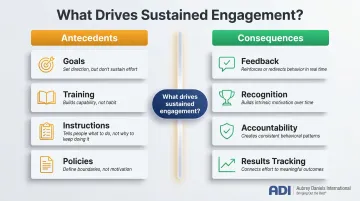
Leaders over-invest in antecedents (goals, training, instructions, policies) and under-invest in consequences (feedback, recognition, accountability). The distinction matters because antecedents tell people what to do but don't sustain it. What happens after performance is what actually shapes behavior over time.
Engagement surveys, culture decks, and mission statements share a common limitation: they're antecedents. Without consistent, meaningful consequences tied to performance, they fade into background noise. Consider what these tools can and can't do:
- Goals and instructions set direction but don't drive follow-through
- Recognition programs work only when delivered close in time to the behavior
- Culture decks establish values but can't replace behavioral reinforcement
- Accountability systems require consequences to have any real effect
Continuous Feedback Over Annual Reviews
Annual performance reviews are structurally inadequate for building engagement. More than 9 in 10 managers are dissatisfied with how their companies conduct annual reviews, and nearly 9 in 10 HR leaders say the process doesn't yield accurate information. Feedback that arrives months after behavior cannot reinforce or correct it effectively.
Effective feedback loops are frequent, specific, and behavior-focused. They acknowledge what employees did well and what needs adjustment, delivered close in time to the performance event. 80% of employees who received meaningful feedback in the past week are fully engaged. Employees receiving daily feedback are 3x more likely to be engaged than those receiving annual feedback.
ADI's Behavior-Based Approach
For over 45 years, Aubrey Daniels International has applied behavioral science to business performance improvement across industries. ADI's approach helps organizations identify the specific reinforcers that matter to individual employees, design systems that deliver them reliably, and build manager capability to sustain engagement over time. Engagement is not a one-size-fits-all initiative — it requires understanding what reinforces each person and delivering those reinforcers contingently, tied directly to the behaviors the organization needs.
Strategies to Improve Employee Engagement and Performance
Build a Culture of Positive Reinforcement
Leaders should audit their ratio of positive to corrective feedback. Most organizations discover they deliver far more correction than recognition. Increase the frequency of specific, sincere recognition tied to observable behaviors. Train managers to catch people doing things right — not just respond when something goes wrong.
Reinforcement must be individualized. The most effective recognition is honest, authentic, and individualized to how each employee wants to be recognized. Employees receiving high-quality recognition are 9x as likely to be engaged and 45% less likely to turn over after two years.
Align Goals with Meaningful Work
SMART objectives are a starting point. Employees put in more discretionary effort when they see how their individual contribution connects to team and organizational outcomes. Managers should build that line of sight through regular conversations — not just annual goal-setting reviews — that tie daily tasks to broader purpose.
Practical ways to make that connection visible:
- Reference team goals in one-on-one check-ins, not just performance reviews
- Recognize contributions in context of the larger outcome they supported
- Revisit purpose when assigning new tasks, not just during onboarding
Invest in Manager Development
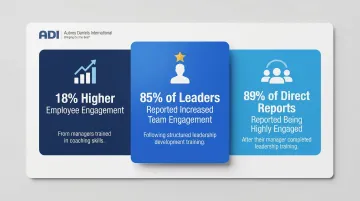
Because managers are the single biggest lever in engagement, organizations should prioritize building manager capability in behavioral coaching, feedback delivery, and recognition practices. The data on what happens when that investment is made is consistent:
- Managers trained in coaching and best practices see up to 18% higher engagement and a 20–28% boost in other performance metrics
- 85% of leaders reported increased team engagement after training in core leadership skills (DDI)
- 89% of their direct reports reported being engaged in their roles following that same training
Measuring Employee Engagement and Performance Outcomes
What to Measure and Why Narrow Tools Fall Short
Tools like eNPS (Employee Net Promoter Score) capture sentiment but not behavior. Gallup warns that eNPS's narrow focus does not reveal the full picture of workforce health or point to opportunities to improve business outcomes.
Effective measurement should assess specific engagement conditions alongside performance KPIs:
| Engagement Conditions | Performance KPIs |
|---|---|
| Expectation clarity | Productivity |
| Recognition frequency | Safety |
| Growth opportunity | Turnover |
| Manager quality | Quality |
Gallup's Q12 framework, validated across 183,806 business units, measures actionable conditions rather than abstract sentiment. This approach enables organizations to identify where engagement gaps exist and which teams are at highest risk — but identifying the gap is only the starting point. What organizations do with that information determines whether measurement actually moves the needle.
The Action Imperative: Measurement Without Follow-Through Destroys Engagement
Gallup states that surveying employees and then ignoring results is "one of the fastest ways to destroy workplace morale," causing engagement and business metrics to "plummet."
Each survey cycle demands a clear response:
- Share results with employees
- Identify priority areas for improvement
- Design targeted interventions
- Track improvement over time
Measurement should be continuous, not annual. When findings prompt open discussion and targeted action, engagement improves. When they don't, trust erodes — often faster than it was built.
Frequently Asked Questions
What is performance management and how does it support employee engagement and development?
Performance management is the ongoing use of behavioral science principles to shape, reinforce, and sustain the behaviors that drive results. When done well, it creates the consistent feedback and recognition environment that fuels genuine engagement and development, moving employees toward discretionary effort rather than compliance.
What are the best ways to improve employee engagement?
The most evidence-backed levers are:
- Frequent positive reinforcement tied to observable behaviors
- Clear expectations and continuous feedback loops
- Strong manager quality and individualized recognition
- Connecting work to meaningful outcomes
Annual reviews alone don't move the needle — consistent, timely reinforcement does.
What are the key components of employee engagement?
Core conditions include role clarity, access to resources, meaningful recognition, growth opportunities, and strong manager relationships. Together, these environmental factors shape the behavioral patterns — persistence, initiative, collaboration — that define genuine engagement.
What are common areas for employee improvement?
Common gaps include communication skills, time management, initiative, collaboration, and quality of output. Sustainable improvement requires consistent behavioral feedback delivered close to the performance event — not one-time training.
What are the key components of performance management?
Key components include clear expectations, ongoing behavioral feedback, meaningful positive reinforcement, accountability structures, and development planning. Effective performance management is continuous, not episodic.
What are the 5 C's of employee engagement?
The 5 C's — Connection, Contribution, Communication, Collaboration, and Commitment — provide a practical framework for diagnosing engagement gaps. Use them to pinpoint which conditions are missing when performance or morale falls short.