Introduction
Most leadership programs focus on what leaders achieve. Few focus on what leaders do — the specific, daily behaviors that determine whether employees show up fully engaged or simply go through the motions.
That distinction matters. According to Gallup, **70% of the variance in team engagement** is determined solely by the manager. And yet most organizations still promote and evaluate leaders based on results, not on the behaviors that produce them.
Employee-centered leadership flips that equation. It's built on observable, repeatable actions that directly shape how employees think, feel, and perform — and the evidence is consistent: when leaders practice specific behaviors, teams engage more deeply and contribute more.
This article breaks down what employee-centered leadership looks like through a behavioral science lens, the six behaviors that define it in practice, and how to build them consistently over time.
Key Takeaways
- Employee-centered leadership is defined by observable, repeatable behaviors that prioritize employee needs, development, and well-being — not personality traits.
- The six behaviors span reinforcement, empowerment, coaching, psychological safety, purpose alignment, and empathy.
- These behaviors are grounded in Applied Behavior Analysis — nearly a century of research showing that consequences shape what people do.
- Consistent practice of these behaviors, not occasional good intentions, drives measurable gains in engagement, retention, and discretionary effort.
- Organizations that build systems around these behaviors create cultures where high performance becomes the norm, not the exception.
What Is Employee-Centered Leadership?
Employee-centered leadership is a leadership approach in which a leader's daily actions prioritize understanding and responding to what employees need to perform at their best — including clear expectations, meaningful recognition, development opportunities, and psychological safety.
This is different from task-centered or results-only leadership. Both approaches care about outcomes. The distinction is in how those outcomes are pursued. Task-centered leaders manage the numbers. Employee-centered leaders manage the conditions that produce those numbers — the behaviors, environment, and reinforcement patterns that determine whether people bring their best effort or their minimum.
The Behavioral Science Foundation
ADI (Aubrey Daniels International) has spent over 45 years applying behavioral science to organizational performance. Their approach draws on nearly a century of research in Applied Behavior Analysis — the same scientific methods used in the physical sciences: rigorous measurement of behaviors, controlled experimentation, and replication across real work environments.
Behavior is a function of its consequences. People do what they do because of what happens to them when they do it. In leadership, that means the unit of change is observable behavior — not attitude, not intent. What a leader consistently does determines what employees experience and how they respond. That's what makes the six behaviors below worth examining closely.
6 Ways to Demonstrate Employee-Centered Leadership Behaviors
1. Use Positive Reinforcement to Recognize Progress — Not Just Results
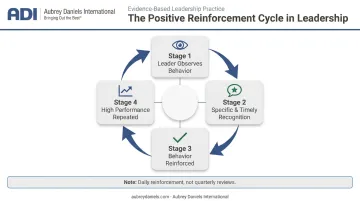
Positive reinforcement in a leadership context means providing specific, timely, and meaningful acknowledgment when an employee demonstrates a desired behavior or makes genuine progress — not just when they hit a final target.
This matters because of how behavior actually changes. Reinforcement that closely follows the behavior it's meant to strengthen dramatically increases the likelihood that behavior will be repeated. That repetition is the engine of sustained performance improvement.
ADI frames this as a core distinction: "Reinforce Behavior, Celebrate Results." Reinforcing behavior means recognizing the actions people take — the problem-solving approach, the proactive communication, the careful preparation — rather than waiting for the outcome to confirm those actions worked.
In practice: A leader who recognizes a team member's analytical thinking during a project review — not just the project outcome — reinforces the reasoning behaviors that produce good results consistently.
Research from SHRM found that supervisor effectiveness in providing recognition accounts for 49% of the variance in employees reporting they work harder because of recognition. That's not a soft metric — it's a direct measure of how much manager behavior shapes employee effort.
ADI's guidance is explicit: positive reinforcement "has to be a daily affair." Leaders who save recognition for quarterly reviews miss most of the opportunities that matter.
2. Empower Employees Through Autonomy and Delegated Ownership
Empowerment is not a feeling leaders give employees. It's a behavioral arrangement — one in which employees receive real authority, clear parameters, and the resources to make meaningful decisions about their work.
The distinction is important. Leaders who tell employees they're empowered while checking in constantly, reversing decisions, or hovering over execution aren't empowering anyone. They're creating the appearance of autonomy without the substance.
Effective delegation looks like this behaviorally:
- Assign ownership of outcomes, not just tasks
- Set clear expectations up front so employees know the boundaries within which they can act
- Resist stepping in prematurely — allow employees to build judgment through experience
- Provide support when asked, not as a default management mode
This matters especially in hybrid and remote environments, where micromanagement is both more tempting and more damaging. When employees can't demonstrate competence through proximity, leaders often fill that gap with over-monitoring — which signals distrust and suppresses the initiative it's meant to protect.
Autonomy is a well-documented driver of intrinsic motivation. Employees with genuine ownership over their work are more engaged, more creative, and more likely to exceed what's required. That last outcome is what ADI defines as Discretionary Effort: "the level of effort people could give if they wanted to, but above and beyond the minimum required." Empowerment is what makes that effort available.
3. Develop Employees Through Behavior-Based Coaching
Behavior-based coaching focuses on specific, observable actions — not vague impressions or personality assessments. A leader who tells an employee to "be more confident" or "show more initiative" has given them nothing actionable. A leader who says "I'd like to see you share your analysis in team meetings before being asked — here's what that could look like" has given them something to practice.
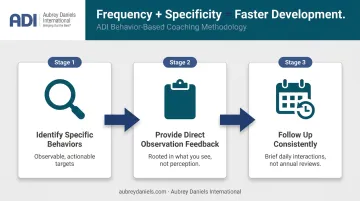
ADI's coaching methodology is built on this precision. Their approach trains leaders to:
- Identify the specific behaviors employees need to start, stop, or do differently
- Provide feedback rooted in direct observation, not general perception
- Follow up consistently — not just after formal reviews
That last point is where most organizations fall short. ADI's Coaching for Rapid Change process involves brief daily coaching interactions around mission-critical behaviors. The frequency and specificity of feedback determines how quickly employees develop — and how engaged they remain.
Infrequent, high-stakes performance conversations create long lags between behavior and consequence, making it harder for employees to connect feedback to specific actions.
In a pharmaceutical sales division that applied this methodology, the division retained its full team over 15 months despite market pressure, and maintained 100% engagement through a period of significant organizational change. Frequency of coaching mattered more than the formality of the process.
4. Foster Psychological Safety and Open Communication
Psychological safety isn't a cultural value to declare — it's a pattern of leader responses that employees learn to predict over time.
Google's Project Aristotle identified psychological safety as the single strongest predictor of team effectiveness across 180 teams studied. Teams perform best when members believe they can speak up, ask questions, admit mistakes, and raise concerns without facing criticism or consequences.
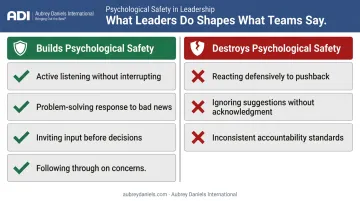
That belief is built — or eroded — by specific leader behaviors:
Behaviors that build psychological safety:
- Active listening without interrupting or redirecting
- Responding to bad news with problem-solving rather than blame
- Consistently inviting input before finalizing decisions
- Following through when employees raise concerns
Behaviors that destroy it:
- Reacting defensively to pushback
- Ignoring suggestions without acknowledgment
- Applying inconsistent standards of accountability
Leaders who respond poorly to difficult conversations don't just damage one relationship — they train the entire team to stay silent. That silence masks performance problems until they become crises, and it eliminates the frontline information leaders most need.
ADI's behavioral leadership work explicitly addresses this, teaching leaders to "create the psychological safety required to enable open and honest conversations" and to approach incidents and mistakes as learning opportunities rather than events requiring blame.
5. Connect Daily Work to Meaning and Purpose
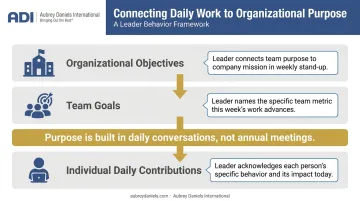
Purpose isn't communicated through annual all-hands meetings or mission statement posters. It's built through consistent, specific conversations that draw an explicit line between what someone is working on today and why it matters.
The behavior looks like this: in everyday interactions — project check-ins, one-on-ones, team meetings — employee-centered leaders regularly articulate how individual contributions connect to team goals, customer outcomes, and organizational objectives. The connection is made personal and concrete, not gestured at generically.
ADI's Behavioral Roadmapping process puts into practice this by working backwards from desired business results to define the specific frontline and leadership behaviors that drive those outcomes. The intent is to ensure that employees at every level understand not just what they're doing, but why it matters in measurable terms.
Employees who understand how their work connects to a larger purpose consistently show higher engagement and productivity. Without that connection — even in technically satisfying roles — quiet disengagement sets in, and it shows up in performance data months before anyone names it.
What this looks like in practice:
- Referencing customer impact during project reviews, not just internal metrics
- Linking an individual's contribution explicitly to a team goal during one-on-ones
- Celebrating team wins by naming the specific behaviors and decisions that produced them
6. Show Genuine Empathy and Compassion
Empathy in leadership isn't a soft skill — it's a behavioral competency. It involves observing cues that something is off, asking questions to understand an employee's actual experience, and adjusting how you lead based on what you learn.
Leaders who skip this step pay a real performance price. Unaddressed stress and burnout don't stay contained — they show up in absenteeism, disengagement, and turnover. None of those outcomes are cheap.
Empathetic behavior has concrete, observable characteristics:
- Checking in proactively — not only when performance declines
- Normalizing conversations about workload and capacity
- Adjusting expectations during known high-stress periods
- Following through on commitments to support balance and well-being
That last point is where empathy becomes leadership behavior rather than intention. A leader who says the right things but doesn't adjust expectations or protect time teaches employees that expressed care isn't real. What makes it real is consistent follow-through — and employees are very good at telling the difference.
ADI's framework frames this as helping employees thrive — one of the documented common leadership errors their consulting work addresses is specifically "Failing to Help the Human Thrive." The framing reflects something important: sustainable performance requires attention to the whole person, not just the role.
The Science Behind Why These Behaviors Work
All six behaviors share a common foundation: they shape the consequences employees experience at work, and consequences determine what people do next.
When employee-centered behaviors are practiced consistently, employees receive clear expectations, timely recognition, genuine development, psychological safety, a sense of purpose, and felt care. Those experiences make high performance the natural response — not an obligation.
This is the behavioral science distinction between compliance and discretionary effort. Employees managed through pressure or ambiguity may meet minimum performance standards. But employees who are positively reinforced and genuinely supported invest the extra initiative, creativity, and ownership that produces exceptional results. ADI's founder, Dr. Aubrey Daniels, put it directly: "The only way organizations can earn discretionary effort is through the effective use of positive reinforcement."
That earning process happens through daily behavioral choices, not annual programs.
Gallup's research puts numbers on this: highly engaged business units achieve 14% higher productivity, 23% higher profitability, and 10% higher customer loyalty compared to disengaged ones. Strategies and systems create the conditions, but it's leaders' daily behaviors that make engagement the rational choice for their teams.
ADI's Behavioral Leadership implementation is designed to do exactly this: shift organizations from relying on individual leaders trying harder to building systems that reinforce the right behaviors consistently. That's the difference between a cultural initiative and lasting change.
Common Mistakes That Undermine Employee-Centered Leadership
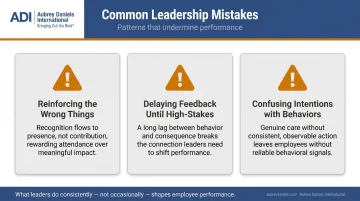
Even leaders who genuinely care about their teams can undermine employee-centered leadership through behavioral patterns they don't notice. Three show up consistently in ADI's consulting work:
Reinforcing the wrong things. Many leaders accidentally reinforce compliance, busyness, or seniority rather than the behaviors that drive results. When recognition follows presence rather than contribution, employees learn to optimize for the wrong signals.
Delaying feedback until it's high-stakes. Quarterly or annual reviews create enormous lag time between performance and consequence. The further apart those events are, the harder it is for employees to connect feedback to specific actions — and the less likely behavior is to change.
Confusing good intentions with good behaviors. Leaders who care about their teams but rarely translate that care into observable, consistent actions — specific coaching conversations, timely recognition, explicit purpose conversations — leave employees unsure of where they stand. Intention without behavioral follow-through doesn't register as leadership.
ADI's research consistently shows that leaders rate their own impact more generously than their direct reports do. Tools like ADI's Precision Leadership Survey surface that gap directly — showing leaders how their behavior actually lands, so they can act on what employees experience rather than what they intend.
Frequently Asked Questions
What are the key employee-centered leadership behaviors?
Six core behaviors, all grounded in behavioral science:
- Use positive reinforcement to recognize progress
- Empower through real delegation
- Coach based on observable behavior
- Build psychological safety through consistent responses
- Connect work to purpose in everyday conversations
- Show empathy through proactive action
What is the difference between employee-centered and task-centered leadership?
Task-centered leaders prioritize outputs and processes. Employee-centered leaders focus on the conditions and behaviors that make those outputs possible — recognizing that sustainable performance comes from developing and reinforcing the people doing the work, not just measuring what they produce.
How does positive reinforcement support employee-centered leadership?
Positive reinforcement is the behavioral mechanism that makes employee-centered leadership effective. Specific, timely acknowledgment of desired behaviors — delivered consistently — increases the frequency of high-performance behaviors over time.
How can leaders build employee-centered behaviors consistently over time?
Focus on these behaviors in daily interactions rather than saving them for formal moments. Seek regular upward feedback on how your behavior affects your team, and use structured tools — like coaching frameworks or consistent one-on-one routines — to make consistency achievable rather than aspirational.
What happens when leaders neglect employee-centered behaviors?
The absence of employee-centered behaviors — even without actively harmful leadership — produces disengagement, reduced discretionary effort, and higher turnover. Employees default to doing the minimum when nothing in their environment rewards doing more.
How does employee-centered leadership impact organizational performance?
Employee-centered behaviors drive higher engagement, stronger retention, lower absenteeism, and greater discretionary effort. These outcomes translate directly into productivity, quality, and financial results — Gallup's meta-analysis links high engagement to 23% higher profitability and 14% higher productivity, both attributable to manager behavior.