Introduction
Most organizations treat disengagement, high turnover, and underperformance as motivation problems. They roll out recognition programs, revise compensation structures, or bring in motivational speakers — and then wonder why nothing sticks.
The real issue is behavior — not motivation.
When people don't perform, it's rarely because they lack the will. The environment, shaped by leadership behavior, isn't reinforcing the right actions. That's the core insight behind Applied Behavior Analysis (ABA): behavior is a function of its consequences, and those consequences are largely determined by how leaders act every day. It's the principle Aubrey Daniels International (ADI) has applied to organizational performance for over 45 years.
Trust is no different. It isn't built through good intentions. It's built through consistent, observable behaviors that leaders either practice or neglect.
This article covers nine of those behaviors. Each one is concrete, learnable, and applicable at every level of an organization.
TL;DR
- Employees who strongly trust their leaders are roughly 5× more likely to be engaged than those who don't — making trust one of the most measurable drivers of performance.
- Trust isn't a personality trait — it's the cumulative result of specific, consistent actions practiced over time.
- The nine behaviors span how leaders listen, communicate, recognize, develop, and onboard new team members.
- Leaders at every level can practice these behaviors to strengthen culture from within.
What High-Trust Leadership Really Means
Trust in a workplace context is a measurable behavioral outcome, not a feeling. Employees extend trust when leaders act in ways that are predictable, fair, and reinforcing. When those actions are inconsistent or absent, trust erodes regardless of what leaders say they value.
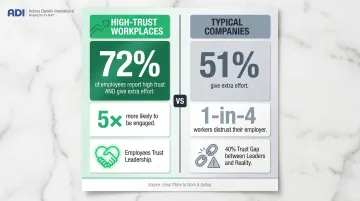
A useful benchmark: MIT Sloan research shows employers overestimate workforce trust by nearly 40%, and roughly one in four workers don't trust their employer. That gap exists because leaders often confuse good intentions with effective behavior — and employees experience the behavior, not the intent.
ADI's work in behavioral science draws a clear line here. Impact always matters more than intent. What leaders do — how frequently they communicate, whether they follow through, how specifically they recognize people — shapes the environment that either builds or erodes trust.
Trust as a Performance Multiplier
ADI formally defines discretionary effort as "the level of effort people could give if they wanted to, but above and beyond the minimum required." Trust is the primary driver of whether employees choose to give it.
Great Place to Work data shows that 72% of employees at certified high-trust workplaces both report high trust and give extra effort — compared to 51% at typical companies. That 21-point gap represents enormous untapped performance, driven almost entirely by leadership behavior.
The 9 High-Trust Leadership Behaviors
1. Listening
Listening is the foundational trust behavior — not because it's the most impactful in isolation, but because everything else depends on it.
Genuine listening means setting aside assumptions, asking questions with real curiosity, and ensuring the other person feels understood. Proactive listening goes further: seeking out voices that haven't been heard, running structured conversations across teams, and following through on what surfaces.
The impact on trust is measurable. Gallup research finds that employees whose manager is always willing to listen to work-related problems are 4.2 times as likely to strongly agree they trust leadership.
When leaders listen consistently, employees speak up earlier, surface problems before they escalate, and share ideas they'd otherwise keep to themselves. That openness accumulates — and it starts with whether leaders actually listen.
2. Speaking
Clarity, frequency, and honesty are what make communication a trust-building behavior. Employees need to know not just what is happening but why — and they need to hear it consistently across channels and levels.
The trust risk of poor communication is measurable. Deloitte reports that 86% of leaders surveyed said greater organizational transparency builds workforce trust.
Gallup adds that employees who receive feedback from their manager daily are 2.1 times as likely to strongly agree they trust leadership — a direct link between communication cadence and trust.
When employees hear different versions of the same information, confidence in leadership drops. Silence or spin causes more damage than difficult news delivered honestly.
3. Thanking
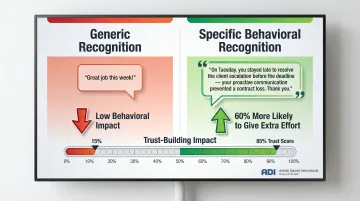
Recognition builds trust when it's specific and behavioral — not when it's generic.
"Great job this week" lands differently than "The way you handled that client call on Thursday — staying calm, asking the right questions, keeping the relationship intact — that's exactly the kind of judgment we need more of." The second version tells employees precisely what they did and why it mattered, reinforcing the behavior itself.
ADI's model is direct: reinforce behavior, celebrate results. Positive reinforcement must be frequent and specific. Great Place to Work data backs this up — employees who receive meaningful recognition are 60% more likely to give extra effort than those who don't.
4. Developing
Leaders who invest in their people's growth signal something deeper than professional support — they signal that those individuals are worth investing in. That signal is one of the clearest trust-builders available.
Development looks like:
- Personalized growth conversations, not annual reviews
- Sharing your own learning journey, including failures
- Feedback delivered as specific, actionable guidance — not evaluation
- Connecting development opportunities to each person's actual ambitions
ADI's Applications of Behavioral Leadership workshop teaches leaders to provide "effective, objective feedback using actionable performance descriptions in place of generalities." That distinction — specific versus vague — is the difference between feedback that shapes behavior and feedback that goes nowhere.
5. Caring
Whether employees invest emotionally in their work — or simply show up — often comes down to whether their leader demonstrates genuine care.
When leaders take genuine interest in employees' lives — acknowledging personal challenges, supporting flexibility, treating mistakes as learning opportunities rather than failures — they create psychological safety. That safety changes observable behavior: employees in high-trust environments take 8.5 fewer sick days, and moving to higher trust quintiles measurably reduces chronic stress.
Gallup notes that only one in four U.S. employees strongly agree their organization cares about their overall wellbeing. Organizations that close that gap see measurable gains in retention, engagement, and discretionary effort.
6. Sharing
Equitable sharing operates on two dimensions:
- Distributing rewards and opportunities fairly across all roles — including shift workers, frontline staff, and others who are often less visible
- Ensuring every employee understands how their performance connects to compensation and company success
ADI's Profit-Indexed Performance Pay™ framework addresses both. It creates aligned, position-specific scorecards that tie individual performance to organizational profitability — giving employees a clear, objective line of sight between their contributions and their rewards.
Great Place to Work's trust model measures equity as a distinct dimension, and SHRM research finds that workers in positive organizational cultures are nearly four times more likely to stay with their employer.
7. Celebrating
Celebration serves a different function than recognition.
Recognition acknowledges a person. Celebration makes the behavior visible to everyone. Done well, it answers the question every employee is silently asking: "What does 'good' actually look like here?"
Effective behavioral celebration:
- Names the person and the specific action
- Explains why it mattered to the mission
- Is visible enough that others understand the standard
- Reflects actual organizational values — not just results
When everyone can see what earned the recognition, the behavior spreads. Repeated consistently, it becomes one of the most cost-effective culture tools a leader has.
8. Inspiring
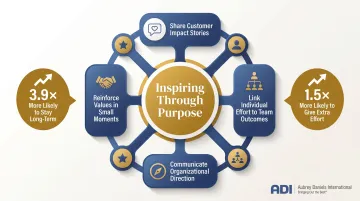
Inspiration doesn't require charisma. It requires connecting work to purpose — consistently, in everyday interactions.
Leaders inspire through:
- Telling customer impact stories that show the downstream effect of good work
- Linking individual effort to team and organizational outcomes
- Sharing where the organization is headed and why it matters
- Reinforcing company values in the small moments, not just all-hands meetings
Great Place to Work research shows employees who feel their work has genuine purpose are 3.9 times more likely to want to stay long-term and 1.5 times more likely to put in extra effort. Purpose shows up in how leaders talk about work every day — in one-on-ones, in debriefs, in passing conversations — not just in posters or annual presentations.
9. Hiring and Welcoming
Trust begins before the first day on the job.
The onboarding experience is a behavioral signal. When a new hire arrives to find a prepared workspace, a clear first-week plan, and leaders who seem genuinely glad they're there, the message is: you were expected, you were wanted, you matter here. When onboarding is chaotic or indifferent, the opposite message lands — and it's hard to undo.
Gallup reports only 12% of employees strongly agree their organization does a great job onboarding. Employees who rate their onboarding as exceptional are nearly twice as likely to feel fully prepared and 2.3 times more likely to report the job matched expectations. The behavioral impact of those first weeks extends far beyond the first month.
The Business Case: Why These Behaviors Drive Results
These aren't soft skills. They're performance drivers.
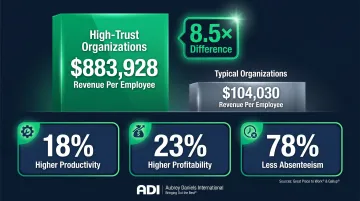
High-trust organizations show dramatically different financial outcomes. Great Place to Work analysis of Fortune-level Best companies reports revenue per employee of $883,928 compared to $104,030 at typical organizations — an 8.5× differential. Gallup's meta-analysis finds that highly engaged employees (trust-correlated) deliver 18% higher productivity, 23% higher profitability, and 78% less absenteeism.
The Cost of Low Trust
Low trust has real operational costs that go beyond engagement scores:
- Slower decisions (more approval layers required, less delegation)
- Higher turnover and associated replacement costs
- Reduced collaboration across teams and functions
- More management oversight needed to compensate for lack of initiative
Every hour spent managing through distrust is an hour not spent on productive work.
Why These Behaviors Compound
These behaviors create reinforcing feedback loops. Leaders who listen and act get better information from employees; leaders who recognize specific behaviors see those behaviors increase. Each cycle builds on the last.
Trust behaviors don't just produce outcomes — they generate the feedback that sustains them. Over time, this is what shifts a high-trust culture from a leadership initiative into an organizational norm.
Building These Behaviors Into Your Leadership Culture
Knowing the nine behaviors is not enough. Organizations need a system that makes them consistent at scale.
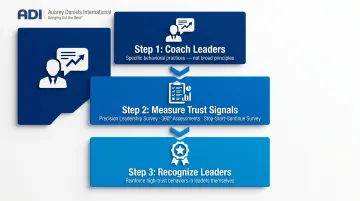
That requires three things:
- Coach leaders on specific behavioral practices, not just broad principles
- Measure trust signals through structured employee feedback — ADI's tools include the Precision Leadership Survey, 360° assessments, and the Stop-Start-Continue Survey, each designed to surface gaps between a leader's intent and actual impact
- Recognize leaders who model high-trust behaviors, reinforcing those behaviors in the leaders themselves
ADI's behavior-based approach to Performance Management gives organizations a research-backed framework to identify which leadership behaviors are producing results, which are missing, and how to build reinforcement structures that sustain trust-building across teams and levels.
To see how this works in practice — whether through leadership development, culture assessment, or performance coaching — connect with ADI's team.
Frequently Asked Questions
What are the four trust leadership behaviors?
Commonly cited frameworks identify consistency, transparency, integrity, and empathy as the core four. Different models use different groupings, but the underlying principle is consistent: trust is built through observable, repeatable actions that make people feel safe, valued, and supported — not through one-time gestures.
What are the 5 key leadership behaviors?
Five widely recognized behaviors include clear communication, accountability, empathy, developing others, and leading by example. These behaviors are most effective when practiced consistently and when leaders are held accountable for modeling them, not just endorsing them.
What are the 7 C's of leadership?
The 7 C's typically include competence, courage, communication, compassion, commitment, confidence, and culture. Each connects directly to trust: employees extend trust to leaders who demonstrate capability, follow through on commitments, and create environments where people can do their best work.
What are the 9 traits of a leader?
Common trait models include integrity, accountability, empathy, decisiveness, communication, vision, resilience, humility, and the ability to develop others. The important distinction: traits describe character, while behaviors describe consistent actions. Character matters, but it's behavior that others experience and respond to.
How does trust impact employee performance and retention?
Employees in high-trust workplaces are more productive, more likely to give discretionary effort, and far less likely to leave. Trust removes the psychological friction that slows collaboration, risk-taking, and commitment — so employees can focus on the work instead of navigating uncertainty about leadership.