Introduction
You've done everything right on paper. The values were workshopped, the town halls were scheduled, the posters went up. Six months later, people are doing exactly what they were doing before.
Most culture change programs fail as a design problem, not a leadership one. They try to shift everything at once, which means they effectively shift nothing. The messaging reaches people's ears but not their daily habits.
There's a more precise approach: identify a small number of high-impact behaviors — the "critical few" — and reinforce them relentlessly until they spread.
According to Deloitte's Global Human Capital Trends research, 82% of leaders view culture as a potential competitive advantage, yet only 19% believe their organization actually has the right culture. The gap comes down to method.
This article breaks down what critical few behaviors are, how to identify and prioritize them, and what it takes to make them stick — drawing on behavioral science principles that ADI has applied with organizations across manufacturing, healthcare, financial services, and other industries for over 45 years.
TL;DR
- Critical few behaviors are 3–5 specific, observable, repeatable actions that reshape culture when practiced at scale
- Culture change fails when it's too broad, too top-down, or ignores how people actually change emotionally
- Three elements drive the framework: keystone behaviors, existing cultural strengths, and authentic informal leaders
- Prioritize by impact first — a hard-to-implement, high-impact behavior beats an easy, low-impact one consistently
- Reinforcement, not communication, is what makes behaviors permanent
Why Most Culture Change Programs Fall Short
The Initiative Overload Problem
Most culture change efforts are comprehensive by design. Leaders worry about leaving gaps, so they add more: more training modules, more messaging tracks, more commitments posted in conference rooms. The result is initiative fatigue — employees field so many directives that none of them gain traction.
Research from Bain found that 88% of business transformations fail to achieve their original ambitions. The culprits are consistent:
- Overloading top talent with competing priorities
- Under-investing in capability building at the frontline
- Treating transformation as a communications exercise rather than a behavioral one
The Rational vs. Emotional Gap
Most change programs speak to logic. They present the case for change, define the new values, and ask people to get on board. What they miss is the emotional layer — the habits, social norms, and informal reinforcement patterns that actually govern daily behavior.
Culture is shaped by what people do, not what they're told to believe. ADI's foundational principle captures this directly: we can change culture if we change behavior — not the other way around. When new behavior replaces long-standing habits without adequate direction and reinforcement, the old patterns resurface within weeks.
Why Behavior-First Works
People act their way into a new way of thinking more reliably than they think their way into a new way of acting. Change the daily actions first, and the mindset shift follows.
As HBR notes, organizational culture is shaped by what senior leaders visibly do — not by the posters on the wall or the perks in the break room.
What Are Critical Few Behaviors?
Defining the Terms Precisely
A critical few behavior is a habitual, observable, repeatable action that can be tracked over time. This definition excludes three things people often mistake for behaviors:
- One-time events (a company-wide clean-up day isn't a behavior — it's an event)
- Policy changes (publishing a new protocol doesn't change what people actually do)
- Attitude shifts (wanting employees to "be more customer-focused" isn't measurable or observable until it shows up in specific actions)
ADI defines organizational culture as "the patterns of behavior strengthened or weakened by people or systems over time." The critical few are the specific actions that, when reinforced consistently, build those patterns in the direction of your strategic goals.
Why "Few" Is Not a Compromise
Limiting focus to 3–5 behaviors isn't settling for less — it's the mechanism of change. Strategy& (PwC) explicitly recommends addressing three to five key behaviors as the feasible range for generating genuine behavior change. Habit research reinforces why: individual habits take an average of 66 days to become automatic, with wide variation depending on complexity. Spreading that attention across 10 behaviors simultaneously fragments it past the point of usefulness.
What Makes a Behavior "Critical"
Not every behavior worth improving belongs in the critical few. Critical behaviors are those that, when exhibited widely, produce measurable impact on a specific business outcome — safety performance, customer retention, operational efficiency, revenue.
The results when organizations get this right are concrete:
- An automotive distributor focused on specific driver behaviors cut product damage claims by half in one year, saving $4 million, and reduced annual driver turnover to 3–4% against an industry standard of 100%
- A railroad division targeting critical safety behaviors for 3,000 employees achieved a 60% decrease in lost-time injuries within 12 months

Neither outcome came from a comprehensive culture overhaul. Both came from behavioral focus.
Behaviors vs. Values vs. Traits
A quick distinction:
| Term | What It Describes | Observable? |
|---|---|---|
| Values | What we aspire to be | No |
| Traits | How things actually feel around here | Partially |
| Behaviors | What people specifically do, daily | Yes |
A company might value "collaboration" (aspiration) and have a trait of being "relationship-driven" (observable pattern). The behavior — say, "a team member proactively shares relevant data with a cross-functional peer before being asked" — is what you can actually track, reinforce, and scale.
The Three Elements of the Critical Few Framework
These three elements work as an integrated system, not a sequential checklist. Organizations that see results from behavior-based culture change tend to use all three simultaneously.
Keystone Behaviors
A keystone behavior isn't just any high-priority behavior. It's one that creates a chain reaction — once it spreads, it makes other positive behaviors more likely. The clearest real-world example is Paul O'Neill's focus on workplace safety at Alcoa: by making safety the single visible commitment from leadership, operational discipline, cross-team communication, and accountability improved across the board. Safety was the keystone that unlocked the rest.
When identifying keystone behaviors, apply four tests:
- Can others observe it happening in the moment?
- Will peers naturally want to emulate it?
- Can you track whether it's spreading over time?
- Does it connect directly to a business outcome metric?
The most effective keystone behaviors are usually already present somewhere in the organization — practiced by your best people in certain teams or shifts. The goal is to identify and scale those, not import entirely foreign behaviors that conflict with how things currently work.
Existing Cultural Traits
Every organization has cultural traits — the shared characteristics people recognize as "how we do things here." These are distinct from values (what leadership hopes is true) because traits reflect current reality. A workforce might be fiercely loyal, intensely competitive, skeptical of outside ideas, or quietly proud of technical precision. These traits exist whether leadership acknowledges them or not.
Working with these traits accelerates change. Working against them creates resistance that derails it.
Limit your focus to 3–4 traits. More than that dilutes the emotional resonance of each one. Good cultural traits for this purpose:
- Resonate across different functions and subcultures
- Trigger a genuine positive response when named aloud
- Connect logically to the company's strategic direction
Those traits also point you toward the right people to carry change forward — which is where the third element comes in.
Authentic Informal Leaders (AILs)
AILs are the people others watch. Not necessarily the highest performers or the most senior, they're the individuals colleagues trust, ask for opinions, and follow informally. Their influence runs through peer networks rather than org charts.
In culture change work, AILs serve two functions. First, they act as validators: if a proposed critical behavior genuinely excites an AIL, that's a strong signal it will spread. If they're skeptical, that skepticism contains information worth understanding before you proceed.
Second, AILs are amplifiers. When they model a behavior, peers notice and emulate it in a way they wouldn't with a manager directive.
Research from the University of Maryland's Smith School confirms this split: supervisor-led interventions produce faster initial change, while peer-led interventions produce more sustained, long-term adoption.
The mistake most organizations make is treating AILs as message carriers — briefing them on the culture change program and asking them to spread the word. That's not co-design; it's top-down messaging with a peer distribution layer. Genuine co-design means AILs help shape the behaviors before they're finalized.
How to Identify and Prioritize Your Critical Few Behaviors
ADI's Behavioral Roadmapping process — sometimes called Reverse Engineering — works through four steps that move an organization from a diffuse list of "important things" to a precise, actionable set of behaviors.
Step 1: Define the Goal
Name the specific strategic or operational outcome you're targeting. Reducing workplace injuries. Improving cross-team handoffs. Increasing first-call resolution. Without a defined goal, behavior selection becomes a values exercise rather than a performance exercise.
Step 2: Brainstorm Candidate Behaviors
Ask: In a future state where we've hit this goal, what would people actually do differently every day? Candidates must be specific and repeatable — "proactively shares production data with the downstream team before shift end" rather than "be more collaborative." They should also apply across levels and roles.
Step 3: Prioritize Using Impact vs. Implementation Factors
Plot candidate behaviors on two dimensions:
- Impact: Will this behavior move the needle on the goal?
- Implementation factors: Actionability, visibility, measurability, speed of results, ease of adoption
Weight impact above all other factors. A behavior that's difficult to implement but produces high impact belongs in the critical few. An easy behavior with marginal impact doesn't — regardless of how quickly it can be rolled out.
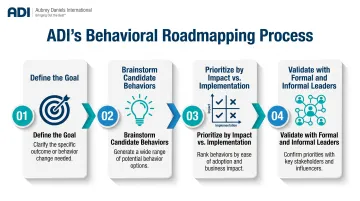
Step 4: Validate with Formal and Informal Leaders
Gather formal leaders' input through structured prioritization exercises. Then test the shortlist with AILs — share each proposed behavior and ask them to react, tell stories about how they already exhibit it, or explain why it doesn't resonate. What they say — and how they say it — tells you more than any scoring matrix.
The output: no more than 3–5 behaviors that leaders at every level can remember, model, and reinforce without a reference card.
Sustaining and Reinforcing Critical Behaviors So They Stick
Identifying the right behaviors is only the starting point. What converts a behavior from a directive into a cultural norm is consistent reinforcement.
ADI's approach, grounded in Applied Behavior Analysis (ABA), holds that behaviors reinforced with positive, timely, and specific feedback are far more likely to become habits than those that are simply announced or trained. Effective reinforcement means:
- Positive — focus on what went right, not what was avoided
- Timely — delivered as close to the behavior as possible
- Specific — names the exact action: not "great job today" but "I noticed you flagged that quality issue before it reached the customer — that's exactly what we're working toward"
Building a Reinforcement System
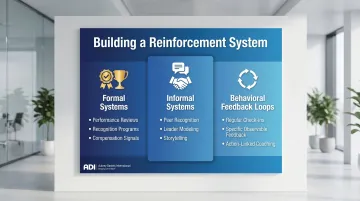
No single mechanism is sufficient. Effective reinforcement combines:
- Formal systems: Performance reviews, recognition programs, and compensation signals that demonstrate the critical behaviors are taken seriously
- Informal systems: Peer recognition, leader modeling, and leader storytelling that make behaviors feel personally meaningful
- Behavioral feedback loops: Regular check-ins with specific feedback tied to observable actions, not general performance ratings
ADI explicitly frames this in its client work: change that does not build in feedback and positive consequences for new behavior is not sustainable. The rate of performance improvement is directly related to the amount of positive reinforcement provided for that improvement.
The Most Common Failure Mode
Treating behavior rollout as a communications campaign. Leaders announce the critical behaviors, share the "why," and move on — expecting that clarity of intention will drive adoption. It won't.
As HBR puts it: culture is shaped by what leaders visibly and consistently do. If leaders announce behaviors but don't model them, employees learn quickly that the initiative is performative. The behaviors don't spread, the culture doesn't shift, and within 18 months a new initiative arrives to replace this one.
How to Know If Your Critical Few Behaviors Are Working
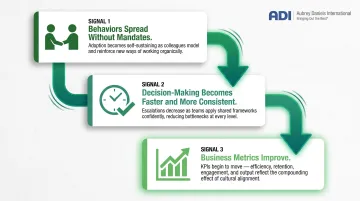
Culture change is easy to declare and hard to verify. These three signals — appearing roughly in sequence as culture shifts — tell you whether the work is actually taking hold:
1. Behaviors spread without being mandated. Peers start coaching each other on the critical behaviors without management prompting. A miner reminding a colleague about a pre-task check without being asked is cultural embedding. ADI has seen this pattern directly — FMC Corporation's employees began "reinforcing their peers and tracking their own performance" as a natural outcome of behavior-focused culture work.
2. Decision-making becomes faster and more consistent. When behaviors become genuine habits rather than compliance exercises, employees stop waiting for sign-offs on situations that fall within the cultural norms. They use those norms as a guide. The need for escalation decreases. Novel situations get handled consistently, even without prescribed policies.
3. Business metrics tied to the behaviors improve. This is the ultimate test. If the critical few were correctly identified, the KPIs attached to the original strategic goal should show directional improvement within a measurable timeframe.
In ADI's client work, a national healthcare insurance provider that focused on behavior-based precision leadership saw a 1,500% rise in net production in its first full year — and sustained improvement for over 20 years by maintaining behavioral focus. Results that durable trace back to one thing: behaviors embedded deeply enough to function without enforcement.
Frequently Asked Questions
What is the "critical few" in culture change?
"Critical few" refers to a small number — typically 3–5 — of specific, observable behaviors that, when practiced at scale, have an outsized impact on organizational culture and strategic outcomes. The premise is that focused behavioral change outperforms comprehensive culture overhauls because it's precise, trackable, and spreadable.
What are the 4 C's of corporate culture?
The 4 C's commonly referenced in culture work are Clarity (shared purpose), Consistency (leaders modeling expected behaviors), Connection (employees' emotional commitment), and Consequences (how behavior gets reinforced or corrected). The critical few behaviors approach directly strengthens all four, especially consistency and consequences.
How many behaviors should an organization focus on at one time?
Research and practitioner guidance consistently point to 3–5 behaviors as the optimal range. Strategy& explicitly recommends this range for generating genuine behavioral change. Fewer may lack complementary reinforcement; more causes cognitive overload and dilutes adoption momentum.
What makes a behavior a "keystone" behavior?
A keystone behavior triggers a chain reaction: once adopted, it makes other positive behaviors more likely. It must be visible, spreadable through peer networks, measurable, and tied to a business outcome. Paul O'Neill's safety focus at Alcoa — which lifted operational discipline company-wide — is the most cited example.
What is the role of informal leaders in cultural change?
Authentic Informal Leaders (AILs) are trusted, well-connected peers who influence colleagues through credibility rather than authority. In the critical few framework, they serve as co-designers who validate whether proposed behaviors will actually resonate. Their enthusiasm or skepticism reliably predicts whether a behavior will spread.
How long does culture change take using this approach?
Deep cultural transformation takes years, not months. The critical few approach produces visible early wins faster than comprehensive programs because behaviors are trackable and spread through peer networks. Habit research shows individual habit formation averages around 66 days, and early organizational signals can appear within the first few months when reinforcement systems are in place from the start.