At its core, a behavioral assessment program is a formalized process for observing, analyzing, and understanding the environmental causes and functions of behavior — so that targeted, effective interventions can be designed rather than guessed at.
This guide covers everything you need to know: what these programs consist of, the methods and tools involved, the step-by-step process, and how the same underlying science applies in both educational and organizational settings.
TL;DR
- A behavioral assessment program systematically identifies why behavior occurs using direct observation, interviews, and data analysis
- Core components include defining target behaviors, multi-method data collection, functional analysis, and intervention planning
- Common tools: functional behavioral assessments (FBAs), BASC-3 rating scales, ABC observation protocols, and structured interviews
- Under IDEA, FBAs are legally required for students with disabilities before developing a Behavior Intervention Plan (BIP)
- Applied in workplaces, behavioral science helps leaders pinpoint what drives or undermines performance and design systems for lasting improvement
What Is a Behavioral Assessment Program?
A behavioral assessment program is a formalized, evidence-based process rooted in applied behavior analysis (ABA) that examines the relationship between a person's environment and their behavior. It is not a single test or questionnaire — it's a multi-method program that draws on observations, interviews, records, and standardized instruments to build a complete picture.
The ABC Model: The Science Behind It
The foundation of any behavioral assessment is the ABC model — Antecedents, Behaviors, and Consequences:
- Antecedents — conditions or triggers that precede the behavior
- Behavior — the observable, measurable action itself
- Consequences — what happens immediately after the behavior, which reinforces or diminishes it
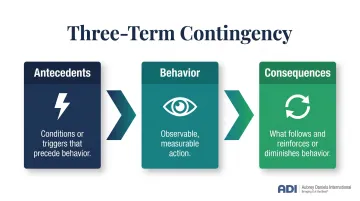
This three-term contingency framework applies across settings — and it's precisely what separates behavioral assessment from traditional psychological approaches.
Behavioral vs. Psychological Assessment
These are distinct approaches. Behavioral assessment focuses on observable actions and the environmental factors that drive them — not personality traits or internal constructs. That distinction matters because:
- Observable behaviors can be measured and tracked
- Environmental conditions can be changed
- Interventions can be designed around specific, modifiable actions
Personality assessments categorize who someone is. Behavioral assessments identify what someone is doing and why — and that makes them directly actionable in a way trait-based tools simply aren't.
Where Behavioral Assessment Programs Are Used
Educational and clinical settings: Under the Individuals with Disabilities Education Act (IDEA), functional behavioral assessments are embedded in federal assessment requirements for students with disabilities. When disciplinary action would change a student's placement, an FBA and BIP are legally required.
Organizational settings: The same science applies directly to workplaces. Behavioral assessment programs help leaders identify which antecedents prompt employee behaviors, which consequences reinforce them, and where the performance environment itself is falling short.
Behavioral assessments are not punitive. Their purpose is to understand the function of behavior so appropriate, individualized support can be designed — making them proactive tools rather than disciplinary ones.
Key Components of a Behavioral Assessment Program
Every behavioral assessment program — regardless of setting — includes four core components.
Component 1: Behavior Identification
The first step is defining the target behavior in specific, observable, measurable terms. Vague definitions undermine everything that follows.
- ❌ "Disruptive behavior"
- ✅ "Leaves workstation without permission more than three times per shift"
- ❌ "Poor attitude"
- ✅ "Interrupts manager during feedback conversations, occurring in 4 of 5 observed interactions"
Operational definitions specify exactly what counts as the behavior and what doesn't — allowing consistent measurement across observers and settings.
Component 2: Multi-Method Data Collection
No single data source tells the full story. Robust behavioral assessments draw from multiple streams:
- Interviews with teachers, managers, caregivers, or colleagues
- Direct observation in natural settings (classroom, workplace, home)
- Record reviews — past performance data, incident reports, grades
- Standardized rating scales completed by observers or the individual
- Self-report where applicable and appropriate
This combination reduces bias and builds a more accurate picture of behavior across different environments and interactions.
Component 3: Functional Analysis
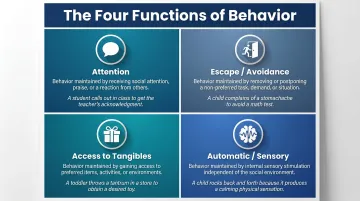
Central to any behavioral assessment is identifying the function — the purpose the behavior serves for the individual. The four standard behavioral functions in ABA are:
- Attention — the behavior produces social attention from others
- Escape/Avoidance — the behavior allows the individual to avoid or exit demands
- Access to tangibles — the behavior produces access to preferred items or activities
- Automatic/sensory reinforcement — the behavior produces sensory stimulation regardless of social context
Understanding function is what separates a targeted intervention from a generic one. Take task refusal as an example: the same surface behavior requires a completely different response depending on whether it's driven by escape or attention-seeking.
Component 4: Hypothesis Development and Intervention Planning
All data is synthesized into a testable hypothesis in this format:
"When [antecedent condition], [individual] engages in [behavior] in order to [function/purpose]."
That hypothesis directly drives the intervention: a Behavior Intervention Plan (BIP) in schools, a performance improvement strategy in a workplace, or a positive behavior support protocol. The assessment and the plan must be tightly linked. When that connection holds, the intervention targets root causes rather than symptoms — which is what makes behavioral change stick.
Common Methods and Tools Used in Behavioral Assessment Programs
Indirect Assessment Methods
These gather information without real-time observation:
- Structured interviews with teachers, caregivers, managers, or the individual
- Behavior rating scales completed by observers (parents, teachers, supervisors)
- Record reviews — historical data, prior assessments, performance files
Indirect methods are efficient for establishing context and history, but they rely on subjective reporting. Direct observation is needed to confirm what self-reports and third-party accounts can only approximate.
Direct Observation Methods
Direct observation — watching and recording behavior as it unfolds in the natural environment — produces objective data that indirect methods cannot replicate. It captures what actually happens, not what someone recalls or interprets.
Common recording techniques include:
- Frequency recording — counting how many times a behavior occurs
- Duration recording — measuring how long a behavior lasts
- Interval recording — noting whether behavior occurred within defined time blocks (whole-interval, partial-interval, momentary time sampling)
- ABC data collection — recording the antecedent, behavior, and consequence for each instance
Standardized Behavioral Rating Scales
These tools provide normative comparisons and are used primarily in clinical and educational contexts:
| Tool | Publisher | Primary Use |
|---|---|---|
| BASC-3 (Behavior Assessment System for Children, 3rd Ed.) | Pearson Assessments | Broad behavioral/emotional profiling, ages 2–25 |
| Conners 3 (Conners Third Edition) | WPS Publishing | ADHD and related behaviors, ages 6–18 |
| Vineland Adaptive Behavior Scales | Pearson | Daily living skills and adaptive functioning |
Functional Analysis (Experimental)
A functional analysis goes beyond hypothesis to confirmation. Trained analysts systematically manipulate environmental conditions — testing attention, escape, tangible access, and control scenarios — to establish a verified causal link between environmental factors and the behavior. Unlike a standard FBA, which identifies likely functions through observation and inference, a functional analysis confirms them through controlled testing. It is typically conducted by trained behavior analysts in clinical settings.
Workplace-Adapted Assessment Methods
Those same principles translate directly to organizational settings. In workplace assessments, the methods shift to fit the environment — but the behavioral logic remains identical:
- Performance observation checklists
- Behavioral interviews with managers and direct reports
- 360-degree feedback surveys
- Performance data review and trend analysis
ADI's workplace assessments, for example, use interviews, focus groups, and direct observation of employee interactions alongside proprietary tools like the PIC/NIC Analysis® — a framework that identifies the antecedents and consequences shaping behavior from the performer's point of view, revealing why people do what they do at work.
Steps in a Behavioral Assessment Program
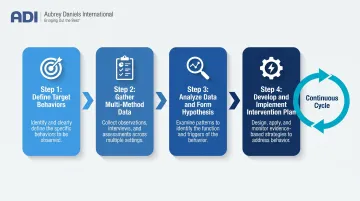
A behavioral assessment program follows a structured sequence — from identifying what to measure, through data collection and analysis, to building and monitoring an intervention. Each step builds on the last, so clarity at the start determines the quality of the outcome.
Step 1 — Define and Prioritize Target Behaviors
Identify which behaviors to assess using specific, observable, measurable language. Prioritize based on:
- Severity or safety risk
- Frequency of occurrence
- Impact on the individual's functioning or team performance
Step 2 — Gather Multi-Method Data
Combine indirect and direct assessment methods to build a full picture:
- Conduct interviews with relevant stakeholders
- Review available records and performance history
- Administer any relevant rating scales
- Observe behavior across multiple settings and times
Single observations rarely tell the whole story — consistent patterns across contexts are what matter.
Step 3 — Analyze Data and Form a Hypothesis
Review all collected data, identify consistent antecedents and consequences, and develop a clear hypothesis statement:
"When given an independent writing task, Jordan leaves their seat in order to escape the demand."
This hypothesis should be testable and directly tied to a specific behavioral function.
Step 4 — Develop and Implement an Intervention Plan
Translate the hypothesis into a targeted plan with:
- Antecedent modifications (changing triggers)
- Teaching replacement behaviors that serve the same function
- Consequence adjustments (reinforcing the replacement behavior)
- A system for monitoring outcomes and refining the plan over time
In schools, this becomes a BIP. In workplaces, it may take the form of a performance improvement strategy, management coaching plan, or redesigned feedback system.
These four steps aren't a one-time checklist — they form an iterative cycle. As behavior changes and new data emerges, the plan evolves with it.
Behavioral Assessment Programs in the Workplace
The behavioral science powering clinical FBAs is equally applicable to organizational performance — and ADI has been demonstrating this for over 45 years.
What a Workplace Behavioral Assessment Examines
A workplace behavioral assessment doesn't just look at employees in isolation. It examines the entire performance environment:
- Leadership behaviors and their impact on direct reports
- Reinforcement patterns — what gets praised, what gets ignored, what gets punished
- Feedback systems — whether feedback is specific, timely, and consequential
- Competing contingencies — production incentives that inadvertently reward unsafe shortcuts
- Team interactions and cultural norms that strengthen or weaken desired behaviors
ADI's organizational assessments specifically analyze how business goals align with the behaviors that are actually reinforced in the workplace — and where leadership practices are inadvertently suppressing the performance they're trying to produce.
Why This Approach Outperforms Personality-Based Assessments
Personality instruments like DISC or Myers-Briggs categorize how people tend to think or feel. Behavioral assessments identify what people are doing, why they're doing it, and what needs to change in the environment to shift outcomes.
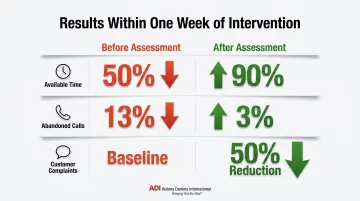
That distinction drives real business results. When ADI assessed a national insurance firm's call center, the analysis revealed their quota system was forcing employees to choose between thorough customer service and meeting targets.
Changing the performance measure — based on behavioral assessment findings — produced measurable results within a week:
- Available time increased from 50% to 90%
- Abandoned calls dropped from 13% to 3%
- Customer complaints fell by 50%
A pharmaceutical sales division saw similar results: behavioral assessment through manager ride-alongs and performance observation moved the team from 52nd out of 55 in key product sales to 1st within a year.
Both outcomes came from the same process — identify the behavioral functions, redesign the environment, and measure what actually shifts.
Frequently Asked Questions
What does a behavioral assessment program consist of?
A behavioral assessment program consists of four core components: operationally defining target behaviors, gathering data through indirect and direct methods, identifying the function the behavior serves, and developing an intervention plan tied to those findings.
What methods are used in a behavioral assessment program?
Programs combine indirect methods (structured interviews, rating scales like the BASC-3, record reviews) with direct observation techniques including frequency recording, duration recording, and ABC data collection. In clinical settings, a controlled functional analysis may also be conducted to confirm behavioral function experimentally.
What are the steps of a functional behavior assessment?
The four steps are: (1) operationally define the target behavior, (2) gather data through indirect and direct methods across multiple settings, (3) identify the likely function of the behavior, and (4) develop a Behavior Intervention Plan (BIP) or equivalent plan directly linked to that function.
Which comes first, BIP or FBA?
The FBA always comes first. Under IDEA regulations on discipline, an FBA must be completed before a BIP is implemented — the FBA identifies the reason behind the behavior, and the BIP is built from those findings to target the correct function.
What is the difference between functional analysis and functional behavioral assessment?
An FBA is a broad assessment process using multiple indirect and direct methods to hypothesize behavioral function. A functional analysis is a specific experimental procedure conducted within or after an FBA, where environmental conditions are systematically manipulated to confirm that hypothesis with greater causal certainty.
What is a brief functional analysis in ABA?
A brief functional analysis uses shorter sessions and fewer condition presentations than a standard functional analysis to identify behavioral function more quickly. First described by Northup et al. (1991), it suits classroom or outpatient settings where a fast clinical decision is needed while preserving the core experimental logic.