Introduction
Most performance problems get solved the wrong way. A manager notices declining output, assumes it's a motivation issue, rolls out a training program, and six months later wonders why nothing changed. The real problem was never motivation. It was an unintended consequence embedded in the measurement system — one that actively punished the very behavior leaders wanted more of.
Behavioral assessment is designed to prevent exactly this. It's a systematic, data-driven process that identifies not just what behavior is occurring, but why — meaning what environmental conditions are triggering it and what consequences are keeping it in place.
Behavioral assessments are well-documented in clinical ABA literature, but their application in organizational settings is equally rigorous — and directly relevant to business leaders. This article covers the core methods professionals use, how the process unfolds step by step, and what separates effective assessments from ones that lead to the wrong intervention.
TL;DR
- Behavioral assessments identify the antecedents and consequences maintaining specific behaviors, not just the behaviors themselves.
- Three core methods are used: indirect assessment (interviews, surveys), direct observation, and functional analysis.
- The goal is to determine a behavior's function — what it produces or avoids for the performer.
- Assessment findings drive targeted interventions — skip this step and you're likely treating the wrong problem.
- ADI's organizational assessments surface environmental variables that training programs alone cannot address.
What Is a Behavioral Assessment?
A behavioral assessment is a structured evaluation that identifies specific behaviors, the conditions that trigger them (antecedents), and what follows them (consequences). Together, this ABC framework — Antecedent, Behavior, Consequence — produces a functional picture of why a behavior is happening.
According to EBSCO's research definition, behavioral assessment emphasizes observable behavior and environmental factors rather than trait-based descriptions. That distinction matters.
How It Differs from Other Evaluations
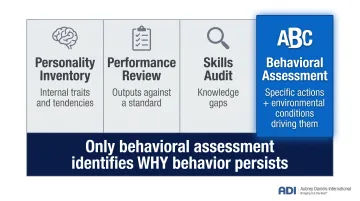
| Tool | What It Measures |
|---|---|
| Personality inventory | Internal traits and tendencies |
| Performance review | Outputs against a standard |
| Skills audit | Knowledge gaps |
| Behavioral assessment | Specific actions + environmental conditions driving them |
A performance review tells you what happened. A behavioral assessment tells you why it keeps happening.
The end product is a testable hypothesis: an evidence-based explanation of what function a behavior is serving. That explanation informs a targeted intervention, not a generic fix.
Crucially, this is a diagnosis of the situation — not a judgment of the person behind it.
The Core Methods Behavior Analysis Professionals Use
Behavior analysis professionals draw from three categories of assessment methods, typically in combination. Each one yields different types of evidence.
Indirect Assessment
Indirect assessment gathers information without real-time observation through structured interviews, behavioral checklists, questionnaires, and record review (performance data, incident logs, prior evaluations).
It's the usual starting point because it's efficient and surfaces patterns across time and settings. Common clinical instruments include:
- Functional Assessment Interview (FAI)
- Motivation Assessment Scale (MAS)
- Functional Assessment Screening Tool (FAST)
In organizational contexts, the Performance Diagnostic Checklist (PDC) is among the most documented tools. It examines whether performance gaps stem from skill deficits, unclear expectations, resource constraints, or consequence problems.
For ADI's organizational clients, indirect assessment often begins with proprietary survey instruments grounded in behavioral science:
- Culture Survey
- Precision Leadership Survey
- Safety Culture Survey
- Psychological Safety Survey
These tools are designed to surface data on what is reinforcing or punishing performance across an organization — not just what employees think or feel.
One important caveat: Idaho's FBA Technical Handbook notes that indirect questionnaires and rating scales have limited reliability and validity compared with direct observation. Indirect data generates hypotheses. It doesn't confirm them.
Direct Observation
Direct observation involves watching performers in their actual work environment and recording what happens in real time. The standard format is ABC data collection: document the antecedent, the behavior, and the consequence for each behavioral incident.
This method catches what interviews miss. A performer might describe their workflow accurately yet have no awareness that a specific supervisor interaction, a task transition, or a production bottleneck is triggering the behavior in question. Those patterns only emerge when you're present to observe them.
Multiple observation sessions matter. A single session can reflect an atypical day; consistent patterns across sessions build the evidence needed to form a reliable hypothesis.
ADI's site assessments incorporate direct behavioral observation alongside interviews, focus groups, and document review — specifically to capture what's actually happening in the environment versus what stakeholders believe is happening.
Functional Analysis
Functional analysis is the most controlled method available. The professional systematically manipulates environmental variables (introducing or removing specific antecedents or consequences) to test which conditions are actually maintaining the behavior.
This methodology was established by Brian Iwata and colleagues in the early 1980s, and it remains the gold standard for confirming behavioral function. Unlike indirect tools and observation (which generate hypotheses), functional analysis tests them experimentally.
The tradeoff: it requires specialized training, careful ethical oversight, and more time and resources. It's best reserved for cases where indirect and observational data don't yield a clear conclusion. A randomized FBA trial found that descriptive and indirect methods identified behavioral function for about 70% of participants but showed only 38.5% exact agreement with functional analysis results — a meaningful gap in high-consequence clinical or organizational settings.
How the Behavioral Assessment Process Works: Step by Step
The specific format varies by setting and practitioner, but the underlying logic is consistent: define the behavior precisely, gather data from multiple sources, analyze patterns, form a hypothesis, validate it, and then design an intervention.
Step 1: Pinpointing the Target Behavior
Before any data is collected, the behavior must be operationally defined — described in observable, measurable terms that any trained observer could identify consistently.
In organizational contexts, this means translating vague complaints into specific descriptions:
- "Low engagement" → "Does not initiate peer collaboration during project kick-offs"
- "Poor attitude" → "Fails to complete reports by the Friday deadline"
- "Safety non-compliance" → "Omits three steps in lockout/tagout procedure when supervisor is absent"
ADI's Behavioral Roadmapping process formalizes this step, working backwards from desired business results to identify the specific behaviors at each organizational level that drive those results. Without precise definitions, every subsequent step produces unreliable data.
Step 2: Gathering Indirect and Record-Based Data
The professional collects existing information: structured interviews with the performer and those who interact with them, behavioral surveys or questionnaires, and review of performance records, incident logs, and prior evaluations.
The goal at this stage is to form initial hypotheses, not final conclusions. Patterns across data sources — when the behavior occurs, under what conditions, what consequences follow — begin to reveal what's maintaining it.
Step 3: Direct Observation in Context
Direct observation comes next. The professional observes the performer in their actual environment across multiple sessions, collecting ABC data in real time to identify triggers and maintaining consequences that interviews may not have surfaced.
Consistency across sessions is the signal. If the same antecedent precedes the behavior repeatedly and the same consequence follows, that pattern becomes the functional hypothesis.
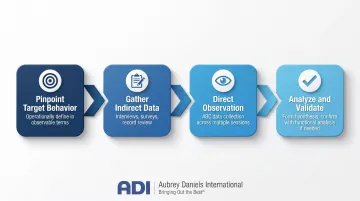
Step 4: Analysis, Hypothesis Formation, and Validation
The professional synthesizes all collected data to identify the most likely function of the behavior — what it produces or avoids for the performer — and develops a clear, testable hypothesis.
When data are inconclusive or contradictory, the professional may run a controlled functional analysis to confirm the function before any intervention is designed. This step is what separates rigorous behavioral assessment from informed guessing.
Key Factors and Common Pitfalls
Assessment quality depends on who conducts it, how rigorously data are collected across methods, and whether hypotheses are tested before driving intervention design.
The most common pitfall: acting on indirect data alone.
Relying exclusively on interviews and surveys without observation or validation frequently results in interventions targeting the wrong behavioral function. Adding training when the real issue is that the desired behavior is never reinforced in the environment produces no improvement — and in many cases actively frustrates performers.
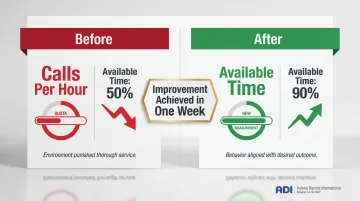
ADI's work with a national insurance firm's call center illustrates this directly. The assessment revealed that an existing quota system measuring "number of calls per hour" was forcing employees to choose between providing thorough service and meeting quota. This wasn't a skills gap or a motivation problem.
The environment was inadvertently punishing the behavior leaders wanted. When the measure shifted to "available time" (percent of workday spent resolving customer problems), available time improved from 50% to 90% within one week.
Other factors that undermine assessment quality:
- Vague operational definitions that produce inconsistent data collection
- Single-session observations that miss behavioral variability
- Failing to examine organizational systems — measurement processes, consequence structures, leadership practices — as potential antecedents and consequences
- Treating assessment as a one-time event rather than an ongoing diagnostic process
Each of these gaps shares the same root cause: treating behavior as the problem rather than examining the environment that produces it. Rigorous assessment accounts for what performers experience before and after the behavior — not just what leaders observe on the surface.
Common Misconceptions About Behavioral Assessments in the Workplace
"This is a clinical tool — it doesn't apply to business."
The same science underpinning clinical functional behavior assessments has been applied to organizational performance management for decades. The BACB's OBM resources confirm that Organizational Behavior Management applies behavior analysis principles to workplace performance across manufacturing, finance, healthcare, government, and beyond. The methodology doesn't change; the context does.
"We already do performance reviews — isn't that the same thing?"
No. A performance review evaluates outputs against a standard. A behavioral assessment examines the specific actions producing those outputs and the environmental conditions shaping them. One tells you what the score was; the other tells you why the game played out the way it did and what to change for next time. ADI's assessments — culture, safety, performance systems — are specifically designed to examine the behavioral mechanics that performance reviews never touch.
"If I can see the performance problem, I understand its cause."
This assumption is where most interventions go wrong. Behavioral analysis routinely reveals that the apparent cause — whether employee attitude, motivation, or skill — is rarely the actual driver. A natural gas producer ADI worked with found that workers were systematically skipping safety steps not because of poor safety culture, but because those steps felt redundant and time-consuming with no clear explanation of why they mattered.
The root cause was environmental: missing antecedents (clear rationale) and absent consequences (no feedback for compliance). Once identified and addressed, the dangerous behavior was virtually eliminated.
Frequently Asked Questions
What are the 7 steps of a functional behavior assessment?
Steps vary by framework, but a standard FBA sequence covers:
- Operationally define the target behavior
- Gather indirect data through interviews and questionnaires
- Review records and conduct direct observation with ABC data
- Identify patterns and form a function hypothesis
- Validate the hypothesis (via functional analysis if needed)
- Develop an intervention plan based on findings
What are the 4 types of behavior analysis?
The four branches are: experimental analysis of behavior (basic research), applied behavior analysis (applying principles to socially significant behavior), behavioral service delivery (direct clinical practice), and Organizational Behavior Management (OBM), which applies ABA principles to workplace and business performance.
Are RBTs allowed to administer standardized assessments?
In clinical ABA contexts, Registered Behavior Technicians may assist with assessment procedures but must work under close BCBA supervision and cannot independently administer standardized assessments or conduct formal functional analyses. In organizational settings, behavioral assessments are conducted by qualified behavior analysis consultants or certified practitioners.
What is the difference between a behavioral assessment and a performance review?
A performance review evaluates outputs against established standards. A behavioral assessment examines the specific behaviors producing those outputs — the antecedents and consequences maintaining them — giving leaders a clear picture of why performance gaps exist and which environmental changes will actually close them.
What happens after a behavioral assessment is completed?
Assessment findings are translated into a targeted intervention plan specifying changes to antecedents (triggers, expectations, instructions), consequences (reinforcement systems, feedback frequency), or both. For ADI clients, this typically takes the form of a Behavioral Roadmap paired with a data collection plan to monitor whether the intervention is actually shifting the target behavior over time.