Introduction
In Applied Behavior Analysis, every behavior selected for change must meet one non-negotiable standard: it must be observable and measurable. Without that, clarity about what's actually being targeted — and whether it's improving — is impossible.
Without a clear behavioral definition, there's no reliable baseline and no defensible evidence that progress has occurred.
A practitioner who targets "aggression" without specifying exactly what that looks like will collect inconsistent data and draw unreliable conclusions from it.
This article breaks down what makes a behavior observable and measurable, how to define and select a target behavior in ABA practice, and why the same principles that govern clinical work also apply in organizational settings, where vague performance descriptions create the same measurement failures.
TLDR
- Observable behavior is any action another person can directly see — not an internal state, assumption, or label.
- Measurable behavior can be quantified using dimensions like frequency, duration, latency, or intensity.
- Vague labels like "attitude" or "disengagement" are not behaviors in the ABA sense — specific, visible actions are.
- A target behavior must be defined before any ABA intervention can begin.
- Applying that same precision to organizational settings produces measurable, sustainable performance improvements.
What Is Observable and Measurable Behavior in ABA?
Observable Behavior: What It Means (and What It Doesn't)
An observable behavior is any action or response that can be directly seen by another person. It exists in the external world. Contrast that with internal experiences — thoughts, feelings, attitudes, beliefs — which cannot be directly observed by anyone other than the person experiencing them.
This distinction matters because ABA is a science. Science requires data that different observers can independently collect and agree on. If two practitioners watching the same session record completely different things, the data is worthless.
The Dead Man's Test, attributed to Ogden Lindsley, offers a quick check: "if a dead man can do it, then it ain't behavior." All three of the following pass that test — a corpse can do them:
- "Sitting quietly"
- "Not interrupting"
- "Refraining from hitting"
None of them are behaviors in the ABA sense. A behavior requires a living organism to actively perform an action.
Measurable Behavior: The Dimensions That Matter
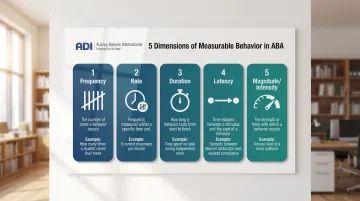
Measurable behavior is behavior that can be quantified. The BACB Task List (5th ed.) requires practitioners to measure behavior across multiple dimensions:
- Frequency — how many times a behavior occurs in a period
- Rate — frequency per unit of time
- Duration — how long each instance lasts
- Latency — time between a stimulus and the start of the behavior
- Magnitude/Intensity — the force or strength of the behavior
Measurability is what turns observation into usable data. Without it, there's no way to establish a baseline, detect change, or determine whether an intervention is producing meaningful improvement.
From Vague Labels to Behavioral Definitions
A behavioral definition is a precise, objective description written so that two independent observers would agree on whether the behavior occurred. Clarity prevents ambiguity and reduces disagreement in data collection.
In practice, this means replacing interpretive labels — the kind that mean different things to different observers — with descriptions of specific, visible actions. The table below shows the difference:
| Vague Label | Observable, Measurable Equivalent |
|---|---|
| Aggressive | Strikes another person with an open hand |
| Engaged | Maintains eye contact with the speaker for 5+ seconds |
| Motivated | Completes assigned tasks before the stated deadline |
| Disruptive | Shouts out during instruction more than 3 times per 30-minute session |
Writing definitions this way is what makes consistent data collection possible across practitioners, settings, and time.
Why ABA Requires Behavior to Be Observable and Measurable
The Behavioral Dimension of ABA
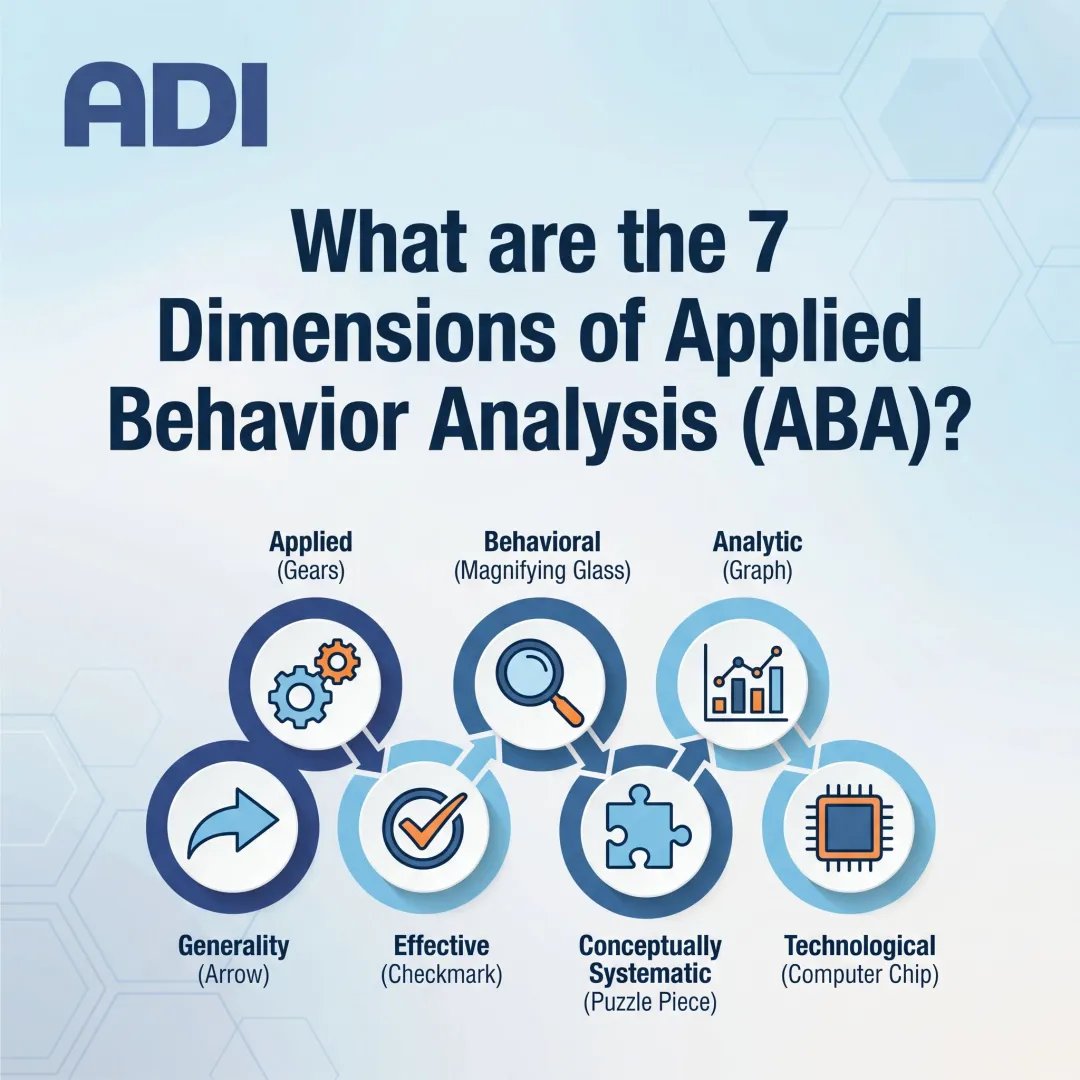
The requirement for observable and measurable behavior traces directly to the foundational framework of the field. Baer, Wolf, and Risley's 1968 paper establishing the seven dimensions of ABA identified "behavioral" as one of those core dimensions — meaning interventions must address behavior that can be measured, not inferred states or subjective impressions. That was a scientific requirement, not a philosophical preference.
Objectivity and Interobserver Agreement
When two observers independently measure the same behavior and get similar results, that's interobserver agreement (IOA) — a core quality check in ABA. When a behavior is poorly defined, IOA drops. One observer records a hit; another records a push; a third records "aggression." None of them are measuring the same thing.
Conventional practice targets at least 80% IOA across a meaningful portion of sessions to confirm that data reflects what actually happened rather than each observer's interpretation.
Measurement Enables Accountability
Without baseline data and ongoing measurement, there's no way to answer the most important question in any intervention: is this working?
Observable and measurable behavior enables practitioners to:
- Establish a pre-intervention baseline
- Track change across sessions
- Determine when a criterion has been met
- Decide when to modify or discontinue a treatment plan
Measurement also removes practitioner bias from the equation. Decisions rest on what was observed and recorded, keeping the process accountable to data rather than impression.
How to Define Target Behaviors in Observable and Measurable Terms
Selecting a Target Behavior
Not every behavior warrants a formal intervention. Selection focuses on what will make a meaningful difference:
- Social significance — does changing this behavior meaningfully improve the person's life?
- Impact on the individual and others around them
- Feasibility of consistent measurement in the natural environment
Writing the Goal
A well-constructed ABA goal specifies every component needed to evaluate success:
Given [antecedent/context], [individual] will [observable target behavior], [criterion — rate, duration, or percentage], by [target date], as measured by [data collection method].
Each element does real work: the antecedent anchors the behavior to a specific situation, the criterion defines what "success" looks like, and the measurement method keeps data collection consistent across observers.
Compare these two versions:
- ❌ "Jada will be less aggressive."
- ✅ "Given restricted access to a preferred item, Jada will tap a picture icon card corresponding to her need in 90% of opportunities across 10 consecutive school days, as measured by event recording on the daily data sheet."
The first version can't be measured and doesn't tell anyone what Jada should do instead. The second is functional, specific, and defensible.
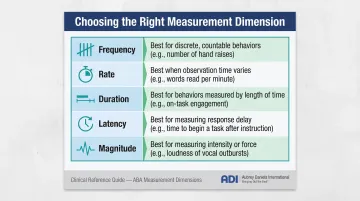
Choosing the Right Measurement Dimension
| Dimension | Best Used When |
|---|---|
| Frequency | Behavior is discrete and brief (hand-raising, greetings) |
| Rate | Comparing across sessions of different lengths |
| Duration | Behavior extends over time (on-task, tantrums) |
| Latency | Response speed matters (compliance, transitions) |
| Magnitude | Intensity varies meaningfully (vocal volume, force) |
Avoiding Common Definitional Errors
Strong behavioral definitions pass what practitioners call the "stranger test": a person unfamiliar with the individual could read the definition and reliably identify when the behavior occurred.
Definitions fail when they:
- Are too broad (capturing multiple different behaviors under one label)
- Infer intent ("tries to escape," "attempts to communicate")
- Embed the practitioner's interpretation ("behaves inappropriately")
- Rely on terms that observers interpret differently ("tantrum," "noncompliant")
The fix is always the same: describe the action, not the judgment.
Applying Observable Behavior Principles Beyond the Clinic
The Same Problem, Different Setting
ABA's insistence on observable and measurable behavior isn't unique to therapy — it's a requirement for any context where behavior needs to be understood, changed, or evaluated. Most organizations struggle with the same problem that poor behavioral definitions create in clinical settings: they describe impressions instead of actions.
Feedback like "lacks initiative," "unprofessional," or "disengaged" tells an employee nothing specific. It can't be measured, it can't be agreed upon by two managers, and it gives the employee no clear path to improvement. That's not a management philosophy problem — it's a measurement problem.
Behavior-Specific Feedback vs. Vague Feedback
The difference between vague and behavioral feedback is concrete:
| Vague Feedback | Behavior-Specific Feedback |
|---|---|
| "You're not taking ownership." | "Three of last month's reports were submitted after the deadline." |
| "You seem disengaged in meetings." | "You haven't contributed a comment or question in any of the last five team meetings." |
| "Your communication needs work." | "Two clients this quarter reported they didn't receive a response within the 24-hour window." |
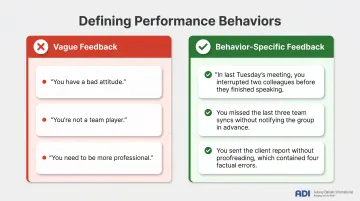
Behavioral feedback describes what happened. It's specific enough that two managers would agree it occurred, the employee knows exactly what to change, and managers can track progress.
How ADI Applies This in Organizations
Aubrey Daniels International has spent over 45 years applying the science of behavior to organizational performance. The foundational principle is the same one ABA clinical practice relies on: define behavior precisely before trying to change it.
ADI's Behavioral Roadmapping process starts with desired business outcomes, then traces back to the specific behaviors required at each organizational level. Rather than asking "are people engaged?", it asks: what do engaged employees at each level actually do?
That question applies equally to frontline employees, supervisors, managers, and executives.
That precision has produced documented results. At a national insurance firm, replacing a vague productivity metric with a behavioral one — shifting from "calls per hour" to the percentage of available time spent actively resolving customer problems — moved the metric from 50% to 90% within a single week. Block calls dropped from 30% to 3%. Abandon rates fell from 13% to 3%.
The intervention didn't change people's attitudes. It changed the behavior being measured and reinforced.
That same logic applies to every manager trying to close a performance gap. ADI's Applications of Behavioral Leadership workshop teaches leaders to apply it directly. Participants learn to:
- Replace vague performance descriptions with specific, observable behaviors
- Apply behavioral coaching techniques to address gaps consistently
- Use the PIC/NIC Analysis® to identify what consequences are driving current performance
- Diagnose why gaps exist before prescribing solutions
Frequently Asked Questions
What is observable and measurable behavior?
Observable behavior is any action that can be directly seen by another person — it happens in the external world, not inside someone's mind. Measurable behavior is one that can be quantified using dimensions like frequency, duration, or intensity, making it possible to track objectively whether change is occurring.
What is an example of observable and measurable behavior?
"Being disruptive" is not observable or measurable. "Shouts out during class more than three times per 30-minute session" is — because it specifies what the behavior looks like and how often it occurs. Anyone watching the session could count it.
What is a target behavior in observable and measurable terms?
A target behavior in observable and measurable terms is a specific action selected for change, defined clearly enough that any trained observer can recognize and record it consistently. It includes a criterion for success and a designated measurement method.
Why does ABA require behavior to be observable and measurable?
Without observable, measurable behavior, there's no objective data. Practitioners can't establish a reliable baseline, evaluate whether an intervention is working, or demonstrate that real progress has occurred — only that someone believes it has.
What is the difference between a behavior and an internal state in ABA?
Internal states — emotions, attitudes, beliefs — are not behaviors in the ABA sense because they can't be directly observed or consistently agreed upon by multiple independent observers. ABA targets the specific, visible actions associated with those internal states instead.