Introduction
Since 2008, global banks have paid $321 billion in fines for regulatory failings including money laundering, market manipulation, mis-selling, and terrorist financing, according to Bloomberg. Compliance costs have risen by over 60% compared to pre-crisis levels. Yet conduct scandals keep surfacing — Wells Fargo's fake accounts, LIBOR manipulation, persistent mis-selling.
Banks have invested heavily in training, compliance infrastructure, and governance frameworks. Most of those investments haven't failed for lack of funding — they've failed because they target the wrong driver entirely.
Permanent conduct change requires understanding what actually drives human behavior — and what conditions sustain it once the pressure of a regulatory review has passed.
This article examines why culture reform programs keep falling short, what behavioral science tells us about embedding lasting change, and what a genuine transformation path looks like — from frontline incentive design to how leaders at every level reinforce the behaviors that actually matter.
Key Takeaways
- Banks have spent billions on conduct reform, but most programs treat culture as a project rather than an ongoing management discipline
- Behavior is sustained by consequences — not by training, policy, or stated values
- Middle management is the primary transmission layer for culture, yet most reform programs skip it
- Effective culture measurement tracks leading behavioral indicators, not just lagging misconduct counts
- Behavioral design can achieve psychological safety and accountability at the same time — without trading one for the other
Why Banking Culture Reform Programs Keep Falling Short
The One-Off Program Trap
Most conduct reform programs are launched in response to regulatory pressure or a specific scandal. They have a start date, a project team, and — eventually — a completion milestone. Then the organization moves on.
The G30's 2018 report, Banking Conduct and Culture: A Permanent Mindset Change, is explicit on this point: culture management must be continuous rather than a stand-alone initiative. Culture is not a project. It is, as the G30 frames it, "the way we do business" — something that must be institutionalized into daily management practice, not handed off to a working group.
The Compliance-Only Mindset
When the primary driver of behavioral change is fear — of fines, enforcement action, or reputational damage — employees learn to avoid getting caught, not to genuinely internalize values. This is the behavioral difference between avoidance conditioning (training through fear of consequences) and intrinsic motivation.
Punishment-based systems tell people what not to do. In practice, they:
- Create anxiety that suppresses internal reporting
- Produce minimum-viable compliance, not genuine behavior change
- Fail to build the values-driven culture banks say they want
Only consistent positive reinforcement of valued behaviors does that.
Executive Firefighting
The Central Bank of Ireland's 2018 Behaviour and Culture of the Irish Retail Banks review found that several executive committees displayed "firefighting behaviour" — focusing on urgent, short-term issues at the expense of long-term transformation capacity. When leadership attention is perpetually absorbed by the immediate crisis, the structural work of culture change never gets done.
It is a systemic reinforcement problem: short-term crisis resolution gets rewarded, while long-term culture investment does not.
The Rolling Bad Apples Problem
Individual accountability alone cannot solve conduct culture. The FSI/BIS in 2023 identified the "rolling bad apples" problem — misconduct-prone individuals moving between institutions without their histories being disclosed. The FCA's CP25/18 in 2025 explicitly linked regulatory references to countering this pattern, and FCA SYSC 22 already requires firms to obtain references covering a six-year period.
Disclosure reform addresses exits — it doesn't change the conditions that produce misconduct. Hiring for values alignment, and reinforcing it continuously, is where culture actually intervenes.
Culture Fatigue
Reform momentum weakens as urgency fades, leadership changes, and competing priorities emerge. Without behavioral reinforcement mechanisms embedded in the everyday management system — not just an annual training cycle or a values poster — culture change gradually erodes.
The New York Fed has explicitly warned against complacency as economic conditions improve. The banks that sustain progress are those that have built reinforcement into how managers operate day-to-day, not those that revisit culture only when the next crisis forces their hand.
The Behavioral Science of Lasting Culture Change
Behavior Is a Function of Its Consequences
This is the foundational principle of Applied Behavior Analysis (ABA), rooted in decades of research going back to B.F. Skinner's operant conditioning work. In organizational contexts, it means one thing: stated values, codes of conduct, and training programs describe what banks want employees to do — but consequences determine whether those behaviors are actually repeated.
A 2003 meta-analysis by Stajkovic and Luthans covering 72 organizational behavioral management studies found that behavioral management interventions improved task performance by approximately 17%. The mechanism is not inspiration or intention — it is the consistent application of reinforcing consequences to the right behaviors.
Most banking conduct frameworks are built almost entirely on punishment: fines, enforcement, disciplinary action. These consequences are necessary, but they only tell employees what not to do. They don't build the culture banks actually want.
Behavioral Pinpointing: From Values to Observable Actions
Vague cultural attributes cannot be managed. "Integrity" means something different on a trading floor than in a retail branch. Effective culture change starts with identifying the specific, observable behaviors that define a value in practice.
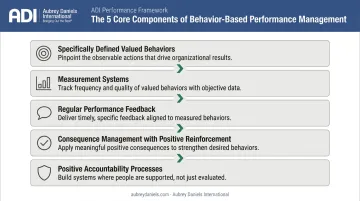
ADI calls this process Behavioral Roadmapping — working backwards from desired outcomes to define the critical behaviors required at each organizational level. The five core components of ADI's behavior-based Performance Management system are:
- Specifically defined valued behaviors and results
- Measurement systems tied to those behaviors
- Regular performance feedback
- Consequence management (positive reinforcement and accountability)
- Positive accountability processes
Fifth Third Bank applied this approach to sales culture. By pinpointing the specific behaviors needed for customer engagement rather than managing against sales volume targets, the bank's Processing Solutions Group increased leads 5x and achieved record sales through steady behavioral improvement.
Building Feedback-Rich Environments
Culture doesn't hold because of a single intervention. It holds because daily interactions between managers and employees consistently signal what is valued. ADI's methodology identifies three elements that, implemented systematically, deliver genuine performance management: measurement, feedback, and positive reinforcement.
Effective feedback must be:
- Frequent — annual reviews are too infrequent to shape behavioral habits
- Specific — tied to observable actions, not general impressions
- Timely — delivered in the moment, not summarized twelve months later
What changes behavior is the manager who notices and reinforces specific actions as they happen.
M&T Bank implemented ADI's approach by moving away from a focus on the performance appraisal process toward building a complete system for managing people performance. Using ADI's Precision Leadership® Survey as a management development and coaching tool, the bank saw a strong positive correlation between leadership survey results and managers who drove increased employee engagement.
Leadership Behavior: Setting the Right Conditions at Every Level
Beyond "Tone from the Top"
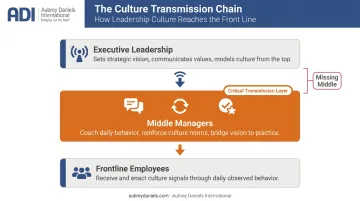
Employees don't experience culture through a CEO's values statement. They experience it through how their direct manager behaves on a Tuesday afternoon when something goes wrong. The G30 and New York Fed agree: culture is transmitted through the management chain, not broadcast from the top.
The New York Fed's 2017 white paper on Misconduct Risk, Culture, and Supervision states that people learn how to behave by observing colleagues and especially leaders. Senior leaders must model behaviors consistent with firm values to build what the paper calls "cultural capital." When stated values aren't demonstrated in daily interactions, they carry no weight — employees take their cues from what leaders do, not what firms publish.
Board Governance for Culture Oversight
Boards have a specific and active role here. The G30's 2018 Recommendation 1 calls on bank boards to reevaluate governance structures to ensure a specific board committee has oversight of conduct and culture — providing continuing focused attention and clear accountability, and preventing responsibility from being diluted across multiple committees.
Boards should:
- Actively engage with behavioral data, not just lagging outcome metrics
- Challenge management on leading conduct indicators
- Understand what is happening at the front line, not just in the boardroom
- Act decisively when conduct failures surface, rather than treating them as isolated incidents
Psychological Safety as a Behavioral Outcome
Psychological safety is not a soft concept. The New York Fed defines it as a shared belief that a team is safe for interpersonal risk-taking, meaning people won't be punished for raising concerns. It is created or destroyed by how managers actually respond when employees surface problems.
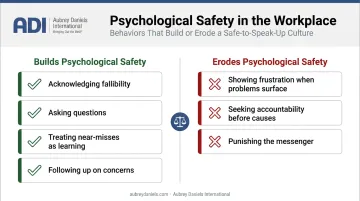
Manager behaviors that build psychological safety:
- Acknowledging their own fallibility openly
- Asking questions rather than asserting conclusions
- Treating near-misses as learning opportunities, not blame events
- Following up consistently when concerns are raised
The opposite behaviors erode it just as quickly — and often faster.
Manager behaviors that erode it:
- Showing visible frustration when problems are surfaced
- Seeking accountability before understanding causes
- Punishing the messenger without addressing the message
Through ADI's HOP (Human and Organizational Performance) framework, leaders work on replacing reactive habits with behaviors that invite honest conversation about how work is actually done — not just how it was planned.
Middle Management: The Overlooked Transmission Layer
The G30's Recommendation 6 identifies middle management as integral to embedding cultural reforms. Yet most banking culture initiatives focus on board-level governance and frontline compliance training — leaving middle managers without the tools, skills, or support to fulfill their cultural role.
This is the "missing middle." It matters because employees experience culture through their direct manager, not the CEO. If middle managers are reinforcing the old culture through their daily interactions, even inadvertently, no top-down initiative will reach the front line.
What Middle Managers Actually Need
Effective culture transmission requires more than awareness training. Middle managers need:
- Clarity on which specific behaviors to reinforce and why
- Coaching skills to deliver timely, behavior-specific feedback
- Feedback mechanisms that give them visibility into their team's conduct indicators before problems escalate
- Organizational support that recognizes and rewards good culture management — not just financial results
If managers are only reinforced for hitting financial targets, culture-building behaviors will not persist. Managers themselves must receive reinforcement for culture-building activities, or those activities get crowded out by whatever the performance system actually rewards. ADI's methodology addresses this at the structural level, not just through awareness.
The Counter-Productive Manager Problem
Command-and-control management styles, implicit pressure tactics, and results-at-all-costs performance norms persist not because managers are unethical, but because those behaviors continue to work in the short term. The incentive system still rewards them.
Changing management behavior requires changing what gets reinforced at the management level, which means redesigning performance systems, not just running a leadership workshop. ADI's Applications of Behavioral Leadership workshop equips managers with behavioral coaching skills, the PIC/NIC Analysis® framework for diagnosing performance issues, and positive accountability processes that replace management by exception with proactive reinforcement.
Reforming Incentives and Accountability Without Creating Fear
Realigning What Gets Rewarded
The G30's Recommendation 4 calls for removing the link between quantitative sales targets and compensation for sales staff. The FCA's 2014 thematic review (TR14/4) found that incentive schemes could drive gaming — including sales-volume spikes before quarterly deadlines — and that even discretionary schemes created mis-selling risk when sales results remained a significant bonus factor.
The behavioral design principle is straightforward: incentive structures must reinforce the behaviors banks actually want, not just the outcomes they can most easily measure. Changing those structures without careful monitoring can backfire. The FCA explicitly warned that removing financial incentives must not simply transfer pressure to other performance management approaches, such as aggressive sales targets.
ADI's Profit-Indexed Performance Pay™ system addresses this by aligning compensation with both organizational profitability and individual behavioral contribution, distributing more pay to high performers based on their greater contribution rather than their rank on a volume leaderboard.
Accountability and Psychological Safety Are Not Opposites
Strengthening individual accountability is essential. But accountability implemented purely through punishment creates fear, drives under-reporting, and produces defensiveness rather than transparency. The behavioral design challenge is to hold individuals accountable for their choices while preserving the psychological safety needed for employees to escalate concerns and admit mistakes.
Pairing clear accountability mechanisms with positive reinforcement for honest, customer-focused behaviors is what makes this balance work. Accountability lands differently when it's connected to understood expectations and applied consistently — it becomes a guide rather than a threat.
Celebrating Role Models as a Cultural Lever
The G30's Recommendation 5 specifically recommends that banks celebrate role models in behavior, both in business decisions and individual actions. This is a behavioral lever with direct impact on what gets normalized, not an optional culture initiative.
Positive recognition reinforces the specific behaviors that define the desired culture. It creates social proof that the stated values are real. ADI's methodology specifies that effective recognition must be:
- Tied to specific observed behaviors, not just results
- Delivered frequently as a daily practice, not reserved for annual reviews
- Connected to concrete actions rather than generalized praise
- Available to all employees, not structured as a competitive ranking
ADI explicitly identifies "Employee of the Month" programs as violating reinforcement principles — they concentrate recognition rather than distributing it, and they reward results rather than behaviors.
Measuring Culture Through Behavioral Indicators
The Problem With Lagging Metrics
Measuring culture through outcome metrics — misconduct incidents, regulatory breaches, fines — is inherently backward-looking. By the time a breach appears in the data, the behavioral conditions that produced it have been present for months or years.
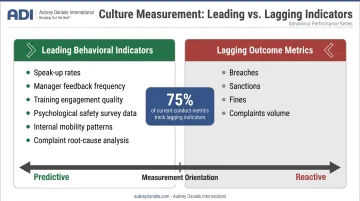
The FMSB's 2023 Conduct and Culture MI report found that 75% of current conduct metrics track "sticks" — breaches, sanctions, and complaints — rather than the behavioral indicators that predict misconduct. This is the wrong emphasis for proactive culture management.
Leading Behavioral Indicators
Effective culture measurement captures observable behaviors before they become misconduct incidents. Examples relevant to banking include:
- Speak-up rates and escalation frequency by team and business unit
- Manager feedback frequency measured through upward surveys
- Mandatory training completion rates, analyzed for engagement quality not just completion
- Psychological safety survey data designed to detect whether employees actually feel safe raising concerns
- Internal mobility and promotion patterns that reveal whether conduct-positive behaviors are being rewarded
- Complaint patterns analyzed behaviorally for root causes, not just volume
Building the Measurement Framework
Tracking these indicators requires a structured framework, not ad hoc reporting. The G30 emphasizes that metrics should be examined as trends over time, not single data points. Boards should focus on anomalies and exceptions — summary averages can mask cultural deterioration before it surfaces as a breach.
ADI's culture measurement approach combines:
- Culture surveys that capture employee perceptions of reinforcement patterns and psychological safety
- Site assessments using behavioral observation, interviews, and focus groups
- Upward feedback surveys providing anonymous data on manager behaviors
- Re-survey cycles at scheduled intervals to track behavioral change over time
The shift from post-facto misconduct tracking to continuous behavioral monitoring gives leaders something lagging metrics never can: enough warning to act before a pattern becomes a problem.
Frequently Asked Questions
What is the difference between banking conduct and banking culture?
Conduct refers to observable behaviors and actions by individuals — how customers are treated, how risks are disclosed, how decisions are made under pressure. Culture is the underlying set of values, beliefs, and norms that drive those behaviors. Conduct is the visible output; culture is the behavioral environment that produces it.
Why do banking culture reform programs often fail to produce lasting change?
Most programs treat culture change as a one-off initiative rather than an ongoing management discipline. They rely on punishment and compliance frameworks rather than positive reinforcement, and never change the daily signals managers send employees — so old behaviors keep getting rewarded even when new ones are stated as priorities.
What role does middle management play in embedding banking culture change?
Middle managers are the primary transmitters of culture for most employees. Employees experience culture through their direct manager's behavior, not the CEO's values statement. Unless middle managers are equipped, supported, and reinforced for culture-building behaviors, top-down culture initiatives will not reach the front line.
How can banks measure cultural change effectively?
Effective measurement combines leading behavioral indicators (speak-up rates, escalation behaviors, psychological safety data) with lagging outcome metrics tracked as trends over time. Behavioral audits and upward feedback surveys give a more complete picture than misconduct counts alone.
What does behavioral science tell us about making conduct standards stick?
Behavior is sustained by its consequences, not by intentions, training, or stated values. For conduct standards to become permanent, the behaviors they describe must be consistently reinforced through recognition, feedback, and management attention — not just addressed when they fail.
How should banks balance individual accountability and psychological safety?
Accountability and psychological safety are not opposites. A well-designed behavioral system holds individuals accountable for their choices while ensuring employees feel safe to escalate concerns, admit mistakes, and speak up. Pairing clear accountability with positive reinforcement for transparent, customer-focused behavior is what makes accountability feel fair rather than fear-driven.