High performers consistently deliver strong results, which creates a dangerous blind spot: because output looks fine, coaching stops. Feedback becomes rare. Development conversations get replaced by task assignments. The assumption is that top performers are self-sustaining.
They aren't.
Research shows high-potential employees are 2.7 times more likely to leave within a year when their manager doesn't regularly provide growth and development. Strong output can mask declining engagement for months before it shows up in any metric — and by then, your best person is already interviewing elsewhere.
This article covers why high performers need deliberate coaching, what makes that coaching different, which behaviors to target, and how to build a rhythm that actually sustains peak performance. The approach draws on Applied Behavior Analysis (ABA), the same science ADI has applied in organizations across manufacturing, healthcare, financial services, and beyond for over 45 years.
TL;DR
- High performers disengage quietly — output stays acceptable while discretionary effort drops
- Behavior-focused coaching targets what's actually coachable: specific, observable actions, not outcomes or traits
- Precise, timely positive reinforcement is more effective with top performers than generic praise
- Coaching goals must connect to real business outcomes or they lose traction fast
- Short, frequent coaching conversations outperform quarterly reviews for sustaining engagement
Why High Performers Still Need Coaching
The Disengagement Pattern No One Sees Coming
High performers don't burn out dramatically. They don't miss deadlines or cause problems. What actually happens is quieter: they stop volunteering ideas. They narrow their contribution to what's explicitly required. They begin scanning for environments that will invest in their growth.
High-performing employees often disengage first because they receive more work and less coaching, leading to reduced initiative, selective participation, and declining discretionary effort — all before output metrics show anything unusual.
ADI defines discretionary effort as the level of effort people could give if they wanted to, above the minimum required. It's voluntary. It can't be demanded. When high performers stop giving it, the loss is real — even when your performance dashboard still looks fine.
The Retention Cost of Doing Nothing
Lack of growth and development has been the primary reason for employee turnover for 13 consecutive years. For top performers — the people with the most options — this pattern is even more acute. They know their market value. They leave when growth stalls.
The replacement costs alone make the case:
- Replacing a technical professional runs roughly 80% of their annual salary
- Replacing a manager or leader runs closer to 200%
- Organizations that invest in development are twice as likely to retain employees and report 11% greater profitability
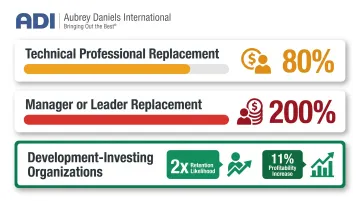
For organizations where top performers drive disproportionate results, that math makes coaching one of the highest-ROI investments a leader can make.
What Makes Coaching High Performers Different
Correction vs. Expansion
Coaching underperformers is about closing gaps — identifying where someone falls short and building back to an acceptable baseline. Coaching high performers is a different task entirely. The goal is expansion: unlocking discretionary effort, extending impact, and continuously raising the developmental bar.
ADI's methodology makes this distinction explicit. Managers too often spend disproportionate time managing poor performers while their top and average performers — the ones with the most to gain from proactive coaching — receive little structured attention.
The mindset shift required: stop treating high performers as finished products that just need deployment. Start treating them as people whose potential has a ceiling you haven't found yet.
Behaviors Are Coachable. Results Aren't.
One of the clearest contributions of behavioral science to coaching is this distinction: results are lagging indicators. By the time a performance problem shows up in output metrics, the behavioral patterns that caused it have been running for weeks or months.
Behaviors are different. They're observable in real time, which means they're coachable in real time.
ADI's Behavioral Roadmapping process works backward from desired business outcomes to identify the specific observable behaviors that produce those results. Rather than coaching someone to "be more strategic" or "show more leadership," coaches learn to identify and target the precise actions behind those labels — behaviors like proactively surfacing ambiguity before it becomes a problem, or structuring decisions with explicit criteria.
The Under-Reinforcement Problem
That behavioral precision only pays off when managers actually deliver feedback — and most don't. Here's a pattern that damages high-performer engagement: managers assume top performers are intrinsically motivated and don't need much feedback. So they give them less of it.
Only 1 in 5 managers provide effective coaching and feedback to their employees — and nearly 40% of employees report inadequate coaching from their managers. High performers are often the most affected, precisely because managers assume they're fine.
In practice, high performers respond powerfully to reinforcement that is:
- Tied to the exact behavior being reinforced, not general performance
- Delivered close to when the behavior occurred, not during the next review cycle
- Connected to something the individual actually values — not just what the manager finds motivating
Generic praise ("great work this quarter") does almost nothing. Behavior-specific reinforcement ("the way you structured that risk analysis gave the team clarity they wouldn't have had otherwise — that's exactly the kind of decision framing we need more of") shapes behavior in a durable way.
This is the core insight from ABA as applied in workplace coaching: identify what truly reinforces a person, and design the environment to deliver that reinforcement consistently. High performers don't disengage all at once — they drift, quietly, when the feedback that used to sharpen them stops arriving.
Key Behaviors to Target When Coaching High Performers
Generic coaching targets — "develop leadership presence," "improve communication" — are too vague to be coachable. Effective coaching for high performers starts with behavioral pinpointing: defining exactly which observable behaviors are driving exceptional performance, then deliberately reinforcing and developing those specific behaviors.
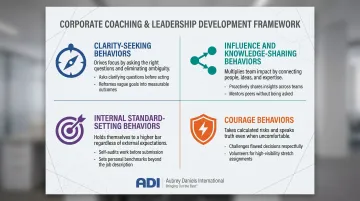
Here are four high-leverage behavioral categories worth targeting:
1. Clarity-seeking behaviors High performers who regularly surface ambiguity, align on priorities before starting work, and proactively clarify expectations operate with fewer false starts and less downstream friction. Coaches should reinforce the specific actions:
- Asking clarifying questions in meetings
- Summarizing decisions in writing after alignment conversations
- Flagging conflicting priorities before they collide
2. Influence and knowledge-sharing behaviors High performers who share what they know — explaining their reasoning, mentoring peers, communicating decisions with context — multiply their impact beyond individual output. These behaviors are frequently undertargeted in coaching because they don't show up in individual performance metrics, which makes them exactly the kind of behaviors a coach should be tracking.
3. Internal standard-setting behaviors The highest performers create their own accountability mechanisms rather than waiting for external expectations. Self-monitoring, seeking feedback before it's offered, holding themselves to standards beyond what's required — these behaviors are observable and coachable. Coaches should reinforce them explicitly; left unacknowledged, even high performers can let these habits erode.
4. Courage behaviors Taking calculated risks, initiating difficult conversations, advocating for an unpopular but well-reasoned position — these require one specific condition to develop: the person must experience a positive outcome when they act. Coaches create that condition by reinforcing courage behaviors promptly and clearly, making it safe to repeat them.
Aligning Behavior-Based Coaching Goals with Business Outcomes
Coaching goals that exist in isolation from organizational priorities tend to drift. They become professional development wish lists rather than strategic levers. To stay relevant and measurable, coaching for high performers must be grounded in the team's mission and the company's specific business outcomes.
According to Deloitte's 2025 Human Capital Trends research, organizations that are highly effective at enabling human performance are 2.08 times more likely to report positive financial results. Yet only 2% of CHROs believe their current performance management system actually works. That gap is a failure of alignment.
ADI's Behavioral Roadmapping Framework
ADI's Behavioral Roadmapping process addresses this directly. The approach:
- Anchor to outcomes — identify the specific results the organization needs to move
- Trace back to behaviors — consultant-facilitated sessions pinpoint the critical few behaviors, at each organizational level, that most directly drive those outcomes
- Build coaching around those behaviors — every coaching interaction is designed to develop and reinforce exactly what the business needs
This process also generates something ADI considers essential: a shared behavioral language. When coaches, managers, and high performers all use consistent terminology to describe what good performance looks like behaviorally, check-ins become more specific and accountability becomes real rather than notional.
The Manager's Non-Negotiable Role
Alignment doesn't happen if managers treat coaching as someone else's job. HR can design the framework. A formal coaching program can provide structure. But the manager must:
- Participate in defining behavioral targets connected to business priorities
- Observe performance in context, not just review reports
- Deliver reinforcement tied to the actual behaviors that matter
When managers delegate this to HR entirely, coaching becomes disconnected from the day-to-day work where behavior actually happens.
Building a Sustainable Coaching Rhythm for Top Performers
Coaching is a leadership behavior, not a calendar event. Quarterly reviews don't shape behavior — they document it. Behavior is shaped by what happens immediately after it occurs, which means the coaching that matters most happens in the flow of work, not in a conference room at the end of a fiscal quarter.
What a Useful Coaching Rhythm Looks Like
More frequent manager-employee one-on-ones make employees twice as engaged, three times less likely to apply for other jobs, and 1.4 times more likely to stay. The frequency matters, but so does the structure.
An effective coaching rhythm for high performers typically includes:
- Brief, frequent touchpoints — ADI's Coaching for Rapid Change process centers on short daily or near-daily interactions around mission-critical behaviors, not lengthy formal sessions
- Real-time behavioral reinforcement — catching and naming specific behaviors close to when they occur, not summarizing them weeks later in a review
- Forward-looking development — each conversation surfaces one emerging challenge or opportunity, keeping the developmental bar moving upward
- Clear behavioral targets — the high performer knows what specifically is being developed and why it connects to team or organizational goals
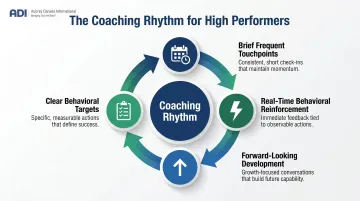
This kind of rhythm doesn't require more time from managers. It requires different time — shifted away from putting out fires and toward deliberate engagement with the people most capable of driving results.
Scaling This Across the Organization
ADI's behavior-based Performance Management approach gives organizations the framework to embed this coaching into daily leadership practice. For teams spread across multiple sites or large leadership populations, ADI offers consulting support and Coach Certification programs that build internal coaches who can sustain the approach independently.
Organizations that develop genuine internal coaching capability don't just improve performance — they build the kind of environment where high performers choose to stay and keep raising the bar.
Frequently Asked Questions
How do you coach a top performer?
Coaching a top performer requires shifting from correction to expansion. Focus on pinpointing the specific observable behaviors driving their success, reinforcing those behaviors with precision and timeliness, and consistently raising the developmental bar to match their growth orientation.
What are the 5 C's in coaching?
The 5 C's commonly referenced in coaching are Clarity, Communication, Commitment, Consistency, and Competence. In coaching high performers, each maps to behavioral targets: clear expectations, specific feedback, commitment to growth, consistent reinforcement, and building the right skills.
What is the 70/30 rule in coaching?
The 70/30 rule holds that the person being coached should do approximately 70% of the talking while the coach listens and asks questions for the remaining 30%. This builds self-awareness and ownership — especially valuable for high performers, who are typically self-directed and growth-oriented.
Why do high performers disengage even when they are meeting their goals?
High performers are motivated by growth and challenge, not results maintenance. When coaching disappears, feedback becomes infrequent, or development pathways are unclear, discretionary effort declines even if output stays acceptable in the short term.
What is the difference between coaching high performers and coaching average performers?
Coaching average performers focuses on closing skill or behavior gaps. Coaching high performers focuses on expanding impact, reinforcing peak behaviors, and unlocking discretionary effort.
How do you measure the success of coaching a high performer?
Measure through observable behavioral change, not output metrics alone. Look for evidence that targeted behaviors occur more frequently, that the individual is taking on greater scope and complexity, and that engagement and discretionary effort remain high over time.