Technical compliance programs can train workers to pass audits. They can't change what happens on a wind turbine tower at hour ten of a shift when the supervisor is at a site two hours away. That gap — between what OSHA requires and what workers actually do when no one is watching — is precisely where safety culture consulting becomes a strategic priority.
This article evaluates five firms best positioned to help renewable energy operators, developers, and EPC contractors close that gap in 2026.
Key Takeaways
- Safety culture consulting addresses the behaviors and leadership practices driving incidents — not just OSHA minimums
- Top firms bring behavioral science, deep hazard expertise, and change methods that hold after the engagement ends
- Key selection criteria: behavior-based methodology, renewable energy relevance, leadership coaching depth, and internal capability building
- BST is now part of DEKRA — both are covered as one entry
- ADI (Aubrey Daniels International) is the only major consultancy built on formal Applied Behavior Analysis — with 45+ years of results in high-hazard industries
Why Safety Culture Is the Defining Challenge for Renewable Energy in 2026
Renewable energy construction combines some of the most dangerous work conditions in any industry: heights exceeding 300 feet on wind turbines, utility-scale arc flash exposure during solar interconnection, and battery energy storage systems (BESS) that can enter thermal runaway during commissioning. EPRI's BESS Failure Incident Database found that 72% of analyzed BESS incidents occurred during construction, commissioning, or within the first two years of operation — precisely when new crews are most active.
The workforce scaling problem makes this worse. BLS projects solar PV installer employment to grow 42% by 2034, from 28,600 to over 40,000 jobs. That volume of new entrants means a significant portion of the renewable energy workforce at any given time will have limited experience with sector-specific hazards.
Compliance vs. Culture: Why the Distinction Matters
These two concepts are often conflated — but they produce very different outcomes in the field:
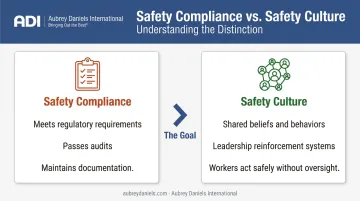
- Safety compliance means meeting regulatory requirements — passing audits, completing OSHA training, maintaining documentation. Necessary, but not sufficient.
- Safety culture is the shared beliefs, leadership behaviors, and reinforcement systems that determine how workers behave when no one is watching. The Campbell Institute describes the target state as moving safety from a compliance-based requirement into a shared, intrinsic organizational value.
A dss+ case study from the European utilities sector illustrates the gap: a company suffered severe and fatal accidents despite a downward LTIF trend. Their investigators found over-reliance on technical controls and insufficient attention to risk perception. The metrics signaled progress; the underlying culture did not.
Distributed renewable energy sites — where a single supervisor may oversee crews across multiple locations — amplify this dynamic. When supervision is infrequent, only internalized safe behavior protects workers. That's what safety culture consulting is built to create.
Top Safety Culture Consulting Firms for Renewable Energy in 2026
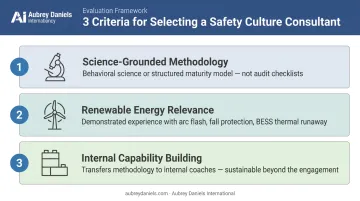
Firms on this list were evaluated on three criteria: methodology rigor (behavioral science or structured maturity model, not just audit checklists), demonstrated relevance to renewable energy or analogous high-hazard environments, and ability to build internal capability rather than ongoing consultant dependency.
Aubrey Daniels International (ADI)
ADI is a behavioral science consultancy headquartered in Atlanta, GA, with over 45 years applying Applied Behavior Analysis (ABA) to workplace performance across utilities, nuclear power, mining, and manufacturing.
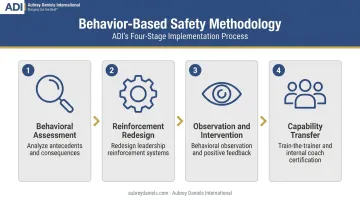
Its safety methodology is not compliance-driven. Consultants analyze the antecedents and consequences that reinforce safe or at-risk behaviors, then redesign leadership reinforcement systems accordingly.
ADI defines safety culture as "repeated patterns of behavior — influenced by people, systems, processes, and the environment — that contribute to or detract from safety." That framing shifts the question from "are workers following the rules?" to "what makes safe behavior the default choice?"
In one documented energy sector engagement, ADI worked with one of the largest natural gas operations in North America (700+ producing wells, 55 employees covering remote terrain). Managers were concerned lone workers weren't consistently working safely.
ADI's behavioral observation and positive intervention approach raised safety equipment use and observable safe behavior from 50% to 75% within weeks, while also reducing contractor turnover and overtime costs.
For renewable energy environments, ADI's distributed workforce expertise is directly applicable. Its train-the-trainer model — used with a multinational transportation client across three countries — addresses the supervisory contact gap that characterizes solar and wind project sites. The Safe by Accident framework, co-authored by SVP Judy Agnew, provides a practitioner guide specifically applying behavioral science to safety leadership.
| Core Approach | Behavior-based safety culture transformation grounded in Applied Behavior Analysis (ABA) and Precision Leadership; focuses on reinforcement systems, not rule enforcement |
| Key Services for Renewable Energy | Safety culture assessments, leadership behavioral coaching, behavioral roadmapping, BBS Prime® and BBS Quick-Launch® implementation, fluency-based safety training (BLITZ Precision Learning), and internal coach certification programs |
| Notable Differentiator | Nearly a century of behavioral science research underpins every intervention; proprietary tools include PIC/NIC Analysis® and Safety Culture Survey deployed in 26 countries and 12 languages; the only major safety culture consultancy applying formal ABA methodology with global delivery capability |
DEKRA (incorporating BST's legacy)
DEKRA is a global safety organization headquartered in Stuttgart, Germany, with a dedicated North American Organizational Safety & Reliability practice. In 2012, DEKRA acquired Behavioral Science Technology (BST), the firm that pioneered behavior-based safety in 1979, integrating BST's methodology into DEKRA's safety consulting platform.
BST's legacy lives in DEKRA's BAPP® (Behavioral Accident Prevention Process), the core BBS methodology now delivered across DEKRA's global practice. DEKRA also offers a Culture of Care Diagnostic evaluating six dimensions: authentic leadership, control of work, learning and development, communication, role of HSE, and workforce engagement.
For renewable energy clients, DEKRA's Energy Transition Services practice provides advisory, training, assessment, testing, and certification support relevant to wind, solar, and storage projects.
| Core Approach | Behavior-based safety using BAPP® observation and feedback systems; Culture of Care Diagnostic for six-dimension culture assessment |
| Key Services for Renewable Energy | BBS program implementation, safety culture maturity assessments, energy transition advisory services, behavioral observation programs, safety leadership development |
| Notable Differentiator | Incorporates BST's founding BBS intellectual property (developed 1979); global reach with local delivery; the Culture of Care Diagnostic provides a structured diagnostic framework distinct from pure observation-based approaches |
dss+ (formerly DuPont Sustainable Solutions)
Originally established in 1968 as DuPont's internal safety consulting arm, dss+ became independent through a 2019 management buyout and rebranded in 2022. Inflexion Private Equity acquired a majority stake in 2023. The firm brings DuPont's legacy safety rigor to energy, utilities, and industrial clients globally.
dss+'s flagship framework is the Bradley Curve, a safety culture maturity model that maps organizations on a spectrum from reactive (no formal safety measures) to interdependent (collective team responsibility for safety). The model gives leadership teams a shared language for diagnosing culture state and planning improvement.
In a documented European utilities case, dss+ was engaged after fatal accidents occurred despite improving LTIF numbers. The team conducted a Safety Perception Survey across 20+ sites, identified over-reliance on technical controls, and implemented management workshops and an HSE culture program.
That gap between lagging metrics and actual culture — exactly what renewable energy operators face as they scale — is where dss+'s diagnostic work is most effective.
| Core Approach | Safety culture maturity modeling using the Bradley Curve; Safety Perception Survey for diagnostic baseline; leadership capability development |
| Key Services for Renewable Energy | Safety culture maturity assessments, Safety Perception Survey deployment, leadership development, operational risk management, HSE governance, risk-awareness workshops |
| Notable Differentiator | DuPont heritage brings 50+ years of industrial safety methodology; the Bradley Curve provides an internationally recognized maturity framework; demonstrated energy/utilities sector engagement with documented culture investigation outcomes |
Intertek
Intertek is a global testing, inspection, certification, and assurance company with dedicated renewable energy services and a documented safety culture and process safety consulting practice. In 2025, Intertek Metoc achieved Level 4 certification on the Safety Culture Ladder — one of the more rigorous international safety culture standards — and the company has a dedicated BESS safety and performance practice with recent case documentation.
Intertek's safety culture methodology is built around its SOP (Safe Operations and Performance) framework. In a documented three-year engagement with Grupo Energia Bogota, Intertek reported safety perception scores rising from 58% to 65%, LTIFR reducing from 0.80 to 0.60, 846 behavioral observations conducted, and 68 internal trainers developed — the last metric being particularly relevant for organizations that need to sustain change without permanent consultant presence.
| Core Approach | SOP (Safe Operations and Performance) methodology combining process safety, behavioral observation, and internal capability development |
| Key Services for Renewable Energy | Safety culture consulting, BESS safety and performance advisory, renewable energy certification, behavioral observation program design, internal trainer development |
| Notable Differentiator | Documented internal capability building in energy-sector engagements (68 internal trainers in GEB case); Safety Culture Ladder Level 4 certification; active BESS safety practice with 2025 case documentation directly relevant to battery storage operators |
How We Chose These Firms
Three questions drove the evaluation:
1. Is the methodology science-grounded or just audit-based? A systematic review published on NCBI found behavior-based safety interventions were associated with statistically significant reductions in workplace accidents and injuries. Firms on this list use behavioral science, structured maturity models, or both — not compliance checklists as their primary change mechanism.
2. Is there evidence of work in renewable energy or comparable high-hazard environments? Wind, solar, and BESS present specific hazard profiles — arc flash, fall protection at height, thermal runaway — that generic safety consulting programs aren't designed for. Sector-relevant experience matters.
3. Can the firm build internal capability and exit? The most common mistake renewable energy companies make is selecting a consultant based on brand recognition or proposal quality without asking: what happens when you leave? Firms that deliver reports and training without transferring methodology to internal coaches rarely produce durable results. Every firm on this list has documented internal capability-building components.
That third criterion isn't abstract. Fatal accidents occurred at a dss+ utilities client with improving LTIF numbers — not because measurement failed, but because over-reliance on technical controls left the workforce's behavioral patterns unmanaged.
The right consulting partner for a renewable energy company needs to deliver on two fronts:
- Diagnostic capability — assessing current culture state and identifying behavioral patterns driving risk
- Implementation support — coaching leaders, training frontline workers, and redesigning reinforcement systems
A firm that only diagnoses produces insight without follow-through. A firm that only implements without a clear cultural baseline acts without direction. Both matter.
Conclusion
The firms on this list represent the strongest available options for renewable energy operators, developers, and EPC contractors looking to move from compliance-reactive to proactively safe. Each brings a structured, evidence-backed approach to culture change — one that goes well beyond one-time training delivery.
When evaluating any safety culture consultant, ask three questions before signing:
- How do you measure behavioral change over time — not just incident rates?
- How do you transfer methodology to internal leaders and coaches?
- What does your track record look like in environments with distributed, rapidly scaling workforces?
For organizations serious about building a safety culture grounded in behavioral science, ADI brings 45+ years of Applied Behavior Analysis expertise to that work. Its Safety Culture Survey has been deployed in 26 countries across 12 languages — practical experience at the scale and geographic spread that renewable energy projects demand.
Reach out to ADI to discuss how behavioral science applies to your specific renewable energy safety challenges.
Frequently Asked Questions
What is safety culture consulting, and how is it different from safety compliance consulting?
Safety compliance consulting focuses on meeting regulatory standards and passing audits. Safety culture consulting targets the underlying behaviors, leadership practices, and reinforcement systems that determine how workers act when no one is watching — and only that deeper work produces lasting injury reduction.
Why does the renewable energy sector have a particular need for safety culture consulting in 2026?
Rapid workforce scaling is bringing large numbers of inexperienced workers into environments with distinct, high-consequence hazards — arc flash on solar arrays, fall exposure on wind turbines, and BESS thermal runaway during commissioning. Distributed site structures mean supervisor contact is infrequent. In that context, compliance checklists cannot substitute for workers who have genuinely internalized safe behavior.
What is behavior-based safety (BBS), and how does it apply to renewable energy?
BBS uses structured observation, data collection, and reinforcement feedback to identify and change specific at-risk behaviors. For wind and solar worksites where supervisors cover multiple locations, BBS engages peers to create feedback loops that don't depend on constant direct oversight.
How long does it take to see measurable results from a safety culture consulting engagement?
Leading indicators — observation participation rates, supervisor feedback frequency, safety perception survey scores — typically improve within 3–6 months of consistent implementation. Lagging indicators like injury rates generally require 12–24 months to reflect the full impact of sustained culture change.
What credentials or track record should a renewable energy company look for when selecting a safety culture consultant?
Look for demonstrated experience in renewable energy or analogous high-hazard environments, a named and structured methodology (not just generic safety training), proven results from past engagements, and a clear approach to building internal safety leadership capability. Avoid firms that can only deliver assessments and reports without enabling internal change agents.
Can safety culture consulting also improve productivity and workforce retention in renewable energy companies?
Yes. Behavioral science interventions routinely produce dual returns. A natural gas operation that improved safety equipment compliance also reduced contractor turnover and overtime costs — because the same reinforcement principles that drive safe behavior also drive discretionary effort and stronger employee engagement.