Introduction
Work injuries cost U.S. businesses $181.4 billion in 2024, including $54.9 billion in wage and productivity losses alone. These figures capture only direct costs—medical bills, lost wages, regulatory penalties. They don't account for the deeper behavioral problem that compliance training alone cannot fix.
Companies spend $50.87 billion yearly on the top 10 causes of serious workplace injuries, yet standard compliance courses rarely address the organizational systems and ingrained behaviors that drive those incidents. Knowing the rules and following them under pressure are entirely different things.
This article examines what makes safety culture training distinct from compliance training and the criteria that separate effective platforms from glorified LMS systems. Five platforms stand out in 2026: ADI, SafetyCulture, DuPont Sustainable Solutions (DSS+), Vector Solutions, and DEKRA.
Key Takeaways
- Safety culture training reshapes attitudes and behaviors, not just OSHA knowledge
- Top platforms combine behavior science, leadership development, and measurable tracking
- ADI, SafetyCulture, DSS+, Vector Solutions, and DEKRA lead in 2026
- Behavior-science-led platforms drive lasting culture change; compliance-focused tools primarily manage risk and documentation
- The right fit depends on methodology rigor, industry context, and whether you need consulting-led transformation or scalable digital delivery
What Is Safety Culture Training (and Why It Needs a Specialized Platform)
Safety culture training is the structured process of shaping employee beliefs, behaviors, and leadership practices to make safe choices automatic—not merely compliant. The UK Health and Safety Executive defines safety culture as "the way we do things around here"—a subset of organizational culture influenced by management commitment, employee involvement, training, communication, and organizational learning.
Generic learning management systems deliver knowledge but cannot drive the behavior change required for lasting safety culture improvement. Research published in Environmental Health Insights identifies organizational barriers—formalistic procedures and productivity-over-safety norms—that create a gap between knowing and doing. Closing that gap requires more than course completion; it demands a platform built specifically to change how people behave when no one is watching.
A safety culture platform must include:
- Tracks safe and at-risk behaviors in real time through structured observation tools
- Builds accountability from supervisors to frontline workers through leadership reinforcement
- Measures baseline attitudes and monitors progress with culture assessment capabilities
- Embeds change past the initial training event through sustainability mechanisms
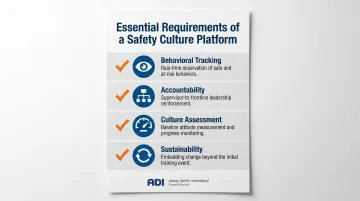
The five platforms reviewed below each address these requirements—in different ways, at different price points, and for different organizational contexts.
5 Best Safety Culture Training Platforms in 2026
Platforms were evaluated on methodology depth, behavior change focus, delivery flexibility, industry applicability, and evidence of sustained culture improvement—not feature count or pricing alone.
ADI (Aubrey Daniels International)
ADI has spent over 45 years applying Applied Behavior Analysis (ABA) to organizational performance, helping companies across manufacturing, healthcare, utilities, and other high-risk industries build measurable safety cultures.
What Sets ADI Apart:
ADI's approach is grounded in the science of behavior—using positive reinforcement, behavioral observation, and data-driven feedback rather than fear-based or punitive safety messaging. The methodology applies the 4:1 ratio principle (four positive comments to one negative) and emphasizes earning discretionary effort through systematic positive consequences, not punishment.
Judy Agnew's co-authorship of Safe by Accident? Take the Luck out of Safety demonstrates her expertise in translating behavioral science into practical safety leadership. ADI's certification programs build internal behavioral coaching capability, making culture change sustainable long after the engagement ends. One utility client reopened a nuclear facility after implementing Precision Leadership methods, averting $250 million in lost annual revenues; the NRC noted the approach "set a new and admirable standard for the industry."

| Training Approach | Behavior-based, grounded in Applied Behavior Analysis (ABA); uses Precision Leadership and Performance Management technology to reinforce safe behaviors | | Key Offerings | Workshops, expert consulting, behavioral assessments and surveys, certification programs, and speaking engagements | | Best For | Organizations in high-risk industries (manufacturing, utilities, mining, healthcare) seeking sustainable, science-backed safety culture transformation |
SafetyCulture (SC Training)
SafetyCulture is a comprehensive digital safety and training platform—formerly known as iAuditor—used by frontline teams globally for inspection management, safety training delivery, and real-time incident reporting. More than 2 million workers in over 180 countries use SafetyCulture, with 77,000 lessons delivered daily via SC Training.
What Sets It Apart:
The platform integrates safety training with operational workflows—training, inspections, checklists, and corrective actions all live in one ecosystem. Mobile-first delivery enables bite-sized course creation and allows training completion to tie directly to inspection findings. This design suits organizations where frontline workers need immediate, contextual safety training at the point of work.
| Training Approach | Digital microlearning with built-in course creation tools; training is embedded alongside audits, checklists, and inspection workflows | | Key Offerings | SC Training (course authoring), scheduling, analytics dashboard, Heads Up communications, mobile app (iOS and Android) | | Best For | Frontline-heavy teams in construction, logistics, retail, and facilities management needing scalable, mobile-accessible safety training |
DuPont Sustainable Solutions (DSS+)
DSS+ is a global operations transformation consulting firm that evolved from DuPont's internal safety management practices—one of the most cited safety culture frameworks in industrial history. The firm became independent in 2019 and rebranded to dss+ in 2022.
What Sets It Apart:
DSS+ brings a maturity-model approach to safety culture, helping organizations assess where they sit on the Bradley Curve—a proprietary framework describing the progression to an interdependent culture with injury rates approaching zero. Their heritage in high-hazard industries (chemicals, oil and gas, mining) carries weight with safety professionals.
DSS+ builds multi-year transformation roadmaps anchored in diagnostic data from their Safety Perception Survey.
| Training Approach | Consulting-led culture transformation using the Bradley Curve maturity model; combines training programs with organizational diagnostics and leadership coaching | | Key Offerings | Safety culture assessments, leadership development, frontline supervisor training, and large-scale organizational change programs | | Best For | Large enterprises in high-hazard industries (petrochemicals, mining, energy) undertaking formal, multi-year safety culture transformation programs |
Vector Solutions
Vector Solutions is a purpose-built online training platform for high-risk industries—including fire and rescue, law enforcement, construction, manufacturing, and utilities—offering an extensive library of regulatory and safety culture courses. The platform serves 24,000+ customers and 31 million users.
What Sets It Apart:
Vector Solutions suits organizations that need compliance training and safety culture content in one platform, with features like role-based learning paths, automated re-certification tracking, and detailed reporting for EHS managers.
The platform blends OSHA/EPA compliance modules with safety leadership topics, enabling mid-to-large organizations to consolidate training administration while addressing both regulatory requirements and cultural transformation.
| Training Approach | Digital platform with a pre-built course library; blends regulatory compliance content with safety leadership and culture topics through role-based learning paths | | Key Offerings | Course library (regulatory and culture-focused content), learning management system, automated certification tracking, analytics and reporting | | Best For | Mid-to-large organizations in fire, public safety, construction, and manufacturing seeking an all-in-one LMS with deep safety content libraries |
DEKRA
DEKRA is a global safety organization operating in around 60 countries, offering safety culture assessments, training, and consulting services to industrial clients. In FY 2025, DEKRA generated €4.44 billion in revenue with 48,155 employees.
What Sets It Apart:
DEKRA uses validated assessment instruments to measure an organization's safety culture baseline, then builds targeted training interventions around the gaps—making their approach data-driven by design. Their global delivery capability suits multinational organizations requiring consistent safety culture programs across geographies. DEKRA's Organizational Safety & Reliability services include behavioral safety training, leadership coaching, incident investigation, and diagnostics.
| Training Approach | Assessment-led methodology: safety culture surveys and behavioral observations establish a baseline before any training is designed or delivered | | Key Offerings | Safety culture assessments, behavioral safety training, leadership coaching, incident investigation, and global consulting services | | Best For | Multinational industrial organizations (automotive, manufacturing, energy) needing globally consistent safety culture programs built on diagnostic data |
How We Chose These Safety Culture Training Platforms
Platforms were assessed on the rigor of their behavior change methodology (not just content volume), demonstrated outcomes in high-risk industries, flexibility of delivery (consulting, digital, hybrid), and ability to sustain culture change without ongoing vendor dependency.
Common buyer mistakes include:
- Hundreds of courses mean nothing if they don't change on-the-job behavior
- Knowing OSHA 1910.147 doesn't guarantee lockout/tagout adherence under pressure — compliance training isn't culture change
- Low per-seat licensing rarely correlates with measurable incident reduction
Evaluate pricing for consulting-led platforms alongside expected ROI. The OSHA Safety Pays Estimator can project the sales required to cover injury costs, factoring in profit margin and indirect cost multipliers.
That math matters. One distribution center implementing behavior-based Performance Management cut lost-time accidents by 45% and medical-only accidents by 22%, saving an estimated $50,000 — well beyond typical training investment.
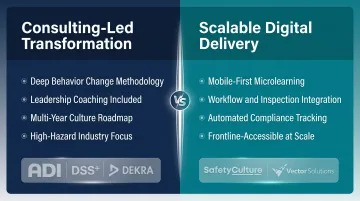
The right platform depends on whether you need consulting-led culture transformation with leadership coaching (ADI, DSS+, DEKRA) or scalable digital training with mobile delivery and workflow integration (SafetyCulture, Vector Solutions).
Conclusion
Not every platform on this list serves the same purpose. Organizations with frontline digital training needs should evaluate SafetyCulture or Vector Solutions. Those pursuing deep cultural transformation in high-hazard environments should look closely at ADI, DSS+, or DEKRA — the differences in methodology matter as much as the feature set.
ADI's approach is grounded in over 45 years of Applied Behavior Analysis research, with a certification model designed to build internal behavioral expertise that outlasts any single training engagement. Organizations that want to change how people actually behave on the job — not just what they know — can contact ADI directly to discuss their specific environment and goals.
Frequently Asked Questions
What strategies can be used to improve safety culture?
Effective strategies include leadership reinforcement of safe behaviors, behavioral observation and feedback systems, positive recognition of safe choices, and consistent consequence management. These differ from one-time training events by making safe behaviors part of daily work rather than a periodic checkbox.
What is the difference between safety culture training and safety compliance training?
Compliance training delivers regulatory knowledge (what the rules are), while safety culture training changes attitudes and behaviors (how people act when no one is watching). Compliance satisfies regulators; culture change shapes what workers actually do without being watched.
How long does it take to see results from safety culture training programs?
Measurable behavior changes can often be observed within weeks of well-designed interventions. Systematic reviews in healthcare show evaluation timeframes commonly within 6 months to 2 years, but lasting cultural transformation typically takes 12–36 months of consistent reinforcement and leadership alignment.
What industries benefit most from safety culture training platforms?
High-hazard industries (manufacturing, oil and gas, construction, mining, utilities, healthcare) benefit most. BLS data shows transportation and warehousing at 4.4 incidents per 100 FTEs, agriculture at 3.9, and healthcare at 3.4—sectors where culture directly correlates with incident rates.
How do I measure the effectiveness of a safety culture training program?
Use leading indicators (behavioral observations, near-miss reporting rates, safety perception survey scores) alongside lagging indicators (TRIR, incident rates, days away from work). OSHA recommends SMART leading metrics tied to hazard controls, worker participation, and PDCA reviews.
Can safety culture training be delivered entirely online, or does it require in-person sessions?
Digital platforms can deliver foundational knowledge effectively. Research shows minimal differences in knowledge outcomes between in-person and online OHS training, though in-person scored higher on engagement and confidence. Deep culture change—particularly leadership coaching and observation skill-building—typically requires blended delivery that pairs online modules with in-person workshops.